

Alexander Grabovetskiy, woodcarver, School of Woodcarving · Published 2020
What does a wood carver mean by "saves me time"?
Quick answer: In part 5 of lesson 54 a number five hit a curve and left a perfect edge in one movement, and I said that when something saves time for me, it makes me happy. That idea of saving time comes back in my other lessons, with rasps and drills, a bigger tool and a clay model.
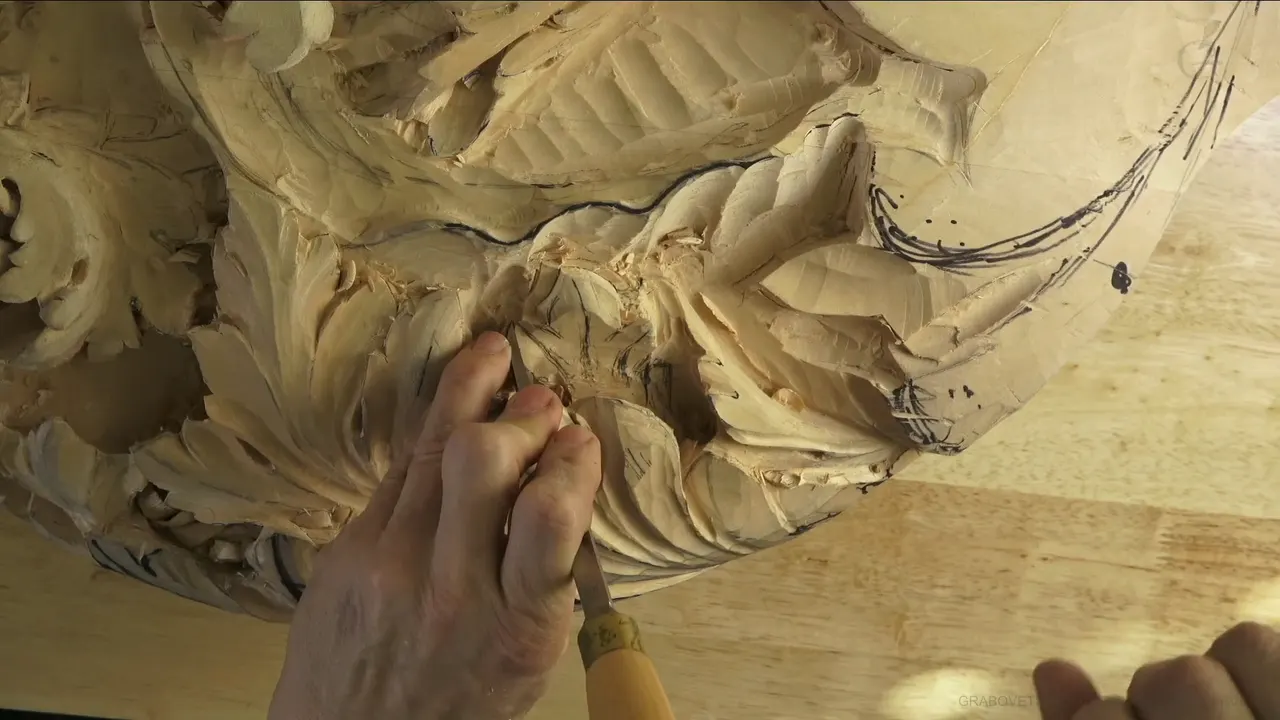

In part 5 of lesson 54, a number five left a perfect edge in one movement. That part also holds the line that gives this page its name. The part names a number nine, a number seven and a number 11. My other lessons use the same words about rasps, drills, a bigger tool and a clay model, and the table below says where.
Have you ever picked up a tool you did not need, just because the job went by faster? Would you like to hear which tool I picked? This part gives you a number five and a shell, then a deep hole and my favorite number nine, with the line I said when the work went fast.
What did the number five do in part 5?
The part opens with a plan: "maybe number five." I don't have to use it, I said, by the way, and I could do the same with a knife or something else. That number five just hits that curvature, which is what I was referring to, and "gives me a perfect cut in one movement." Then I asked you to see how quickly it would go. "Boom, and it's already gone." Perfect edge, I said, really perfect edge.

On this side the work would be exactly the same, I said, "but I have to be a little more careful on this side." It was already giving me that form, that shape. Maybe that side also, and maybe this side also, and then "let me chop this side." Even with more separations still to come on the inside of the movement, "it's just really quick. That's what I like about it."
Here is the line this page is named for: "if something saves me time, it makes me happy." It sounded like almost a song, I said. Next came a plan to repeat the work on the inside, and to create that movement toward the overall movement. "Beautiful." With the same tool I could probably give a little cleaning, though not the final cleaning.

Shells, Rococo and Baroque
I still had to create that shell, and I said it would give me an extra level of shadow. "So that's why I love 15th-century design. I can put shells anywhere."
Then a line I flagged as mine: "that is my own opinion." I think Rococo is better than Baroque, I said, because of those shell movements, and I love Baroque also. I know a man who is probably listening to me, a musician of Baroque-style music who loves that period, and "I love that, too." "This movement is a shell."
Next I planned a 5 millimeters (0.2 in) number 11 veiner, to start "a little bit undercutting underneath of this movement." "It has to be deep excavation," I said, "all the way to the hole," and I planned to get rid of this side too.

A messy carving and my hands
"Let me clean little bit that mess. It looks messy. Really messy." I planned to clean it so that you will understand much better, I think, what my design idea is. It would also get much deeper, actually. "Otherwise, it's not going to look nice."
I'm sorry if my hands cover the view, I said, "but hey, I'm working with my hands. Sometimes there's just no way I can get them away from the angle." About the excavation, "that's beautiful," adding that I think it is beautiful and that it "gives me really nice surround."

Which tools came next?
My number seven was half an inch, 14 millimeters (0.55 in), and I planned to clean in a "more unified way." Going to my previous excavation was possible, though I probably needed to undercut a little on this side, and then it would make sense.
I kind of have to be careful how I attack in, and I said "I almost lost the position." I started somewhere else, though I also need to do this side, "but originally, I wanted to do this side." A triangle "needs to be gone."

"And I can undercut deeper, actually." Just laying my tool on one of the sides, and I can go "everything to the same opening, to the same hole." Probably right away I could create a shadow in the triangle, with "exactly the same idea. Plug cutting." The tool for it is my number nine, I said, to "make my drilling done," and I got to be careful how I do that.

Then a different number nine: "This one is my favorite one." At 6 millimeters (0.24 in), I said, it has "a really short end," and it is "a beautiful tool." My favorite from quarter inches (6.35 mm each), and I have multiple quarter inches, of course. "But I like it for some reason, this one, a lot."

Where else do I talk about saving time?
Each line below is in my words, from the course I name. The tools change with the lesson, and the table gives them.
| Lesson | My words | What I was doing when I said it |
|---|---|---|
| Venice Room 54.5 | Boom, and it's already gone, it just gave me perfect edge | A number five on a curve |
| Lesson 22, part 7 | I could do probably right here, too, pretty much right away | Number five, 12 mm (0.47 in) |
| Workshop 5, part 11 | And especially in production, I got to save time also | Rasps and machine planing |
| Workshop 112 | Just rasp it and forget it | A rasped detail |
| Maine class 8 | I'm gonna use a bigger tool | Sloping the carving |
| Butterflies 13.1 | That would saving you a lot of time | Working all around a shadow |
| Floral Molding 2.1 | Just going to take a little longer | Drilling, not plug cutting |
| Tray of Blessing 6.3 | You can use either number nine and 20 millimeters | The main bowl, 20 mm (0.79 in), and a chopper |
| Roman Acanthus 16.2 | People actually didn't even worry about that deep undercut | Number nine, about 4 mm (0.16 in) |
| Venice 160.3 | It would be much easier to use just the macaroni tool | A 1.5 mm (0.06 in) veiner at a bead |
| Livestream, April 2020 | It's the same mallets for every project | A viewer's question |
| Livestream, April 2020 | I'm pretty sure I saved weeks | A pointing machine and a clay model for carving wood |
Do rasps help in production?

Rasps come up in Venice Room 5, part 11. "I should be honest with you, I really didn't use them before too much. I kind of thought it would be like a fake to the wood carving, but not really." To establish the main form, I said, "I could probably do that." Then: "And especially in production, I got to save time also."
The design will be authentic, I said, but I already broke some of the rules, even when I used the machining, like when I used to plane my wood. Some hand planing, I said, "but it's not much. A machine would take me much quicker." Those are "really nice rasps," and "I've got multiple of them." Later I said "almost perfect feel."
Is it okay to rasp a detail that will be painted?

Over in Venice Room 112, part 1, I planned to take "just number seven" to excavate and clean inside until I'm happy. At a triangle edge I said I'll take a one millimeter (0.04 in) number 11 "and prolong that slightly." "Not much, but a little bit," and it would give a little more pop to that detail.
I also used a rasp: "just the rasp. To rasp it a little bit. And I said to myself, 'Why not?'" My reason was time. The piece would be painted, and "it's going to be gorgeous." Then: "Just rasp it and forget it."
Does one pass all around save time?

I said "that's supposed to cast some shadow" in Carving Plate with Butterflies 13, part 1. Next I would "just continue to work all around," and then came the advice: "It is always a good idea actually to create the same cut, just go around, go around, go around, and then go opposite direction. That would saving you a lot of time."
In this case I worked on one area and did all the directions. "It's okay, I guess. But if you want to save time, it would be probably much better" to make one pass all the way around, then repeat that pass in the opposite direction.
Do separations in a row help?

Several spots in a row show up in Venice Room 22, part 7, and I planned those separations right there, too. At the next spots, right here and right there: "It's going to save me time." After that came the overall movement, with a 12 millimeters number five (0.47 in). I don't want to see really sharp triangles inside, I said, because the original has "like a micro eye" in that case.
Why reach for a bigger tool?

Grinling Gibbons Maine class 8, part 1, has me saying "I'm gonna use a bigger tool. Since I want to save time. And I'm gonna slope it just like that." I'm after exposing that part first, I said, and the first step is to create that roundness. The second step is a number seven used upside down, at "approximately on a 45 degrees," not 90, "that's gonna give you much cleaner cut."
Drill or plug cut?

Part 4 of the same lesson says some spots can take just a drill, but "it's not always possible because you do have a limitation with the drill, the angle limitation." For the triangle in part 5, my plan was plug cutting with a number nine.
Carving Floral and Molding for the Panel 2, part 1, puts the two side by side. A smaller tool, like a number nine at about one-eighth of an inch (3.2 mm), can do the same operation as the drill, "just to create a plug cut. Just going to take a little longer." Then: "Now, I'm going to save time, and I'm going to just drill it." And a little later: "I don't need to create the so-called clean cut."
Did old carvers save time too?

Carving Roman Acanthus 16, part 2, is about extreme undercutting. "Some people don't like it, actually," I said. Of the historical pieces: "People actually didn't even worry about that deep undercut or extreme undercut. But it wasn't just because it looks good, it's just a lot quicker not to undercut extremely. It wasn't by design. So it was just to save time because everyone wants to get paid."
I added "there is always quicker way to do stuff," and: "if you don't want to spend too much time on the cleaning and go really deep underneath, nothing wrong with that." Four millimeters (0.16 in) is about the size of the number nine there, "not quite 3/16 of an inch."
A special tool or a regular one?

In Venice Room 160, part 3, I saw I could lower a section "approximately one-eighth of an inch, about three millimeters," and for me it "would be much easier to use just the macaroni tool. Maybe I will, maybe just to save time." But I can just use normal tools, I said, and I was using a 1.5 millimeter (0.06 in) veiner, right at the side of my future bead.

The Tray of Blessing, Cabernet Sauvignon 6, part 3, covers the main bowl: "you can use either number nine and 20 millimeters" (0.79 in). And to get the majority of it: "in my case, to save you time, I'll just use, you know, a chopper."
A clay model and a pointing machine
My April 2020 livestream on clay modeling before carving wood describes a pointing machine. With the pointing machine and a clay model, I said, "you're saving so much time, so much time because it's much quicker." You take the machine to the model, then to the piece of wood, take a drill bit, drill to the point, "and then you chop it. You gouge really quickly to that point, and you know you're not going to make any mistakes because there is already a point established."
"And oh, man, how much time did I save?" I'm not talking about hours, I said, and "it may be days. But actually, no. No, I saved weeks." I had multiple orders at the same time, and I usually split my day.
That livestream also had a viewer ask whether every project needs a different size, and I asked if that meant tools or mallets. "It's the same mallets for every project." It depends on time and on safety, I said: "if you want to be safe as far as the... Health and so on."
When did I say to slow down?
Part 6 of lesson 54 gives the other advice: "it's better for me to take my time and do it little by little." That goes for you, too, I said. My tool was struggling, "because I've got a really low bevel, and that's not the best tool right now to use for this operation, but I'm still able to grab some of the material." Changing the position and going toward that hole on the inside was my choice.
The full Venice Room lesson 54 and the whole Venice Room Part 5 course are inside the school. Start here to watch the videos.
How it's done
- Pick the tool for the curve. Maybe a number five was the plan in part 5, and I said I don't have to. It hit that curvature, and I called it a perfect cut in one movement.
- Take this side with care. The same work, I said, but a little more careful on this side.
- Plan the shell. A shell was still to create, and I said it would give an extra level of shadow.
- Start the undercut. My plan: a 5 mm (0.2 in) number 11 veiner, a little undercutting under the movement, a deep excavation that goes to the hole.
- Clean with the number seven. Half an inch, 14 millimeters (0.55 in), to clean in a more unified way and go to my previous excavation.
- Plug cut the triangle. For the triangle I planned plug cutting with my number nine, with care in how it is done.
Frequently asked questions
Which tool did I name for the shell undercut in part 5?
My choice was a veiner, a number 11 at 5 mm or about 0.2 inch. I planned a little bit of undercutting under that movement. It has to be deep excavation, I said, and I planned to go to the hole.
What was my plan for the triangle in part 5?
A shadow, probably right away. Plug cutting in that triangle, the same idea, with a number nine. I also said I had to take care with it, and that the triangle needs to be gone.
Is a drill the same as a plug cut for me?
My Floral and Molding lesson says a number nine at about 3.2 mm (1/8 in) can do that job as a plug cut, but it takes a little longer. In the same part I said I would just drill it, to save time.
What to carve next