

Alexander Grabovetskiy, woodcarver, School of Woodcarving · Published 2020
What does a wood carver mean by "in reality"?
Quick answer: In part 6 of lesson 54 I apologized for what you don't see because of my hand, and called it the reality. Other lessons carry the same word with a gouge marked 10 mm (0.39 in) that is almost 12 (0.47 in), a shadow that makes a spot look deeper, and a paint that sounds complicated.
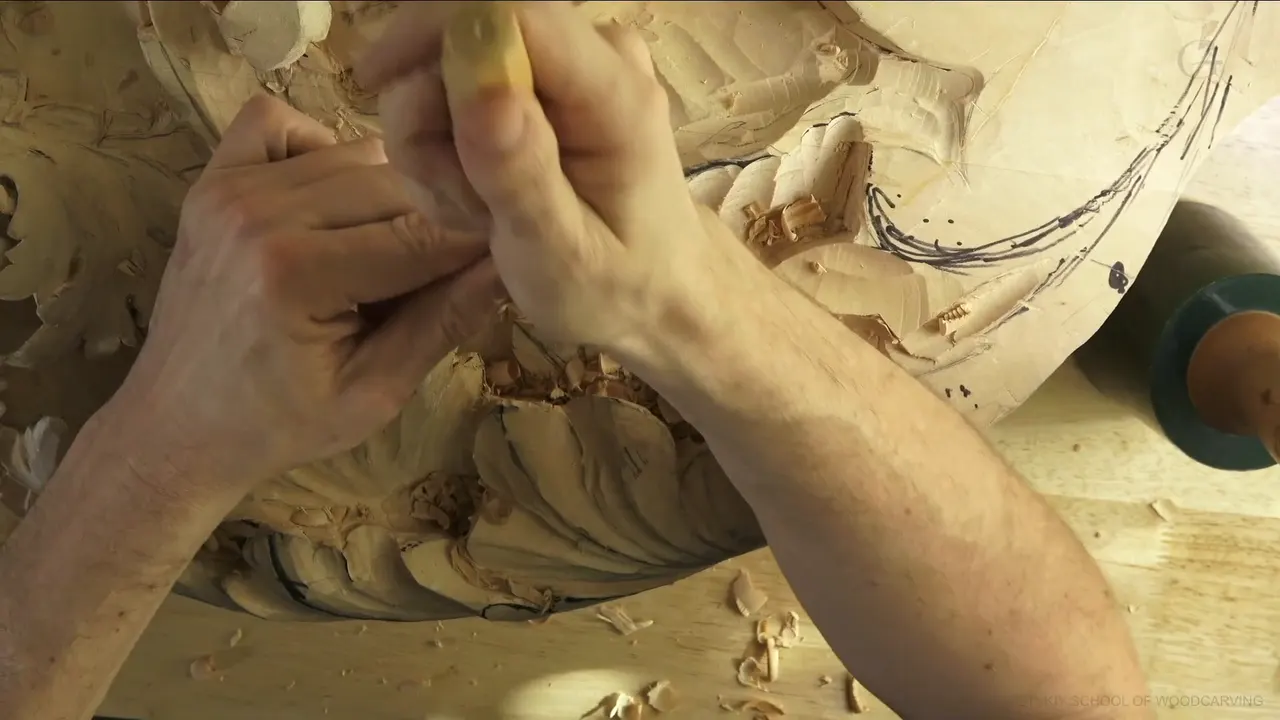

In part 6 of lesson 54, I said: "Again, I apologize that you don't see just because of my hand, but that's the reality." The same word is in my other lessons as "in reality," said about the size on a gouge, and about shadows and paint. The table below says where, and each section tells it.
Ever looked at a carved spot and been sure it was deeper than it was? Would you like to hear what I said when I knew it was not? Part 6 has my hands over a shell and a tool that struggled, and my other lessons carry the word.
What was my hand covering in part 6?
Early in the part, one line is about a shadow. I had just created "deep excavation," I said, and "there's a shadow, and that's, again, like framing it." Inside, I had "a lot of junk." But "this junk doesn't bug me at this point." With number seven I could "clean a little bit," to "get rid of those distractions."

Then came the side I was working on. "So this is the point of this movement, overall movement," I said, and "I have to go right underneath, like that." On the left-hand side, "all that is junk, so I need to just remove only this." That meant care, and a number 11 at five millimeters (0.2 in) "again," with the plan to go "around like that."
A limit came next: "But right here, I don't want to undercut." I did not want to lean the tool either. "I want to make sure my cut is straight down like this, because I still have to create a really nice concave on inside." All I needed was an outline: "That is really important for me not to make mistake," and "it is only outlining." Probably I could remove a little deeper around. "This is a part of a shell," I said, and then "this part of a shell."

"Okay. That is good. So now I need to create that concave." Although "let me clean a little bit again," and "that shell needs to be cleaned." I would use the same number seven, half an inch, 14 millimeters (0.55 in), "and clean little bit."
How did my hands get in the way of the concave?
The first apology came here: "Apologies for my hands, but I can't do anything else. You have to live with that, I guess." After it I could go "a little deeper right here," and I had to create that concave, with movement too. It "just flips like that and go opposite direction this way." Doing it would take "a little time," I said, and then "give me extra dimension. See what I'm doing?"

The advice in the middle was short: "But really important, slice it." Then, "When you're carving like this, so make sure you just slice your cut. You are slicing. And go down, down, down, down, and down."
The inside of that movement needed a smaller tool, and I said "let me think which one." My thought was "maybe I could use just a number nine and a quarter inch" (6.35 mm), to "start small excavations like this." The plan was to go underneath the movement on the left-hand side, which, like I said before, was also going to give me extra dimension.

I had to be careful how I do that, I said. "It's better for me to take my time and do it little by little." That goes "for you, too."
Why did my tool struggle?
I asked if you knew what that sound was. "That's my tool struggling because I've got a really low bevel, and that's not the best tool right now to use for this operation, but I'm still able to grab some of the material." And a risk: "I can break my tool." Then my choice: "I need to change either position or I should change the tool. But I'll just change the position and go toward that hole on inside."

Last came the line this page is named for. Again I apologized, I said, and "that's the reality." Then: "everything is supposed to go to that same hole like I said before."
Does a shadow make a spot look deeper than it is?
In Venice Room 43, part 1, I said "I know it looks big because of the shadow, but it's not really deep." I was "not creating really deep cut." Then the hand: "when I'm placing my hand, you can see that much deeper," and then the real depth: "it's not as deep." After that came a plan: "let me take care of this ridge." Further on: "I'm covering with the hand on purpose, okay? That way I can see the shadow."

A wall stands in Venice Room 67, part 5. "You're looking at a slight angle at this moment, so that's why you see that wall." Beneath it: "it's actually undercut. It's already undercut underneath." Then a plan: "Let me get actually a little deeper." Of a second spot: "this one also could be a little deeper."
Over in Venice Room 53, part 2, a movement "looks like it's both a little bit to the left side, to that side." Straight on, I said, "that curvature is not that extreme." I also planned a move: "probably I could move slightly this way and go right underneath."

On Carving Plate with Butterflies 8, part 2, I wanted to show "how it looks in the world," and said "it's still gonna be a darker." The light was hitting it right then, straight on, and it looked lighter, yet as it really is, it is "gonna be a little darker," I said, "later on once we're gonna get done."

Can you see what I see?
A line for you is in Venice Room 56, part 5, where I offered closer shots. "Maybe I can show you closer. And let me know if you like those close-up shots, okay? If it's better for you." After that: "you see much bigger picture than I see." Back at the wood: "now I have to attack from three sides until I have plenty of space for the full rotation motion."

Next, Venice Room 72, part 8: a transition on the inside follows the curve of a U-shaped tool. Once installed, the human eye will never see it. "But it makes me somewhat happy," I said. The rest I would "do off-camera" because "you really can't see overall picture right here. But once it's done, you'll see it."
Is the size on a gouge its real size?
Marked sizes are the subject of Venice Room 64, part 3, where I said "maybe 10 millimeters" (0.39 in), and then "whatever they mean by 10 millimeters, they're saying it's 10 millimeters tool," but it is "bigger." The size was "almost 12 millimeters or so" (0.47 inch). "But that's okay." Of the makers: "most professional level tool makers, they don't even mark size. It's always just approximate."
A connection point sits in Venice Room 66, part 12. I wanted to hide it somewhere, with "about 12 millimeters" (about 0.5 in) in my words. Then the label: "this says number four." That tool is "just like number three, almost flat."

A number nine is in Venice Room 1, part 14, marked 14 millimeters, though "it's not really half an inch." The real size is 5/8, I said, "about 16 millimeters" (0.63 in). Then: "it's okay. It's close enough."

The gouge in Hashemi Flowers 10, part 9, is "about 3/8 of an inch" (9.5 mm). The reason for "about" is that the maker marks only the sweep, here "just the number eight," so "you have to just kind of guesstimate all your measurements." And "if it's close enough to the task what you need to achieve, then that should be fine."

Carving Grape Onlay 11, part 2, has "like one eighth of an inch" (3.2 mm). It is a number five. "It says it's a four millimeters" (0.16 in), and the real size is "about three millimeters or so" (0.12 in). "It doesn't really matter."

Part 7 of lesson 54 had a size meet the wood. I wanted to see if a number nine at "5/8 of an inch," "16 millimeters" (0.63 in), would fit. "Maybe yes, maybe no." Then: "And no, it's not going to work." And the next tool: "Let me use number seven, 14 millimeters" (0.55 in), with "number seven is actually much better."
Does a design only look complicated?
Twisting ribbons are the subject of Hashemi Flowers 14, part 6. "I know for some people those ribbons, they really look complicated because of the twists they make." Next: "they shouldn't be complicated at all." The tool was "just a number seven and approximately 10 millimeters" (about 0.4 in). "Maybe a little smaller."

In Hashemi Flowers 1, part 2, I named a 20 millimeters (0.79 in) fishtail. "I know this type of design looks really complicated and can scare you off, but believe me, I can prove to you, you are able to do that," I said.
Paint is the topic in Venice Room 52, part 5. "In this case, I will apply authentic 15th century paint, which sounds really complicated," and then "it's not." That paint will be "just a chalk paint, which was really common and still common in some European parts, just using chalk as a media."

One detail is in Venice Room 58, part 11. I did not want a part too weak, and "I left approximately quarter inch thickness of this detail," about a quarter inch (about 6.4 mm) overall. The detail will look "really tiny and fragile," and "it's going to be a quarter inch." The effect: "like a keel of a boat effect almost."

What do I not need to do, even when I do it?
Going deep is covered in Venice Room 9, part 8, where the spot would be visible from the bottom. This is why I was going really deep to the background, though "you really don't have to do that." It could be "even a mistake sometimes." Looking straight, "you're not going to see sometimes too good," and it would "distract the view." So "you have to keep in mind what direction" it will be seen from.

A smooth surface is in Venice Room 24, part 4: "I could take it all the way to the really smooth surface." I "don't really need to because it's going to be paint. And that actually creates beautiful tool marks." The finish was still to come, but "it makes me happy."

One separation is in Venice Room 16, part 9. "Ask me why. I have no answer." I just think it will look much better, I said, "just my opinion." And: "Just extra detail, which" I "really don't need even to do." Still, something extra "makes me happy. It's not boring every day, the same thing."

In Venice Room 40, part 2, divisions were still to make inside, and I did not see any space I left for them. "Maybe I have to raise it much higher," I said, though it was not something I had to do: "I really don't have to do it."

An area sits in Venice Room 37, part 12. It "needs to be excavated right now deeper," and "I don't want to do too much work underneath, but logically, I cannot just excavate and leave undeveloped part. So I need to develop some kind of detail on inside, which you don't see, but it logically has to happen."

Does what I picture match the work?
The picture in my head is the subject of Venice Room 16, part 10. "I already made the decision how it's supposed to look," I said. But "sometimes when you think in your brains" a thing will look good, and "when you work on it" it "doesn't bring you the same result."

And in Venice Room 53, part 12, I asked why I was doing it: "Just to create extra shadow." And then: "it's all about the shadow." "All about light and the shadow," I said, and "it has to look in any environment."

Where else do I say it?
Each line below is in my words, from the lesson I name. The tools change with the lesson, and the last column says what the work was.
| Source | The words I said | The work in front of me at the time |
|---|---|---|
| Lesson 54, part 6 | You have to live with that, I guess | My hands over the part I was working on |
| Workshop 43, part 1 | You can see that much deeper | A spot where my hand made it look deeper |
| Venice 67.5 | That's why you see that wall | A wall that was already undercut beneath it |
| Room 56, part 5 | You see much bigger picture than I see | Close-up shots |
| Lesson 64.3 | Whatever they mean by 10 millimeters, they're saying it's 10 millimeters tool | A tool marked 10 mm (0.39 inch) that was almost 12 mm (0.47 in) |
| Workshop 66, part 12 | This says number four, but it's just like number three | Number four, about 12 mm (0.5 in), almost flat like a three |
| Grape Onlay 11, part 2 | It says it's a four millimeters | A number five gouge, one eighth of an inch (3.2 mm) in my words, marked 4 mm (0.16 in) |
| Hashemi 14, part 6 | They really look complicated | Twisting ribbons carved with a number seven, about 10 mm or 0.4 in |
| Venice 52.5 | Which sounds really complicated | A chalk paint, in my words authentic 15th century paint |
| Room 58, part 11 | Really tiny and fragile | A detail left a quarter inch thick (6.4 mm) |
| Video 24.4 | I don't really need to | A surface left with tool marks on it |
| Video 53.12 | It's all about the shadow | An extra shadow, and a look for any environment |
The full Venice Room lesson 54 and the whole Venice Room Part 5 course are inside the school. Start here to watch the videos.
How it's done
- Clean with the number seven. Number seven could clean up the inside, I said, to get rid of those distractions.
- Only outline. Leaning the tool or undercutting was out, I said. All I needed right then was an outline, with the pass straight down.
- Slice and go down. My advice in part 6 was to slice your pass, and go down, down, down.
- Plan the smaller tool. For the concave on the inside, a smaller tool: maybe a nine at a quarter inch (a little over 6 mm), starting small excavations.
- Take your time. Doing it little by little is better, I said, and that goes for you, too.
- Change position. A struggling tool on a low bevel could break, and I would go toward the hole on the inside from a new position.
Frequently asked questions
What did I say about my hands in part 6?
I apologized for them in part 6. One line: apologies for my hands, but I can't do anything else. Another: I said sorry again for what you don't see, and called it the reality. Right after, I said everything is supposed to go to that same hole.
Which tool did I say was struggling in part 6?
One on a really low bevel. That was not the best tool right now for this operation, I said, though I was still able to grab some of the material. I could break it, so I said I needed to change either position or tool, and I would just change the position.
Is a 10 millimeter gouge really that size?
Venice Room 64, part 3, has me saying the label said 10 millimeters (0.39 inch), and the real size was bigger. I called it almost 12 millimeters (0.47 inch). Most professional level tool makers, I said, don't even mark size, and it is always just approximate.
What to carve next