

Alexander Grabovetskiy, woodcarver, School of Woodcarving · Published 2020
What does a wood carver mean by "a quicker way"?
Quick answer: Venice Room 54 has me naming one option the quicker way: a number five, matching. Other lessons of mine put the same two words beside a knife, a bigger tool, eyeballing and a router plane.
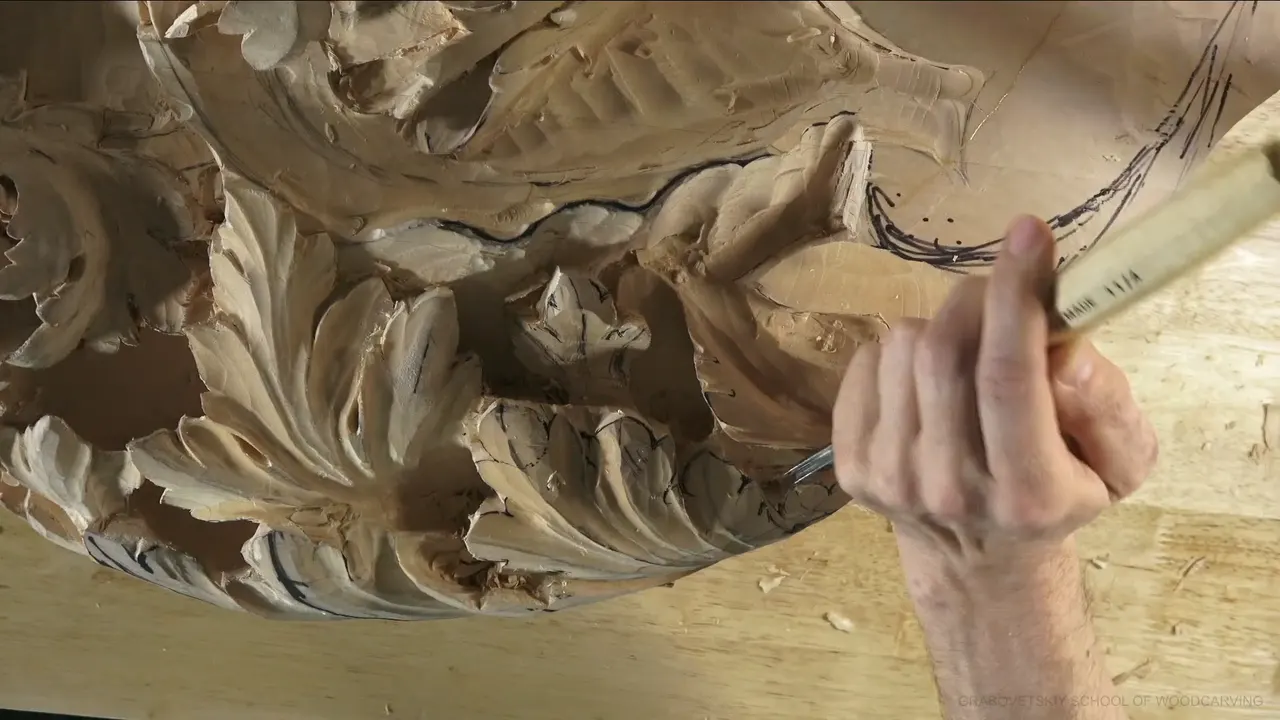

In lesson 54, part 12, I called one way of doing that work "quicker way," and I named the tool I could use for it: number five. The same words are in other lessons too, in Venice Room workshops, Roman Acanthus, Lily Box, Flower Rosette, Hashemi Flowers and the Furniture Panel. A table near the end names each lesson and the work in front of me.
Ever stood over a carved panel and wondered if a faster tool would give you the same result in wood? Would you like to see every place I said it? The tool I named is in part 12, and the lessons below have the rest.
What did I say about a quicker way in part 12?
Part 12 opens with these words: "But you already probably see how deep shadow I am creating. And wood carving, by the way, it's all about the shadow." Then: "Let me excavate deeper."
On the tool I was using: "Okay, number 11. Number 11 and the four millimeters, that's what I'm using. That's about 3/16 of an inch, little less than 3/16 of an inch." In the other system, four millimeters is about 5/32 in and 3/16 in is 4.8 mm, so my "little less" fits.

Another place for number five sits in the same part. Of the ridge: "This ridge, I can always blend with the flatter tool." In this case I said I would take number five, to get rid of that ridge and create the convex. And: "So the previous cut was concave, and now I'm just doing convex."
Later in the part: "And I'm using number 11 and four millimeters. And I need to relief those points and also excavate on the side right here."
Then: "There is a other way to do that, of course. Quicker way. I could use just number five and matching, I would say. How we call it? Just match those curvatures."

Next: "I could actually hit much harder."
What else, in part 12, did I say was not needed?
Two cuts get a line of their own in part 12. "And like I said, I could connect those two cuts, but I really don't need to in this case. It's already impossible to see. It's really, really deep already, so don't have to."

I said this about a ridge: "And now I'm going to blend this ridge with the back bend. Or any flat tool will work in this area. But that happens I just have that back bend on my bench. And I really love back bends." Also: "If I would just use a different back bend, it would give me a really clean cut pretty much right away." Last: "I don't need to use any sandpaper or anything."
A plug cut with a number nine is the subject of part 11 in the same lesson: "I can drill it as deep as I want, and it's actually really fast process." I put the plug at "about six millimeters plug, about quarter-inch plug, and it took me a couple seconds pretty much." The numbers convert to 0.24 in for six millimeters and 6.35 mm for a quarter inch. As for a drill, I said "in some of the spots, it's impossible to get with the drill on inside." Then: "it's almost as fast as with just a hand drill."

Where did I name a quicker way in the Venice Room lessons?
You can hear it in Venice Room 8, part 2: "And maybe I need to excavate it much deeper under here. And let me choose a quicker way. If I'll be able to fit a straight tool. Let me try that." Then: "But this is also too much material anyway, so I can probably safely remove some of it with a bigger gouge."

Workshop 20 has the words in part 3: "So let me try to do a little quicker way. We'll see if I'll be able to. I'll just use number five, maybe even bigger number five." The knife gets a mention too. "With just a knife, you could do a lot of quick cuts." Later: "And this tool could be a little too big as of now."

Over in workshop 24, part 12, the words are these. "But let me use number 11. You know what? That is not the right way I'm doing it, okay." Then: "There is a much quicker way." The captions of that part end on "I could use a bigger tool, but maybe".

Marks are the subject of Venice Room 57, part 10. "So I've got about right there, and every quarter of an inch, every six millimeters. I can place that. And I'm just eyeballing right now, okay?" Then: "Of course, it's one of the methods." Next: "I already showed how I did the middle, the big shell. It was a lot quicker way, but I think it's okay." A quarter inch is a little over six millimeters, so my figure is close.
The same part goes on: "And you could use any other tools like calipers if you wish to mark that." Then: "Eyeballing is okay. And if there's a little bit variation, that's okay, too."

Which bigger tools did I call quicker?
At Venice Room 66, part 1, I said: "Yes, of course, there's always a quick way, quick fix, I should say. Quick fix to use the big tools and clean with the big tools, just like that, with the skew. That's what I did, okay? With the skew."

Venice Room 68, part 1: "Some of them I can actually do quicker with the help of a mallet." Also: "I can do a much quicker job." Last: "Just get the relief cuts first and maybe use a bigger one, maybe 18 millimeters." That comes to 0.71 in.
And in Venice Room 85, part 3: "I can probably just get much quicker result with that number 7, 14 millimeters. Much quicker. Since I already have relief cuts, so I can probably just start chopping." Fourteen millimeters comes to 0.55 in.
In Hashemi Flowers 8, part 2, I said: "Let me take also one-inch number seven." One inch is 25.4 mm. Then: "I can make a lot quicker move, a lot cleaner cut in a single pass." Also: "much quicker and much cleaner. And almost no ridges left."
Another one sits in Venice Room 72, part 11, after "start establishing my convex": "That's going to give me approximately the depth I need to go. A lot of tear. Like I said, that's not the safest way, but that's a really quick way for me, okay? Not the safe way, but really quick." About the knife: "I could get it done with the knife also, but knife doesn't have that sweep. And this one is a sweep number five, and I kind of like that idea that it has a sweep."

How did I weigh the cost of a quick way?
Workshop 20, part 6, has this: "And yes, I know there is much quicker ways to do all that stuff, but if you want to do a quick way, you're losing a lot of details." Then: "I tried that. I've done quick." Also: "It's acceptable, but it's not an art."

Furniture Panel 24, part 1, is about a stabbing cut. My plan there was a number five at three millimeters (0.12 in), placed straight down. Then: "Just stab down and then follow the outline. Go around. Which is acceptable way of carving, but that's not my preference because you're creating too much stress. You're actually spreading those fibers both directions." And: "So it's always better to just outline first. But if you want to do much quicker, that would be acceptable, I would say."
How deep I undercut is the subject of Venice Room 52, part 10. "If you don't undercut extremely like I do, it's a lot easier to cut straight, just a little angle it like that." Then: "quicker production, but you still get the same money. That's the point."
About carvers in the history: "There's a lot of carvers in the history, they did not develop specific way of carving just because it looks best. I think they were just smart people who wanted to work" and "the way to get the food on the table, if you work fast. If you work fast, you get paid fast." Also: "And to make it fast, you don't under-carve deep."
In Venice Room 56, part 8, I said: "I have to work really fast pretty much. But on another hand, I decided to film that for the school, okay? If I wouldn't, I would be much quicker probably."
Roman Acanthus 16, part 2, is about classical designs and historical pieces: "People actually didn't even worry about that deep undercut or extreme undercut. But it wasn't just because it looks good, it's just a lot quicker not to undercut extremely. It wasn't by design. So it was just to save time because everyone wants to get paid." And: "there is always quicker way to do stuff. And if you don't want to spend too much time on the cleaning and go really deep underneath, nothing wrong with that."

Which other tools got the name in my courses?
Roman Acanthus 4, part 1: "Alternative way versus using just the gouges, we could use just a number 12 knife." I called it one of my favorite knives. About the pattern: "We can just follow the pattern just with that knife." Following it that way was, in my words, actually much, much quicker to work around. Then: "I'll take again number seven and remove even more. And that is not my final depth yet."

Hashemi Flowers 43, part 5: "And if I need to clean it, I'll grab my V-tool again and clean that better. But as you see, knife is actually a really quick way to work."

The background is the subject of Flower Rosette 5, part 2: "in the previous workshops I showed you could take actually just gouge and kind of remove it." Next: "And that's a good approach, but I found much quicker way." Also: "I've got small and big router plane." And: "this small thing is actually really a friend of yours."
Of the passes, I said: "I'm not going to do it in one pass." Multiple passes were the plan. About a ring: "this ring is actually going to be my stopper. That is going to be my final depth."

Lily Box 8, part 7: "I'll use a number five." For that gouge I named a quarter inch (about 6 mm) as the size. Next: "And now I can lower down a little bit this part also." Of course, I said, a quicker way exists. I could go across the grain.

Where does each quicker way sit in my lessons?
The right-hand column of the table names the lesson, along with what I was doing there.
| The quicker way I named | The work in front of me, and where |
|---|---|
| Number five | Curvatures to match, after a number 11 at four millimeters (0.16 in) (Venice Room 54.12) |
| A straight tool | A deeper excavation I may need under a spot, with a straight tool if it fits (Venice Room 8.2) |
| Bigger number five | My preliminary convex, with a knife named as another way (Venice Room 20.3) |
| A bigger tool | Number 11, which I said I would use, and a bigger tool I could use (Venice Room 24.12) |
| Eyeballing | Marks every quarter of an inch (about 6 mm), placed by eye (Venice Room 57.10) |
| Big tools | A clean-up that I called a quick fix (Venice Room 66.1) |
| Sweep number five | Convex work at a depth I called approximate (Venice Room 72.11) |
| A mallet | Chopping something out, relief cuts first, and a bigger one (Venice Room 68.1) |
| Number seven | Relief cuts already in, and 14 millimeters (0.55 in) to start chopping (Venice Room 85.3) |
| A number 12 | Following a pattern with a knife, in the Roman acanthus course (Roman Acanthus 4.1) |
| Less undercut | Classical pieces, and the time spent cleaning deep underneath (Roman Acanthus 16.2) |
| Across the grain | Five at a quarter inch (6.35 mm), and a part I could lower (Lily Box 8.7) |
| A router plane | Taking out a background, with a set final depth (Flower Rosette 5.2) |
| Knife again | Layers taken down, and a V-tool I could grab to clean (Hashemi Flowers 43.5) |
| One inch | Seven at one inch (25.4 mm), for a single pass (Hashemi Flowers 8.2) |
| Stab and go | Probably five at three millimeters (0.12 in), and an outline first (Furniture Panel 24.1) |
| Straighter | My undercut, and the speed it gives (Venice Room 52.10) |
| Filming | Filming for the school, and being much quicker, probably, without it (Venice Room 56.8) |
The full Venice Room lesson 54 and the whole Venice Room Part 5 course are inside the school, with more wood carving to watch. Start here to see the videos.
How it's done
- Name the tool. Lesson 54 names number five, with the word matching beside it.
- Match the curvatures. My words in that part were: "Just match those curvatures."
- Weigh the loss. In workshop 20, I said a quick way costs details.
- Check what shows. In part 12, I said it was already impossible to see.
Frequently asked questions
Which tool did lesson 54 give for a quicker way?
A number five, matching the curvatures. That was the one I could use, I said. I had named my number 11 at four millimeters (0.16 in) in the same part.
Did I connect the two cuts in lesson 54?
Those two cuts could be connected, I said, but I did not need to in this case. In my words, the spot was really, really deep already.
What does a quick way cost, in my words?
In workshop 20, I said that with a quick way, "you're losing a lot of details." I also said it's not always the best, and that it's acceptable but not an art.
What to carve next