

Alexander Grabovetskiy, woodcarver, School of Woodcarving · Published 2020
What does a wood carver mean by "light source"?
Quick answer: Part 11 of Venice Room 54 holds my plan to shift the light source a little, in a part with excavations of 25 to 50 millimeters (about 1 to 2 inches). Other lessons of mine put the same two words beside concaves, overlaps, windows and lamps.
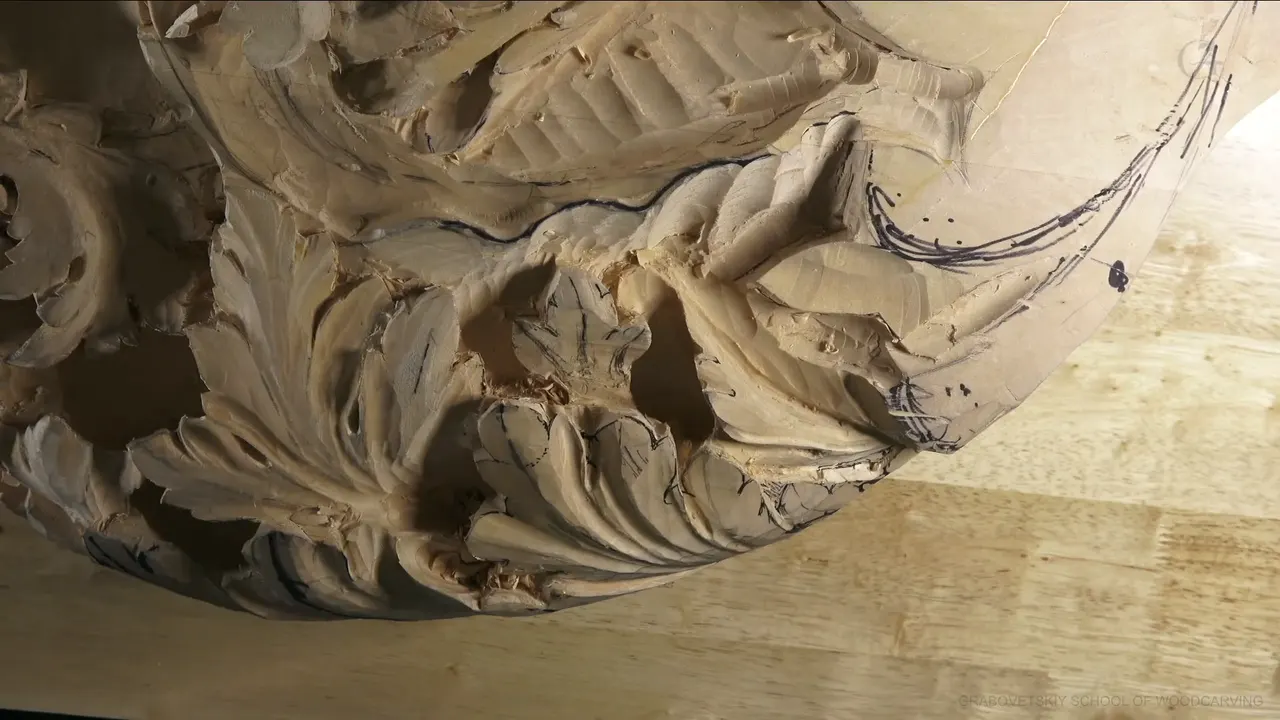

In lesson 54, I talked about changing the light source a little, in the part where I show how deep I dig. I name a light source in other lessons too: Venice Room, Furniture Panel and a livestream. Below they stand side by side, and a table near the end says where each one is.
Ever wondered where my lamp stands when I pick a depth? Would you like to see every place? Part 11 has depths, shadow and a plan to move the light.
What did I say about the light source in part 11?
"I am working on this development. I shouldn't say ancient or antique. It is 15th, 16th century design authentic to Venice." My work, I said, was "a more detailed work right now," and I wanted "to concentrate on creating some more separations."

Some marking was "already" done "where I want to place them." You could see "a lot of excavations around this movement." I gave "the reason why I create the deep excavation around some of the movements," and offered the overall picture, to try to explain. Those two excavations, I said, match the ones "on this side," and "it's about the same depth."
Then the numbers. "Approximately, I am going between 25 millimeters, about an inch deep, all the way to 50 millimeters in some deeper spots, like right there. It's about two inches deep, so about 50 millimeters deep." In inches that is 25 mm (0.98 in) and 50 mm (1.97 in).

"Those excavations, they create darker spots. And it's all about the shadows." In my words, a deeper excavation gives a much darker spot.
"You like painting in three-dimensional world, you create darker, lighter spots." Plenty of people carve without the deep excavation, I said, and "they really don't do extreme undercut. And it's okay." Then: "But deeper you get, a much more dimension you're going to show."

About the light I said: "And let me, for example, change the light source just to move little bit, and you'll see how it actually creates even more beautiful look. It's just those spots casting really deep shadows. Okay? And depends how you position the light, it just changes the look of it. Okay? So that's what I'm after."
"Yes, it is my design. But I have to be honest, it is my design, but I had to be authentic to Venetian style." And "Venetian style is not the same as, let's say, if you go to Milan. Even in the same 16th, 15th century, you would say it's acanthus leaf." Then: "But in Milan and Venice, Venezia," and "absolutely different approach to carving those acanthus movements." About what you see, I said "it is authentic, pretty much to Venice."

"Let me carve." Of the triangles I said "I always do relief cuts." One small section was "not developed yet," and "I'm going to excavate really deep." Next: "I have to create really deep shadow right here and really deep shadow right there."
One way I named is "like a plug cutting," with "number nine." The number nine is "always like a half a round. Okay? So the true half round." Turned, it makes a perfect round, and I planned to make my rotation movement "carefully, without pressing too much." Then: "You're just removing small plugs. Okay? So I can drill it as deep as I want, and it's actually really fast process."

A new angle was next, and my plan was to excavate toward inside, "just like that." The plug measured "about six millimeters plug, about quarter-inch plug, and it took me a couple seconds pretty much." A drill is in that part too: "some areas, for example, right here, you are able to use a drill, no problem. But sometimes, in some of the spots, it's impossible to get with the drill on inside."

Does the light source decide how deep I dig?
In part 6 of Venice Room 27, "I probably could do a much deeper concave right here." Then: "And I probably should." One sentence carries the light: "Again, because the light source is going to be from this side and I need some kind of shadow casting over that direction." After it, a "really nice excavation right here."

Over in Venice Room 41, part 5, I said "I also want to excavate kind of deep and create beautiful shadow line," and the light source is named in the same sentence. A big concave was next. "I start downhill cut like this with the bigger number 11. I'm using 18 millimeters, almost three-quarter of an inch." Three-quarters of an inch is 19 mm, and 18 mm is 0.71 in.

Venice Room 65 gives a reason too, in part 12. "Again, the reason why I'm doing that excavation," I said, and the light, hitting one side of the piece, followed in the same sentence. Then: "I really need that shadow casting."

A concave got its explanation in Venice Room 15, part 1: "I know the position of the room and the light source." Next came "exactly like I placed my lamp." The plan was extra shadow casting in that direction, and the phrase for it was "More exaggerated concave."

A room that changes the plan shows in The Tray of Blessing 2, part 1. "We are painting with the shadows and the light." The piece was not going on a wall. Its light would be "either from the window, if it's gonna be in your dining room," so "for me to create the shadow, I have to excavate somewhat deeper in this area because the light is hitting from the side, okay?"

"The shadow, it's much easier when you take that piece on the wall and the light source above. You can just get by with a shallower cut and you're still gonna cast the shadow. But in this case, I gotta do extreme excavation."
I wanted to separate one leaf from another part, in Venice Room 97, part 7. Depth needed care, because the cut would show from the bottom. The tool: "number 11 again and 5 millimeters, 3/16 of an inch" (5 mm is 0.2 in). Next: "I don't want to go too deep."

Which side does the shadow fall on?
A pipe was my subject in Venice Room 20, part 4. One of its sides, I said, "got to be kind of raised." "Because I really want to cast a shadow." Next: "And let me think which way I should cast it." My next words: "I think I should create another concave on that side and get that pipe a little raised."

The light comes overhead in Venice Room 64, part 3. "The light's going to hit inside, and it's not going to cast." Next: "Let me clean a little bit with two millimeters, number 11" (that is 0.08 in). My plan for the section was to undercut it, "because that is going to cast shadow. So that shadow is important for me."

Lesson 30, part 2, in Venice Room 30: "Yes, it is about movement and design." Then "How is it going to look in the environment it's going to be installed?" And "there's five levels of shadow, by the way. It's a complicated subject on its own, shadow, and worth to study, actually."
Another line from that part has two millimeters (0.079 in) in use, plus a switch to one and a half (0.06 in) planned, both on a number 11. A little deeper, I said, would be a "focal point for the shadow."
What lights do I think about?
In Venice Room 64, part 12, I called it "the basic stuff": "if I understand before I start drawing," then "the light source and what kind of shadow." Next came "how the light travels, how many light sources I have." Then a list of lights: "from the window," and "from the door opening, if it's interior light, if it's a light at night." My words after it: "So I have to consider all of those lights."
The Venetian Flowers Rosette 2, part 3, adds the wall. My reminder is how the piece is "positioned on the wall or whatever to the eye level." Then "In my case, the light source going to go from above." I wanted "a lot deeper shadow on this side," which meant one petal was supposed to go underneath another. At night, once the light is on, I said "you can see that much, much better."

By day, I said in Venice Room 101, part 3, the source of light is windows and open areas. At night it is "just the light source from our ceiling." Both give shadow, "but not as deep as at night."
In a Livestream April 2020 video I said I have to study where the piece will be located, installed, "if you wish." Then: "The light source, position of the eye, how you're going to look at it. So that all makes a big difference."
Can the light source change which part overlaps?
Furniture Panel 35, part 2, has a cut I was about to make. "Before I make a cut, I have to think about," I said, and then "where the shadow shadow is supposed to fall, obviously." Next: "And the light source most likely gonna come from above." Then "my shadow has to fall on that part right here." And: "This part gonna overlap that part."

Furniture Panel 33, part 2: "the light gonna most likely shoot from above." Then "if I gonna overlap this one over this one, I'm not gonna get shadow," and I said "I need to lower down this part slightly and create that shadow." Last: "Exaggerate the shadow with the light."
What happens when the light source moves?
At Venice Room 91, part 8: "I am happy overall, but you see only with the light source from one point. But if I'm going to change the light source to another side, let me check." Then "So now it gets in a different direction, and it feels like it does fold. Right?"

Lesson 100, part 11, in Venice Room 100: "I can exaggerate this area closer to the edge, create even deeper shadow." Also: "It also depends on the light source, how you cast that." I planned to try one light: "If I going to turn on just one of the lights." Then: "So see this shadow right here? Just beautiful." The shadow, I said, "just outlines it."

Venice Room 76 has part 1: "I can jump and use maybe one and a half millimeters, like 16th of an inch, and excavate even deeper." That is 1.5 mm, and a sixteenth of an inch is 1.6 mm. Then: "Right now, I don't see that shadow because I've got the light sources. It's actually from two sides. It's just shining from both sides, and I kill that shadow." And: "I need those two lights. That way I can see from both sides."

Over in Venice Room 131, part 2, comes "really, really slight undercutting." Also: "I know you don't see that shadow now because I have light sources from all over."

At Venice Room 93, part 10: "I really don't need any sharp ridges," I said, and "the light source, just kind of harsh right now."
Which lamps do I like at my bench?
About a pipe in the lighting video of Livestream April 2020: "I had to make it exaggerated because I want to see a shadow, okay?" "Depends how you are changing your light source," I said, so "you can see it's casting different shadow." After it: "I really need that shadow."
Someone had asked about my lighting setup, so I answered: "I like to use magnifier lamps, and I do have two of them," and "those are LED." Next: "I'm not trying to sell you anything. I'm just trying to answer a question. So those lights, I can position from any point on my workbench, and I can cast any type of shadow and just check whatever I wanted to."
Of natural light I said "especially the worst light, if you're using just above light." So "the best idea to get at least one light," and "I encourage you, if you can afford to get two lights because it's always better to use the two lights." Of the color: "So I can make it yellow and get rid of completely of white, and I can work at night without getting tired."
Where else do I say it?
The table below names the lesson. The right-hand column says what was in front of me when I named the light, a lamp in one lesson and a petal in another.
| The light I named | What was in front of me, and where |
|---|---|
| Placed lamp | A more exaggerated concave, with the room in mind (Venice lesson 15, part 1) |
| One side raised | A pipe I wanted a little raised (Venice lesson 20, part 4) |
| Hollow made deeper | A deeper concave and a really nice excavation (Venice lesson 27, part 6) |
| A big concave | A downhill start with 18 millimeters (0.71 in) on a number 11 (Venice lesson 41, part 5) |
| Light overhead | An undercut with 2 millimeters (0.08 in) on a number 11 (Venice lesson 64, part 3) |
| All the lights | Windows, a door opening and interior light (Venice lesson 64, part 12) |
| Two lights | A shadow I kill, and a look at both sides (Venice lesson 76, part 1) |
| Another side | A fold I wanted to check (Venice lesson 91, part 8) |
| Above the leaf | A number 11 at 5 millimeters (0.2 in), for a leaf I wanted to separate (Venice lesson 97, part 7) |
| One lamp on | A shadow that, in my words, just outlines it (Venice lesson 100, part 11) |
| Lights all over | A really slight undercutting (Venice lesson 131, part 2) |
| Day and night | Shadows of a different depth in the same carving (Venice lesson 101, part 3) |
| Wall piece | A shallower cut than the same tray lit by a window (The Tray of Blessing 2, part 1) |
| Where it falls | An overlap, and the place my shadow has to fall (Furniture Panel 35, part 2) |
| Eye level | A petal I wanted to go underneath another (Venetian Flowers Rosette 2, part 3) |
| Bench lamps | Two lamps over my work, in a livestream video |
The full Venice Room lesson 54 and the whole Venice Room Part 5 course are inside the school, with more wood carving to watch. Start here to see the videos.
How it's done
- Know the light before drawing. I called the basic stuff understanding the light source before I start drawing, in lesson 64.
- Dig where the shadow falls. A deeper concave was what I said I probably should dig in lesson 27, and I named the light on that side.
- Move the light and look. Another side for the light, then a check: that was my plan in lesson 91.
- Use two lights. Two lights were needed to look at the carving from each side, I said in lesson 76.
Frequently asked questions
How deep were the excavations in lesson 54?
I gave a range, between 25 millimeters, about an inch deep, and 50 millimeters in some deeper spots, about two inches. In my words, a deeper excavation gives a much darker spot.
Which lights did I list in lesson 64?
Light from above and through a window, from the side and through a door opening, plus interior light and a light at night. All of those lights count, in my words, starting before I draw.
Why did I keep two lights in lesson 76?
Light shining from two sides killed a shadow, I said. I still needed both lights, so that I could look at the carving from each side.
What to carve next