

Alexander Grabovetskiy, woodcarver, School of Woodcarving · Published 2020
What does a wood carver mean by "much safer"?
Quick answer: Part 10 of Venice Room 54 has me saying "much safer" about an air compressor, with "no problem" beside it. Other lessons of mine put the same two words beside crosswise cuts, tool size, angle, relief cuts and a scroll saw.
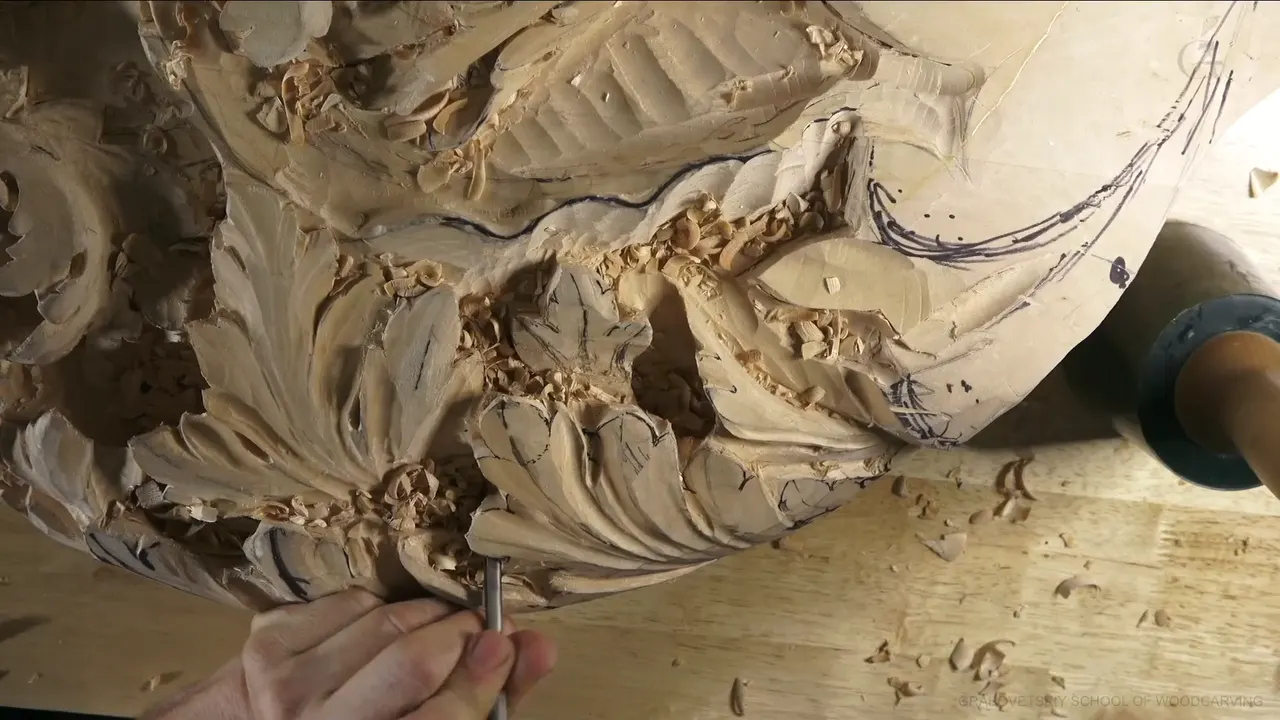

In lesson 54, part 10, I put "much safer" beside the air compressor. Those words come up all through my courses. They sit beside grain direction, tool size, angle, a first cut and a scroll saw. Below they stand side by side, and a table near the end says where each one is.
Ever heard me say "much safer" and wondered what I was comparing it to? Would you like to see the words that stand beside it, in this part and in lessons from other courses? Part 10 sets a hair dryer against an air compressor, plus some water, some noise and a vacuum cleaner.
What did I say about the air compressor in part 10?
"Carefully remove all that waste which I don't need anymore," I said, and "I can go as deep as I wish." After that came the dust: "It's time for me to clean this area." Blowing was the plan, and "Okay. I'm going to use my hair dryer."

"And I like my hair dryer technique actually much better than air compressor." Why? An air compressor, in my words, "accumulates some water, and I don't really want the water on my piece and all." Draining it once in a while changes little, I said: "there's still a possibility there's going to be some water."
"That is not the best idea. Well, I guess it's okay idea." My next words: "You could use air compressor with no problem, but I feel much safer not to."

Noise was my other point. "And noise, of course. Air compressor gives you a lot of noise. It's also downside of air compressors." For another way to clear the area: "Yeah, you could vacuum it. Use a vacuum cleaner," and "I do that sometimes also."
What came next in that part?
"Okay, number nine, that's what I'm using," came first, then "Just to create really nice concave." Another line: "So you should be able to detect how it moves." A maybe followed. "And maybe I should use a bigger number nine," I said, to "hit this side like this and create an escape movement." Then "It's what I call it, how it escapes out like that."

"Beautiful. Although it's messy, but it's okay. It's still beautiful." Right after: "Okay, let me put that back and think what I could do next."
Next, "just to create much better divisions." "I need to create something like this because I don't really want to see the long cut like that." One more division was coming, "right here," and "I still have to work on that detail." Then a wish: "I probably really want to get really big opening, deep opening in this area. Okay. To give an extra shadow spot."

A ridge bothered me. "I like the movement, what I created, but I don't like that ridge I created," I said, and "I need to blend that ridge." The tool was "Number one back bend." Then "go in like that," and "create some smaller details and get that little nicer."
I planned to show how the carving looks overall. You only see a part of it, I said. Near the end of the part I said "Look how much stuff I got on it. So I really have to vacuum it."

Is a crosswise cut safer?
In The Tray of Blessing 1, part 1, I said "also keep in mind the grain direction. In this case, the grain runs this way, and I'm gonna try, uh, create my cut across the grain, 'cause it's much safer, especially when you start." Next, a micro crack: "If there is a micro crack, it's gonna pop all the way."

A gouge size comes with it in Furniture Panel 15, part 8. "I could use probably just a #9 and quarter inch," I said (a quarter inch is 6.35 mm). Whenever I can, I said, I go crosswise, and "It's much, much safer."

The same idea is in Furniture Panel 20, part 5, with number eight and one-eighth of an inch (3.2 mm). If I have a position to attack crosswise, I said, "it's always the best." About removal areas like that, "much safer."
A choice between tools is in Lily Box 2, part 5: "I'm using number five." Then "But I think even number seven would do an even probably better job," and "I would excavate deeper right away, pretty much." The cut there was crosswise, "because it's really much safer, I would say."

A fragile piece comes up in Hashemi Flowers 27, part 3. First, "I have to be careful because right now, looks like this piece is too fragile." Then "Okay, the right way. The correct way." Last, "it's always safer to do that across the grain."
When is a smaller tool safer?
A smaller knife comes up in Furniture Panel 17, part 9. "Too deep," I said. "Don't want to risk it, okay?" I could "always use a bigger one to clean up." But "to remove the material, I'm probably going to feel safer to use a smaller one."
The same idea is in Venice Room 77, part 7. "Sometimes I think it's safer to use smaller tools." I added "But see, even by holding by hand, little by little," and "Yeah, I know it's probably going to take a little longer with the smaller tools, but on the other hand, it could be much safer." The size was five millimeters (0.2 in).

Why not a big gouge right away? I answered in Lily Box 13, part 1, with "I could, but I'm not sure if it's going to help me or not." My answer: "I think it's just safer, especially if I want to save as much as possible the stem parts."

A tool that moved shows in Venice Room 35, part 4. "Let me try 3 millimeters. And it still moves." Then "Let me use 2 millimeters number 11 and see if it's going to be safer. And yes, it is much safer" (0.12 in, then 0.08 in).

Another one is Venice Room 96, part 4, where I said "I don't wanna overdo it" and "That wouldn't be a big mistake." Then "that would be safer," with the number eight as the tool.

Furniture Panel 18, part 5, has a very thin blade: "Again, I'm using only 1/16 of an inch blade, okay?" (about 1.6 mm). "Just I feel it's a little safer for me as of now." Near a line in the same part I wanted to "stay away a little bit from the line."

Does the angle of the cut make it safer?
In Furniture Panel 19, part 4, I said "It's better to work with the grain in this case, but I'm using a 45 degrees my cuts, because I feel much safer." After it, "And it looks better. When you look at it, it just gives me much better finish."
A triangle is the subject in Furniture Panel 21, part 10, and I said "I have to attack it from the triangle side. From the point side, I should say. Even if I have to break the rule of the grain, the wood, working with the grain, okay? I found that for me at least, it's much safer, and I can create a much nicer curvature."

Lily Box 6 has the relief cuts. In part 11 I said "Now I'm going to do the relief cuts. Same idea." Then "Although, I need to attack that from this side," with "much safer" right after it.

In Venice Room 105, part 2, I told you to be careful with a crosswise attack, "because it can chip, so that's why I'm angling slightly." Then "So that is not the safest way to do. But if you angle, so it becomes much safer."

Acanthus over Moldings 5, part 1, has a raised part that pushing would destroy. "I'm gonna destroy my raised part. So that part I have to attack from the opposite side." Later: "let me go and attack that from the opposite side," and "much much safer."
In Grape Onlay 8, part 3: "So if you can get it from the other side," I said, and "much safer."
What about relief cuts and shorter cuts?
In Venice Room 8, part 1, I said that this time I would relieve those triangles much better. "So just straight down cut with number nine." Then, beside it, "much safer."
Venice Room 72, part 4: "But like I said many times, it is much better to create the relief cuts first," and "I will just angle it on inside like undercutting." The next words were "much safer."

Venice Room 75, part 4, has a warning: "Just make sure you don't go all the way through. Otherwise, you're going to split and you're going to damage the backside." In my own words: "I left approximately 10 millimeters before I hit too hard" (0.39 in), and "It will be much safer."

On a piece with no support underneath, in Hashemi Flowers 22, part 1: "Just be careful. Don't press too hard. You can easily break it. Okay?" Then "Just make multiple cuts," and "much safer." It was "number seven and one inch" (25.4 mm).

Modern Acanthus 1, part 3: "I'm creating really shortcuts like a scooping out just like this, okay. So my cuts no more than about half an inch, maybe three quarters of an inch the most, but it's gonna give me much safer cut" (12.7 mm, 19.05 mm).
With a V tool in Hashemi Flowers 10, part 10: "Never force it." Next, "It would be safer if you would just take your time, grab a V tool, and do that more safer way."

"Little bites. Really, really small bites," I said in Floral and Molding 13, part 1. "Well, actually, I could to the line. But it's safer to stay a little bit away, maybe about one millimeter away or so" (0.04 in). In lesson 2 of that course, my cut was "no more than 3/32 of an inch in some of the spots" (about 2.4 mm), and "I always find that much more safer to do that way."
Is a different tool safer than a gouge?
In Lily Box 12, part 7, I said I would make it shorter. Then "of course, I could take it at your scroll saw, or maybe I could just use a knife and carefully." My words after that: "Safer would be, of course, a scroll saw. Okay. So much safer."

Undercutting this way, in Venice Room 30, part 2: "I have to be careful not touching that, but I just did. Okay. So I should use a back bend for that operation," and "much safer."

Plate with Butterflies 11, part 1, has a curved tool. "It's much easier with this just because it has a curvature and it's laying right above." Looking at the butterfly from the side, "much safer not to damage the butterfly itself," I said.

And in Greek Acroterion 2, part 2, has this: "Maybe I could do without this step, but I feel it's probably safer for me if I would do this way."
Where else do I say it?
The table below names the lesson. The right-hand column says what was in front of me when I called a way safer, from a hair dryer to a butterfly.
| The words beside it | What was in front of me, and where |
|---|---|
| no problem | A hair dryer over an air compressor, and some water as my worry (Venice lesson 54, part 10) |
| especially when you start | A crosswise cut, with a micro crack in view (Tray of Blessing 1, part 1) |
| whenever I can | A number 9 at a quarter inch (6.35 mm), gone crosswise (Furniture Panel 15, part 8) |
| really much safer | Number five, or maybe number seven, in a first layer (Lily Box 2, part 5) |
| always safer | A piece that looked too fragile to me, and the correct way (Hashemi Flowers 27, part 3) |
| feel safer | A smaller knife to take the material off, a bigger one to clean up (Furniture Panel 17, part 9) |
| do without this step | A step I might skip, in a Greek piece (Greek Acroterion 2, part 2) |
| a much safer cut | Short scooping cuts of about half an inch (12.7 mm) (Modern Acanthus 1, part 3) |
| wouldn't be a big mistake | Number eight, and not wanting to overdo it (Venice lesson 96, part 4) |
| yes, it is | A number 11 at 2 millimeters (0.08 in), after a 3 millimeter tool still moved (Venice lesson 35, part 4) |
| not the safest way | An angled cut, because the wood can chip (Venice lesson 105, part 2) |
| the opposite side | A raised part I would destroy by pushing (Acanthus over Moldings 5, part 1) |
| safer would be | A scroll saw, with a knife as the other idea (Lily Box 12, part 7) |
| not to damage | A tool with a curve, and a deep butterfly (Butterflies 11, part 1) |
The full Venice Room lesson 54 and the whole Venice Room Part 5 course are inside the school, with more wood carving to watch. Start here to see the videos.
How it's done
- Clear the area. In part 10 I planned to use a hair dryer on the dust, and I said I use a vacuum cleaner sometimes also.
- Weigh the choice. I like the dryer technique, and water was my worry.
- Try a smaller tool. I tried 2 millimeters, number 11 (about 0.08 inch), in Venice Room 35, and said it is much safer.
- Attack from the other side. In Lily Box 6 I said I needed to attack from this side.
Frequently asked questions
Which downsides of an air compressor did I name?
Water, for one. An air compressor "accumulates some water," I said, and even if you drain it once in a while there is still a possibility of some water. Noise was another: "Air compressor gives you a lot of noise."
Which ways of clearing the area came up in part 10?
A hair dryer, which I like "much better than air compressor," and a vacuum cleaner. About the vacuum I said "I do that sometimes also."
Where do I say a crosswise cut is safer?
The Furniture Panel lessons 15 and 20, the Lily Box course, the Hashemi course and a tray course carry it. In my words it is "always safer" in one and "much safer" in another.
What to carve next