

Alexander Grabovetskiy, woodcarver, School of Woodcarving · Published 2020
What does a wood carver mean by "I guess"?
Quick answer: Part 9 of Venice Room 54 has me saying "I guess" about one deep spot, and I said it beside the words "just trust" about a separation. Lessons in other courses carry it beside a gouge choice, a size, a mistake, a glue problem and a matter of taste.
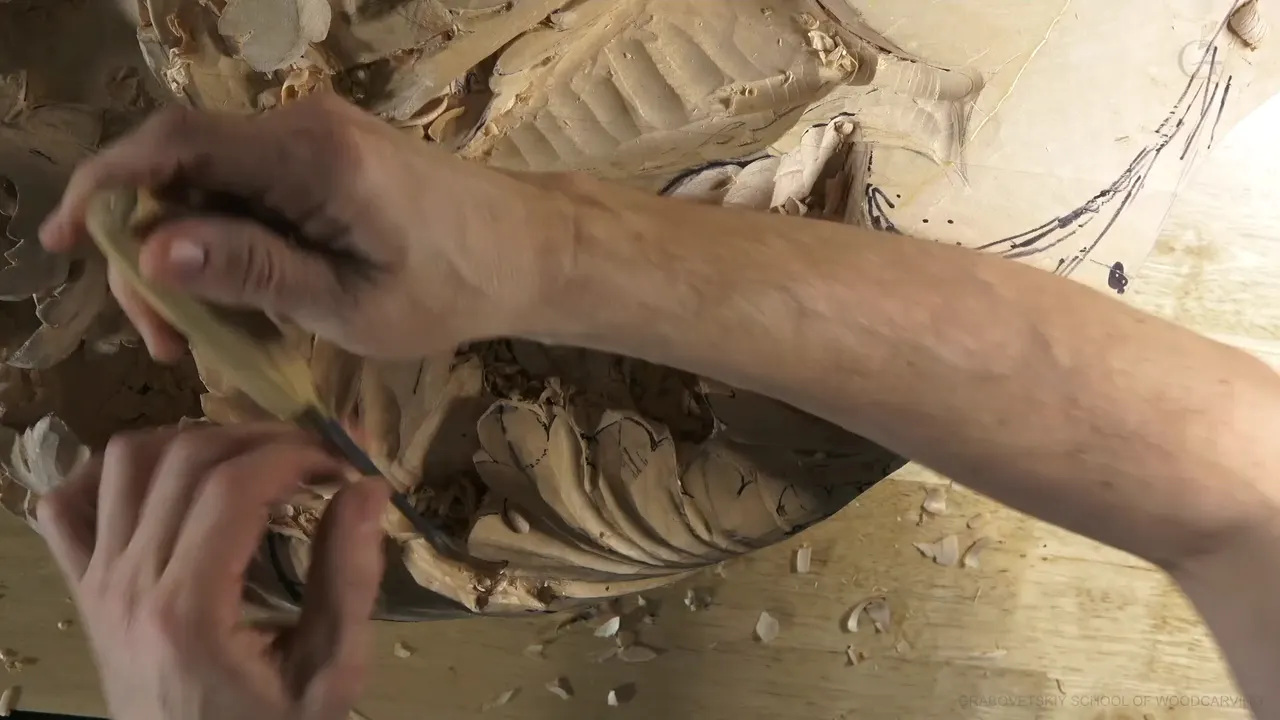

In lesson 54, part 9, I said: "It's not the most convenient spot. I guess it's okay." Those two words, "I guess," come up all through my courses, beside a gouge, a size, a mistake, some glue and a matter of taste. This page sets them side by side, and the table at the bottom says where each one sits.
Ever heard me say "I guess" and wondered what came next? Would you like to hear the words that stand beside it, in part 9 and in lessons from other courses? In part 9 you get a deep hole, a number nine at a quarter inch, and the words "just trust."
What came before that line in part 9?
In my words, "I can probably just do my excavation on this side." "I'm ready to do my plug cut," I said. "I really need to create a deep excavation right here." I named the number nine for it, "same number nine what I used before. One quarter of an inch, six millimeters." A quarter inch is 6.35 mm.
Plan for the spot: "Let me preliminarily create some spot where it's supposed to go." The goal, in my words: "Just the goal create that deep shadow." As for the light, "since my light is changing, right now it's getting late, so those shadows are going to be even more detectable."

I also talked about livestreams. In my words, "I'm doing right now livestreams," with "looks like people like it." For the platforms the number was "About 13 different platforms," and "I'm just streaming at the same time."
The cut, in my words: "I'm creating really deep excavation that give me beautiful shadow." And "Everything just goes to the same hole." I was still using a quarter inch (6.35 mm), "but later on, probably a good idea to switch to a smaller one."
Separations came next. "Now I need to create a better look on this side." A need of mine was "another separation which is going to go right there underneath." For one section the tool "would be probably I can fit only 3 millimeters, I would say number 11." My next words were "3 millimeters is too big," followed by "I probably have to use 2 millimeters" and "let me try 2 millimeters" (0.12 in and 0.08 in).

"There is a hole I created," I said, after "that's going to go all the way to that hole also." Then: "I'm going to create the eye right away in this section because there's going to be an invisible part of this movement."
What followed that line in part 9?
Before it: "And I need to go really deep." After it: "It should look good. And let me blend it and inside a little bit."
Cleaning the section was a need too, "for I can see much better and create much better separation right here." My own correction followed: "Or division, I should say. Much better division. And it's supposed to be like that."

The other place in this part with the same two words comes here. "Not sure if you can see that or not," I said, and "No, you probably don't." Then: all you have to do, I said, is trust, and then "I guess, at this point."
"Let me hit that with the number five." Also, "I can see that I'm able to excavate inside right here." Another plan: "Also going to create the plug cut." Next to it: "Just rotate and see how nicely I can just get that plug out. Beautiful." Deeper was possible: "I can get deeper." From there, "Now I can attack from sides," and "that gave me opportunity to clean underneath of this small detail."

Tools come up near the end of the part: "I can probably use a back bend." Also "maybe smaller number 11, 4 millimeters. Maybe 4 millimeters and just to create little nicer movements right here" (about 0.16 in).

Which gouge sat beside "I guess" in my other lessons?
There was a wall to dig out in Lily Box 5, part 4. "Let me think which approach I could take," I said, and "Well, I guess I could use number three. Or even maybe I could use number seven."

A flatter gouge shows in Venice Room 85, part 8. "I guess I could get a flatter gouge right now, or even number seven will work also in this case as of now," I said, and "Just get to my approximate depth."

A size is named in Venice Room 62, part 9. I planned on "the spoon veiner." Then "That is a little too big, I guess," and "I need little smaller." Next would be "five millimeters right now, number 11 veiner" (0.2 in), to excavate "a little deeper."

A sharpness call sits in Furniture Panel 15, part 5. Number five was the plan. "Again, I did not sharpen them." The size was "12 millimeters, half an inch" (about 0.47 in). On the steel: "I guess I need to sharpen it, so right now, it's not too sharp for me." After a touch on a stropping wheel, my words were "Yep, it does. It does work."

The same part has "guess" beside the tool size too. "I like the size. It's a true European size." You can get really close to the detail, I said, "and it still can be used with a mallet, and you can use it just by hand. So that, I guess, is a plus."
Which mistake sat beside "I guess"?
A cut that went wrong sits in Venice Room 8, part 8, from the Venice Room Part 1 course. "That is a mistake what I've done," I said, "I just attacked too deep right away, but that's okay." Close by: "I guess it is not the first mistake I made. But that's all right."

Pressing too much would be a mistake, I said in Venice Room 63, part 5. "Mistake of overdoing it, okay? And I guess I've done it too many times."

The ending of Venice Room 61, part 9, has a mistake in it: "I guess it's enough for now. See, I just made a mistake." The rest of the work would go off camera, I said, "because I'm going to stick my head up." Of the overview picture: "I guess you can see it's a beautiful and deep shadow."

Glue is the problem in Venice Room 78, part 1: "Oh, this one needs to be glued again. I wasn't too careful, I guess."

Carving Roman Acanthus 16, part 5, has a rule about hands: "Never put your hand in the way of a tool." If it slips, I said, "you don't want to slip it and cut yourself." About my own hands: "I've done it. I cut myself multiple times." Then "I guess you also have to cut yourself sometimes. That way you will understand and learn from your own mistakes."

What about a spot I could not reach, or one the camera could not show?
A deep hole is the job in Venice Room 74, part 11. I needed "to excavate a really deep hole right here," with "just the two millimeters, like I said, number 11" (about 0.08 inch). On the spot: "Not your convenient spot. But I guess it's okay. Again, not convenient because I'm carving actually pretty much against the grain, but I really want to excavate somewhat deep. I want to create that shadow."

"Almost impossible for me to get in," I said. Then: "I do have a bump left over from previous cuts, and I can actually use it. I will just take advantage of it, if you can say it that way."
A plug is the subject in Venice Room 64, part 12. "I have to be careful because I am working along the grain." Soon "I guess I've got really deep already. So now it's time to remove that plug. See? Here you go. See, it's already popping out." And "Just a single cut already created that deep shadow."

A corbel was planned in Venice Room 53, part 1, one that would be attached. "I know you don't see that," I said. I would not be able to "actually place the camera right there," and "I guess you have to trust" was part of it. There was an apology too: "I apologize I can't place the camera on the angle." Of one section I said "about two inches, which is approximately about 50 millimeters, I'd say."

Lesson 61 has another one, in part 5. "Number nine, and that would be 13 millimeters," I said (0.51 in). Beside it: "I guess it's a little too far for you. You can't really see what I'm doing." Thirteen millimeters, I said, is "bigger than half an inch," or 12.7 mm.

What about a call that was mine to make?
Grain is the topic in Hashemi Flowers 10, part 2: "right now I am working against the grain. That is not the smartest way to do." Next, "Rotate that and attack that from opposite side." I could also "flip upside down and attack from the backside, but that's okay, I guess I am able to remove a lot of material just like that."

The subject in part 13 of that same lesson is glue. Getting some glue was my plan, with "Don't want to see too much squeeze out." Next: "I'm not even going to clamp it," and "Clean around right away." Last, "That's good. Not good, but that's all right, I guess."

In Furniture Panel 38, part 2, I was "just removing paper" and said "I'm not gonna create any cuts. I don't wanna do roundness." Some people round the volutes "like a button, almost like a dome." On that: "I'm not, I'm not a biggest fan personally, again, it's up to the taste, I guess."

Hazelnuts 3, part 3, has a question to myself. First, "I think I do like it." The question, "Do I like it or I don't like it?" had the answer "I guess I do." A maybe came next: "Maybe I can just spend a little more time just cleaning up on inside."

A part could float in Greek Acanthus 9, part 4. "It would create a beautiful picture," I said, about making one part "like in air." The line itself: "I could do that, I guess. I'm not sure if I should or not." Before deciding I would think first whether it was a good idea, and "But I think it is."

Another division is named in Venice Room 60, part 10: "Not a division but... It is a division, I guess." My plan was "just number 11" to "clean that stuff out."

Where else do I say it?
Each row names the lesson. The tools change with the lesson, and the second column says what was in front of me.
| The words next to it | The work in front of me, and where |
|---|---|
| I need to go really deep | A really deep spot, with a smaller veiner to try (Venice lesson 54, part 9) |
| which approach | A wall to dig out, with a seven as the other idea (Lily Box lesson 5, part 4) |
| a flatter gouge | Number seven would work as of now, down to my approximate depth (Venice lesson 85, part 8) |
| a little smaller | Too big, I said, and a 5 mm (0.2 in) number 11 on my list (Venice lesson 62, part 9) |
| sharpen it | Number five at 12 mm (0.47 in), not too sharp for me (Furniture Panel 15, part 5) |
| the first mistake | Attacking too deep right away (Venice lesson 8, part 8) |
| overdoing it | Pressing too much (Venice lesson 63, part 5) |
| enough for now | A mistake, and the rest of the work planned away from the camera (Venice lesson 61, part 9) |
| cut yourself sometimes | A rule about where the hand goes when a tool slips (Carving Roman Acanthus 16, part 5) |
| really deep hole | Number 11 at 2 mm (0.08 in), and a bump left over from earlier cuts (Venice lesson 74, part 11) |
| deep already | Plug to remove (Venice lesson 64, part 12) |
| have to trust | A corbel I planned to attach, and a camera I would not be able to place (Venice lesson 53, part 1) |
| too far for you | Number nine at 13 mm (0.51 in) (Venice lesson 61, part 5) |
| lot of material | Rotate and attack from the opposite side, with a flip as another option (Hashemi Flowers 10, part 2) |
| too much squeeze out | Glue for a part, with squeeze out I did not want to see (Lily Box lesson 5, part 13) |
| up to the taste | Paper taken off, with no roundness wanted (Furniture Panel 38, part 2) |
| I do | Small cuts, and a maybe about more cleaning inside (Hazelnuts 3, part 3) |
| if I should or not | Space below one part, to make a beautiful picture (Greek Acanthus 9, part 4) |
The full Venice Room lesson 54 and the whole Venice Room Part 5 course are inside the school, with more wood carving to watch. Start here to see the videos.
How it's done
- Name the spot. In lesson 54 I said I really needed to go deep, in a spot that was not convenient.
- Say what you think of it. My lines were "I guess," with a plan to blend a little bit inside.
- Name the tool. For one section I named a number 11, called the first size too big, and planned to try a smaller one.
- Say what the camera misses. On a separation I told you that you probably could not see it.
- Go on. The number five was my next plan, for a hit.
Frequently asked questions
What came after the deep spot in part 9?
Next I said "It should look good. And let me blend it and inside a little bit." Cleaning the section was on my list too, "for I can see much better."
Which gouge sizes came up for the section I had to take care of?
A number 11 at 3 millimeters (0.12 in) came first. I called it too big and said I probably had to use 2 millimeters, about 0.08 inch.
What was my ask when a separation could not be shown?
You probably could not see it, I said, and all you had to do was just trust, "I guess, at this point."
Which tools came up near the words in other lessons?
What to carve next