

Alexander Grabovetskiy, woodcarver, School of Woodcarving · Published 2020
What does a wood carver mean by "probably should"?
Quick answer: In part 10 of workshop 59 I said "I probably should get this one underneath of that." The same two words sit in other lessons of mine. Some come with a tool, a measure or a side to attack from, and others lead into a remark.
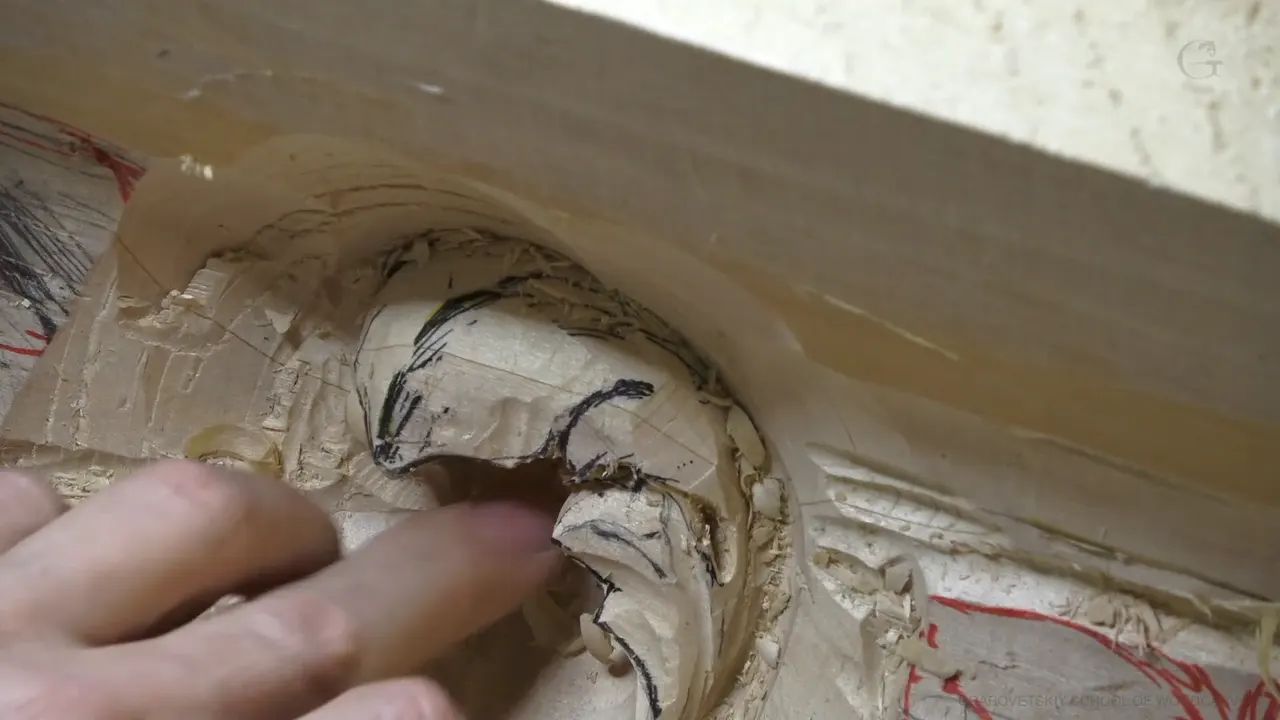

The words "I probably should" are in Venice Room 59, part 10, and in other lessons of mine. This page reads that part of my wood carving course line by line. Then the page visits the other lessons, with the tool or the angle I named near the words.
What came before the words in part 10?
In part 10 I said "That is good. I can actually do exactly the same right here and create a nicer movement. Okay?" An apology follows: "Sorry that you can't see."
The cue after that is "And see, it creates beautiful shadow even more. Even more shadow."
Tool and size come in these words: "I have to take number nine again, about half an inch, about 13 millimeters, I would say."
How deep could the cut go?
"And again, have to be mindful how deep I go." Then: "Can't go too deep because I've got only two inches. Right? And I'm already one inch in, and I still have to carve other details." Two inches is about 51 millimeters, and one inch is close to 25 millimeters.

The plan for the stretch after that was this: "I'm going to use now number three or maybe number four gouge and just try to establish undercut this way." Two short lines are next, "Undercut this way." and "And let me clean this section also."
One more option sits just before the words: "And now I can actually get this eye worked out also." Then: "But before that, let me think."
Where do the words sit in part 10?
Here they are: "I probably should knock a little bit this section right here." "Right." comes next, then "And that is good." After those, "And get number nine again and get rid of some of that mess."

About the inside I said "I'm sorry that you can't see what is going on inside. But all I'm doing is just getting rid of the mess." Then "Just getting rid of that mess and creating even deeper shadow. That's exactly what I'm doing."
More plans sit in these lines: "Again, going to take number nine and clean a little more." Another is "I need to attack this side and clean this area." The size was "Number nine and 3 millimeters, one-eighth of an inch."
A warning has its own reason attached: "But I have to be really careful because I don't want to create extra tool marks on inside that later on I have to deal with."

Which tool went with the second line?
Ahead of it came "So let me now attack this division. So this division, how we're going to do it?" Then "Because I can't really use the normal tools, but I can still probably try to do a spoon gouge. Two millimeters, number 11." That is 0.08 in.
The second line sits in "Again, let me think." and then "I probably should get this one underneath of that." After it came "That would look much better. In my opinion, of course."

What about the ceiling?
"See how slow I have to go this area?" Then came "Because of the position." And "I'm working right on a transition to the ceiling area. Really interesting transition to the ceiling."
My plan for the tool: "So now I have to switch to a smaller one, to a smaller number 11 spoon gouge, and I'm going to use one millimeter." One millimeter is 0.04 in.
A second plan: "I have to also keep an eye what the grain of the wood does, and go in and create an extra shadow."

How did part 10 end?
Blending is next: "All right. And now it's time to blend this cut because it doesn't look too nice." For the tool I said "And to blend it, I need some kind of flat chisel, maybe just even number one."
The last lines of the part are "But I have to also keep an eye what grain does. Little by little, without forcing." And "Okay. Again, one millimeter. One millimeter, number 11, and get rid of what I just created, that mess, and get even deeper."

Does part 9 of workshop 59 use the same words?
It does. In workshop 59, in part 9, I said "So I need to turn to number 11 in a spoon gouge." Then "Which one I should use?" And "Probably should use 10 millimeters and go uphill cut, just like that." Ten millimeters is 0.4 in. Elsewhere in that part: "And now I can probably excavate much deeper in this area, too, and connect with my main undercut." Also "Number five, and that's going to be about 5/8 of an inch, about 16 millimeters." Then "Actually, you know what? I could use number six. Number six will give me much better cut."
Is there a plan like this in part 11 of workshop 59?
The plan in part 11 reads "Maybe number seven I should use." The size is in "Number seven and 14 millimeters I'll try first and just get a little more pronounced arc." Fourteen millimeters is close to 0.55 in. Before that I said "I still don't like how sharp this area looks. It doesn't look too appealing." And "The shadow is too straight, and I have no idea why is that, because I do have a curved cut, but it casts a wrong shadow."
In the same part: "Maybe I shouldn't even mark." And "Let me clean it first, and then I'll decide what to do with that."
Which tools go with the words in other lessons?
Over in Carving Hashemi Flowers 24, part 3, I said "I'm using number seven and 5/8 of an inch." After that, "I probably should use first a knife." Five-eighths of an inch is near 16 millimeters. Then comes "Even if my tools are really sharp, but I can't take too much material at once." And later: "I'm always making my cuts slicing cuts, not just pushing. That would be a big mistake."
Carving Roman Acanthus 16, part 1, has "Well, a couple approaches we could take. So what I probably should do, I could use maybe just a small gouge and create a concave cut right on the side of those lines. Okay, let me do that." Then "And I'll take number eight and also about one-eighth of an inch, and I'll just create a relief cut at first." In millimeters that is near 3.

Take workshop 152 of the Venice Room, part 1, in this lesson: "Okay, so now what I need, number 9." Then "And in this case, I probably should go with the quarter inch or so," A quarter inch is close to 6 millimeters.

Advice for you sits in Carving Floral and Molding for the Panel 13, part 1, where the tool named is "only a one millimeter tool" (0.04 in). My words: "And if you still did not buy a really tiny, small micro tools, you probably should do that if you are planning to do carving like flowers and so on. Those tools, they're not too expensive whatsoever."
Do the words ever sit beside an angle of attack?
Take Carving Vase with grape leaves 2, part 6: "And blend it even better like this. Okay? And I probably should just change the position how I attack, from what side I attack." A few words on, "I can blend this side this way." And "Well, I actually could use right now number seven"

Workshop 98 of the Venice Room, part 3, is in this lesson: "Just to give a little more shape. Though I probably should rotate and attack from opposite direction." The cue after it reads "But for now, that's the stage I want to see it."

Over in Venice Room 128, part 2, I said "Just get around. Although this part, I need to lower down a little more, otherwise it's not going to look as nice." Then "I'll take number three." My next words were "I probably should attack that from opposite side, from here." Later in the part, "I do like that shape."

What happens when the line names no tool
In Venetian Flowers Rosette 1, part 3, I said "By the way, I probably should measure. Because even if I try to do 90-degree cut, it's still probably not as accurate." Then "I'm still able to see my edge,"

In the first Venice Room workshop, part 4, the verb is the same: "But on another hand, I probably should measure my board" The board size is in "In my case, that board is inch and seven-eighths approximately." That is about 48 millimeters.
Carving Furniture Panel 16, part 9, has "And again, I'm a little too aggressive, I guess." I said "And I probably should pull a little bit higher." Then "I can always go back deeper." A later cue says "Double-check. Yep, I'm still higher than the rest of it."

Workshop 87, in part 5, has "You know what? I think I probably should create the normal height, which is supposed to be the final height of this spot, and I left a little wider spot, and looks like I have to move this side little bit to the left." Then "Okay, so I need to figure out the height of it, okay?"

In Venice Room 106, part 2, I said "So the most important is actually pretty much that, that, and that. Okay?" Then "Well, I probably should repeat myself. I'm not going to remove it. I have to just make it the same level as that part, okay, and blend that with this edge." The tool was named in "number 11 and seven millimeters in this case. Okay? Little more than a quarter inch."

In Chamomile and Bow Rosette 2, part 3: "Second, I've done a groove inside. It's like a concave cut. Well, I probably should go back." Then "What I've done first, I've got convex and concave and a concave,"

Venice Room 11, part 8, has "So I probably should be happy with that depth and not go deeper." Later in that part: "Now, when I look from below, it gives me a really good shadow. And I am happy with that."
When the words open a remark
In Carving Corinthian Acanthus Leaf 3, part 4, the words are "I probably should explain to you what I'm doing." The next cue is "There is a rule in wood carving, you never cut toward yourself."
In Venetian Flowers Rosette 6, part 2, the words lead into a remark about a tool: "Also, with this one roll, I probably should mention why I like it." Right after it: "I can get an angle right inside of the undercut and create some texture right there." Before that I said "Just make sure you don't use a regular mallet."
Which lesson names which tool?
Lesson numbers in the first column are in the form lesson.part, and the two 59.10 rows are one for each spot.
| Lesson | Tool or move named near the words | A short line of mine from the same stretch of the video |
|---|---|---|
| 59.10, the knock | No tool in that line; number nine is named in the cues after it | "Right." |
| 59.10, the division | A spoon gouge, 2 millimeters (0.08 in), number 11 | "That would look much better." |
| Hashemi 24.3 | A knife, used first even with sharp tools | "not just pushing" |
| Roman 16.1 | A small gouge, and number eight at 1/8 in (about 3 millimeters) | "create a concave cut" |
| Venice 152.1 | Number nine at a quarter inch or so (about 6 millimeters) | "what I need, number 9" |
| Panel molding 13.1 | Micro tools, one millimeter (about 1/25 in) | "not too expensive whatsoever" |
| Vase 2.6 | Where to attack from: the side | "blend this side this way" |
| Venice 128.2 | Attack from the opposite side, with a number three named just before | "I do like that shape." |
| Rosette 1.3 | Measuring | "still probably not as accurate" |
| Furniture Panel 16.9 | A little bit higher, with going deeper still possible | "still higher than the rest of it" |
| Room 106.2 | Number 11 at seven millimeters (about 0.28 in), a little more than a quarter inch | "blend that with this edge" |
| Room 87.5 | The normal height of a spot | "move this side little bit to the left" |
| Chamomile 2.3 | Going back over what I did first | "then I've got the groove" |
| Rosette 6.2 | A roll, with a hammer planned in place of a regular mallet | "create some texture right there" |
| 1.4, first Venice workshop | Measuring a board, 1 7/8 in (about 48 millimeters) | "inch and seven-eighths approximately" |
| 11.8, first Venice workshop | A depth, and no deeper than that one | "it gives me a really good shadow" |
The courses behind these lessons are in the school, and each one has a page of its own. Venice Room: workshops 50 to 61, 86 to 97, 98 to 109, 122 to 131, 144 to 155 and the first set. The rest: Hashemi Flowers, Roman Acanthus, Corinthian Acanthus, the panel molding course, the grape leaf vase, Venetian rosettes, the Furniture Panel and Chamomile and Bow Rosette.
Start here to watch hand tools at work on wood, in relief and in carving.
How it's done
- Name a tool. For the division I named "a spoon gouge. Two millimeters, number 11."
- Mind the wood. "I still have to carve other details."
- Go slow. Near the ceiling area: "Because of the position."
- Watch the grain. "Little by little, without forcing."
- Blend last. "some kind of flat chisel, maybe just even number one."
Frequently asked questions
Which plan comes just before the pause in part 10?
An option: "this eye worked out also."
How much wood did the part 10 board have?
Only two inches (about 51 millimeters), and "I'm already one inch in" (about 25 millimeters).
What is said about the pace near the ceiling?
"See how slow I have to go this area?"
Which tool sat next to the words in Hashemi Flowers 24, part 3?
What to carve next
- Venice Room workshop 59
- Venice Room workshops 50 to 61
- Carving Hashemi Flowers 24
- Hashemi Flowers course
- Carving Roman Acanthus 16
- Roman Acanthus course
- Venice Room 152
- Venice Room workshops 144 to 155
- Carving Floral and Molding for the Panel 13
- Panel molding course
- Carving Vase with grape leaves 2
- Grape leaf vase course
- Venice Room 98
- Venice Room workshops 98 to 109
- Venice Room 128
- Venice Room workshops 122 to 131
- Venetian Flowers Rosette 1
- Venetian rosettes course