

Alexander Grabovetskiy, woodcarver, School of Woodcarving · Published 2020
What does a wood carver mean by "envision"?
Quick answer: I used the word envision in part 2 of Venice Room 59, about the middle line, plus the movement I need. Other lessons have me using it about eyes, stems, a letter S and a leaf, from the Furniture Panel and the Butterflies plate to the Maine class and other Venice Room workshops.
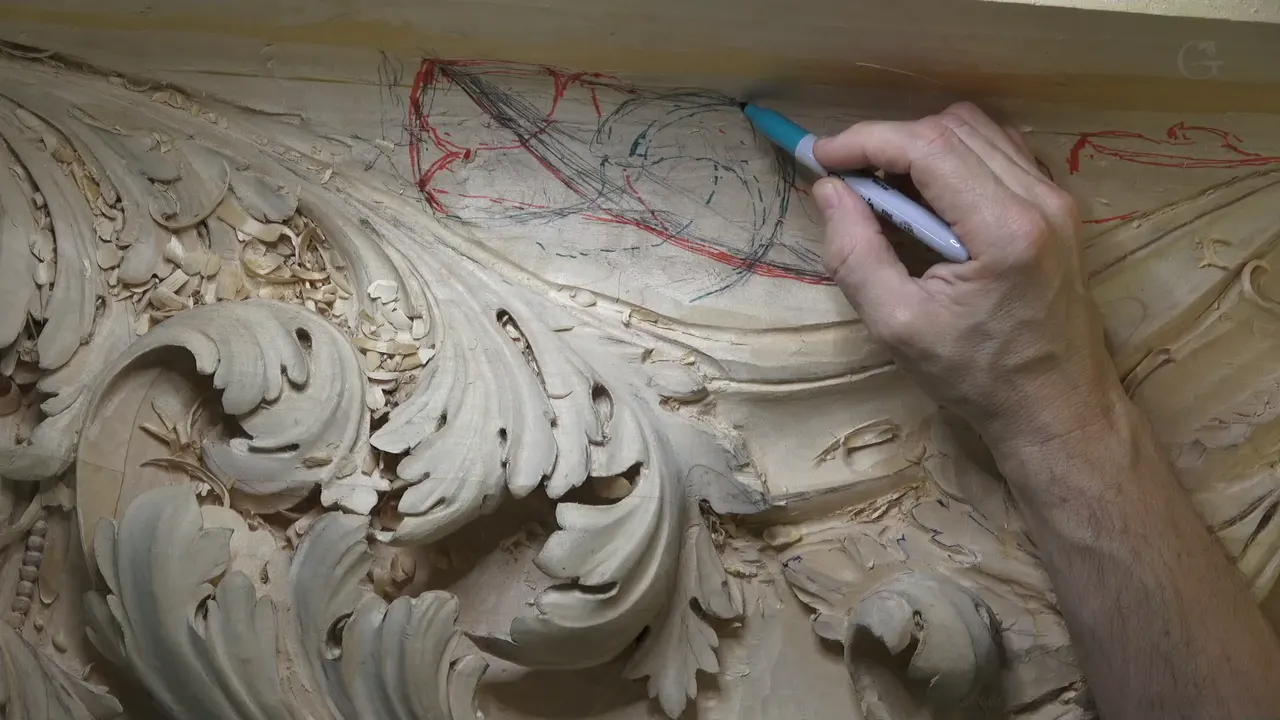

"That's what I need, okay? Pretty much, I can already envision what is going to happen." I said that in part 2 of Venice Room 59, while I talked about the middle line, and about the movement I need. The word shows up in the Furniture Panel and Butterflies courses too, and in the Grinling Gibbons class in Maine and more Venice Room workshops.
Here is what made this area hard, how thick the board is, and how deep I could go. The lessons further down show the same word in other places.
What did I mark on the panel in part 1?
In part 1, my question was whether to attack one section or concentrate on the volute. Both areas are important, but I said I should probably attack this section, because I can see a movement going upward there. I needed really good taper going that direction. As of then, I kind of didn't like this section, because it was not a gradual movement. By the way, that is just a middle line of this movement. "And that is a little better. Not exactly the best, but much better."
So now it just curves upward, with maybe a little more curve right there. "My question is, how developed I want to see this?" I have to make that decision, I said.
On markers, I said I'd probably use just a marker, and in this case orange, to get that movement. Another section goes in a different color. For me, I don't have to, because I know exactly which part overlaps which. It's just for you to understand. I'm just doing middle lines.
What was I looking at when I said I can already envision it?

"I can get much deeper in this area without touching my molding," I said. Messing it up is what I want to avoid.
I got to keep the middle line. Losing it does not scare me: if I cut it out, I can always reestablish it. Sometimes the excavation makes me change it. In my words, "It just changes everything sometimes."
For now, I'd go to the middle line, because I need some really good movement.
Why did I call this part of the panel challenging?

I opened with good news and a warning in one breath: "I think it's going to be good. Although challenging because, like I said, that is already a ceiling part." The upside is the shadow. I called it really beautiful, absolutely gorgeous, and I said it is going to give me a beautiful transition.
I stopped myself with "Let me think again." It's easy to draw something and then kind of think, "Why did I do that?" because I still have to be able to carve it. If you think it's easy, it's not. I meant "this concavity transition to the ceiling."
So I have to think twice or more before I do something like that. My plan was to outline with no problem and see if I need to change some stuff or not.
For the outline I named number 11, 12 millimeters, and called it half an inch. The area sits right in the transition to the ceiling. "If you don't think it's challenging, try it once, because really, I'm limited from both sides."
| Lesson | The tool and the size I named | For |
|---|---|---|
| Workshop 59, part 2 | number 11, 12 millimeters | the outline of a challenging area, I said |
| Workshop 59, part 3 | number nine, 20 millimeters, three-quarter of an inch | a plug cut to get depth |
| Furniture Panel 20.1 | number 11, one millimeter | the initial cut, going really close to the line |
| Butterflies 4-2 | about 1/8 of an inch, about three millimeters | the distance to this line |
How thick is the board, and why does that matter?

I'm glad I have an eight quarter material ceiling right now, I told you. "So it's two inches almost, a little less than two inches, but like one and 15/16." In metric, it's "about 50 millimeters, a little less than 50 millimeters probably."
So I must be mindful of the depth, and of how it's going to blend all together.
Part 1 of this lesson put the board inside the question. My words were, "everything depends how deep I going to excavate the sides." If I flip all the way, I said, there's a challenge in how thick that board is. The other choice was partial flipping. In the same part I described the idea as a boat, like a fisher's boat front.
Why can't I show you the whole picture?

The main movements can probably be outlined right away, and at least it will look like something done. "Got to work a little quicker. There's a lot of stuff ahead of me in this project." It's a great project, by the way, for you to watch.
I did not show you all of the projects I'm working on, because with certain customers I'm not able to show what is going inside of their home. This one has restrictions too. I won't show you the whole picture of the installed work. It will be in another country, and it goes overseas, and yes, I will go there and watch the installation progress. I may not get to make a picture, I said, "unless if they're going to let me."
I'm not going to tell you the name of the customer. As a clue, the house sits on "the most expensive mountain, I should say, with a beautiful view," and to buy land on this mountain is the most expensive in the whole world. And if God lets me, when I travel there, I'll see one of the best views in the world.
How deep did I plan to go, and with what?

My question out loud: how deep should I go in this area? Other movements will run that direction from underneath, and I don't want to be too crazy removing too much of material. "But just get some in. Not a big gouge." I named a number seven and gave a size I will not print, because that caption is not clear.
I need that depth, I said, to get the flip movement the right way. "I mean, the right feel of it."
Part 3 opens on the same worry: I'm not going to go too deep yet, so we'll see. Going deeper is always possible, but too deep, too soon, and I can be in trouble. "And I don't want to be in trouble."

I asked you whether you like the project. Comment a little more, I said: I'm not trying to beg for comments, but it will give me encouragement to film it. "So for me it's important to know, okay?"
The tool is the same one: number 11 and 12 millimeters. I wanted to reestablish the middle line before I would lose it, and to make sure there is enough depth to create the movement below. I don't really worry that I'm losing a boundary line. "All I need is just right now the main movement. That is what I worry about, okay?"
Deep excavation, I said, gives that feel like it is flipping. I just got to be careful because, like I said, I have lots of limitations. "This is on my way and that is on my way. Everything is on my way." I also said: "Challenging area, but it's not that challenging."
I planned a plug cut. "I'm going to take just number nine, maybe even 20 millimeters, like three-quarter of an inch." Carefully rotating my tool, I'll excavate in. It's kind of big plug, but it should give me really good depth right away.
"Deep, but not too deep." Later, I can always go deeper, once I establish the roundness itself, the main movement. Then I can go back and excavate much deeper with number 11 or so.
What do I ask of you when I say envision?

Furniture Panel 14, in the design course, has me talking about another division and about invisibly repeating this curvature. Once it's subdivided, it will make sense. I understand sometimes it's hard to envision what I'm doing. That will look good, I told you.
Jumping a little higher was my plan: "Okay, let me think what I can do in this area." That shape will be another volute. Overlapping volutes with acanthus movements was, in my words, "a really common technique."

I had only a preliminary outline in Venice Room 27. I do understand that sometimes it's hard to envision the detail, but "I already have a picture in my mind. Sometimes you just have to wait until I've done with that detail."
An eye is what I said it will be, one that won't be visible from the bottom, yet will be visible from the farther point of the room.
How does envision play into a tool choice?

The word sits beside a tool choice in Furniture Panel 21. I want to make it look really nice, I said, and not really thick. Here is the line: "That is probably the most what I can envision." Number seven is the tool I will take right now, I said, and it is about half an inch, or about 13 millimeters.
My cut will go over the main part of the volute, and the closer I get to the center, the higher my cut will be. Further on, I said it gives me "extra shadow right here" and "extra definition almost."

I was going to eliminate a line in Furniture Panel 20, one that belongs to part of a flower. There are a couple of ways to do it. One is a separation, and another is a part that goes all the way while the other part goes underneath, crisscrossing. "But that's not what I want to do." My choice was an extension running to that flower, and I envision it that way.
I named number 11 and one millimeter (about 0.04 inch) for the initial cut, the first tool for this section. I would be really careful and go really close to the line.
I don't have too much space there, and if I push too hard, I can damage this tiny detail. The depth I gave was about maybe one thirty-seconds of an inch, no more than that. That is about 0.8 millimeter.
Which movements do I envision before dividing?

One part, in Venice Room 55, will be a head of acanthus. "And how I envision one part of it, which is going to be maybe invisible, most of it." That part will become part of this movement right here, I said.
It doesn't make sense as of now, but it will. I need to make sure it's really authentic to the original; in the future, a huge corbel will be connected, and I will connect it with the dominoes.

The plan in Venice Room 56 was semi-final form, and "I can see much better." "So right here, I can envision letter S movement."
The rule for it: when you're doing a letter S, it's supposed to face always out if there's a middle line of the main piece. You should not put a letter S moving forward. Usually it goes outward, out of the middle line.

In Venice Room 61 I said I have to make the decision which part will flip and which will overlap. "If I'm going to envision the edge of this one, and it's supposed to go somewhere underneath. So there's supposed to be an eye."
I also have to do exactly the same eye on the opposite side. That would let me widen the section a little, which I don't really need, because a flower will be connected and it will cover most of it.
How does envisioning show up in the shadow and the space between cuts?

The cut in Venice Room 66 already gives me some shadow, which I'm after, and I don't think I need to dig far. It's underneath and you will not see it. "And the way I'm envisioning that, so this leaf or that separation."
There is a middle line, and I have to be logical about how it will be. "This makes sense, and I can go and create a lot nicer transition."

Carving Plate with Butterflies 4 has me saying 60% for one and about 40% for another. "That's how I envision."
For one more, I'll go to about 1/8 of an inch, about three millimeters, to this line. There will be some space between each of those. Even if you don't see that space, leave it, for the cut.

I wanted some kind of dark spot in Grinling Gibbons class in Maine 14, and for that I need to create a stem. "So there's gonna be open stem. That's what I'm envisioning."
I wondered whether you could catch it: "I don't know if you're gonna be able to catch that or not." And in part 1, I said, "I know it's kind hard to see on the camera what I'm doing, and my apologies."
The full Venice Room workshop 59 and the whole Venice Room Part 5 course are inside the school. Start here to watch the wood carving videos.
How it's done
- Think twice before a hard area. I have to think twice or more before a spot like this one.
- Outline and see what changes. My plan was to outline with no problem and see if I need to change some stuff or not.
- Check what the board allows. Be mindful of the depth, and of how it all blends together.
- Keep clear of the molding. In that area I can get much deeper without touching my molding.
- Keep the middle line, or put it back. The line can be reestablished, so losing it is not a worry.
- Ask how far to go before you excavate. I asked how far to go in that spot, and I did not want to take out too much material.
Frequently asked questions
How deep did I want to dig in this part?
The question was depth. Other movements will run that direction from underneath, so I can't be too crazy about removing material.
Can you lose the middle line on a panel?
Losing the line is not a worry. When I cut this out, it can be reestablished, and sometimes the excavation makes me change it.
How thick is the board in this part?
An eight quarter material ceiling, one and 15/16 of an inch, which is about 50 millimeters.
Where is the finished panel going?
What to carve next