

Alexander Grabovetskiy, woodcarver, School of Woodcarving · Published 2020
What does a wood carver mean by "you don't have to agree"?
Quick answer: In part 11 of workshop 59 I said "Somewhat nice." Right after, I told you that you do not need to agree, and then I said it looks nice to me. The same words are in lessons from the first Venice Room course, the Furniture Panel, Hashemi Flowers and more.
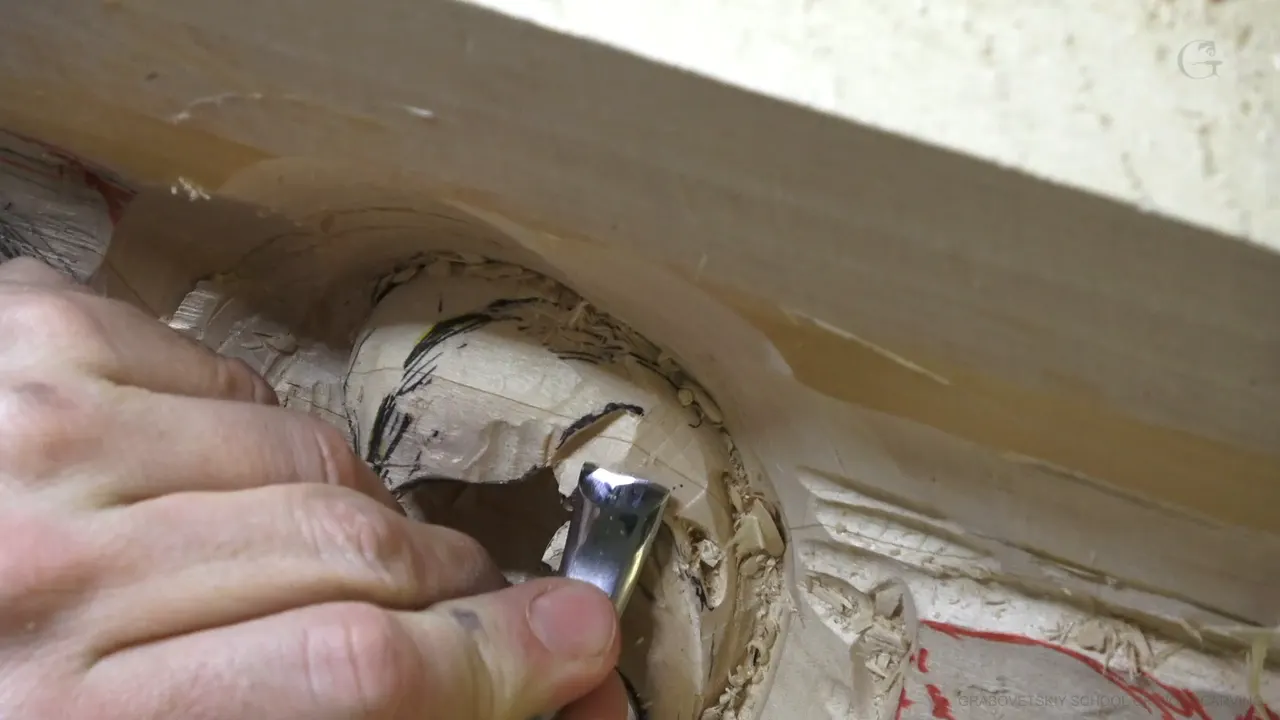

In Venice Room 59, part 11, I told you that you need not agree, and the same words appear in other lessons of mine. This page reads that part of my wood carving course in order. Then it visits the other lessons, with my own lines from the same stretch of the video.
What did I not like about the shadow in part 11?
In this video I said "I don't worry about this ridge, what I just created." Then "Now I can take a back bend, and hopefully I'll be able to use my back bend and blend it really nicely." And "it does the job."
"I still don't like how sharp this area looks." On the shadow, I said "The shadow is too straight, and I have no idea why is that, because I do have a curved cut, but it casts a wrong shadow."

I named a tool as a maybe: "Maybe number seven I should use." The size was "Number seven and 14 millimeters I'll try first and just get a little more pronounced arc." Fourteen millimeters is close to 0.55 in. And on the light: "But it could be just my light also."
"But on the other hand, I think it actually looks better." Some lines on, "It looks much better." Later, "I don't like straight shadow, but it is what it is."
Was there an extra division to carve?
"I have to think about how I can create extra division right here, because looks like I need to." Then "Maybe I shouldn't even mark." And "Let me clean it first, and then I'll decide what to do with that."

"Maybe there is going to be a division, and that is going to be a part of this movement. Or maybe I should get rid of altogether this chunk." "But I kind of like that returning effect." One more idea: "I could actually get another separation right here in this area, and I need to do exactly the same on the opposite side."
Right after: "That way, I can excavate underneath, and it's going to give me a really beautiful, unified look."
Which tool went with the relief cuts?
The tool was number 11: "Number 11, of course, and create the relief cuts." "Relief cut number one, and relief cut number two." In that stretch I said "I still don't like this chunk."
"You know what I mean? It just doesn't look organic, okay?" Then came "It doesn't flow together, I should say," and then "Okay. This part goes underneath, and that flips this way."
Where are the words in part 11?
The words sit in this stretch: "And let me use number seven to create this cut." "And same number seven on the opposite direction this way." Then "But got to be careful how I do it."

"So now it looks somewhat nice." "Somewhat nice." Then came "And you don't have to agree with me, by the way. I think it looks nice."
What did I say about depth after that?
"Go in." "And go in even deeper." "And deeper." After that, "But not too deep, because I still have to clean from opposite direction." "Again, you don't see most of what I'm doing underneath." Also "I don't want to change the position of the camera. I really don't." And "all it is just a cleanup job," with "Nothing special."
"But now I'm going to excavate underneath of here because I'm able to now, and because of the grain, I got to be careful how I attack it." Then "I'm going to use the technique with the number nine." Then "Preliminary cuts around. Just going to relieve that first."

After those cuts: "It removed most of the material I don't need. And now I can clean it, and I can develop the part which is supposed to be part of this leaf easily." Next, "I should probably take number 11. And 5 millimeters, 3/16 of an inch." And "go upward because in this case, it's the only way I can go."
Is there a look in the other parts of workshop 59?
In workshop 59, part 12, I said "not bad at all. Okay. Hopefully you like it too, like I do." Part 10 has "That would look much better. In my opinion, of course."

Which other lessons have the same words?
The first Venice Room course has it in lesson 7, part 8: "It looks much better than what it was looking before. Again, that is at least my opinion, okay?" Next, agreeing with me was not a must, and "you'll see how it looks in the overall design."

In Venice Room 34, part 6: "It's not bad at all." Should you not go along with me, that is fine too: "I am okay with that." Later in part 6: "I think I've got too many lines and that would be a mistake to keep. I'll just chop around that."

Next is workshop 42, part 6: "Then, so far, I think it looks good." I added that it is fine if you see it another way. The size: "And now let me use 1.5 millimeters, and I can get actually even deeper. Number 11, of course." That is near 0.06 in.

Over in this lesson, workshop 46, part 10: "Really beautiful development. And yes, I guess that is my opinion." I told you agreeing was optional, and "But I like it, personally." Then "Just a little bit of cleaning." And "I need to roll it this way a little bit, okay? To that middle ridge."

Do I ever ask you to go along?
Comments are what workshop 53 asks for in part 12. "Beautiful development. I love it. Look at the overall picture, how it just flows nicely." Then "Hopefully, you agree," and I was okay if you do not. After it: "if you agree that that piece is going to look good, please comment. Comment, comment, comment. Really important for me to know your opinion, okay?" The tool was "number 11 and 4 millimeters veiner" (roughly 0.16 in).
The next case is workshop 71, part 10, where I said "I'm not quite like this line. That doesn't feel natural for me. Okay? It does not. It's just a little too straight in my opinion." Then "I think it's going to look much better this way. And you should agree with me." Also "See, that was a good thing that I did not dig too deep from the beginning because I'm changing my mind on the go."

Another Venice Room lesson, 87, says in part 11 "So we are trying to fake the eye and make it look much deeper than that area really is." For anyone who does not agree, I said "think about this part, which we're going to work little later, wrapping all the way from this point and going all the way backward."

A livestream from April 2020 is on this livestream page, where I said "level number two, people who are working with wood would be, I would call finish carpenters." You should agree there, I said, and then "A finish carpenter is taking little different level. It's not like better or worse."
How does the Furniture Panel course put it?
In the design course for the Furniture Panel, lesson 11, part 2: "I think it's good. That's in my opinion." Some of you may not go along with me, and I said "But it's okay. I'll survive."
Panel lesson 13, part 4, has "Okay. It does look good to me." If you disagree, I said I was okay with it: "But that is my design, my approach. Put some shades."
The carving stage has it too, in lesson 18, part 3: "That's detail inside of detail. In my opinion, it looks awesome." Agreeing was not needed, I said, and it looks awesome to me. Then "All it takes right now, just to clean up."
In lesson 20, part 3, I said "it happens a lot, actually, when I have to look at my work and make the decision if it looks good or if it doesn't look good." I said that once you see it, you will probably agree, and "a really nice flow, I should say." Also "I know it looks a little messy right now, but it's okay."

Is it only about how a shape looks?
Hashemi Flowers 30, part 4, is in this lesson. "I am leaving all my tool marks right on the piece, because depends how you look at it. It creates beautiful shadows." And "every facet, every tool mark makes a beautiful look. At least in my opinion." Agreeing was not needed, I said, and then "I don't like to use a sandpaper. It just doesn't look the same." And "if you want to use a sandpaper, it's okay with me, 100% okay. So it's up to you."

In Hashemi Flowers 7, part 3, I said "the reason why I'm doing that, it's just for the light's sake. I know some of you probably would say it's maybe overkill," and I said I probably must agree with you, "but for me to make that as overkill makes sense." Before those lines: "let me take small number nine, maybe about 10 millimeters" (0.4 in). After them: "Let me take a bigger number eight, maybe 20 millimeters, three-quarter of an inch."
Carving Hazelnuts is another course, and in lesson 7, part 2, I said "I like how it blends together." And "I know it looks messy, but it depends how you look at it, because if you see the final result in your head," then you will agree.

What about a skill?
Corinthian Acanthus Leaf 5, part 2: "Undercutting is actually, I would say, it's one of the most difficult skills." Clean undercutting, I said, gives you "a whole lot of skill and abilities to work on deeper levels," if you learn it. And "that's actually one of the most important skills." Somebody may disagree, I said, and that was fine with me.

In part 1 of Roman Acanthus 16, in this lesson: "So that is what we after, just like a concave on inside. I personally think it just look awesome. I think it just looks really, really, really nice." I hoped you agree. Next: "this cut is only about 16th of an inch deep" (1.6 millimeters), "and that means we have to really, really hold our gouge really stably."

My apron course, workshop 8, has "let's say you make a form in a clay and then use it as a pattern, you can just establish the form." Then "Especially traditional carving." I was not sure you would agree, and you did not necessarily have to, I said. After that: "Let's say if you are a fine artist and you paint with oils and, well, if you modern artist, you paint with acrylics, just still you can do really beautiful art."
Which lesson goes with which look?
Each row names its lesson and part, and the course it comes from.
| Lesson, part and what I was looking at or planning | A short line of mine near the words |
|---|---|
| Venice Room 59, part 11: a shadow too straight, and a number seven at 14 millimeters (0.55 in) that I planned to try | "So now it looks somewhat nice." |
| In the first Venice course, 7.8, a spot that looked much better than before | "at least my opinion" |
| Workshop 34, part 6, Venice Room: too many lines, and a plan to chop around them | "I am okay with that." |
| Workshop 42, part 6, in the Venice Room: a look, then a 1.5 millimeter (near 0.06 in) number 11 named as a plan | "so far" |
| Lesson 46, part 10, in the Venice Room: cleaning, plus a roll toward the middle ridge that I said I needed | "But I like it, personally." |
| From Venice Room 53, part 12: a veiner at 4 millimeters (roughly 0.16 in), number 11 | "please comment." |
| Lesson 71, part 10, Venice Room: a line that was a little too straight | "doesn't feel natural for me" |
| Venice Room 87, part 11: a shape that wraps around four sides | "think about this part" |
| Design course for the Furniture Panel, lesson 11, part 2: something I could make a little bigger | "I'll survive." |
| Furniture Panel design lesson 13, part 4: a flower to make a little bigger, to hide a detail underneath | "my design, my approach" |
| Carving stage, lesson 18, part 3, Furniture Panel: detail inside of detail, then cleanup | "awesome" |
| Panel lesson 20, part 3: my work, with a choice to recut a little deeper, or to outline first and clean | "a really nice flow" |
| Hashemi 30, part 4: tool marks left on the piece | "it's up to you" |
| Hashemi Flowers 7, part 3: a small number nine, maybe 10 millimeters (0.4 in) | "for the light's sake" |
| Carving Hazelnuts, the seventh lesson, part 2: a piece that looked messy | "the final result in your head" |
| Roman Acanthus 16, part 1: a concave on the inside, with a cut about 16th of an inch deep (1.6 millimeters) | "really, really, really nice" |
| Corinthian Acanthus, lesson 5, part 2: undercutting | "clean undercutting" |
| The apron course, workshop 8: a form made in clay and used as a pattern | "Especially traditional carving." |
Each course has a page of its own, starting with the Venice Room: workshops 50 to 61, the first set, 26 to 37, 38 to 49, 62 to 73 and 86 to 97. The rest: the Furniture Panel, its design course, Hashemi Flowers, Hazelnuts, Roman Acanthus, Corinthian Acanthus, the Dining Table Apron and the livestreams.
Start here to watch hand tools at work on wood, in relief and in carving, with a chisel, a knife and a mallet in view.
How it's done
- Say what looks wrong with the shadow. "The shadow is too straight."
- Look again. "But on the other hand, I think it actually looks better."
- Allow for the light. "But it could be just my light also."
- Mind the depth. "But not too deep."
Frequently asked questions
Which line sits beside the words in part 11?
"Somewhat nice."
How did I talk about my light?
"It depends how I cast that light."
What about the ridge?
"I don't worry about this ridge, what I just created."
Did I want to move the camera?
What to carve next
- Venice Room workshop 59
- Venice Room workshops 50 to 61
- Venice Room 7
- Venice Room Part 1 course
- Venice Room 34
- Venice Room workshops 26 to 37
- Venice Room 42
- Venice Room workshops 38 to 49
- Venice Room 46
- Venice Room 53
- Venice Room 71
- Venice Room workshops 62 to 73
- Venice Room 87
- Venice Room workshops 86 to 97
- Livestream April 2020
- Livestream events
- Carving Furniture Panel 11
- Carving Furniture Panel 13