

Alexander Grabovetskiy, woodcarver, School of Woodcarving · Published 2020
What does a wood carver mean by "chip by chip"?
Quick answer: I said those words in part 9 of Venice Room 59, about a half rotation: a cut to one side, then a switch to the opposite direction. My plan for it was number nine, 13 millimeters (0.51 in). Other lessons carry the same words, each with a tool of its own.
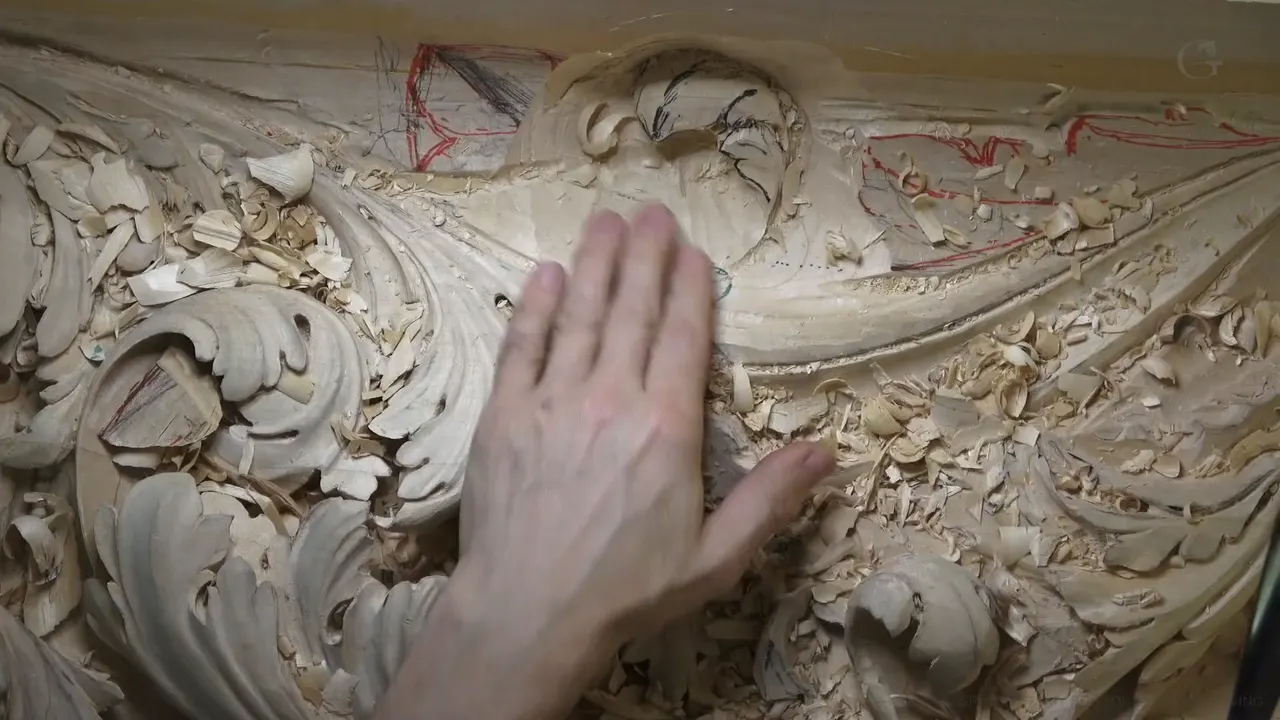

"Without taking too much in one cut." I said it in Venice Room 59, part 9, during a dig I called a "rotation cut, like excavating deep." This page follows those words through part 9 of my wood carving course, then to other lessons where I said the same thing, with the tool I named each time.
What was I after before the half turn in part 9?
Part 9 opens with "I am really after that shadow." My next words were "I don't think I'm able to excavate more of it this way." Then, "too much stress on my blade, on the gouge." The plan that followed was "So I need to turn to number 11 in a spoon gouge."
I asked "Which one I should use?" and said "Probably should use 10 millimeters and go uphill cut, just like that." Ten millimeters is about 0.4 in. With that "probably" in it, the size stays a plan.
How did the half rotation go from one side to the other?
Here is the dig as I described it: "what I'm doing, I'm actually going in and make my rotation cut, like excavating deep." After it came this line: "But I got to feel how much stress I'm creating on the tool."

The turn to the other side is in these words: "I'm going to rotate to the right now, okay? To the opposite direction."
The tool followed. "I'm using number 11, but number nine will work also." And "Let me do it number nine, let's say, and 13 millimeters, half an inch." For number nine I said "this operation like I'm doing right now."
I gave a "because" for number nine: "because when you go in, you doing a full rotation. Not full rotation, half rotation, I'm sorry." Then: "Like this to the one side, little by little, chip by chip, without taking too much in one cut."

The words after that cover the other side. "And then you just change the side or angle from which you attack, and go that direction, opposite direction." Then "Even if you don't see it, but it's clean and nice."
Next: "Now I going to help with my finger, with my thumb." An apology, "Sorry that you don't see, but you can see the shadow it casts." Also: "It really should give you an idea that development is becoming more and more beautiful."

What did I say about one side of the shape?
"I'm not too happy about this side. I would like to see a lot more pronounced concave." Then "going this direction," and later, "that's more or less what I want to see as far as the concave." On the drawn lines: "yes, I can always recreate my divisions. I have no problem with that."
Short lines followed. "And let me relieve that area." "That is good." And "now I can probably excavate much deeper in this area, too, and connect with my main undercut."

Why did I watch for tool marks inside the shape?
"I can probably excavate much deeper" came with a limit: "I don't want to see too many tool marks on inside because it's going to be visible from the floor up."
A size came with number nine. "Number nine and a quarter inch, that's what I'm using. Six millimeters." Then, "And I can go even deeper now." And, "Okay, good."

Near the end of part 9, a tool is still a plan, number five at "about 5/8 of an inch, about 16 millimeters." Then a second thought: "Actually, you know what? I could use number six. Number six will give me much better cut. Also about 5/8 of an inch." The part ends with "create a better shape right here."
Where was the work heading?
Earlier in the same part: "I think it's a good development." And "another shell going from underneath," in my words, and "that's going to interweave together." Also "I told you it's going to be something unique."

A request came next: "please, do not get frustrated if you are not able to carve something like that. Just try small section, just try." About the school I said "my goal of this school, just to show it to you." Also "it's up to you if you want to do it or not, or if you just want to watch."
Which limits sit in parts 8 and 10?
In part 8 I said "almost impossible to get really clean, continuous cut from all the way right here and go right there for now." Then "So I need to switch little bit angle how I cut that and excavate little by little from another angle."
In part 10 the limit is in inches: "Can't go too deep because I've got only two inches. Right? And I'm already one inch in, and I still have to carve other details." So the figures are two inches (about 51 mm) and one inch (about 25 mm) in.
What went with the words in part 12 of workshop 58?
Venice Room 58, part 12, opens with the grain: "The grain of the wood." Next, "I don't think I'll be able to use a straight tool from this side." And "Maybe some of it. To a certain degree I'm able to."

Next, "at least I can remove some of that with the number seven." Then "create consistent movement. And gradual movement all the way up." After that came the words from part 9, with "Again, it's kind of" in front.
The next tool was a plan. "let me probably use, I think number five maybe now." Then a bigger one, also a plan: "let me use a bigger number five". The reason is in my words: "that way I'm going to eliminate the lots of carving marks, tool marks, facets." And "Just gives me really long, consistent cut."

I put the order of the work this way: "pretty much the idea is you start from small cuts with the smaller tools, and then you use a bigger tool to blend everything." Also, "with the bigger tool, you're able to actually eliminate absolutely almost all of those tool marks. That you even don't need to use any sandpaper or anything."
Later in part 12, with "spoon number five," I said "just to hit the high spots and get closer to the line." Then "It is becoming a molding." On number six: "maybe number six is not going to work everywhere, but some spots it will." The surface, I said, "creates really beautiful and smooth surface."
What went with them in the fourth part of workshop 86?
Over in Venice Room 86, part 4, I said "Again, I have to be careful and change the position." Then "I'm using, by the way, just number seven."

I gave a reason: "if you would ask me why I'm using number seven, in this case, I can't overdo it, and number seven gives me just enough ability to manipulate the shape,"
That tool, in my words, is "one of the favorite tools, actually, when I'm working with figure, if you want to carve a face of a human." Also, "you can actually change the shape quickly enough, but without removing too much at once." For the time: "It took me a couple of minutes, pretty much, to do the shape."
Further on, "it has to be concave also." And "later on, I'll work on this intersection," which would be "like a miter point from two sides."
After that, "this part is actually true architectural part." For anyone interested in architectural carving, I said "that's pretty much the way it's done." "Back then, they did a lot of twisted moldings, crown moldings, cornices, if you wish to call that way."
And in the Greek Acroterion course?
In Carving Greek Acroterion 5, part 6, I said "clean it to make that flat side to side." Then "I need to get my cut a little deeper on this side."

Without that tool, "any flat, small chisel will do." I named "Number one double bevel, and this one is a single bevel." A question follows: "you must have some small other tools, otherwise, how else would you do that?"
"And just taking my time to make sure I'm not making any mistakes." The part 9 words follow, "Just" in front.

Then "It looks like this side is pretty much done." What it needed was "just a little cleaning those facets, high ridges, or chisel marks, whatever you call them." Next, "I will do exactly the same thing on the other side."
And in the vase course?
Carving Vase with grape leaves 2, part 2, has this: I said "I can use just one of the sides or wings, if you wish, of the tool and create really beautiful cut." Then, "So now I could continue with the number 7 and 14 millimeters and clean it just like that" (about 0.55 in), and the part 9 words come next.

A correction came next. "I'm using only edge, pretty much only edge of the tool, only one side. No, I shouldn't say edge." Then "And blend it."
A number 3 is next in my plan, with a couple of ways in: "I could attack with the normal position, like a normal chisel position, or I could just flip it upside down."
Another choice was a size: "I could use a smaller tool. Again, it's number 3, but one-eighth of an inch" (about 3 mm), "and clean it." And another idea: "number 11 and 3 millimeters" (about 0.12 in), "maybe about a 45 degrees position, and clean it without digging too deep."
A warning closed that stretch: "create too deep of a groove, and that's going to create a problem." For the curve, my plan was "just probably number 3," at "about the 10 millimeters, about three-eighths of an inch." Then "carefully, carefully, carefully." And "yes, I am doing across the grain."
Of the tool just named, I said "This tool would be a little too big because I do have that curvature and I don't want to mess this curvature up." So, "I'll take 6 millimeters, same number 3" (about 0.24 in).
Did the Roman and Greek acanthus courses use different words for it?
They did. Over in Carving Roman Acanthus 9, part 5, I said "it's all about digging inside." My plan was "Let me see if I'll be able to use my number 9 and carefully just dig on the inside."

Next, "Just be careful what you're doing with your tools. Just don't press too much." Next, a word for people with few tools: "I know a lot of you have only starter kit, just preliminary tools, just the basic tools." Also "I just want to show to you it's possible to do even without the spoon gouge."
In Carving Greek Acanthus Leaf 11, part 1, I said "I'll take number 3, just about half an inch, about 13 millimeters, I'd say, and just to start digging deeper." Then, "Just try not to take too much at once, because you can make a big mistake if you'll do that."

I added "And I know it's tempting. I'm guilty also. When you're trying to do too fast, too quick, but that's a big mistake." Then: "You can see what happened actually just now. I wasn't too careful." And the plan after it, "Now I need to lower that down a little bit." A plain line follows: "sometimes mistakes do happen."
Which tool sits beside each of my lines?
Here are the seven lessons, with the tool named in each and a line of mine beside it. The first three rows are Venice Room workshops.
| Lesson and part | Tool | A line of mine beside it |
|---|---|---|
| Workshop 59, part 9 | Plan: number nine at 13 millimeters (0.51 in), the size I named for the half rotation | "half rotation" to one side |
| Venice Room 58, part 12 | Number seven | "consistent movement" |
| Part 4 of workshop 86 | The same number seven, a favorite of mine when I carve a face | "just enough ability to manipulate the shape" |
| Acroterion 5, part 6 | Chisel number one, double bevel | "just taking my time to make sure I'm not making any mistakes" |
| Vase with grape leaves 2, part 2 | Spoken as number 7 at 14 millimeters (about 0.55 in) | "only one side" of the tool, plus a correction about the word edge |
| Greek acanthus 11, part 1 | A number 3 near 13 millimeters (1/2 in) | "big mistake" |
| Roman acanthus 9, part 5 | Number 9 in my plan, or a spoon gouge if you have one | "Just don't press too much." |
These videos are in the school: the workshop 59 page, the Venice Room Part 5 course, the Venice Room Part 8 course, the Greek Acanthus course, the Roman Acanthus course, the Greek Acroterion course and the grape leaf vase course. Start here to watch hand tools at work.
How it's done
- Feel the tool. In describing the dig I said "I got to feel how much stress I'm creating on the tool."
- Go to one side. "Like this to the one side," in my words. A half rotation, not a "full rotation."
- Take the other side. A new "angle," then the "opposite direction," in my words.
- Look at the shape. Of one side I said "I would like to see a lot more pronounced concave."
- Weigh another tool. "I could use number six," I said, about a plan with number five.
Frequently asked questions
What did I name for the half rotation in part 9?
Number nine, 13 millimeters (1/2 in), which I put as "Let me do it number nine, let's say."
What should you do after the first side?
Switch sides or switch the angle you attack from, and go in the opposite direction.
Can a cut you cannot see still be clean?
Yes, in my words: "clean and nice," even when you do not see it.
How big was number nine?
What to carve next
- Venice Room workshop 59
- Venice Room Part 5 course
- Venice Room 58
- Venice Room 86
- Venice Room Part 8 course
- Carving Greek Acroterion 5
- Greek Acroterion course
- Carving Vase with grape leaves 2
- Grape leaf vase course
- Carving Roman Acanthus 9
- Roman Acanthus course
- Carving Greek Acanthus Leaf 11
- Greek Acanthus course