

Alexander Grabovetskiy, woodcarver, School of Woodcarving · Published 2020
What does a wood carver mean by shoveling out wood?
Quick answer: Shoveling out is my picture for "that operation" in part 8 of workshop 59, a dig under one shape: "It's exactly what it is." In my plan the tool was a number nine of 20 mm. Other lessons carry the same picture, with number 11 and number three.
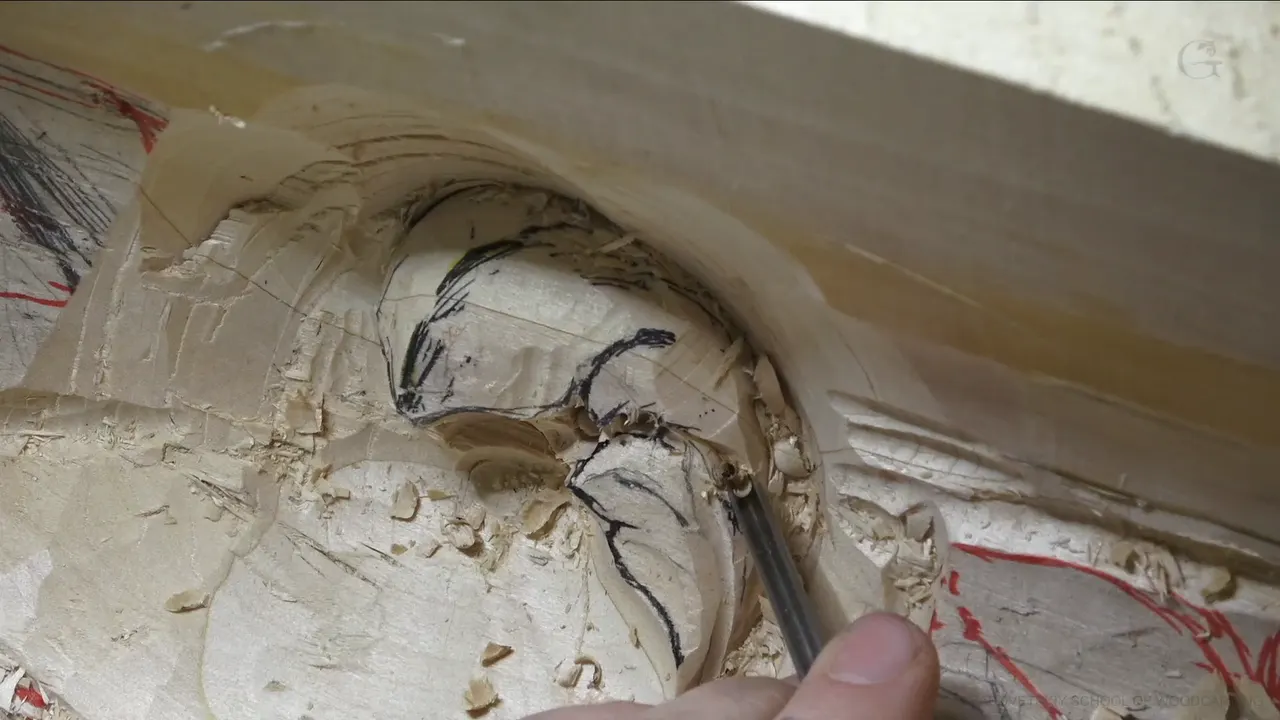

"It's like shoveling out." I said that in Venice Room 59, part 8, about "that operation," a big cut under one shape. This page follows the shovel through part 8, then through other lessons, with the tool sizes I named each time.
The words land at 6:18, soon after my warning about stress on the blade. Right behind them came "shovel out stuff, okay?" The cut, I said, would give "a beautiful shadow." Then I asked a question, "See how it's already developing that shadow?" And my word for it was "gorgeous."
How big an eye did I plan at the start of part 8?
At 0:22 I said a bigger eye was "also going to work." The size was another matter, "also a question," and my answer was "I'll use 3 millimeters" and "Number 11, of course" (about 0.12 in).
Part 7 ends on a plan of mine. I had made a mistake there, and my words were "Now I have to fix it somehow or create bigger eye. Maybe I'll just do a bigger eye."
How did I describe the grain at that spot?
I called it "just the location, just how the grain works in this location." The spot was "not the best location," in my words, and "Not the friendliest, I should say." Still, "it's still possible to do some really good stuff." I put the fix twice: "I just have to be more careful. Just got to be a little more careful."
Which small tools came before the big one?

The plan was to "use probably 1.5 millimeter and excavate little by little." Two systems came in one breath: "1/16 of an inch or a mil and a half. 1.5 millimeters." The tool was a number 11.

Cleanup waited: I would "attack that little later, and then make it absolutely clean and nice." I might go to micro tools too: "if I need to, I'll switch to micro tools. And sometimes it's super handy to have those micro tools." A "0.5 millimeter micro tool" (about 0.02 in) was the size I gave. I stopped with "That's enough for now" because, in my words, "it's possible to make mistake." Do I want to make one? "Of course not."
How did I start undercutting in part 8?

My plan was to start undercutting underneath, and "let's finalize it," so I could develop the rest after. The tool in my plan was "number 11, 4 millimeters right now," to "see if I'll be able to get little by little inside" (about 0.16 in).
Then came a limit. A "really clean, continuous cut" from "all the way right here" to "right there" was, for me, "almost impossible." The move was to "switch little bit angle" and come at it from another angle.

"Now I can try to connect those cuts," I said. I asked for "the relief cut where is the separation." My next move was underneath: "I don't think I'm going to move anymore toward that direction."

One more line from that stretch is about noise. Sorry for the squeaking, I said, because I was pushing against my workbench, and the bench gave me that sound.
Which word did I use for that operation?

I could "just start excavating underneath of here, which, unfortunately, you don't see." A number nine at 20 millimeters was named for a "big cut if I need to," and then I said "yes, I need to." Twenty millimeters is 0.8 in. A short order followed: "Go like that."

When I spoke again, it was about "that operation," and I called it "really interesting." The line itself: "It's like shoveling out. It's exactly what it is." That, in my words, was "going to give a beautiful" shadow, and "moving like that, flips, and opposite direction."
What did the warning about the blade say?
The warning was "if you're going to do that operation, feel your tool if it's too much stress on the blade." And the fix, short: "make a little less pressure."
Feel the gouge for that stress. The warning came after my plan for the 20 mm tool, and before I called the move a shovel.
Why did I want more roundness inside the shape?

"Now I can probably use the same tool and get little more roundness on inside of here," I said, because I did not want to see "this area too flat." My aim: "I'm really after that shadow effect." The last note in part 8 was "Blend little bit this way."
How does part 9 follow the shoveling?
In part 9, at 0:07, "I am really after that shadow." A limit on the big tool followed. I did not think I was able to excavate more of it that way, since it would be "too much stress on my blade, on the gouge," and the next tool had to be "number 11 in a spoon gouge."
Of the spoon gouge I said "Probably should use 10 millimeters and go uphill cut" (about 0.4 in). What I was doing, I called a "rotation cut, like excavating deep," with a note to feel "how much stress I'm creating on the tool."
For the next move I said number nine would work too, at 13 millimeters, or half an inch. My words for it were "half rotation," then "chip by chip, without taking too much in one cut."
Where else did I say shovel in Venice Room 64?

Venice Room 64, part 3, has a plan first: "I will switch to spoon number 11." Seven millimeters was my try, and I gave a reason for seven, "extra marks with a smaller tool" to avoid, and "I can lay on a previous cut pretty much and match my cut." Then, "Two millimeters, four millimeters, maybe. Maybe four millimeters. Let's see if it's going to work out."
The dig itself comes at 3:30: "And go all the way to the hole. And get all that junk dug out like a shovel, almost." Next came the light. "The light source is going to come from above," I said, and it would "hit inside." In another line, "that is going to cast shadow. So that shadow is important for me."
Sizes came after. "Seven millimeters is a little too big now because I can't get underneath of here," I said, and "with this four millimeters, little bigger than eighth of an inch, I'm able to." That works out to 0.28 in. Even the four, I said, would be "a little too big for me to get inside."
Inside, in my words, "it's already deep shadow. Deep and everything is clean."

In part 4 of that workshop, at 0:53, I took "two millimeters again, number 11 veiner," to "dig out whatever I just created." That was "just mess I just created." I added "maybe just shovel out a little bit, blend in inside, even if you don't see it." Two millimeters is near 0.08 in.
Later a tool "works much better for me," and I said "Even if I have to carve toward myself, it is still okay." "I can excavate a little deeper," I said, though I did not "have to go too deep, again, for the reason I just said multiple times."
Near the end I said "let me excavate the eye," with "number 11" at "one 16th of an inch, 1.5 millimeters," the same size I named in part 8 of workshop 59. The dig: "I'm going to go that direction and attack that from the opposite direction also, just like that. But I can actually excavate, like shovel it out, okay? Start in, then move it slightly that way."
Does workshop 60 say shovel?

Yes: in Venice Room 60, part 7, number five "works just fine," I said. Next, "angle it a little in right away." That gives "preliminary undercut." Later in that stretch: "there's going to be a development going from underneath. It's going to be a shell work. That's why I don't take too much of the material in the middle yet."
I also said "I have to get deeper, so I'm safe to take a little more material." One warning sat beside it: "if you get too deep of a cut, you're going to damage background, and you don't want to do that unless if it's on purpose."
The shovel line comes at 7:46, after "let me take out some of that stuff." A number 11 and "the seven millimeters" were the tool, a little bigger than a quarter inch. "Some of that stuff out has to be gone." Then "just dig out," and last, "Well, it is sort of a shovel."
What did workshop 37 call it?

The start of Venice Room 37, part 11, is "Now we can develop a convex." Near 1:20 I said I was "not afraid of losing the sides," since "I can always dig deeper." "Just a straight number 11 right here" was my tool for one stretch, and "I can see my convex coming alive," I said.
The words come at 6:50: "I feel like I'm working with a shovel almost. Just digging toward myself." A glue line showed up next, and I said "I've got to another level." With that, I could "attack it with the number 11."
Which tools sit around the shovel line in Venice Room 28?

In Venice Room 28, part 12, "I need to get a long bent or medium bent number 11 because kind of hard to get in." And "maybe a little heavier mallet." Twelve ounces was "not going to fly." It would, I said, "but I can get tired a lot quicker," so I needed 30 ounces to "let the mallet do the work." That is near 340 g for 12 ounces and 850 g for 30.
For the beginning I needed probably number three, I said, and "I still don't want to lose this detail right here." "At least I can knock little bit this inside and go inward," I said. It felt "almost like I'm using shovel. Huge tools."

After that, "Number seven or eight," and "Anything will work." One of them, in my words, was too dull, "Or maybe not little, maybe it's really dull." I took one I had sharpened. "Yep, it's much nicer," I said, and "Now it just cuts and gives me really nice and clean result."
On dull tools I said a lot of people make that mistake, when "the tool is dull and they still continue to carve with that." And "it just takes one minute and you can carve again without the struggle."
Clean excavation came next, "Beautiful and deep," and I said it was "going to give me beautiful shadow." Then "Nice movement," and I said it would be "really visible from the bottom."
Did I use the word in a livestream too?
In the Livestream April 2020 lesson, in the April 8, 2020 video, the question was "Should I take two-week course, or one will do?" My answer began "it's easy to teach, take a gouge or whatever, the carvers shovel, how we say, and dig inside of the wood."
I went on to say "Wood carving actually adds a lot more than digging." Wood carving, in my words, is the "ability to think in three-dimensional world" and "to see what two-dimensional people don't see." The part I called easy to teach was the digging, and wood carving was the larger thing.
How does a shovel fit a huge tool?
In my Maine Coast sharpening class, the huge-tools video has "what about three inches tool when I said I have some of them really big and huge, like a shovel almost." I asked how to use the same machine and the same approach. Then came "By hand?" and "just the true shovel." The jig answer was "You just use a bigger jig."
The limit on size was my own: "three inches fits perfectly. Three and one-eighth fits perfectly," and "usually there's no bigger tool than three inches, I mean three and one-eighths." That is near 79 mm, or 3.125 inches. I also said why there is no bigger tool: "you have to be a big tractor to push it if it's bigger."
Related: my sharpening a large gouge lesson sits in the same Carving Tool Sharpening course.
Why do my sizes carry an about?
My remark on tool sizes sits in workshop 64 too, starting from "maybe 10 millimeters." Then, "Whatever they mean by 10 millimeters, they're saying it's 10 millimeters tool, but in reality, it's bigger. It's almost 12 millimeters or so, closer into the half an inch."
I went on to say "most professional level tool makers, they don't even mark size. Okay? It's always just approximate."
Which sizes sit in the table below?
Eight lessons, with the shovel line as I said it and the tool beside it.
| Lesson and part | What I said, word for word | Size or tool |
|---|---|---|
| Venice Room 59, part 8 | "shoveling out" | Number nine, 20 mm (about 0.8 in), in my plan |
| Workshop 64, part 3 | "a shovel, almost" | "Maybe four millimeters" (about 0.16 in), as a plan |
| Part 4 of workshop 64 | "shovel it out" | Number 11, one 16th of an inch, or 1.5 mm |
| Lesson 60, part 7 | "sort of a shovel" | Number 11, 7 mm (about 0.28 in) |
| Workshop 37, part 11 | "I feel like I'm working with a shovel almost" | A straight number 11 |
| Venice 28, part 12 | "It feels almost like I'm using shovel" | Number three, in my plan, "for the beginning" |
| Maine sharpening class | "the true shovel" | Tools up to 3 1/8 in wide (79 mm) |
| Livestream lesson | "the carvers shovel" | A gouge, or "whatever," to dig inside the wood |
All of these videos live in the school: the Venice Room workshop 59 page, the Part 5 course, the Part 3 course and the Part 6 course of the Venice Room, plus the livestream events. Start here to watch the hand tools at work.
How it's done
- Plan the big tool. Part 8 named number nine at 20 millimeters (0.79 in) for a big cut, as a plan.
- Feel the blade. Feel your tool while you dig, I asked in part 8.
- Ease the pressure. Strain on the blade is the sign, I said, to press a little less.
- Look at the shadow. After my shoveling picture I asked whether you could see how the shadow was already developing.
- Watch for roundness. Part 8 has "little more roundness on inside of here."
Frequently asked questions
Which tool did I say I could use for the big cut in part 8?
Number nine, 20 millimeters (0.79 in). I said I could use it, and then I said "yes, I need to." The cut was one you do not see.
What should you feel for while you are digging a big cut?
The strain on the blade, I said. When it is too much, ease off with a little less pressure.
Which small sizes did I name in part 8?
Three millimeters came first, then a number 11 of 1/16 of an inch, and a 0.5 millimeter micro tool. A 4 millimeter number 11 was named for going underneath.
How big was the biggest tool I mentioned?
What to carve next