

Alexander Grabovetskiy, woodcarver, School of Woodcarving · Published 2020
What does a wood carver mean by "rough carpentry"?
Quick answer: In workshop 59, part 12, I called the shape rough and compared it to a house while it is being framed: it looks like a house before it is finished. Venice Room 68 has "don't finish until you frame it," and other lessons have roughing in and roughing out.
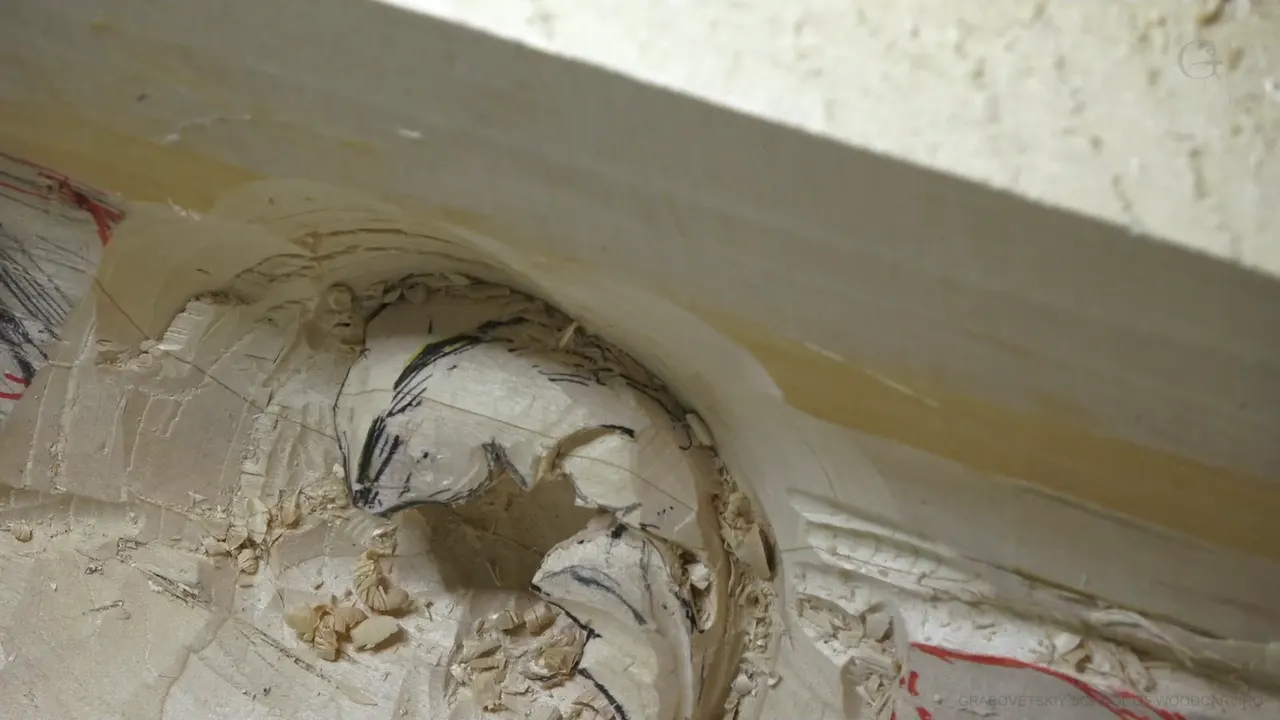

My words in part 12 of workshop 59: "It's not a finished house yet, okay? Same idea right here. So you see the main frame." Other lessons of mine have lines on the same theme. This page sets them beside it, each with a link to its lesson.
Have you ever stopped a carving because it still looked rough? Would it help to hear how I talk about that stage in other lessons of wood carving? Start with the part itself.
What was I carving when I said it?

"Now I'll take number six and finish up this movement," I said in part 12. Then: "I feel resistance somehow, so I've got to do it more careful."
"I can undercut even more," I said. Then: "But I still have to make sure it's strong enough, so I do not make it too weak." On the movement: "it just gives me really nice flipping motion."

"I've got so much to clean up because I used the marker," I said. Then a back bend: "This is number five I'm using, back bend." The plan was "maybe attack from both sides and see," and "I have to make slicing cuts."

A note on the view: "I apologize if you can't see, I'm covering with my hands." Then "Okay. That is good. Although, of course, it's not the final look yet."
How did I cut the small concaves beside the middle line?

The plan: a pencil "right now," and concaves "on the sides of that middle line." The tool: "Let me use number 11 and 4 millimeters and try to be as accurate as possible." Four mm is 0.16 in.

They would be "small, but still readable by human eye." And: "There is a couple of ridges I created, and that's going to cast some shadow, and you are able to see it."

A deeper cut: "Let me get a little deeper cut right here." About the tool: "Although this tool is a little too big." A smaller tool, I said, would come "a little later" to "finalize some stuff like this." And: "What I mean by small tools, like seeing those intersections." And: "I really want to make it a little longer concave between," and "That way it's going to look more finished, I would say."
How did I describe the rough shape?

"Although it's not that finished look and all, because I still have to work around, and I don't want to make it too fragile yet."

Then: "So it's just a rough shape, like rough carpentry when you're framing a house. When you're framing a house, it looks like a house, but it's not a finished house yet, okay? Same idea right here."
A possible tool: "some of my new addition, my riffles or rasps, and try to figure out if my overall shape is good or not." And: "Get rid of some of the marks, that way."

"Anyway, like I said, it's not the final form. I can always hit that again with the gouge and see if I'm going to like it or not." The rasps have a limit: "not everywhere I'm able to use it because, again, I'm limited with the ceiling and also other parts."
What did I say about the next movement?

Then an overall picture: "I think it looks good, not bad at all." And "Hopefully you like it too, like I do."

For the next step: "I need to develop the next movements," with one "somewhere sticking from underneath." A middle line would be "underneath right there."

"I need to determine the middle line of this movement I just worked on." On dividing: "take this point and that point and divide it by 10, that's supposed to fall on six parts out of 10." Then "this is going to be my six and that is going to be my four parts."
What do parts 10 and 11 say about the same stage?

Workshop 59, part 10, has "Can't go too deep because I've got only two inches." Then "already one inch in," with other details left to carve. Two inches is 50.8 mm, and one inch is 25.4 mm.
Number nine and 3 millimeters, one-eighth of an inch, is the tool I named there. "I don't want to create extra tool marks on inside that later on I have to deal with," I said. Three mm is 0.12 in. And: "I'm sorry that you can't see what is going on inside."
On the mess: "But all I'm doing is just getting rid of the mess." Then, in part 11, "I don't worry about this ridge, what I just created," and "all it is just a cleanup job." One more note there: "Let me clean it first, and then I'll decide what to do with that." For number 11 at "5 millimeters, 3/16 of an inch" (0.20 in and 4.8 mm), the plan was to "just remove all that mess I just created by number nine."
Which lessons call this stage a frame?

In part 6 of Venice Room 68 I said "I just damaged a little bit this piece. That's why I'm not finishing completely until I've done with all the roughing in, like rough carving, like rough carpentry. So don't finish until you frame it." Also "you got to frame that first and then finish everything." And: "I'm happy with the overall feel of it. Which means the middle part is kind of raised, and then it goes both directions."
Over in Lily Box 10, part 4, I said "I know it looks really rough, but that is exactly what it is. It's a rough stage, roughing out stage. Like a framing. So if we are framing the main movements, there's no reason for me to pay attention to the final details." Then "Okay, now I need to remove all that."
Modern Acanthus 1, part 3, gives "Okay rough carpentry." And: "So pretty much what we're trying to do we want to establish 3D movement overall movement without the details yet." Elsewhere in that part: "Do not go all the way. Like I said, we're going to keep an inch and a half on this side." An inch and a half is 38.1 mm.
Do other lessons compare carving to a house?

Grape Onlay 2, part 3, has "Concentrating too much on detailing. It's too early. So I compare that as, uh, you would build a house, you concentrate on a roofing before you put the basement in." Then "You really have to concentrate on overall look like blocking in."
Tray of Blessing 4, part 1, has "Please don't, overcomplicate don't start on details yet, because when you're concentrating on details, you are losing overall picture. It's like, uh, putting the roof on top of the house before the basement, pretty much before the framing." Then "We still working on the framing. Okay? So the basement, we already kinda done so, but it's still framing."
From part 2 of Modern Acanthus lesson 1, about a depth: "It doesn't have to be exactly one inch okay, it's not like you building a house. Not in this case. Sometimes it really important but not in this case." One inch is 25.4 mm.
Venice Room 1 is a lesson in Part 1 of the room. Part 3 has "I cannot make mistake, not even one millimeter," which is about 0.04 in. Then: "The reason why I can't make mistake, so the house, or I should say the framing in the house, in particular room, based pretty much on the design, okay?"
The same tray course has another use of the word, in lesson 6, part 1: "But I think it looks much better now." Then "You can see the shadow, and that's actually, you know, just like a framing for this piece."
Which lessons say rough shape or roughing in?

Lily Box 13, part 1, has "So again, now, I'm going to do a rough shape. And to do rough shape, let's make it a little lower. I need to take approximately maybe a 16th of an inch down to this green line, and I'll use just 1/8 of an inch number eight gouge." In millimeters, a 16th is 1.6 and an eighth is 3.2.
A little further in: "I'm using a knife, and I'm digging inside of this block of wood, but I'm not afraid because that is just what was left over from another project." Then "I'm just giving a rough shape."
From Lily Box 4, part 3: "Even if this stage is roughing out, but still I have to approach it like I'm working on details." Then, in part 5, "We're still roughing out the details. Roughing out, still in a roughing stage."
In Hazelnuts 3, part 2, I said "But that's okay, I'm just roughing in overall motion." Hazelnuts 7, part 2, belongs to the Hazelnuts course: "you can see obviously how beautiful shadow already done." Then "Although we're just roughing in." Then "But I think nothing stops me from starting undercutting. That way, I can see a somewhat finalized look."
On blocking in, Grape Onlay 11, part 3: "All I'm after is just blocking in, roughing in. Even if it doesn't look too good." Also, about details: "Again, don't pay attention to the detail yet. So we didn't put any details yet. We gonna do it little later." From Grape Onlay 2, part 2: "it's all about just the roughing in, uh, overall idea."
In workshop 79, part 3: "It's just the removal of the material." Then "just the roughing out."
In Venice Room 80, part 2, I said "But now I need just a somewhat rough form." And Venice Room 94, part 8, has "And that's it, I mean, as far as rough shape. OK, so that is only a rough shape yet."
Lesson 1 of the room, part 13, says "You can call this stage as roughing in, not just the setting in, because we are roughly trying to get overall design in." Then "Even if it doesn't look too appealing yet, but it's absolutely okay."
On removing a lot of material, in part 9 of that lesson: "I don't like to carve and remove the material along the grain, but in this case, I have to remove a lot of material because it has to be gradual." Then "use a hatchet, if you have a hatchet. I have a beautiful handmade hatchet." It is for "some roughing out," and "just be really careful how you work with that."
The first lesson of the tray course, lesson 1, has "See how quickly I can excavate the material." And: "that stage of wood carving called, uh, roughing out."
Historical work is the subject in Venice Room 58, part 9: "They would create the rough shape, and then they would create some shapes on inside that would distract from smoothness."
Did I talk about finish carpentry in my livestreams?
In my April 2020 livestream I said "I used to build houses. I had multiple crews when people worked for me. Some of the crews did only finish carpentry and so on." In a second livestream from that month: "all the finish carpenters, they are able to cut the two by fours, two by sixes, get the staircase, even figure out the roof. They can frame, finish carpenters."
Where does each of these lines sit?
Each one is set here next to what I was working on. The lessons are named as they are in the school.
| Lesson | What I was working on | My words |
|---|---|---|
| Venice 59.12 | Small concaves along the middle line, with the shape not final yet | A rough shape |
| Venice 68.6 | A spot I had damaged a little, finishing held back | Frame it |
| Modern Acanthus, lesson 1, part 3 | 3D movement, with the details not there yet | Rough carpentry |
| Grape Onlay, lesson 2, part 3 | Detailing too early | Roofing before the basement |
| Tray of Blessing, lesson 4, part 1 | No details yet, the overall picture first | Still framing |
| Lily Box 10.4 | Something that looked really rough, I said | A framing |
| Olives, Lily Box 13, part 1 | A plan to take a 16th of an inch (1.6 mm) down to a green line | Rough shape |
| Part 5, Lily Box 4 | The details, which I was still roughing out at that point | A roughing stage |
| Hazelnuts, lesson 3, part 2 | Overall motion | Roughing in |
| Workshop 79, part 3 of Venice Room | The removal of the material | Roughing out |
| Venice 94.8 | Cuts that went as far as a rough shape | Only a rough shape yet |
Where can you watch these lessons?
The video is workshop 59 of Venice Room 59, inside Venice Room Part 5. Other courses are one click away if you start here, and Grape Onlay is one of them.
How it's done
- Finish the movement. "Now I'll take number six and finish up this movement."
- Be more careful when I feel resistance. "I feel resistance somehow, so I've got to do it more careful."
- Check the strength. "Make sure it's strong enough."
- Create the small concaves beside the middle line. "Create some small concaves, okay?"
- Keep it a rough shape, not too fragile yet. "It's just a rough shape."
- Look at the overall shape. "Try to figure out if my overall shape is good or not."
- Find the next middle line. "Determine the middle line."
- Divide the distance between two points by 10. "Divide it by 10."
Frequently asked questions
Was the shape finished?
The shape got the words "a rough shape" in part 12. I also said "I can always hit that again with the gouge."
Which tool did I name for the concaves?
I named "number 11 and 4 millimeters," which is 0.16 in. They would be "small, but still readable by human eye."
How would I find the next point?
Take two points and the next point is "supposed to fall on six parts out of 10."
How deep could I go?
What to carve next