

Alexander Grabovetskiy, woodcarver, School of Woodcarving · Published 2020
What does a wood carver mean by "interweaving"?
Quick answer: In part 6 of workshop 59, I said a leaf sticking from underneath would go deeper. In Roman lesson 10 I said a leaf passes under another, and in Furniture Panel lesson 4 I said everything in a design has to interweave.
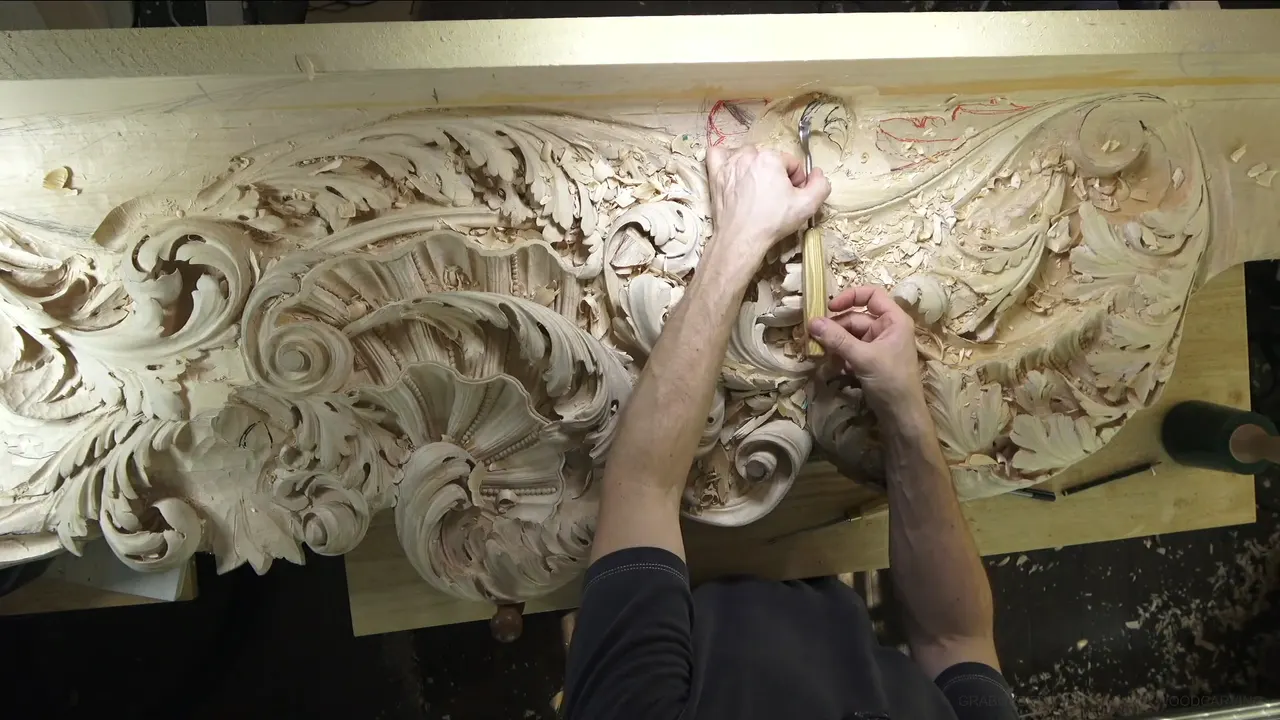

"That's going to be really nice interweaving movement underneath." The line is from Venice Room 59, part 6, about a leaf that sticks out from underneath. This page follows the word through that part, then through my Hashemi, Furniture Panel, Roman acanthus and other lessons, where I use it for leaves, a design and a grid.
What was I working on before I said it?

Part 6 opens on a flip. "See beautiful return." After that: "I want to roll it a little more if I need to." Next, a plan: "Let me chop out whatever I don't need."
I named the gouge too: "any gouge will do, but I got 12 millimeters, number 11." In inches that is 0.47.
Why did I hold the undercut back?
The limit sits in two lines of part 6, the second much shorter than the first. First: "I also don't want to undercut because I still have to create the final shape on this." Then, shorter: "Not yet, at least."

Part 7 of the workshop says it in new words. "I'm not undercutting yet because I still going to develop even to the smaller divisions this section." Right after that line comes this one: "create really beautiful movement on inside."
What did I say right after the line?
A hedge: "I hope so, I should say." The leaf and the shell I named later in the part were both still to come.
Which tools went in beside that leaf?

Number three came next in my plan: "number three and 20 millimeters" (0.79 in). The shape plan was small, "little better shape right here." One more plan sat beside it: "I need to determine if I'm going to show any movement this direction, which I don't think I need."
I called the form "the main shape this way, like a bowl." I also asked you: "Do you see the development, by the way?" And: "You should be able to see it."

Nine is next in the part. "Use 20 millimeters, three-quarter of an inch, and that's number nine." Of the brand I said "Any number nine will work." The pass needed care: "I got to be really careful how I do that." Afterward: "So that is actually good."
Cleanup is the next plan. "Now we're going to get rid of some of that mess because right now it's just distracting." Then: "It doesn't look too appealing to me." A number 11, "maybe about seven millimeters" (0.28 in), was to "get some of it out," and "not too deep because I have a development yet to do, another leaf."
How much wood did I have to spend?

The depth had a limit. "I also have to keep an eye how deep I go right here because there's going to be another shell movement later on." The next line has the figure: "I've got only two inches, and I got to be really wise how deep I go." In millimeters, two inches is 50.8.
A plan for the inside: "Now I can probably work my details on inside." And the next tool: "number nine and a quarter inch" (6.35 millimeters).
What came before the final shape?

Concave, then convex. "I still have to create concave because it also applies everywhere." "There's supposed to be concave going that direction." And my plan for the ridge: "raise this ridge, but concave before I create the final shape right here."

For the concave I named a tool: "take number nine," at "10 millimeters, three-eighth of an inch." In inches, 10 millimeters is 0.39. I said I was "okay just to get concave and also another concave right here on this side." Then: "Concave and concave." After that: "I'm able actually to do convex." And: "So round up."
What had part 5 set up for the concave and convex?
Part 5 has this: "It's supposed to have a concave, convex, concave idea, and I want to stick to it." Later in that part: "So I've got concave, I've got convex, and I've got concave."
Which direction could the tool not take?
"See, I can't do this direction." Then the why: "Even if I'm just using a back bend, it's still already laying, but it's just impossible to go uphill because that transition right here." It ends: "That's why I have to be attacking only from the ceiling side."
Does the word return in workshops 58 and 59?

Part 9 of workshop 59 has it. "really good tying together," I said, and of a shell yet to come, "going from underneath." Then: "That's going to interweave together."

Workshop 58, part 4: "See that movement, it interweaves all together." Then: "This movement goes that direction, that movement goes that direction, this movement opposite direction." A why came with it: "I've done it on purpose because I really want to be authentic to Venice. To be exact, it's a Venetian style, 15th and 16th century."
Later in the same part I say of one spot, "That is like a piece of molding," and add "this is a solid piece, so nothing glued on."
How do I describe one leaf under another?

Roman Acanthus 10, part 3, has the clearest lines on it. The tool first: "Quarter inch, sweep number five" and, further on, "I'll refine those leaves." A quarter inch is 6.35 millimeters.
"I kind of like that movement because it's like it interweaves. This leaf goes underneath of that one and continues on this side, and the same leaf, which is above this one, goes underneath of that section of that leaf." The closing line of that part: "The whole idea of acanthus, it's an interweaving."
Where is the weave in my Hashemi Flowers lessons?

The basket weave is in Hashemi Flowers 5, part 1. "I can actually make this one above, and this is going to go below, just like that." Then: "It's like a basket weave, I would say. I'm pretty sure I can say that." My tool plan: "just the V tool, and I'll take number 16 and 3 millimeters" (0.12 in), and "first of all, I'll just establish my outline."
A reason for the V tool: "just to mark where it's going to go underneath." Then a plan: "later on, I am planning to undercut this, for it's kind of hiding behind this part." A depth: "Approximately maybe eighth of an inch, I would say" (3.2 mm).

Part 2: "we have to undercut later on." Then, of the word "weaving": "for me, it does make sense. It interweaves."

Part 3 sets the order. "That is just preliminary for now. Before we do undercuts and make a final look. So I need to work on my leaves. Okay? I need to establish the forms of the leaves, and then I'm going to undercut this part underneath of the leaves, and then continue to develop my basket or whatever the weaving or grid line, and that is going to make more sense."
A bigger tool is in my plan, "a bigger gouge" for the leaves, with a pick: "probably number seven and one inch" (25.4 mm).
How do I make a grid look woven?

Hashemi Flowers 26 opens on the grid, part 1: "Let me work right now on a grid." The way to do it: "make it look like it's truly interweaving," and "take a V tool and undercut underneath."
The cut has a limit. "Make it a V cut, but not as deep," I said, because "it does have support." From the high point, "no more than 3/16 of an inch, or maybe even less, maybe 3 millimeters." Three-sixteenths of an inch is 4.8 millimeters. Between 3 millimeters and 5 millimeters (0.12 to 0.20 in) is "the highest spot."
The grain gets two lines: "Right now, I am working against the grain, but I don't want to rotate." And: "Some spots, I probably have to use a smaller V tool, but that is an end grain again, so the tool must be really, really sharp." Then: "from the backside, I will have to bring that to that line."

Part 2 returns to the grid. "I know, in reality, I didn't have to do that. It still would look nice, but I want to make it look even better than just nice, okay? Like it's true interweaving. And especially if I do have access from the backside, why not to do that?" A thickness follows: "no more than 3/16 of an inch or even 1/8 of an inch sometimes," which is 4.8 mm and 3.2 mm.
Do I use the word for a design too?

Furniture Panel 4, part 1, begins with a plan: "I'll change that a little bit, that design. I'll refine it." Then: "Just doesn't flow good. The idea is everything has to be just interweave. It has to be organically connected. Okay. And as of now, it is not."
Further on: "And if you will ask me why, like I said before, everything has to interweave, and this has to flow with this side." And: "also still create kind of 90 degrees angle to repeat this corner."

The verb is in a plan in Furniture Panel 10, part 4. "I like it a lot, actually. And maybe this one can actually weave around right from behind." A little later: "Or even this one can go underneath and pick up above and go back underneath again."

In Furniture Panel 14, part 1, another word is there: "intertwined." The lines: "It's a single stem. I'm not sure if I should do double stem or not because I think it's going to look really nice if I would do something intertwined like this." And: "I think it looks nice."

Curly Kitchen Cutting Board 10, part 2, starts with a question someone asked: "One of you asked me about lines and organic lines, how they're supposed to flow to each other." My answer: "if you remember, I said everything's supposed to go to the same line, and that's a rule or law of flow." The word follows: "it still organically flows and interweaves to the main detail." A doubt: "I'm not sure if it makes sense or not, but at least for me, it feels much better."
Does a grape or a butterfly weave too?

Grape Onlay 7, part 3, has the grapes and a turn of the piece: "I just flipped the piece." About the wood: "that thickness to my advantage." The gouge: "number nine and 10 millimeters is my first tool to excavate some of that" (0.39 in). Then: "What I can do, I can actually get that movement go right underneath of, uh, that movement right here. And that's gonna be really good weaving. It's gonna look really nice."

Carving Plate with Butterflies 4, part 2, has a curl plan: "Let me create another curl this way. Which is actually also going opposite direction." And: "this one goes opposite direction." The word is in "but interweave I should say but you really don't have to I think it's gonna be good again."

Grinling Gibbons Maine class 13, part 2, has a line that says "it just kind of weaves together." The captions around it are rough, so I print only those words. Next: "I need to create the movement."
Where did I tell the acanthus story?
In Carving Corinthian Acanthus Leaf 1, part 1, I said of the story behind the Corinthian order, "I don't know if it's a tale, or if it's a true history." In that story an acanthus plant was right underneath a basket on a grave, and it did not grow through. It tried "to actually interweave around this basket and just create beautiful movements around this basket."
Which sizes did I name along the way?
Eight sizes sit in this table, my figure first and the other system beside it.
| Lesson, part and tool | What I named, with the number | Other system |
|---|---|---|
| Clearing cut in part 6 | a number 11 named as "12 millimeters" | Roughly 0.47 in |
| Number three, named in the same workshop | "20 millimeters" | Near 0.79 in, close to 3/4 in |
| Mess to remove | number 11, "maybe about seven millimeters" | Close to 0.28 in |
| The depth I had to work with, said in part 6 | "two inches" | Exactly 50.8 mm |
| Details on the inside, part 6 | number nine at "a quarter inch" for the details | Exactly 6.35 mm |
| Roman lesson 10, part 3, for the leaves | "Quarter inch, sweep number five" | Also 6.35 mm |
| The V tool of lesson 5 in the Hashemi course, part 1 | a V tool, "number 16 and 3 millimeters" | Near 0.12 in |
| Grape Onlay 7, part 3, the first tool | number nine, "10 millimeters" | Roughly 0.39 in |
Everything above is inside the school, in the Venice Room workshop 59 page, the workshop 58 page and the Venice Room Part 5 course. Start here to watch the wood carving videos.
How it's done
- Hold the undercut back. My line in part 6 was "Not yet, at least."
- Say what the leaf will do. That leaf will "go deeper," I said.
- Keep an eye on how deep the gouge goes in this wood. "I've got only two inches."
- Concave comes first. Concave before the final shape, as I planned the ridge.
- The side the tool can reach. "That's why I have to be attacking only from the ceiling side."
- Form the leaves, then undercut. Hashemi lesson 5 gave "establish the forms of the leaves" ahead of my plan to undercut.
Frequently asked questions
Do I use interweave for a leaf that goes under another leaf?
The Roman lesson describes a leaf that runs under another one and "continues on this side." It ends on "an interweaving." In workshop 59, a shell still ahead of me was to "interweave together."
When did I say the undercut would come?
Later. Part 6 has me saying I did not want it "yet." Hashemi lesson 5 has the leaf forms first and the undercut after them, as my plan.
Is weaving only about leaves for me?
Not in the Furniture Panel lesson, where I said it of a design. On the curly board it was lines that flow to a main detail.
What to carve next
- Venice Room workshop 59
- Venice Room Part 5 course
- Venice Room workshop 58
- Roman Acanthus 10
- Hashemi Flowers 5
- Hashemi Flowers 26
- Furniture Panel 4
- Furniture Panel 10
- Furniture Panel 14
- Curly Kitchen Cutting Board 10
- Grape Onlay 7
- Carving Plate with Butterflies 4
- Grinling Gibbons Maine class 13
- Carving Corinthian Acanthus Leaf 1