

Alexander Grabovetskiy, woodcarver, School of Woodcarving · Published 2020
What does a wood carver mean by "a good tool to have"?
Quick answer: In part 7 of workshop 59, I called a small gouge "really nice," and named it number eight. Roman lesson 10 has me on small tools that reach spots a big tool handles less easily. Lesson 12 of the Furniture Panel course has a tool that divides 10 in six parts, and I called it handy.
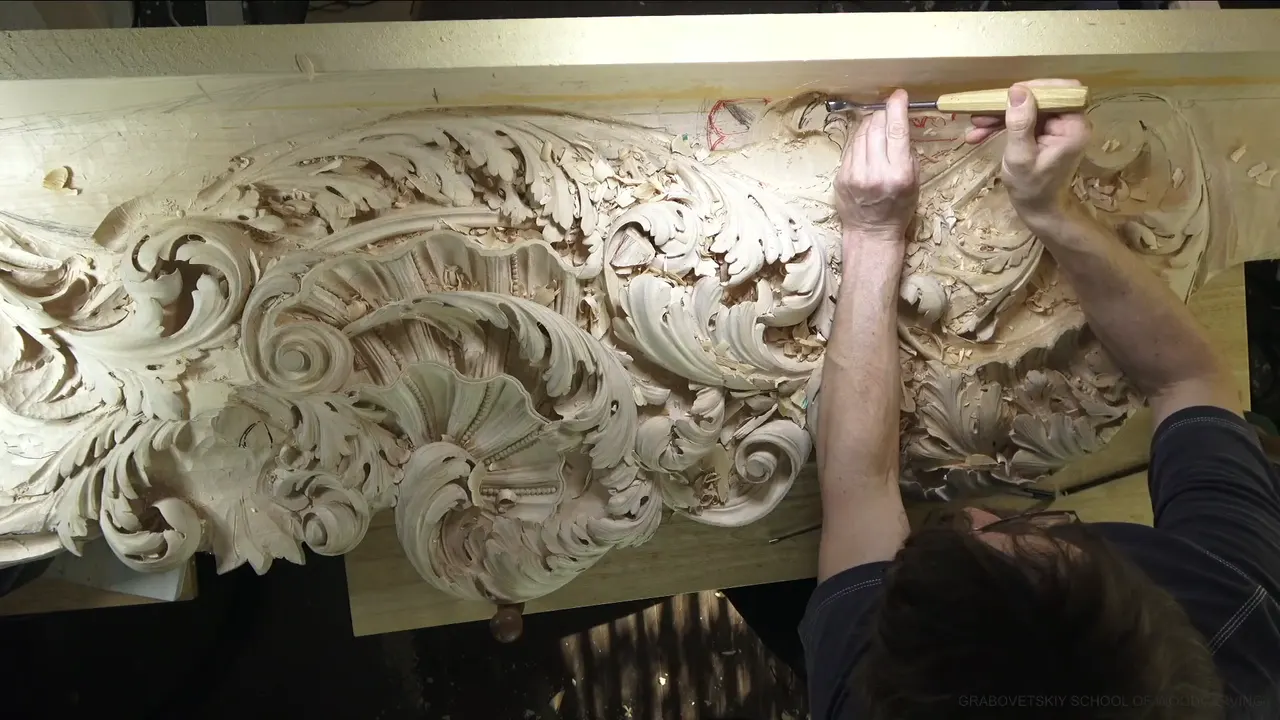

"But it's a really nice small tools to have." That line is from Venice Room 59, part 7, about a small gouge, and I say a line like it about other tools in my Venice Room, Hashemi, Furniture Panel, Roman and Floral lessons. This page follows the line through part 7 and then through those lessons, with the sizes I named.
Where does part 7 start?

It starts on "It is challenging. It is." Then I said I could "eliminate that, but then it would be too easy, and I don't want to make it too easy."
Then the shapes: "I got concave. I got convex." Beside them sat a plan, "Maybe I can just hit little at this direction, too," and then "It has to be more gradual" and "It's got to be more gradual than that," and "for me, it does look good."
The S came as a plan: "Let me recreate those movements. So I've got a letter S." A maybe followed, "I could go a little more that direction right here," and I was "ready for number nine."
Which gouges did I name in part 7?

Number nine came first, and the cut was "Straight down cut, just like that. Go around." I named a bigger one I could use, "like number nine and three-quarter of an inch, and create much quicker cut" (19 mm). Of the inside: "Don't worry about on inside" and "I still going to excavate underneath."

Number five was next. "I think number five will fit this profile," I said, and then "Number five is actually perfect." I put the size at "like seven-eighths of an inch, I would say," which is 22 mm. The limit sat beside it: "Don't want to go too deep because I still have to develop the lower leaf, but it gives me boundary."

Number 11 came next, with "four millimeters" (0.16 in) as its size. A separation was coming, I said, and about the wood: "You saw I moved little bit of grain."
The mallet is in the part too, "Sorry for the mallet on the way." Right after it: "Use a bronze mallet, maybe it's not going to be as distracting on your eyes." As for the undercut, "I'm not undercutting yet because I still going to develop even to the smaller divisions this section."
How did the plug cut give me a shadow?

Beside "Same number 11, by the way," the plug cut came with a plan and a size: "Let me see if I going to be able to fit one quarter of an inch and just do plug cut" (6.35 mm). The cut would give me "a really good shadow," I said.
On the plugs: "I'm not able to make complete rotation, like attacking from two sides. I'm still able to remove some of the plugs." The shadow: "It gives me really deep shadow." The undercut was still ahead, and "that way, it's already going to give me an idea how deep I should go."
What did I call the small gouge with no sweep marked?

For the eye I had a plan, "I could use number eight." Then the doubt: "It's number eight or number nine. It all depends, okay?" About the sweep of that gouge, there is a doubt: "They really don't show what sweep it is," and "I would call it number eight."
I know someone who calls it number nine, I said, and then came "really nice small tools." The true gouge came with a definition: "The true gouge means you can rotate, make a complete rotation. It's going to give you a perfect round."
How does part 7 close?

"Okay, first cut." Then a plan with a size: "Now we're going to use number 11 and one millimeter spoon gouge" (0.04 in). "I'm going to preliminary excavate this way," I said, and of one small part, "I still kind of like of this small part raising up."
A choice stood open, "Yes, I could use micro tools right now, I think." Next a mistake, "Although I made a mistake," and "It's not bueno." And "Now I have to fix it somehow or create bigger eye" followed, and the closing line is a maybe: "Maybe I'll just do a bigger eye."
What did I say about small tools in Venice Room 20?

Venice Room 20, part 1, has a plan, "Let me use a number two," and then "Let me use a small number eight gouge. Or whatever number that is, actually." On the marking: "I really don't know how they mark those in dockyard. All they call it is just a gouge." I called them "those small, tiny tools," said "they're excellent tools," and added "Really good tools." A plan followed, "Let me just carefully excavate that inside a little."
What about the number 11 in Venice Room 21?

In Venice Room 21, part 5, I gave a reason for the number 11s: "I could use just the one side as just a gouge, like number 3 or number 5, because it's like a U." Then how it works, "I can lay on one of the sides, and I still can get a really smooth transition." My words on it: "it's a nice tool to have, I would say." And on makers: "Some manufacturers don't even produce any number 10s."
Must you own that tool?

Venice Room 55, part 1, has "It's multi-use. But you don't have to have" that tool. I went on: "You can do exactly the same operation just by using any other skew or chisel. It's about the same idea." Also "this is a big one, of course, but I do have small ones," and "You really don't have to buy it, unless if you really wanted to, which is fine."

The chisel in Venice Room 63, part 1, is one that "has all of the skew chisels in it." My words: "It has a 45 degree, it has 22 degrees, and it's actually excellent tool." The single word after it: "Multi-use." A plan came next, "Maybe just a slight cleanup again."
What do I say about a back bend?

In Hashemi Flowers 10, part 9, I said I could "make a cut barely touching this side," and "So that's why I love those back bends. So really, it's safer." Next a hedge, "I can achieve the same results with other tools, probably." After it, "But I think it's nice to have a back bend, and that makes it, like I said, safer."
Which knife is in Hashemi Flowers 38?

For small details, I named "just a small carving knife" in Hashemi Flowers 38, part 1. Those tools were "really handy," I said, and "I have multiple different tools." This one: "this small knife helps me to get in the really tiny spots and get some undercutting done also." Then comes "Let me think the movement, what I can do with this small, tiny one."
What does the golden point check on a flower?

In Furniture Panel 12, part 1, I was working on the center points of a flower. "If you divide this line in approximately 10 parts," I said, the point is "a six out of 10, somewhere right there. I'm just eyeballing it. It's not really critical, just approximately." The check came next: "If I'll just use my golden ratio tool and see that? It just gets to that point exactly." That golden ratio tool "just automatically divides 10 in six parts," and I called it "actually really handy."
Which grounding tool is in Furniture Panel 16?

Part 1 of Furniture Panel 16 has a plan: "Now I need to get a small grounding tool again. 16th of an inch" (1.6 mm). The set: "They have a set of those tools," and "all the way to an inch, I think. That's what I have" (25.4 mm). The tool was "really handy" for "areas like that."
Which bend did I call handy?

Furniture Panel 18, part 11, gives the bend: "Number six, and that's medium bend." At "1/16 of an inch," it is 1.59 mm. The tools were "really nice handy tools." A line on stopping followed: "I probably should stop right there. Because like I said, once we're going to work on details, I can always clean my background."
Is it a tool for every day, in Furniture Panel 19?

One tool in Furniture Panel 19, part 9: "I honestly don't know if they still in the business of doing that tool." And "I have couple of them," and "I've got bigger one and smaller one." Then: "That's not the tool I'm using every day though. Although I know some people, they do." Those people "really love this tool," and I found that "I'm not."
What is a cheap set good for?

A price story sits in Furniture Panel 21, part 4: "I paid $15 for the set of 20 or something. And I'm not carving with those tools." I said "You are able to, okay?" and then the use for the set, "just for scraping if you need to scrape it a little bit," followed by a plan to "take a router plane" as "the last operation."
Where is the router plane in the Floral course?

The blade change is in Floral and Molding for the Panel 2, part 2: "I changed the blade, by the way, on a router plane. Right now it's only five millimeters, and I can just go much lower" (0.2 in). Also "now it's not late yet to use a router plane." Later in that part: "Even if you're doing just wood carving, it's a really good tool." And "see how nice and clean surface I got."
Which tools do Floral lessons 1 and 8 mention?
Lesson 8 of that course, part 2, has "I don't think they had the macaroni back then, but it's okay, I'll just use it just for the sake to show that to you." And "It's one of the really good tools."
Lesson 1, part 3, has "Obviously, it's a good idea to have proper tools for that. But I also understand not all of you do have the right tools." Then "But any skew will work to, let's say, refine the outline," and "any straight tool, like number three."
How small can a number 11 get?

Part 3 of Roman Acanthus 16 has "Just give that a little bit of a undercut." The tool I named: "really small, tiny number 11." If half a millimeter was out of reach, I said "I'm pretty sure you're able to get a one millimeter number 11" (about 1/50 in and 1/25 in). I added "This is European size, so you can see it actually fits pretty much in my palm."
Which chisel did some people call lazy?

Roman Acanthus 10, part 5: "I can actually do a lot of stuff with this." And "It works just like a knife, but it's a chisel, and I'm using the small one." Some people would name it "a lazy hand carving tool." I said "I'm not completely agree with that." Of small tools, I said "it's just handy to have small tools you can reach the areas when the big tool is not as convenient."
Does a carver's vice help in Venice Room 49?

A vise sits in Venice Room 49, part 7. "I can do a lot of different wood carving with this vice," I said, and "There's inserts with the different sizes. This is a two-inch" (50.8 mm). Also "I can rotate any direction" and "I can work upright, upside down," and last, "It's actually really handy to have."
Which sizes are in the table below?
Eight sizes sit in this table, each in inches or millimeters as I said it, with the other system beside it.
| Lesson and part | My figure, as I said it | Other system |
|---|---|---|
| Nine, in part 7 | a bigger tool I could use, at "three-quarter of an inch" | Near 19 mm |
| Five, same part | the size, "like seven-eighths of an inch, I would say" | Close to 22 mm |
| The 11 for excavation | my plan for number 11, at "four millimeters" | Roughly 0.16 in |
| Plug cut size | the size in my plan, "one quarter of an inch" | Near 6.4 mm |
| Spoon gouge plan | number 11 together with "one millimeter" | Nearly 0.04 in |
| Furniture Panel 18, number six | a medium bend tool, at "1/16 of an inch" | About 1.59 mm |
| Floral lesson 2, router plane | the blade I changed, now "only five millimeters" | Nearly 0.2 in |
| Roman Acanthus 16, number 11 | a really small tool, at "half a millimeter" | Close to 1/50 in |
Everything above sits in the school, in the Venice Room workshop 59 page, the workshop 55 page and the Venice Room Part 5 course. Start here to watch the wood carving videos.
How it's done
- Name the small gouge. Workshop 59, part 7: I named the small gouge number eight.
- Hold the undercut for now. "I'm not undercutting yet," I said in the same part.
- Try a size for the plug cut. Part 7 has my plan to see if a quarter inch (about 6.4 mm) would fit for the plug cut.
- Reach with a small tool. From Roman Acanthus 10: "small tools you can reach the areas when the big tool is not as convenient."
- Keep number three in mind. In the Floral course, lesson 1: "any straight tool, like number three."
Frequently asked questions
Which number did I give the small gouge in part 7?
Number eight or number nine, I said. I would call it number eight, and I know someone who calls it number nine. The brand does not show the sweep, in my words, and I named it number eight.
Do I need the exact tool?
In workshop 55 I said "You can do exactly the same operation just by using any other skew or chisel." In the Floral course, lesson 1, I said "any skew will work to, let's say, refine the outline." Workshop 55 also has "I do have small ones."
Is a back bend safer?
In Hashemi Flowers 10, part 9, my words were "it's safer." Other tools, probably, can give the same results, and I love those back bends.
What to carve next
- Venice Room workshop 59
- Venice Room Part 5 course
- Venice Room workshop 55
- Venice Room 20
- Venice Room 21
- Venice Room 49
- Venice Room 63
- Hashemi Flowers 10
- Hashemi Flowers 38
- Furniture Panel 12
- Furniture Panel 16
- Furniture Panel 18
- Furniture Panel 19
- Furniture Panel 21
- Floral and Molding for the Panel 2
- Floral and Molding for the Panel 8
- Floral and Molding for the Panel 1