

Alexander Grabovetskiy, woodcarver, School of Woodcarving · Published 2020
What do you do when using a mallet is impossible on a gouge cut?
Quick answer: In Venice Room 59, part 5, I named a number 11 and "probably bronze mallet," then said I had to push the tool. In Venice Room 76 I said a mallet was not a good idea in that case, and in Venice Room 70 I said "just by hand."
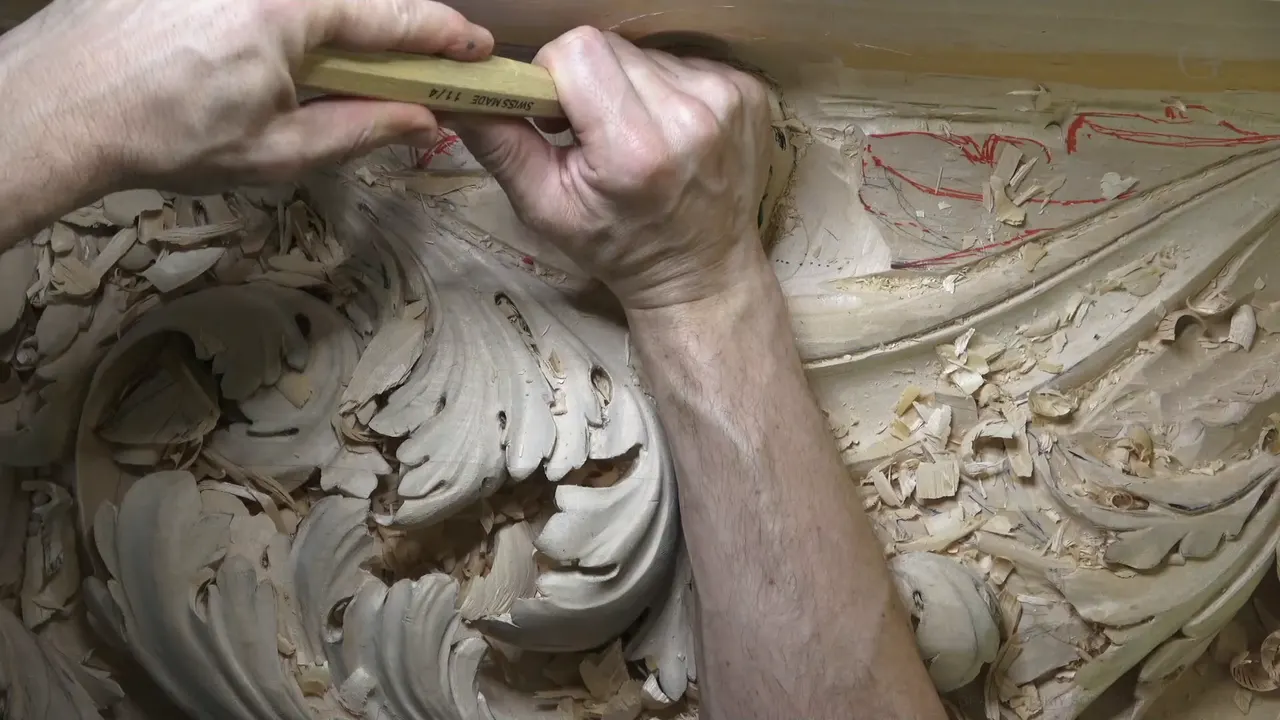

"It's impossible for me to use the mallet right now with this tool. Just have to push it." I said that in Venice Room 59, part 5, while planning a number 11 gouge for the eye. This page follows the mallet through that part, then through other lessons, where I put it down in some and picked it up in others.
What was my plan before the first cut?

The part opens on a question: "But how am I going to do it? There is two ways." One way is to "go this direction and get that piece underneath of this line or opposite." My pick came next: "logically, I think I should take this part a little bit underneath of that line."

An eye is the aim. I called it my "main cut right now with the number 11." The size, in my words, is "probably around four millimeters, three millimeters will work also" (0.16 in and 0.12 in). The mallet was a plan too, a "probably bronze mallet." About the attack I said "carefully attack it," and added: "I'm not sure if even a straight tool will be sufficient for me. Maybe not."
What happened to that plan for the mallet?
Then a limit on depth: "And yes, I could go a little bit deeper, but I don't want to go too deep because remember, I still have to be creating some concave-convexes movements." The divisions are a plan: "one of the divisions is going to go underneath."
What was the problem at the transition to the ceiling?

That workshop has a spot with a back bend, in part 4. My line there: "Transition to the ceiling part. But it doesn't mean it's impossible, I'll just use a back bend." And: "Even if I have that molding in the way," I could use the back bend.

Part 6 gives a reason in plain lines. "Even if I'm just using a back bend, it's still already laying, but it's just impossible to go uphill because that transition right here." Then comes the conclusion: "that's why I have to be attacking only from the ceiling side."
What else is in the rest of part 5?

A concave beside the eye comes next, "some kind of pipe." The tool was a number 11 at "seven millimeters" (0.28 in), "but I will need to sharpen it. Not to sharpen it, but buff it." And: "of course, I mean, to buff it, I'm always using the same machine."

The wheel was "just a felt wheel." "That should be enough, sharp enough, I should say" is the next line, and then my pace: "little by little."

A second concave got "a little bigger tool," "10 millimeters" (0.39 in). My idea: "concave, convex, concave." "I want to stick to it." Of the whole run: "All I need right now is just a concave-convex movement."

"Let me use back bent again and probably have to-- I can't break any rules right now and blend it a little bit." Then "Have to turn from this side." And then: "So I've got concave, I've got convex, and I've got concave. So now I can easily put my middle line wherever I want to."

Division lines go "from this line on inside because I need that eye, and I need to excavate this part." A marker is my plan: "Let me use a marker." Near the end of the part: "I'm able actually to put some kind of little S movement," and "I'm able to do another subdivision going like that."
How deep could I go in part 6?
The depth gets a number in the part after this one. Another leaf is on my mind: "not too deep because I have a development yet to do, another leaf." And I have to keep an eye on how deep I go, "because there's going to be another shell movement later on." Then: "I've got only two inches, and I got to be really wise how deep I go." In millimeters, two inches is 50.8.
Where else in the Venice Room did I leave the mallet?

Venice Room 76 is plain on this, in part 4: "I really can't use any mallet because I already have the main body of a carving." By hand, I said, I could at least try to excavate a little deeper, and I would not be able to do the plug cut. About a hit: "I don't think that's a good idea, by the way." Later in that part comes an answer to a "why": "it would look unnatural toward the ceiling, the overall movement. You're still going to detect that there's something just wrong. That's why I didn't."

Thin wood is the setting in Venice Room 70, part 6. "I've got about maybe 5/8 of an inch" (15.9 mm), I said, "in this spot," and I said I did not have too much thickness left. Soon after, in my own words, maybe no mallet was needed there: "In this case, just by hand. And that's probably the most I can go." Then: "Not much material I have left, but I still want to develop the feel."
On the skew, in that part: "Any tool will work, but I like the idea of using skews. It's just much quicker sometimes for me. Not always, but in some operations, it's really quick."

Six words open part 8 of Venice Room 69: "And maybe without the mallet now." The reason in the same stretch was the grain: "I'm not pushing too hard in this area because it's actually along the grain." And in the same part: "I could do exactly the same with actually just a knife or skew."

Workshop 75 has a short one, in part 3. "I don't think I'm going to need my mallet anymore," followed by "I'll just go by hand on that side." In the same part I like to create the design on a clean canvas, "a clean surface to draw on." See Venice Room 75.
What does a mallet give me?

The clearest words are in Hashemi Flowers 5, part 2. The words open with a plan, "I could use probably a mallet, and I'll be safe," and go on: "you can control a lot nicer with the mallet, but the more material you take out, the weaker it becomes, and it's easier to break." Then the turn: "At some point, I'm not going to be able to use any mallet. But now I probably could, and that's actually going to save me some time." About a V tool, further on in the same part: "the v-tool helps me to make a relief cut."
Hashemi Flowers 1 has two. One is in part 4: "I'm using mallet right now because this actually gives me much more control." Another is in part 5, where the grain is "kind of weak" and "you have to keep an eye on how hard you strike when you're using a mallet." The link is Hashemi Flowers 1.

The same idea shows in Furniture Panel 15, part 6. "I really don't have to use that mallet, but I mentioned that many times, mallet gives you a lot more control. For some of you, it sounds weird, but once you try it, you'll see."

Furniture Panel 21 has two as well. One is in part 14: "if you feel like you don't have too much control cut by hand like that, you can always use a mallet. Okay. Mallet is a good thing." One more is in part 12, where I said I would take a mallet to help me, and then it was "a beautiful movement, but I got to be careful," because "it's becoming more fragile and fragile."

The part before that one, in the same lesson, has a tool size I liked: "It's a true European size. Okay, so that is really handy. You can get really close to the detail, and it still can be used with a mallet."

Another is in Furniture Panel 17, part 3, with "be careful when you're doing that type of cut," and: "it's a lot more controllable tool. So you can control much better how deep your cut is."

The nineteenth Furniture Panel lesson has a plan, in part 7, for a "half a millimeter" tool (0.02 in) to "dig even deeper." About the mallet: "I need to control it better." And: "just tap it." A warning follows: "please make sure you don't do that movement upward. You can ruin your edge. So just hold really steadily in one position. Don't create a rocking effect."
Which mallet weights did I name along the way?
Mallet weights are named in Venice Room 67. After a tap from the opposite direction, in part 10, I said "Although I should use a heavier mallet. I used only 12 ounces" (340 g), "but I should use 30 ounces" (850 g). Outlining with 18 millimeters (0.71 in) and a number 11, in part 9 of that workshop, I said "I need to use a bigger mallet."
What about a slight mallet and a choppy area?
The shortest is in Hashemi Flowers 12, part 7. The line is "Now maybe I can use just a slight mallet." Then: "No. It's too fragile." And: "I got to use a smaller V tool," at "3 millimeters" (0.118 in). Two more lines are in Furniture Panel 24, part 4. "I'm just trying to be as careful as I can, because I do not want to damage it." And: "now I've got a kind of choppy area right here. So maybe mallet will help me clean that area a little better." Soon after, I said this about the mallet: "I'm using mallet because it's sometimes a good idea."
Where did I leave the mallet alone?

In Hashemi Flowers 29, part 3: "Take also v-tool again and outline it. I don't even have to use my mallet." Some carvers have a name for the stage: "setting in stage. We set the main movement in the second layer."

Over in Furniture Panel 19, part 6, outlining with "1 millimeter" (0.04 in) went with "I don't need the mallet." A shorter one sits in part 8 of Furniture Panel 16, with a number two: "I can probably start. Or even I don't need the mallet, probably." See Furniture Panel 16.

A mallet line of its own sits in Hashemi Flowers 43, part 2. Here is the line: "with the mallet, you create too much shakiness and even we use two screws, but they can become even more loose." And then: "So that's why actually using just hand and taking my time."
Is a skew a way to push without a mallet?

A skewed back bend is the subject in Venice Room 60, part 9. "With the skew, first of all, it makes it a lot easier to slice. And also, I don't have to slice it, I can just push it pretty much, and it's already going to slice it. Because the cut goes on an angle."
A different line on pushing sits in Hashemi Flowers 15, in part 3. My words: "On almost all of my cuts, I do my slicing, like a carver's cut is how we call it." And: "Even if I feel like I could just push it and I can get really good results, I still think slicing will give you a much cleaner cut."
What do I strike with a hammer instead?

The small round ones are the subject in Chamomile and Bow Rosette 4, part 3. The line is "I always use just a hammer, just a normal carpenter's hammer. I never use a mallet because it's still metal, and I don't want to damage the mallet."
Which sizes did I name along the way?
Seven sizes from these lessons sit in this table, each with my figure first and the other system beside it.
| Lesson and part | What I named, in my words | The other system |
|---|---|---|
| The eye, part 5 of workshop 59 | number 11, "probably around four millimeters, three millimeters will work also" | Close to 0.16 in, and 0.12 in |
| Same part, near the eye, a concave beside it | number 11 at "seven millimeters" | About 0.28 in |
| Same part, second concave, bigger tool | the "a little bigger tool," "10 millimeters" | Near 0.39 in |
| Hook, workshop 76, part 4 | a "one millimeter spoon," then "two millimeters" for the mess | Roughly 0.04 in, then 0.08 in |
| Mallet weights, workshop 67, part 10 | a mallet used at "12 ounces," then "30 ounces" wanted | Equal to 340 g, and 850 g |
| Panel lesson 19, part 7, the plan with a mallet | a tool of "half a millimeter" | Close to 0.02 in |
| The board, workshop 59, part 6, as I named it | "only two inches" | Exactly 50.8 mm |
Everything above is inside the school, in the Venice Room workshop 59 page and the Venice Room Part 5 course. Start here to watch the wood carving videos.
How it's done
- Name the choice. I started part 5 with "There is two ways."
- Pick the tool for the eye. Number 11, with a bronze mallet as the plan.
- Push the tool in that spot. Have to push it, with no mallet.
- Hold back on depth. Going deeper was possible, but the concave-convex movements were still to come.
- Buff the tool. Buff for the number 11, and I named "just a felt wheel."
- Keep the main movement in view. With concave, convex and concave done, my middle line could go wherever I wanted.
Frequently asked questions
Did I say a mallet gives more control?
Yes. Hashemi 1, part 4, has "this actually gives me much more control." In part 3 of Furniture Panel 17 it is "a lot more controllable tool."
What did I plan for the first cut in part 5?
Number 11 for the eye. The mallet was a bronze one in my plan, and after that I said it was impossible to use with that tool.
Is a mallet a good idea every time?
Not in part 4 of workshop 76, where I said it was not, with "the main body of a carving" already there. In part 14 of Furniture Panel 21 I said it is a good thing.
How thin was one spot in workshop 70?
What to carve next
- Venice Room workshop 59
- Venice Room Part 5 course
- Venice Room 76
- Venice Room 70
- Venice Room 69
- Venice Room 75
- Hashemi Flowers 5
- Hashemi Flowers 1
- Furniture Panel 15
- Furniture Panel 21
- Hashemi Flowers 29
- Furniture Panel 19
- Venice Room 60
- Hashemi Flowers 15
- Chamomile and Bow Rosette 4
- Furniture Panel 17
- Furniture Panel 16