

Alexander Grabovetskiy, woodcarver, School of Woodcarving · Published 2020
What is foliage in wood carving?
Quick answer: In part 12 of Venice Room 60, I compare an acanthus I have set in to "a foliage" and say it will be "a little different." Other lessons use the word beside a small detail, flowers, a law about the center line and a gouge. The lessons are named below, each with its part.
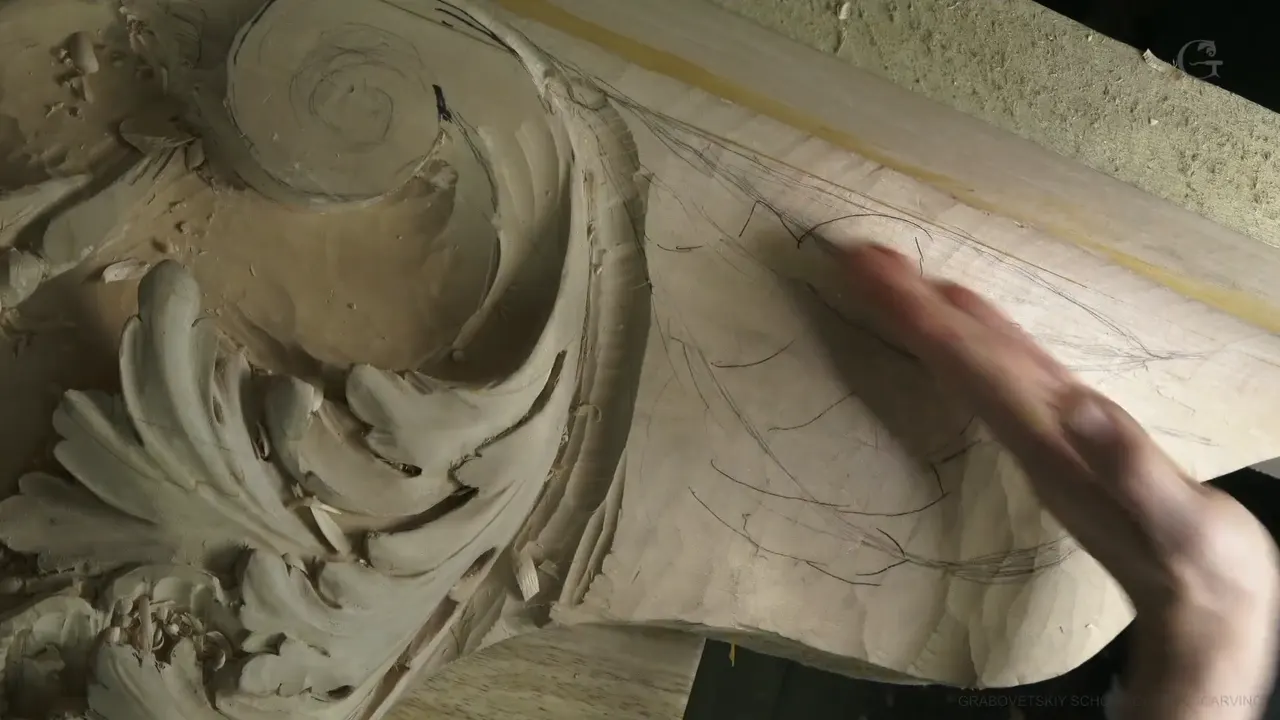

In Venice Room 60, part 12, I talk about an acanthus I have just set in: "It's still like a foliage, but it's going to be a little different." Other lessons of mine have the word beside a small detail, beside flowers, in a law about the center line and for a gouge I planned to take. Below, those lines sit next to part 12, and every quote names its lesson and its part.
Have you ever drawn a flower into a design and wondered what goes around it? Part 12 comes first. My words about foliage from other courses of my school follow it.
What did I say about foliage in part 12?
After "So I just set that in," I say the acanthus "can go a little bit underneath of this, whatever the movement is, whatever the name of it." Then comes the comparison to "a foliage," with "a little different, what you normally don't see."

I say it will be "really nice and interesting," and I admit I know I repeat myself. Who knows what it will be, I ask, "until you see it."
What was on the board before that line?

The transcript opens on a plan to repeat "a little bit of movement of this outer line," and to go "all the way again this way." I call that "the secondary line."
One movement and "a second movement" are in the plan. The acanthus is "sticking from underneath of a flower," and a flower is in the plan.
For the middle line I plan to use a blue marker, so that "I'm not going to forget what is what." I admit: "And yes, I do forget once in a while."

One line will be acanthus, and the other "not acanthus, but a different type of movement." About that second one I say "Really interesting movement, actually." Then: "Here you go. That is boundary of this movement, and now I need to establish my acanthus."
What did I plan around the flower in part 12?

The flower does not rule out divisions. "doesn't mean that I can't do" divisions going this direction, I say, and I stop mid-sentence: "Oh, actually, you know what? I have to be mindful how I do at that side."
Inside, I wonder about "movement from inside here, another division from this eye, which is going to repeat that side." In the same breath: "Oops, shouldn't put that marker right there."

The far side of the design will flip. It will be "not from above movement, but from below movement." It is one of the techniques I plan to use, "about the same," I say, and "not the same."
Which gouges did I name in part 12?

I ask myself what I should do first, then say which movement I am going to "probably work on right now." About it: "It is not acanthus, it's movement which was common to that period of time, but looks good."
The tool is number 11, at "probably about 10 millimeters or so," which is 0.39 in. The plan holds an outline and the set-in cut, and a little later I say "So I just set that in."
Next I need "a bigger one" to clear some of that stuff out, and I could probably use 30 millimeters number 11. In inches, 30 mm is 1.2 in.

On the dig: "I need that three dimensions, okay? So that's why I'm actually doing a really kind of deep excavation." I say I am not afraid of it "To take too much," with "plenty of material right here."

Near the end of the transcript I say I need to blend "this chunk just going down," and I could use "just probably a skew." The last cue is "And remove some of that."
Where else do I use the word foliage?
Foliage is in the Furniture Panel design lessons, in Venice Room workshops 1, 56, 96 and 131, in the fingernail gouge lesson and in the Corinthian Acanthus course. A few of those lines are plans, and I keep them as plans: where the words are "Think I should" or "I could," the lesson does not say it was done.
Can foliage be only a small detail beside the main acanthus?

The small detail is in Furniture Panel 9, part 2. Here it is: "And that could be not the main acanthus movement, but just a small foliage. Okay? Just a small detail like this."
I add: "Just sometimes it's a good idea to add." Then I wonder about a volute movement that is not a volute. My words on it: "that is not 100% yet how I probably going to leave it, but at least for now it makes sense. It makes sense for me."
What do I say about foliage and flowers on one panel?

In part 2 of Furniture Panel 8: "But still, the dominant is going to be more divine because I'm still going to add flowers, I'm still going to do leaves, foliage, and so on." I follow it with "At least that's how I see it," and then "I still don't like what I see, by the way."

The plan in Furniture Panel 14, part 5, reads: "Think I should do some kind of foliage, like a leafage, let's say. And maybe some kind of flowers. Filler flowers, okay? Like we did in another area."
Of the filler flower: "Itself, it fills the space. It's a filler." And: "they used those type of flowers to fill some spaces if they sometimes didn't know what to do with the area."
The counting is in the same lesson. I have three flowers and say "Let me do five of them, okay? Because as you remember, Fibonacci number. So it's got to be either three, five, or eight, or whatever the next number is."
Leaves get their count too: "I've got six of them right now. But it's not enough," so I name seven and eight. Then: "I don't think it's enough. So we're going to create the next number," and that number is 13.
Later in that lesson: "This leaf is a little too small, and it's not repeating overall movement, which is this direction, okay?" My plan: "So let me do one of the leaves kind of really long, exaggerated leaves, just like that."
If you asked me why I subdivide even small leaves, I answer: "I still want to get like in the same idea of acantuses. Okay? It's not acanthus, but still, it just kind of ties all together."
Is foliage on the Venice Room list?

Workshop 1 of the Venice Room, Venice Room 1, part 1, tells you what is coming: "a lot of different details you could incorporate in your own designs." The list has "the foliage flowers and stuff like this, some acanthus," and some drapery. The next line is "really beautiful drapery."
Where do T-stops come in with foliage?

Venice Room 56, part 10, has the warning: "So I cannot have T-stops. So that would not be right." I explain with "a letter T," and I think I'll end up "going right in the middle between those two movements."
A little further on: "So it's always like that, my starting point for the development of foliage. It doesn't matter if it's acanthus leaf or not, even if it's grapes. So it's still like that."
The same lesson has more: "I need to repeat that separation on that side, but I don't have too much material." A solution, I say, would be "if I were just to take that down and end up somewhere on the bottom right there." About the whole thing: "So it is a little bit challenging."

The same warning is in Carving Corinthian Acanthus Leaf 3, part 3, too: "And that's really important to understand this law. Everything goes to the center line." The law reaches past the leaf I am carving, to "most of the foliage carving."
Of the T-stop I say: "You would never see a T-stop like this. Okay. That is a T-stop. So it should not go like that." A few lines on: "I should say it's a law. You have to do that."
How do I begin the foliage of a section?

The section outline is in Venice Room 96, part 8. "I think it is good," I say, and "let me jump and outline" comes next: "Not the movement, but whatever the leaves or foliage I'm going to have in this section."
The size is "number 11 and 12 millimeters," which is 0.47 in, and it is "going to give me the depth." The height is to give me also 12 millimeters, and I call that "really good measuring device." Then: "Okay, let me outline it."
Then: "Got to be careful. Of course, it's better to go with the grain." And: "I'm staying away a little bit, about eighth of an inch or so," which is 3.2 mm.
Later in that video the depth drops. Twelve millimeters deep is not the plan for that spot, which will be "a lot more shallow," at "no more than 10 millimeters," or about 0.4 inch.

The leafage is in Venice Room 131, part 3: "And I can probably start developing whatever the foliage, not foliage, but the leafage right here. But I need to create a better shape first."
A plan for the tool: "I'll get probably big number seven and remove a little more material." A little later: "Just much quicker with the bigger tool. That takes me a couple of seconds, and I can redraw everything and just redesign if I need to redesign."
A smaller tool is an option: "I can actually go even with the smaller tool right away, like number 11 and maybe 3 millimeters, and go a little deeper underneath that long leaf, even if I'm not done with that, but still." In inches, 3 mm is 0.12.
Which gouge did I name for foliage?

In the Sharpening Fingernail Gouge lesson I say: "you can go extreme, and I would like to go, actually, extreme on this particular gouge, which I'm planning to use on carving foliage or flowers."
At the jig, set at zero, the cut is "just for straight gouges," I say. Moved forward, the bevel comes out "as a fingernail."
My plan for it is "extreme fingernail," and I say "We'll see." Then: "right now it's at zero, but I want to take it first halfway and see what's going to happen. So I'm going to put it on three, on a mark three."
Further on, a bevel check: "Check my bevel." And: "Extremely high right now."
What do I say about practicing foliage?
Carving Corinthian Acanthus Leaf 4, part 2: "We're going to carve later a more complicated acanthus leaf, but I would suggest not to wait until that point and practice on what we're doing right now."
If you plan a really complicated carving with me, I say, "there is all types of leafage or foliage, I call it, and it's a good idea to just practice different types."
You can put lots of different acanthus leaves into one design, I say, and it will "look beautiful," even "gorgeous."
For the tool: "Well, I'm probably going to need even smaller, number nine, I would say. And I'll take about 10 millimeters right now and work with the smaller one." Ten millimeters is 0.39 in.
And: "Exactly the same idea, just keep the center lines untouched. And if it's possible, if you can handle that, to make as long as possible just a single cut. It gives a really nice movement to your piece."
Which lesson gave me which line?
Numbers read lesson first and part second, so 56.10 is workshop 56, part 10. Each row below is one line with the word in it, beside a line from the same stretch of that lesson.
| Lesson | The line with foliage in it | A line from the same stretch |
|---|---|---|
| Venice 60.12 | Still like a foliage, a little different | Really nice and interesting |
| 9.2, Furniture Panel | A small foliage, not the main acanthus movement | A detail |
| Furniture Panel 8, part 2 | Flowers and leaves and foliage, and so on | I still don't like what I see |
| 14.5, Furniture Panel | Foliage, like a leafage, let's say | Filler flowers, okay? |
| 1.1, Venice Room | The foliage flowers and stuff like this, some acanthus | Really beautiful drapery |
| 56.10 of the Venice Room | My starting point for the development of foliage | So I cannot have T-stops |
| Venice 96.8 | Foliage and leaves for this section | A 12 mm (0.47 in) number 11 |
| 131.3, Venice | Whatever the foliage, not foliage, but the leafage | Probably a big number seven |
| Fingernail Gouge | A gouge for carving foliage and flowers | Extreme fingernail |
| Corinthian 3.3 | The law, beyond the acanthus leaf | Everything goes to the center line |
| Corinthian 4.2 | All types of leafage or foliage, I call it | Try several kinds |
Where can you watch every lesson named here?
Each one sits inside a course of my wood carving school. The Venice Room Part 5 course holds workshops 50 to 61, and workshop 60 is the lesson for this page. Other lines come from the Furniture Panel design course, the Corinthian Acanthus course and the Tool Sharpening course. For a place to begin, start here.
How it's done
- Mark the middle line. A blue marker, I said, so that way I'm not going to forget what is what.
- Establish the acanthus. After the boundary of the other movement, I said, I need to establish my acanthus.
- Set it in with number 11. Around 10 mm (0.4 in), I said, with an outline, and then the set-in.
- Reach for a bigger gouge. A bigger one to clear stuff out, I said, and I could probably use 30 mm (1.2 in) number 11.
- Dig for three dimensions. I said I need that three dimensions, so a deep excavation, and the wood has no shortage of material.
- Blend the chunk. Blend this chunk going down, I said, and I could use just probably a skew.
Frequently asked questions
How did I describe the acanthus I set in during part 12?
It can run underneath the movement a little bit, whatever the movement is, and I compared it to a foliage that is a little different.
Which tool was meant for setting it in?
Number 11, around 10 millimeters (about 0.4 in), with an outline first, I said.
Was I afraid of taking too much wood?
No. There is plenty of material right there, I told you, so I don't really worry about it.
Is foliage only about acanthus?
What to carve next