

Alexander Grabovetskiy, woodcarver, School of Woodcarving · Published 2020
What does a wood carver mean by "casting shadow"?
Quick answer: In Venice Room 60, part 3, casting shadow went with one extra wide pipe, and I pointed you to it: "So that is all shadow." The same words come back in other lessons, beside a concave cut and a raised ridge, and in a few of them beside the light of a lamp.
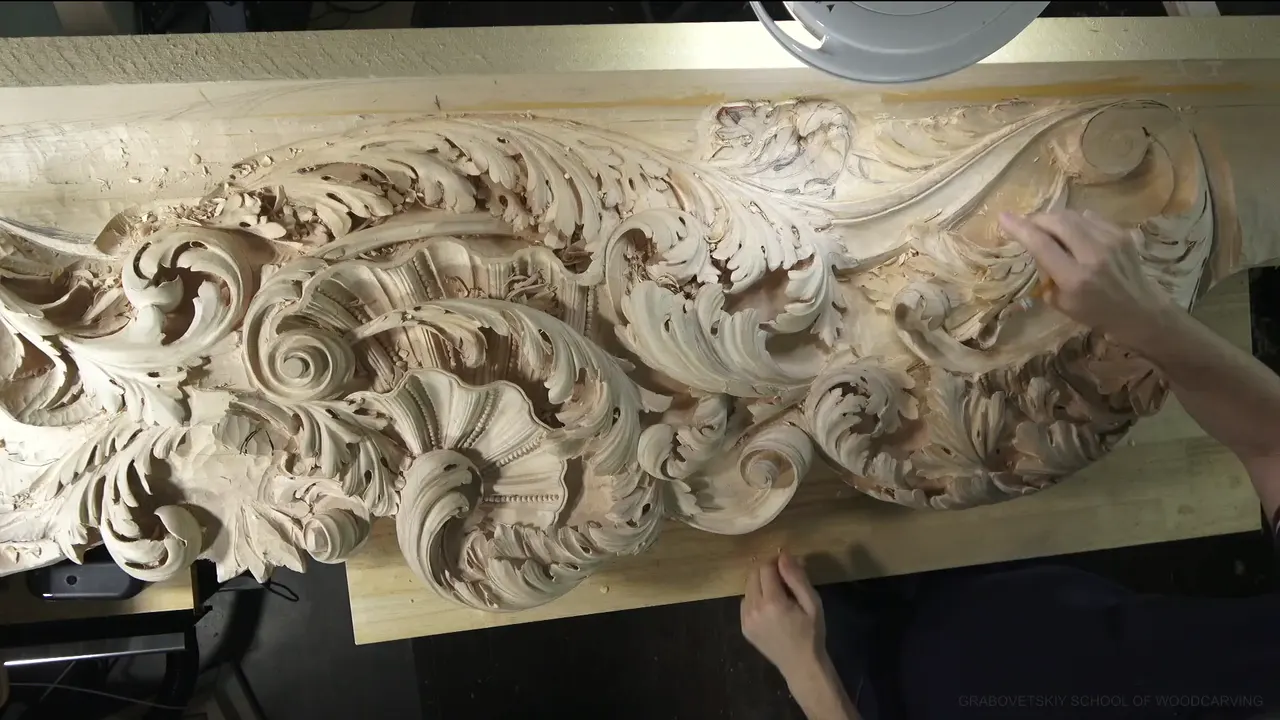

In Venice Room 60, part 3, I said casting shadow about a pipe I had made extra wide. I say the same words in other lessons, and this page lists them.
Have you ever put a gouge into a hollow and wondered where the shadow would fall? Here is what I said in part 3, and then the lessons where I said it again.
Where was I in part 3 when I said casting shadow?

Part 3 starts with "let's work a little more on this section." Some of the work, I said, was already done off-camera, "a little bit, not much," and I wanted to explain it. It applies to the pipes.
"See those pipes right here?" I asked. Then: "So I've got one, two, three, and four." What I was doing: "actually exaggerating those pipes because this movement going upward," I said, "and I need something to pop a little more." Off camera I "pretty much just exaggerated, made them really big and pronounced." It was not finished, but "you get the idea."

On one acanthus leaf: "I've got the concave, and this part of acanthus leaf is actually raised up." And "if you go around, this part is also raised up." Then: "Exactly the same right here. Concave, and this ridge is raised up." After that comes the convex part, which I put as "Then it's convex, the pipe itself."
Landscapers were working on my yard, and I said so: "My apologies for the sound today." Then "concave again, and this ridge is also raised. And same applies everywhere. This is a really common technique."

And here is the line this page is about. "And this pipe I made extra wide. Okay? Again, just to give that pop effect, to give the effect of it's casting shadow a lot more. So see that shadow right here? So that is all shadow."
Next I said I would do "a little more details," and I said you should understand "that what you see, it's not representing the true view." Picture a camera "positioned a little away from me and twisted the way you would see it," I said, and it is like I'm looking at it. I think it is "more logical to get as close as possible to my view."

There were limits, I said, "especially I do have a transition to the ceiling like this," with the camera "just pointing slightly on an angle, so you don't get a true view." Raise it, and you could not see this part correctly. But "later on, I'm probably going to flip it and just work on the ceiling part, which is coming really soon."

"Don't pay attention to this light. I really need that light to see." I wanted to see if I could place it somewhere else and still have a good light, but "I already have this ceiling, and I somehow have to cast that light. Otherwise, it's not good."
What did I plan for the eyes and the pipe?

On to the details, for a "semifinal look right there": "you just follow along with me, please." The plan was "bigger eyes right here," with the line going on underneath, so that "this piece is going to look longer."
I had explained before that on Venetian style "from point to this point, and also that point to that point is almost equal, which creates a circle." It does not fit every acanthus, I said, and French acanthus is "not applicable at all": "this part is really long and twisted. Which is also beautiful, by the way, French acanthus."

"I've got the eyes, but I need to see," I said, and about the pipe: "actually going really good." I could not work "the way I usually work because I have to actually raise myself somehow," and "it's a little far from me." The aim was a nice movement that runs the whole way, and maybe, I said, I would exaggerate this pipe also a little bit.
Tools: "the only tools I could use, it's pretty much number 11 and a spoon gouge. In this case, it would be four millimeters (0.16 in)." And: "It's not quite 3/16ths" (4.8 mm), "but it's bigger than one-eighth of an inch" (3.2 mm).

"And I'll just create my first concave just to give the direction." I warned that my hand would be in the way, and I apologized for that. "My cuts should be really careful cuts right now."

"It is hard not to see. I have to get the lights really close to me."
What did I say about shadow in parts 2 and 4?

In part 2 I wanted "a really deep shadow for it would be really distinguishable." There were "a couple ways" to "create a deep shadow," and one was "my favorite way anyway, just to get my plug cut." The angle mattered: "I can't go in underneath of this leaf with a straight tool."
I "really need that shadow" to "see beautiful outline of this inner line."
The number six, in part 2, was "a quarter inch" (6.35 mm) and "6 millimeters" (0.24 in). On the opposite side I said "I want to see deep shadow," and "I'll just create multiple plug cuts straight down like that."
And in part 4: "my goal is to exaggerate." Then: "Exaggeration of pipe. That's what I'm working on." The smaller pipe too: "it's kind of exaggerated."
Which lessons tie a concave to the lamp?

Venice Room 15, part 1, ties one concave to a lamp. "Again, that's about the shadows, okay?" I have to keep in mind, I said, that "I know the position of the room and the light source, which is going to hit from this side." Then: "So the light source, exactly like I placed my lamp." The concave goes in for that direction: "I'm going to create extra shadow casting that direction." My name for it: "More exaggerated concave."

In part 4 of lesson 15: "I really want to see some shadow right here. Casting shadow, I'm talking about, okay?" Logically a pipe is supposed to be there, and a pipe is convex. But on some original work, I said, I saw a concave cut "on inside right here," kept a short way from the separation, and it "just created interesting detail." Then: "let me try it, okay? If I don't like it, I can always shave it."

Small ridges are the subject in Lily Box 2, part 13: "They make big difference when the shadow just hits from certain point." And "when the light hits from certain point, it casts the shadow." My lamp, I said, was "at the front of me." A light right above was out: "can't do that because of my camera." Still, "personally, I love to do that, okay?"

The Floral and Molding for the Panel course, lesson 10, has a long stretch about light. Then: "wood carving, like I said multiple times, it is always about light and shadow." "In my case, I have lots of light going from all the points," and in real life "pretty much only couple sources of light."
At night, I said, the light is "just from above." In the day, "the main source going to be coming from the front, just shooting straight," with "some secondary light" from the room on the right-hand side. I said it makes for "much deeper shadow," "more 3D, more three-dimensional."
Workshop 58, part 12: "Let me move that light out." Then: "see how it casts a shadow? And depends how I am going to hit with the light, just creates a different look."
Where did I exaggerate a pipe for the shadow?

Workshop 62, part 5, holds my reason for big pipes. "The reason why I'm doing those pipes really exaggerated, I don't have a lot of depth to give a frame, but I still need to get about the same amount of shadows." One of the ways, I said, is to "just exaggerate those pipes," because "they're going to cast some shadows," and "I'm not afraid of doing it."

Venice Room 64, part 8: "maybe I can clean little bit, create deeper shadow. But can you see that? It casts shadow now." Next, the pipe: "there's supposed to be a pipe because I have eye." And "I really want to exaggerate my pipes."
Part 4 of the same workshop: "I can excavate a little deeper." Then, on one side: "there's not going to be any casting shadow on that side because of the light."

Workshop 63, part 7: "Okay, now I can see that is also casting shadow, which is good thing, and that is exactly what I'm after." And: "There's always possibility to overdo what you don't have to overdo."
Part 10 of workshop 64 has a spot I did not like, "that point when casting the shadow." Still, "it's a good idea sometimes to use a more pronounced half-round pipe." My plan was "maybe number nine almost and hit little bit the sides," and I corrected it: "Number nine back bend, I mean." That cut is "kind of dangerous because it's against the grain on one side."

In workshop 73, part 10: "that's beautiful shadow." There will be "even deeper shadow casting from this part of a canvas," but "I don't want to undercut right now because I still have to establish movements on this piece."
My hands in part 4: "I'm actually using a middle finger, not the way a lot of people are using." That finger is "a leveraging point," and "that gives me a lot of control."
How deep did I go for a shadow?

A number got corrected in Lily Box 8, part 13: "I'm sorry, it's a number 11, not number 12." Then: "It was one millimeter, now it's a half a millimeter" (0.04 in, 0.02 in). The cut was "really deep enough," I said, and "plenty for casting shadow." After that: "let me undercut this area."
In workshop 38, part 5: "I'm not going to go too deep because I don't want to create too weak detail, but deep enough for the shadow to travel, or to cast a shadow, I should say."
Workshop 54, part 3: "Everything's supposed to go to the same hole." Then "that's going to give me so rich shadow." The shadow will fall "from both sides, from this side and from the right-hand side also." And: "see how deep shadow that is?"
Workshop 53, part 11: "I'm happy that I have plenty of material." Under that detail, once I undercut, "it's going to cast even more shadow."
Workshop 11, part 10: "that creates a nice movement right there, but it's not enough for me." From below the piece is seen, so I wanted shadow right there. "Go even more extreme," I said, with number nine, "and raise that edge even more."
In Furniture Panel 20, part 8, I said "Let me get my magnifier lamp," and carefully I would undercut around. Then: "Beautiful shadow."
Where else did I say it was casting shadow?
In the Grape Leaves vase course, lesson 2, part 9: "I could go even deeper if I wanted to closer to the center and get an even more pronounced shadow." Then: "my goal is to make a really good concave."

Venetian Flowers Rosette 3, part 1: "I'm going to get probably number 11 in a spoon gouge, maybe two millimeters" (0.08 in). Then: "And it's already casting shadow. Okay? It kind of blocked the light source, and you can see there is a couple spots."

In Grape Onlay 5, part 1, I said you could leave it like that, because from above, from the top, "it's already casting shadow on both sides." Then: "let me get even smaller. One millimeter. It's still number 11, but it's one millimeter" (0.04 in).

In Roman Acanthus 15, part 2, I said "I'm happy with this movement. You can see it's a really deep shadow, much deeper than here. It's casting shadow just because this edge is raised." The other side gets the same: "So let's do exactly the same on this side."
Which lesson gave me which line?
| Line I said | What I was working on at the time | Lesson |
|---|---|---|
| It just created interesting detail | A concave cut on the inside, kept a short way from the separation | Workshop 15, part 4 |
| extra shadow casting that direction | A more exaggerated concave, for the light that hits from one side | Workshop 15, part 1 |
| Just exaggerate those pipes | Pipes made really exaggerated, with little depth to give a frame | Workshop 62 |
| because of the light | A side where I did not need to work on my shadow | Workshop 64 |
| plenty for casting shadow | A corrected number, then an undercut I planned | Lily Box 8 |
| casting shadow just because this edge is raised | A deep movement on a Roman acanthus leaf | Roman Acanthus 15 |
| deep enough for the shadow to travel | A detail I did not want to make too weak | Workshop 38 |
Where can you watch every lesson named here?
Each one sits inside a course of my wood carving school. The Venice Room Part 5 course holds workshops 50 to 61, and workshop 60 is the lesson for this page. The lines come from Venice Room workshops, and from the Grape Leaves vase, Lily Box, Floral and Molding, Grape Onlay, Roman Acanthus and Venetian Flowers Rosette courses. If you are looking for a place to begin, start here.
How it's done
- Point at the pipes. Look at the four pipes, I said.
- Make the pipes bigger. The movement goes upward, so I made the pipes big, to have something stand out.
- Pair the concave with a ridge. Beside each concave I raised a ridge, and then came the convex, the pipe itself.
- Widen one pipe. One pipe got more width, so the shadow reads more.
- Know what the picture hides. The picture is not the true view, and I need the light to see.
- Name the tools. I named a spoon gouge and a number 11 as what I could use.
Frequently asked questions
How many pipes did I point at?
Four, as I said when I asked you to look at them. I made them big, and I made one of them wider still.
Which tools did I name in part 3?
A spoon gouge and a number 11, which I said I could use. The spoon gouge was four millimeters (0.16 in), not quite 3/16 in (4.8 mm), yet bigger than 1/8 in (3.2 mm).
Why is the picture not the true view?
The camera stands off from me, and with the ceiling transition and its slight angle it cannot show what I see. Raising the piece would hide another part.
Where did I want to put the light?
What to carve next