

Alexander Grabovetskiy, woodcarver, School of Woodcarving · Published 2020
What does a wood carver mean by "a better tool"?
Quick answer: Part 10 of Venice Room 60 has me saying I shouldn't blow that, and mentioning a better tool. In other lessons I name a better tool beside a number seven, a number nine, a spoon gouge, a back bend and a skew, and I give the size.
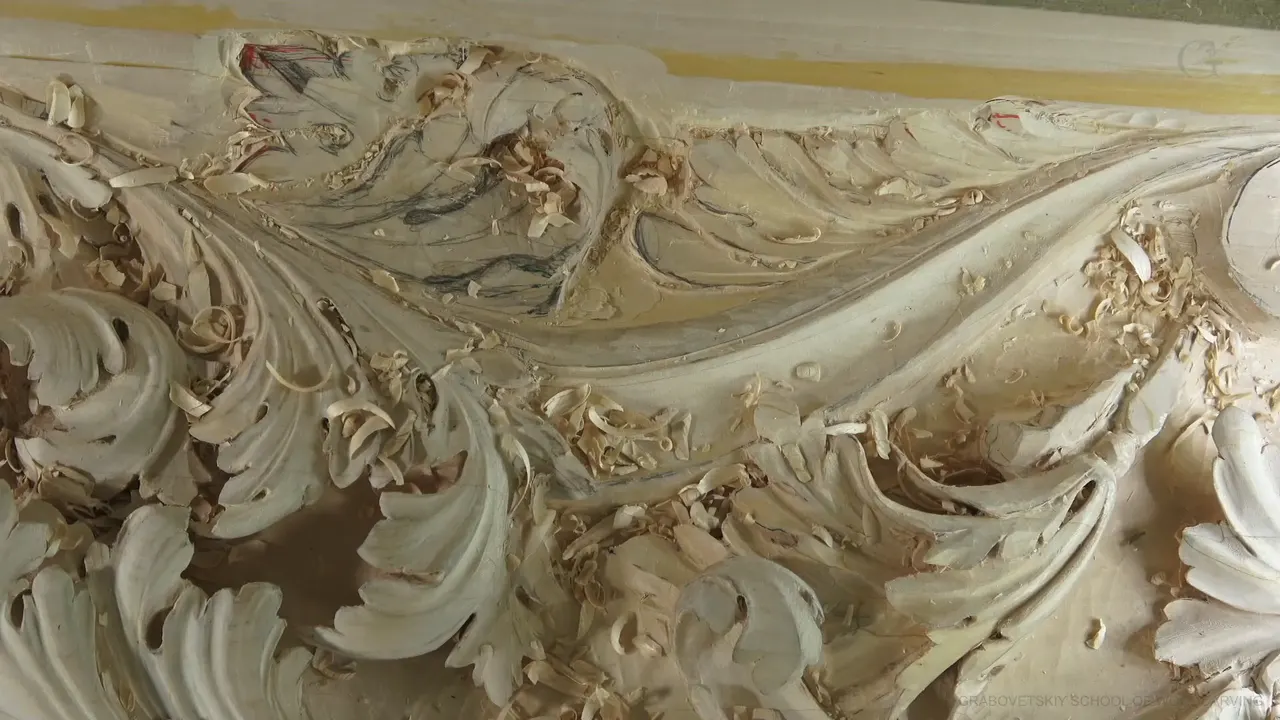

In Venice Room 60, part 10, I say: "Well, I shouldn't blow that. There is a better tool." Other lessons of mine put the same words beside a number seven, a number nine, a spoon gouge, a flat tool and a skew. This page lines them up with the sizes I name.
What tool are you holding right now, and does the spot in front of you want a different one? Below is what I say in this part, and then the lessons where I say it again.
What did I say about my tools in part 10?
"I mean, that is a good tool to have, I should say. That is a good tool to have." A little later: "It is kind of messy, but it is what it is. So I have to clean a little bit on inside." For that clean-up I name the tool. "And I'm going to use just number 11 and clean that stuff out," I say.

About the piece itself I say: "And like I said, it's really hard to see a position of how I can look at it." And: "And, yes, I could raise it upright. I mean, that's possible also, but then you're going to have a problem to see it." It would be easier for me, I say, but "almost impossible for you to see." I add one more thing, that I "really don't want to create the problem to see for you."
What about the vacuum cleaner and the blowing?
A person mentioned the vacuum cleaner. "And yes, I do use a vacuum cleaner, but it is so loud. On the camera, it would be almost impossible for you."

Deep excavation, but how deep?
My words are: "Let me get even deeper excavation underneath of here because I really need to get that shadow." Also: "I am after that shadow." Next: "Extreme but not too extreme." Later I say: "I have to be really mindful. Deep excavation, but how deep?" Then: "So I don't want to get too crazy about excavating too deep."
About the sound: "And what you hear is just me walking around that piece. All right?" About one corner: "And yes, I need to clean little bit that corner, too."
What did I want to establish before the concaves?
"What I want to do, I want to preliminarily establish this movement, how it's supposed to look with all those divisions and stuff like this before I create my concaves and convexes." On the big concave: "I really need to create the big concave on this side to get the same effect."
Which tool did I try for the big concave in part 10?
"And for this, I don't think we're going to be able to use the straight tool. Maybe I am. But let me use maybe number eight or so, and about six millimeters, quarter inch, and try it." Six millimeters is 0.24 in, and a quarter inch is 6.4 mm. After I try it I say: "I am able actually to use the straight tool at this point, at least with this one."

One more line about the gouge, and it ends the part: "And as always, one of the sides is much cleaner than another side when you're using gouge." In my case, "this side, the right-hand side is much cleaner, so I have to stay away little bit from my other part."
Which lessons name a number seven or a number nine?

Venice Room 74, part 5, goes like this. "I could use the same tool, of course, but if I have a better tool for cleaning, I would use a better tool." My pick: "So in this case, it'll be just a large number seven, one of my favorite big tools." Further on I say: "And of course, I could take it to extreme and clean it even better if I wanted to. The question, do I need to or not? I don't think I need it." And of a flat tool: "Somewhat flat tool, that's what I'm using, like number two and 50 millimeters, in this case," which is 1.97 in.

Part 11 of Venice Room 45 names two numbers: "in this case, I'm using number three, but probably a better tool would be, let's use number seven." Later: "And why I don't use it? I don't know." Later in that part: "And yes, I need to take this down quite a bit." And: "Maybe I have to change. Maybe that chunk is a little too big, so we'll see."

My line in Venice Room 40, part 11, is this: "And I need a better tool for it, like number seven, I think. I need number seven in this area." The size is "one inch", which equals 25.4 mm, and what I already have is "straight-down cuts, too deep." Of the material: "I have plenty of material. I can actually go much deeper and create a really beautiful movement."

Two numbers are in play in Venice Room 120, part 1. The lines run: "Number seven, that's what I'm using," and, "I could use number nine." I name number nine as the better choice for that spot. And of the depth: "I could go even deeper because I do have a slope downhill this way." Then: "Every little bit helps."

The reason for number nine is in Venice Room 18, part 4: "And maybe I should use a number nine if I'm wiggling, because number nine doesn't have extended wings." And: "I think that would probably be a better tool." My size: "let me try first with the 5 millimeters." Five millimeters equal 0.20 in, and I say: "And yes, 5 millimeters is good." Then: "Just a little by little, go up."

The Hazelnuts course, lesson 3, part 3, gives it one short line, and I call number 11 "probably better tool". Earlier in that part: "Number nine or number 11 going to do the job. Again, those are just the preliminary in-cuts because I still want to do a lot more motions."
Where else do I name a spoon gouge or a flat tool?

A concave is the subject of Venice Room 62, part 12: "And for this concave, no better tool than a spoon." A spoon veiner or a spoon gouge will work, I say, and then I name my pick: "And I'm going to use number 11 and seven millimeters." Seven millimeters come to 0.28 in. And: "Maybe I even don't have to," and: "Maybe I can take just number six or seven." Next: "And dig toward the main barrel, just like this, okay?"

The tools you own get a word in Venice Room 69, part 6. "This is not the right tool." And: "This would be better tool. I can just get the flatter tool, like number three." Then: "But I understand all of you don't have tools like me, and I should probably just do my normal way." The normal way: "And the normal way would get the bigger tool, which is going to fit." On my bevel: "not established yet the way I like."

The Lily Box course, lesson 6, part 8, has this: "And if I can fit some better tool. Maybe a small number three, eighth of an inch." That eighth makes 3.2 mm. Next, in the same part: "I do apologize if you really can't see, but just get the idea."
Lily Box lesson 2, part 10, goes the other way, to a smaller tool. "I am using one millimeter, and it's already too tight for it, so half a millimeter would be better tool right now." One millimeter is 0.04 in, and the half is 0.02 in. Later: "And I'm happy how it connects."

Number one meets number seven in Lily Box lesson 10, part 3: "I can chop a little bit from the sides with the same number seven." The number one is my pick for "this operation", and I call it probably "a better tool". Also: "And I hope you can see what I am doing."
Where do I name a back bend, a skew or a number three?

Pipes are the subject in Venice Room 21, part 12. "Now, I have to take care of pipes. And to take care of the pipes, no better tool in this case would be than back bent." The sweep and the size: "it would be sweep number five, and I'll use just a 2 mm and knock a little bit that ridge out, okay?" A 2 mm tool measures 0.08 in. And then: "All I have to see it's just the indication of this convex."

Floral and Molding 11, part 2, has this: "for me, it's not really convenient to use a straight tool. So I'll use just the back bent." "I'll use number three back bent," I say, and: "Yeah, it's a much better tool." And: "Yes, I can get a little deeper because I want to see a really nice and beautiful exaggerated pipe."

Floral and Molding 12, part 2, gives a small tool and its size. "I'll use number three. I'll get number three, and that would be one-eighth of an inch." One-eighth makes 3.2 mm too. And: "I think it's going to be much better tool." Around the volute I say: "And it looks like I'm able to use a quarter-inch number five." A quarter-inch is 6.35 mm.

The October 2020 livestream has a skew in it. "Let me double-check what is going on." Next I say: "And I'll take probably just a flat tool, and I'll get rid of that hump. And that is against the grain, so better tool would be just probably a skew." And later: "And yes, sometimes it's impossible to see, but you can feel it with the finger."

In the Grinling Gibbons class in Maine, class 14, part 3, I say: "I need to excavate this part and create the opening." Next: "I need to take from this position." I have a better tool, I say, and it is a "small tiny number nine." Then: "It is already giving me beautiful Shadow and that is what I'm after."
Back bends come again in Venice Room 26, part 2: "Well, of course, I'm using just a flatter tool and straight tools. There is always better tools like back bends. Back bend would give me much cleaner and nicer look very much right out of the chisel." Next: "See how different it is? Just because that tool is excellent to use." In the same part I ask myself: "And why don't I use it?"
Which line came from which lesson?
Numbers read workshop first and part second, so 74.5 is workshop 74, part 5.
| Lesson | What the words go with in that lesson | Tool |
|---|---|---|
| Workshop 60.10 | Cleaning inside, then a concave with a number eight in mind | Eleven, then eight |
| Floral 12.2 | A small tool, and a quarter-inch number five | Three, then five |
| Room 74.5 | A large tool for cleaning, and a clean-up I could take further | Large seven |
| Venice 45.11 | Number three in use, with number seven named as the better one | Seven over three |
| Workshop 40.11 | Cleaning a spot, with a number seven named for it | Seven, one inch |
| Room 120.1 | Seven in use, with number nine as the choice I name | Nine over seven |
| Venice 18.4 | Wiggling, and a gouge with no extended wings | Nine, half round |
| Hazelnuts 3.3 | Preliminary in-cuts for waviness, with the tool named in one short line | Eleven, probably |
| Lesson 62.12 | Concave work where no tool beats a spoon, and a veiner of seven millimeters | Spoon gouge |
| Class 69.6 | Ways to make a surface smoother, and a flatter tool | Flatter three |
| Lily 6.8 | Connecting two lines, with a small tool that might fit | Small three |
| Lily 2.10 | Too tight a first tool, with a smaller one named | Smaller tool |
| Box 10.3 | Chopping from the sides, with one number named for the operation | One over seven |
| Lesson 21.12 | Pipes and a ridge to knock down a little | Back bent |
| Floral 11.2 | Raised part where a straight tool is not convenient | Three back bent |
| Livestream 2020 | Hump against the grain, with a skew named | A skew |
| Gibbons 14.3 | Part to excavate, and a tiny one for the opening | Tiny nine |
| Class 26.2 | Flatter tool in use, and a cleaner look from another one | Back bends |
Where can you watch every lesson named here?
Each one sits inside a course of my wood carving school. The Venice Room Part 5 course holds workshops 50 to 61, and workshop 60 is the lesson for this page. Every quote here is a line of mine from the lesson named beside it. Other lines come from the Venice Room courses, the Lily Box course and a livestream. For a place to begin, start here.
How it's done
- Say which tool is in use. In this case, I'm using number three, I said, and number seven was the one I named as better.
- Try the size. And about six millimeters, quarter inch, and try it.
- Say what the other tool gives. Back bend would give me much cleaner and nicer look very much right out of the chisel.
- Name the reason for a back bend. For me, it's not really convenient to use a straight tool.
- Mind the cleaner side. One of the sides is much cleaner than another side when you're using gouge.
Frequently asked questions
What size gouge did I plan for the concave in part 10?
Maybe number eight or so, I said, at about 6 mm (0.24 in), a quarter inch (6.4 mm). I did not think the straight tool would do, and after I tried it I said I could use it, at least with that one.
Why did I name number nine for wiggling in Venice Room 18?
Number nine doesn't have extended wings, I said. If I'm wiggling, I thought a number nine would probably be a better pick, and my plan was to try first with 5 millimeters (0.20 in).
Which tool was my pick for cleaning in Venice Room 74?
A large number seven, one of my favorite big tools. I said I could use the same tool, of course, but with a better one on hand I would use that.
What to carve next