

Alexander Grabovetskiy, woodcarver, School of Woodcarving · Published 2020
What does "take time" mean when a wood carver says it?
Quick answer: In Venice Room 60, part 5, I had lowered part of the middle of an acanthus and planned to lower more. Then I said I preferred time, a job done right and a correct look. Other lessons carry nearly the same line, beside a thin wall, a deep cut and a tool I could break.
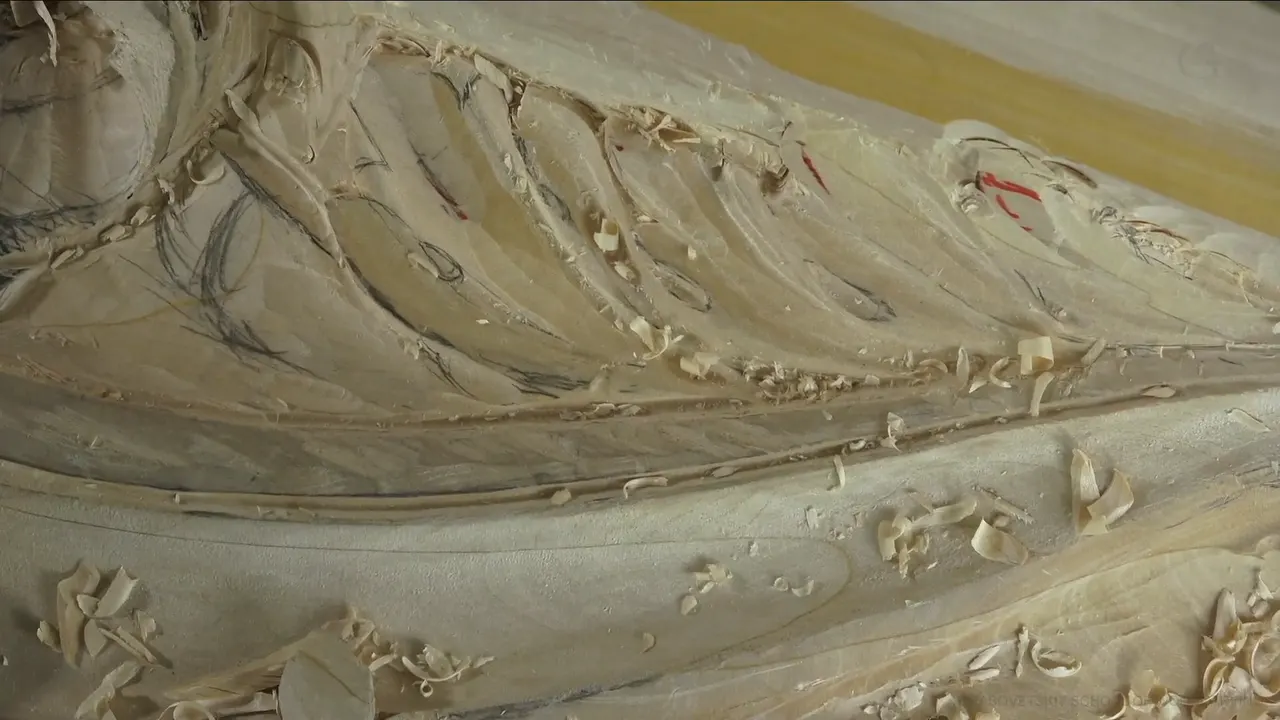

In Venice Room 60, part 5, I said I would rather take time and make it look correct, on one part of an acanthus. Other lessons of mine hold nearly the same line. This page sets them beside the one on this board.
Have you ever stood over a carving with a sharp tool and felt the pull to get it done? Below is the part 5 passage, then the lessons where I say it again.
What was on the board in part 5 before that line?

I say: "Cutting uphill, and turn back and cut that downhill like that, okay? Like a spoon almost." I name the gouge: "Number 10, it's what-- I'm sorry, that is number 9, it's what I'm using, in 10 millimeters, so three-eighths of an inch" (that is 0.39 in, and 3/8 in is 9.5 mm). On this page I give my figure first and the other system after it, in millimeters and inch.
Next I check the tool against its mark. "At least it's saying on the tool it's 10 millimeters," I say, and wider than that, I find: "I think it's about 11 or so. Pretty close to 11 or even 11 and a half." In inches that is about 0.43 to 0.45, which makes it wider than the mark.

"But I have a challenging area because grain." My carving "goes to the ceiling," and I hope you understand why. And: "I have to catch the right position," and then "blend it nicely."
"I think it's pretty close. But this tool is a little too big. I probably should use a little smaller tool."
I ask you to excuse the "screams on the background" and add: "My granddaughter visiting me today." I do not want to stop filming, "because I really have to work." Then: "It is a production project."
What did I think of the concave I had cut?

I look at the concave and say I "kind of like it, but I don't," and I "don't know how to explain." The words that follow: "I've got too much of a spooning." My plan is to remove part of it, probably, with the same 10 millimeters (about 0.4 inch): "maybe just remove this ridge, one of the ridges." Then: "It is in my opinion."
I think the cut will "look much better." Then the groove inside: "When you create a groove on inside, doesn't matter if it's Roman or Greek. If it's a Greek, you're supposed to have a V cut inside." And: "It doesn't look organic, I should say, okay? In my opinion, again."
"Let me kind of take out some of it." Then: "I probably should leave it alone already because the more I do, the more damage I create. Because it's right on the movement top." Next: "Let me leave alone this one, and I'll work on the pipe on inside of this movement, which is a good area."
Which tool did I name for the small pipe?

"Again, I'm going to take number 11, and that's 4 millimeters." That is about 0.16 inch. "I could use actual 3 millimeters or even 2 millimeters, I would say." Then: "Maybe just 2 millimeters." (3 mm is near 0.12 inch, and 2 mm near 0.08 inch.)
"Because I don't have too much space," and I want to avoid "a look that I don't like." Then: "Okay, 2 millimeters. And I'll just go on one of the sides." The result, I say, will be "a little less pronounced. A little less exaggerated, if you wish."
"But I still want to raise it somehow. I don't know yet how." One idea: "Maybe I have to knock this part because it's just sticking too much. I mean, the middle part of this acanthus."
How do a short-bent and a medium-bent spoon differ?

I name a tool for the middle part: "a spoon, but let me think which one." Then, "number 4, a spoon. It's a medium-bent spoon." Two spoons come next, a short-bent one ("See how short the spoon part is") and a medium, and "if you just line up, it's much longer."
As for the marks: "they do mark long and short, but they don't say that is a medium. But English manufacturers, they still do that, okay? That's why I love those tools."
And: "You're still able to get some of the medium bend and some of the short bends and so on."
What had I done to the middle part by then?

"So I actually knocked down a little bit the middle part, and I'm going to knock down a little more even this section." Then: "And yes, I'm not afraid of losing the middle part because I really need to exaggerate those pipes before I do the concave on inside." Last: "And yes, I'd rather take time and do that right and make it look correct."
Do other lessons say it beside a thin wall or an edge?

Venice Room 46, part 4, is about an edge. "I am keeping an eye on what I'm doing to the edge, if I'm creating too much pressure or not," and a break of that edge "is always a possibility." The line goes: "It is better to take time", followed by "excavate little by little than to make the big mistake and press it too hard and all those efforts are gone."
As the hole deepens I check it: "Let's see how deep that excavation is, how nice shadow I'm getting." The pressure stays low. "I'm barely actually creating any pressure," and I name a "stopping point" where I will not be able to reach in.
Hashemi Flowers 10, part 8, is about a tool. "Just be careful, don't pry your tool, okay?" Prying can "break your tool." The advice: "It's better to remove less in one cut, take your time, than to break really expensive tool." That one is a number nine, "20 millimeters or three-quarter of an inch" (0.79 in, and 3/4 in is 19 mm).
What about before a deep cut?

In part 7 of Venice Room 68, a line down the middle and an eye are the worry. "So I don't want to hit that middle line, and I don't want to hit my eye, and there is an eye. Okay? So for me, it is important not to make the mistake. So it's better for me to take my time and little by little start excavating."
In the same part: "I'm not afraid to go deeper." And: "Need to move my light out." The depth: "I'll go all the way, maybe about even 10 millimeters down, about three-eighths of an inch down" (about 0.4 inch, and 3/8 in is 9.5 mm). Then: "So that is initial cut." The eye gets "So really carefully."
The same lesson, in part 3, has a limit in it. At this point I say it is better to take time, to "make sure you're not making mistake." The cut is plain: "So you're just removing whatever needs to be removed, but not more than that." And: "And now I need to establish those convexes." A tool idea: "Maybe I should use even a skew." Of its shape: "It's a back bent, but I reshaped that as a skew," and "that's a number five sweep back bent."

Wanting speed is the subject of Venice Room 44, part 12. "Because of the position of this detail and the grain." I would love to get that quick, I say, "but that would be a big mistake." My way instead is "probably better just to take time," with a plan of "gradual removal," and I add: "And maybe even with the No. 11."

Venice Room 41, part 10, has an uphill cut across the grain. "I have to go uphill with the number 11." Then: "And it's probably a good idea take my time and not force it." Next: "So I am working against the rules, against the grain." Next comes a tool idea: "And maybe I should switch to number nine because it's going to give me more wiggling ability." Of its sweep: "Number nine is actually half a round."

Furniture Panel 17, part 3, is about waste. "Carefully remove that waste." I set time against a rush: it is better, I say, "than to rush it and make a big mistake." And of the rush: "So that would be a really bad idea."

The line "I need to make it deeper" sits in Venice Room 58, part 7. My answer is to take time: "do multi-pass. Pass multiple times." The spoon gouge gets a line too: "This time I did not use even spoon gouge."
What do I say about volutes and tempting cuts?

The subject of Venice Room 62, part 11, is volutes: "If you're going to do those volutes, take your time. They can be really frustrating." Number 7, at 14 millimeters (0.55 in), is the gouge there, and I also call it "half an inch" (12.7 mm). And: "I'm working on a slope and it doesn't really help," and then "Got to be a little more careful now."

Hashemi Flowers 20, part 1, names the pull I feel. "Sometimes it's tempting to make all the cuts as quickly as possible and to get to the result as quickly as possible." And: "It's better to spend a few minutes more than to force it and make a big mistake."

Furniture Panel 18, part 2, is about the final depth. "Don't overdo it, okay? So if you push too deep with the tool, then you have to lower everywhere." The condition: "to be consistent with the background." For one panel that is fine; for many, "every panel's supposed to be the same." My answer is time, and the result, I say, is "better results."
What did part 6 do after that line?

The next part of this lesson keeps a smaller tool in play. "I guess I need to switch to smaller tool, otherwise it's not going to look good." I have a pipe to protect, and I do not want to lose it, with "an eye also right here." I plan to try a number 11: "four millimeters, number 11," about 0.16 inch.
I say I will go "around the eye carefully. Carefully." And of my view: "It's impossible for me to see sometimes, that's why I have to stick my head." Cleanup, I say, is "a little too early yet because I still have to work on the details."
What reasons did I give for spending longer?

In Furniture Panel 19, part 10, I say: "I know I am taking my time, but that's okay." The look I want is "authentic and beautiful." I could "just leave it without taking those extra steps." It "still gives me the outline and so on," I say, "but I think it looks much better when you spend a little longer time."

Another reason sits in part 4 of Venice Room 8: "Yes, and yes, I am taking my time because I'm creating something. And I want to be proud of what I'm doing." Number seven is what I try there, because "I'm still not too happy about it," and it was "much better in this case. It gave me extra shadow."

The same lesson turns to thinking in part 6: "So I'm taking time to think." And: "Or skip forward. No hard feeling."
Does any lesson say the opposite?

A story in The Law of Movement tells of a piece I made "on one diagonal for him and another diagonal for her." I showed it to them, and "They were so happy." The builder installed it, and "when I walked inside of the house, I found that piece was installed upside down." Then: "But I did not say anything. I didn't want to take time to redo that."
Which lesson gave me which line?
| Line I said | What I was facing at the time | Lesson |
|---|---|---|
| Take time | A middle part I had knocked down, with a concave still to do | Workshop 60 |
| Make sure you're not making mistake | A cut that removes only what needs to go | Workshop 68, part 3 |
| Start excavating | A middle line and an eye that I must not hit | Part 7, workshop 68 |
| Than to rush it | Waste that I took out with care | Panel 17 |
| Better results | A final depth that must match the other panels | Panel 18 |
| Than to break really expensive tool | A tool that I could pry and break | Hashemi 10 |
| A few minutes more than to force it | Cuts that were tempting to make quickly | Hashemi 20 |
| Not force it | An uphill number 11 across the grain | Lesson 41 |
| Gradual removal | A detail I would love to get quick | Lesson 44 |
| Pass multiple times | A spot that needed to go deeper | Room 58 |
Where can you watch every lesson named here?
Each one sits inside a course of my wood carving school. The Venice Room Part 5 course holds workshops 50 to 61, and workshop 60 is the lesson for this page. Other lines come from the Hashemi Flowers, Furniture Panel and Principles of Design courses. For a place to begin, start here.
How it's done
- Check the tool against its mark. The 9 carried a 10 mm mark (0.394 inches), and I judged it wider.
- Name a cut that is too much. The concave had too much of a spooning, and I might remove one ridge using that tool.
- Leave a spot alone. More cuts there meant more damage, and I said I probably should leave it alone and planned to turn to the pipe on the inside.
- Pick a small tool for a tight spot. I settled on 2 millimeters (0.08 in) for the small pipe, since I did not have much space and wanted to avoid a look I dislike.
- Bring down what sticks out. The acanthus middle was sticking too much, and I named a number 4 spoon for it.
- Choose time and a right result. I stated time as my choice, along with doing it right and making it look correct.
Frequently asked questions
What had I done to the middle part by the end of this video?
I had taken some of it down and planned to lower that section a bit more. Not afraid of losing it, I said, since I really need to exaggerate those pipes before I do the concave on the inside.
Which tools did I name in part 5?
The number 9, at 10 millimeters (0.39 inch), looked wider to me; a number 11 of 4 millimeters (0.16 in) with a smaller size in mind, and a number 4 medium-bent spoon that I said I would take for the middle part.
How does a short-bent spoon differ from a medium-bent one?
I showed both. The spoon part of the short-bent one is short, and lined up side by side, the medium is much longer. On the marks I said they do mark long and short, but do not say that is a medium.
What to carve next