

Alexander Grabovetskiy, woodcarver, School of Woodcarving · Published 2020
What does a wood carver mean by "more sense"?
Quick answer: In Venice Room 60, part 7, I said I used 2 millimeters on a number 11, and that I will switch to 1 millimeter. Beside that plan I said more sense. The same two words sit in other lessons of mine, each beside a different pick, a tool size or a direction.
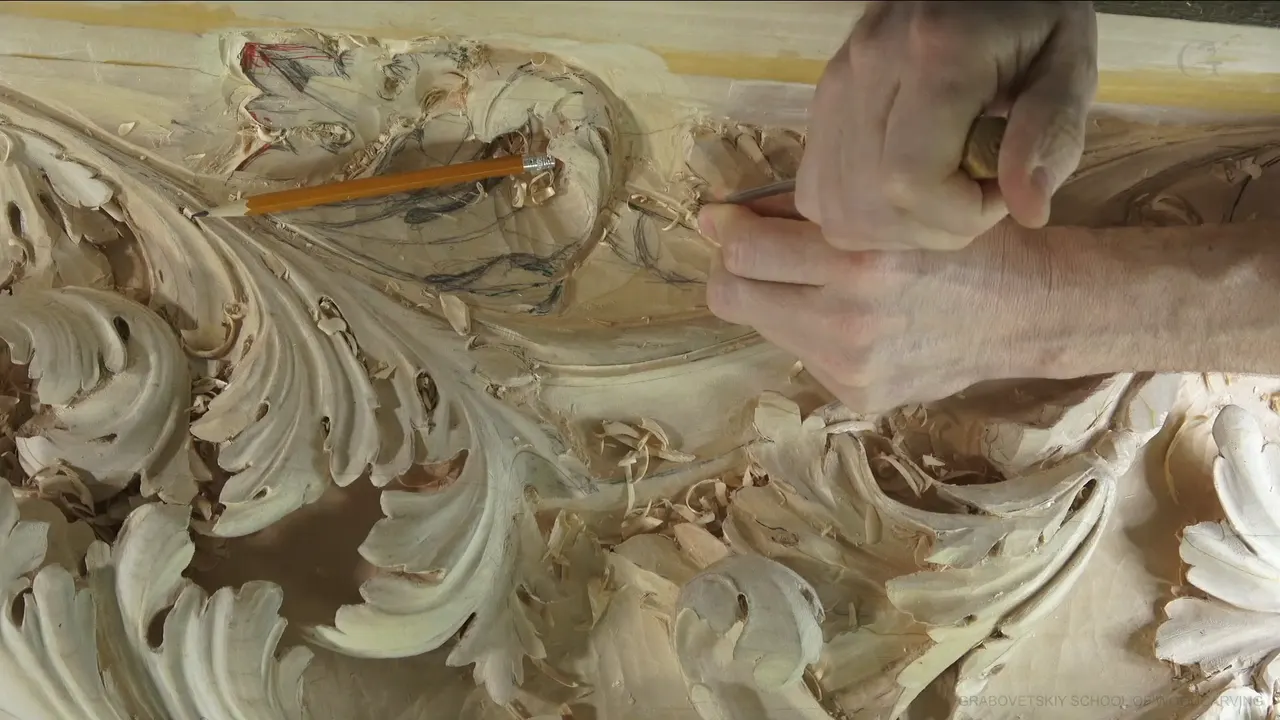

In part 7 of Venice Room 60, I plan to change a number 11 to 1 millimeter, and I say I think it makes a lot more sense. Other lessons of mine use the same two words, beside a tool size, a move or a plan for later. This page lines them up.
Have you ever stood over a carving with two tools in reach and not known which one to lift? Is the choice sometimes only one millimeters wide? Below is part 7, and then the lessons where I say it again.
Which line in part 7 says more sense?

At the number 11: "as far as number 11 goes, I used 2 millimeters, but maybe I should use 1 millimeter," and then "yes, I will change it to 1 millimeter. I think it makes a lot more sense." Both sizes: 2 millimeters (0.08 in) and 1 millimeter (0.04 in).
Earlier in the part I say I need to knock down a section "otherwise it's not going to look nice, and it's not going to give me the point of view I'm after." Next: "At least this one is looking good. I do have another eye. Let me create that eye." Of a leaf I say "This section of the leaf going to go underneath of that one, okay? But not much."

Next, "Here you go. There's going to be an eye," and I say I need to blend the ridge with a different tool. After "Let me see," it is "Number 4, and go in like that."
What did I say about the ridge in part 7?

That I created too much of a ridge: "I still don't like it. Got to get rid of this." Of the shadow I say "Still casts shadow." Then comes a plan, "Blend a little nicer this ridge right here," followed by a verdict, "Okay, now it looks better. Now it does look much better."

Next I plan to start developing the section and to "knock down those guys." I name a mallet and "3 millimeters number 11," one-eighth of an inch, with "A knock. Relieve it." In this area especially, I say, "I got to be really careful." One-eighth of an inch is 3.2 mm, and 3 millimeters (0.12 in) is near it.
Which other tools did I name?

A choice of two: "I don't have to use number 11, I could use number 9 and just get a plug hole cut." Number 5 is the one I will try first. Then "I'm after this shape. After this line right here," then "it looks like number 5 works just fine."
With number 5 I plan to angle it a little in right away, which will give me a "preliminary undercut." There will be more undercut later "because there's going to be a development going from underneath." Then "That's why I don't take too much of the material in the middle yet."

Near the end of part 7 I say "let me take out some of that stuff," and I name the seven millimeters in number 11 (0.28 in), "a little bigger than a quarter inch," which is 6.35 mm. For the stuff to go I say "Yeah, just dig out like a shovel. Well, it is sort of a shovel."
How did part 7 treat waste?

I also want to do another division for this piece, "so that has to become junk. Not junk, but you know what I mean. I mean waste." Then a warning to you: "Kind of preliminary, which I'm not encouraging you to do. That would be a big mistake for some of you, because if you get too deep of a cut, you're going to damage background, and you don't want to do that unless if it's on purpose."
I add "There are some guys, they actually love damaging their work, and they say, 'No, it was just on purpose. Rustic look.' Not in my case." My verdict on how it looks together: "I think it looks good."
Where did part 6 end?

Part 6 of the same workshop closes with "I know on a camera it probably doesn't look too good, but it makes sense, actually, because visually, this piece is going to go underneath. Let me do that. And if I don't like it, I'll fix it. I'll change it. But I think I'm going to like it, and I'm going to start from the eye position."
Which lessons put the words beside a tool size?

Floral and Molding 4, part 3, names a big number seven, "like 28 and a half millimeters or whatever, 30 millimeters." In inches, 1.12, or 1.18 for the 30. Then I say "Now I need to attack that from the opposite direction. That would make more sense."

In Venice Room 68, part 2, the tool is a number 11 at 12 millimeters (0.47 in), and I will start hitting straight down. Next, "Well, actually, you know what? I need to use a bigger tool. I think I should use a 20 millimeters, like three-quarter of an inch. It's going to make more sense." That is 0.79 in for the 20 millimeters, and three-quarters of an inch is 19 mm. Later: "Maybe 30 millimeters will help me to do it much quicker," which is 1.18 in.

Venetian Flowers Rosette 4, part 2, has "it's still too much," and further on "now it makes a little more sense." Next comes a plan, "let me take out that section," with a smaller number 11, "three millimeters or so, like eighth of an inch." Three millimeters come to 0.12 in.
Hashemi Flowers 14, part 6, has small tools: "I know I'm using smaller tools, but for me, in this case, it makes more sense because I can control smaller cuts, a lot less pressure right now." I can always clean "if I have to with the straight tool or with the straight chisel or even knife." The small tool is "about 10 millimeters," or 0.39 in.

A plan for divisions is in Venice Room 63, part 11: "I will give more divisions right now." The words "more sense" finish it. Then a tool, "number 11 and 5 millimeters" (0.2 in), and "Cut down. Relief those parts."
Where does it sit beside a movement?

In Furniture Panel 9, part 3, I say "what I could do, I could do exactly the same right here." Also "I know it's a little change of the design." The thought ends on "more sense."

Furniture Panel 21, part 9, has a line where I can continue "that cut all the way this direction right here." I say we can make this movement grow from underneath. My line closes on "more sense." Later: "Maybe I can outline right away this movement."

Over in Furniture Panel 22, part 5, I say "Let me restore original movement." Then "I hope it's going to make much more sense now." The tool is "one millimeter number 11 again," for undercutting underneath of that line. One millimeter is 0.04 in.

Part 13 of Furniture Panel 23 has a part "flipping above," and "part of the middle section is going to grow from underneath." My tool needs to turn to the right and "create cut like this," and it is going to look "a lot more organic." Next the thought runs on to "more sense." The size comes next: "one millimeter number 11," with a half millimeter planned for later.

On the Venice Room 44 lesson, part 5, I plan an eye: "I think I should give an eye, and get that piece go down all the way underneath." The words "more sense" end that thought, and they come again in part 4, about a separation I need to move "a little farther this way."

Another lesson, Venice Room 63, part 8, has a separation: "I'll just do another separation right here and remove that section. Okay. Hopefully, you can see that, and create that type of movement." I finish that thought with "more sense." Then "We need smaller number 11."

Venice Room 62, part 10, has a slope: "now I can actually exaggerate that slope a little more," and I say "I'm using number five." Of one high spot I say "which doesn't make too much sense because I have a lot of material on the backside, but that's okay." Later I say it will make sense "at the end a lot more."
Where does it sit beside a plan for later?
Drawing is the stage in Furniture Panel 13, part 1: "when we're going to carve it" is where I put "more sense." Right now, I say, "it just doesn't look like it's supposed to be." Later: "I'm just doing the drawings."
In Hashemi Flowers 5, part 3, I list steps: "I need to establish the forms of the leaves," then undercut "this part underneath of the leaves," and "continue to develop my basket." The line ends in "more sense." For the leaves I say I am going to need a bigger gouge, "probably number seven and one inch," and one inch is 25.4 mm.

Hashemi Flowers 16, part 4, has a plan to "make a leaf inside of the leaf." "Hope that makes sense" follows. The next plan is "actual excavation underneath of it," and it ends on "more sense" too. Then "Maybe about quarter inch number nine," and a quarter inch is 6.4 mm.

Venice Room 66, part 1, has two picks. For a long leaf I have to do "multiple divisions." Later, a wider area: "I'm not sure if I should do that big, or maybe I should do one big division like that." Both picks carry "more sense." Then "Yep. I like that."

The plan in Venice Room 70, part 1, reads "Even if I have to dig a little deeper inside of the main head, that's okay." It closes on "more sense" when it is finished. The tool is "10 millimeters, number 11 of course," three-eighths of an inch. Ten millimeters make 0.39 in.
From Venice Room 72, part 1: "I know it doesn't make sense as of now, but it will make sense little later." Of my middle line I say I am "trying to be authentic to golden ratio." The line: "you divide that in 10. Okay. Five parts on one side, five parts on another side, and you move six parts out of 10 either to that direction or that direction. In this case, I move that direction because it makes sense."
What about a tool I am not using?
In Furniture Panel 15, part 10, I talk about getting close to the final depth. First, "without a router plane, it's still possible to do that," and "Just exactly the same operation that I'm doing right now with the flatter gouge." Then: "See, I'm really close, so all I need to do is just to clean. It just makes more sense with the router plane."
Gouges get it done too, I say. "You can get really, really close and get it really clean and nice, and you can make it really flat and beautiful with no problem. You just have to be a little more careful, I would say, when you're doing it with the gouges, because you can dig sometimes a little too deep."
Which lesson gave me which pick?
Numbers read workshop first and part second, so 44.4 is workshop 44, part 4. A pick here is what I named beside the words.
| Lesson | What I was weighing at the time | My pick |
|---|---|---|
| Workshop 60.7 | Whether a number 11 stays at 2 millimeters or goes down to 1 millimeter | 1 millimeter |
| Venice 44.4 | Moving a separation a little farther this way | This way |
| Panel 9.3 | A little change of the design: the same move right there | The same move |
| Hashemi 14.6 | Smaller tools, smaller cuts and a lot less pressure | Small tools |
| Floral 4.3 | Coming at a spot from the opposite direction after a big number seven | Opposite direction |
| Room 68.2 | A bigger tool for a straight down start on the outline | 20 millimeters, then maybe 30 |
| Rosette 4.2 | A section to take out | Number 11, three millimeters or so |
| Lesson 63.11 | More divisions right now, on a section I could clean | 5 millimeters |
| Venice 72.1 | Where to move a middle line, with a slope running one way | Six parts out of ten |
| Panel 15.10 | Cleaning once I am really close to the final depth | Router plane |
| Workshop 66.1 | A long leaf that needs more than one division | Multiple divisions |
| Hashemi 16.4 | Excavation underneath a leaf I want to make inside another leaf | Maybe a quarter inch number nine |
Where can you watch every lesson named here?
Each one sits inside a course of my wood carving school. The Venice Room Part 5 course holds workshops 50 to 61, and workshop 60 is the lesson for this page. Other lines come from the Hashemi Flowers, Furniture Panel and Floral and Molding courses. For a place to begin, start here.
How it's done
- Name the need. I need to blend this ridge, and I need to use a different tool.
- Pick the size. I will change it to 1 millimeter.
- Blend the ridge. Blend a little nicer this ridge right here.
- Number 5 goes first. Number 5 I'll try first.
- Take a little more material when it is safe. Although, I have to get deeper, so I'm safe to take a little more material.
- Clear the stuff. Some of that stuff out has to be gone.
Frequently asked questions
Which size did I plan for the number 11 in part 7?
The number 11 had been at 2 millimeters (0.08 inch). I wondered about 1 millimeter (0.04 inch), then said I will go with the smaller one.
Was the ridge fine as it was?
No, I said I still did not like what I had created. Two lines said I got to get rid of it, and my plan was to blend it a little nicer. After that I closed by saying it looks much better.
Which tool sizes are named in part 7?
A mallet with number 11 at 3 millimeters (0.12 inch), and number 5 as the one to try first. Near the end, a seven millimeters (0.28 inch) number 11, a little bigger than a quarter inch.
What to carve next