

Alexander Grabovetskiy, woodcarver, School of Woodcarving · Published 2020
What does a wood carver mean by "my preference"?
Quick answer: In Venice Room 60, part 8, I say I probably could use number nine for a shadow spot, and I name number 11 as my preference. In other lessons the word sits beside back bends, a name for one tool, a paste and the turn of a wheel.
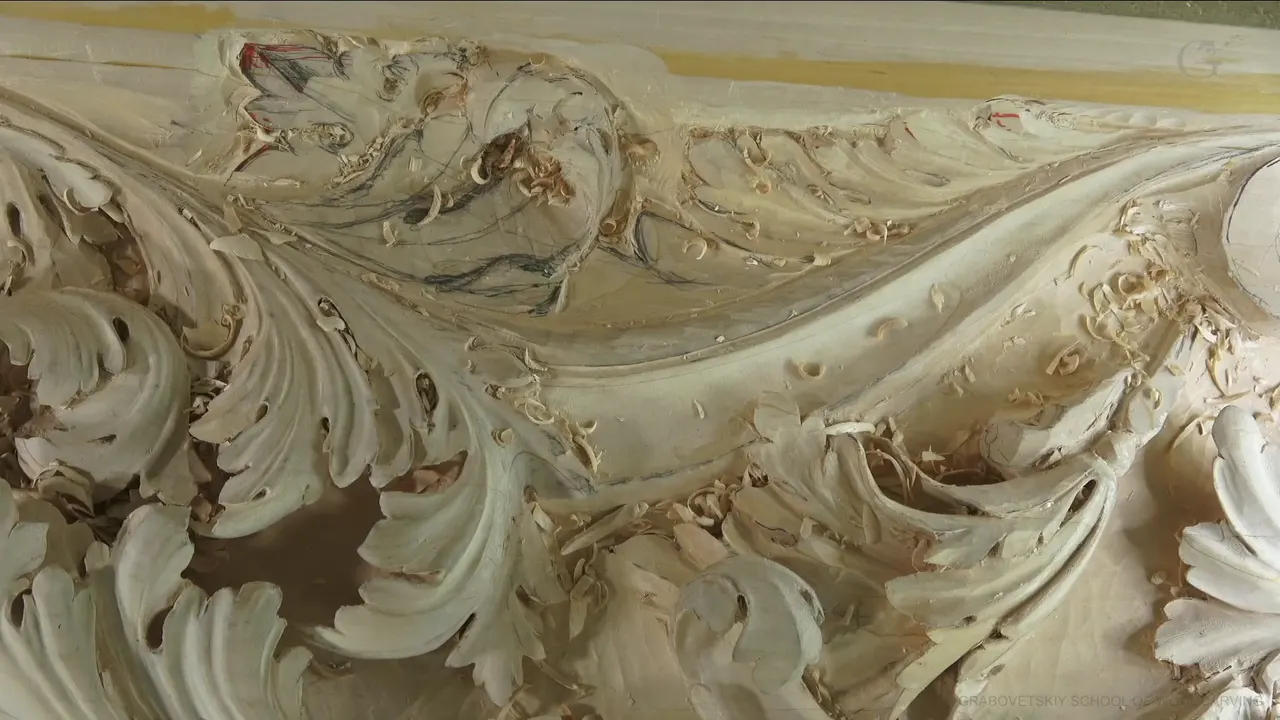

In Venice Room 60, part 8, I say: "Although in this case, my preference is number 11." Other lessons of mine use the word beside back bends, a name for one tool, a paste and the way a wheel turns. This page lines them all up.
Which tool do you reach for when two will do? Below is the passage from part 8, and then the lessons where I use the word again.
What did I name beside number 11 in part 8?
Of two areas I say: "I think this is a little too close to each other, those two areas. I really need to create a beautiful shadow right here, too." On the molding: "It's okay closer to the molding to get close to that leaf." Also: "But this area has to be lower, because I really need to create that effect." I say of the tool: "Use the same tool. I probably could use number nine." The size follows: "And again, when I'm saying same tool, it would be 10 millimeters number nine." Ten millimeters make 0.39 in, near enough.

I name number 11 as my preference for that spot, and I add: "Or I could use actually just a normal straight tool, not just a spoon gouge." And: "But let me create that shadow effect. Shadow spot, I should say."
Which number do I tell you to get first?
"You know what? Just in case, if you don't have number 11s, at least get number nines." I add: "Okay? This one is a 10 millimeters number nine, 3/8 of an inch number nine." Three-eighths of an inch makes 9.5 mm. Of a letter A, I say: "Short bent or spoon gouge."

For another eye, I say: "Now I need number 11. Let me see. Maybe three millimeters. I'm going to use three millimeters number 11." Then: "Oh, this is actually three millimeters, about 1/8 of an inch." Three millimeters make 0.12 in. One-eighth of an inch makes 3.2 mm. The tool, I say, is marked 48, "but it's just a number 11 veiner."
What about my thumb and my middle finger?

"And see position of my thumb, I'm leveraging against my thumb, I'm just cranking against." And: "And sometimes it's painful, because if you got that cut a little too deep, you can actually hurt yourself. So be careful how deep your cuts are." Then: "See, my position of finger was like that. I'm pulling out, and I've got almost a channel on my thumb."
About the middle finger, I say: "Again, some of you don't use the middle finger the right way. So this would be the right way. Okay? Right here. And you're using your middle finger as leveraging." Then comes this: "But don't try to push too hard. You can actually break your bone if you don't do that the right way."
What did my teacher say about hurrying?
"Feel it, okay? Don't dig too deep inside of the wood. It is mistake when people trying to get too much wood at one time. It was my mistake, by the way, too." My teacher told me, "Don't do that." I still wanted to be "super quick," I say, and he answered: "There's a couple possibilities. One of the possibilities better than another. One, that you're going to damage your piece if you're going to try to be speedy, which is not the worst one. And the worst one, you can cut yourself really badly, because we are working with the sharp tools." I add: "So it's better, even if you're doing a large sculpture, not to dig too deep."
What about the gouge itself?

"I guess I need to sharpen it," I say. Then the outside: "Not sharpening, but buffing a little bit." On the inside I say "And now I need to take care of inside," and of the buffing: "There is attachment on the side for buffing, and you probably should know by now what I'm talking about." Then the wipe: "And I need to wipe it, of course. Just a paper towel, because I don't want to get all that mess on my work." Back at work: "Oh, yes, now it's just like butter, took me just a second, okay?"

Which tools go with my preference?

Venice Room 65, part 3, has back bends, and it has the word: "Of course, my personal preference is always back bends. I just love a finish, what they leave, and it's much easier to work in areas like that when everything is on your way." And: "And maybe a little more extreme back bend, like number five."

The shape of one tool gets the word in the Dining Table Apron course, workshop 8. "I just like how the tool is built," I say, "It's a fish tail, it's called a fish tail, it looks like a fish tail." The shape: "So it's wider at the cutting part and just narrows down, and you can easily just get to the corners with the fish tails. And that's my preference, actually, when I'm buying even a new tool." And: "That would be my choice number one."

The Greek Acanthus Leaf course, lesson 5, sets a V tool beside a knife. "And we can work with the V tool just to go to the line. Just like that. Although that is not my preferred way, I should say." The knife: "It can be any brand, any cheap carving knife, any carving knife. But with the edge of the knife, I can actually really nicely get to any details without changing too many tools."

Hashemi Flowers 12, part 6, is about angle: "Again, any V-tool will work, but I really do have a preference, like a 45 degrees or even less. If you do have that, it's going to help a lot."

A name is the subject in Furniture Panel 16, part 7. "And I'm going to use number 23. By the way, the name for this tool is macaroni tool. Same like a product you buy to make a pasta. So macaroni tool." About that name: "I'm not calling it macaroni myself, I just prefer to call it number 23. But it's just my preference. But that's the name for it, macaroni tool." And of the cut: "See? And it just gives me perfect cut without digging underneath."

The Lily Box course, lesson 2, has my reasons for a brand: "But why I still choose certain brands, my preference, why I do that. There is a few different things that I am paying attention. Of course, how comfortable my handle is, and I really like traditional English handles."
A saw is the subject in Venice Room 1, part 6: "This jigsaw is really a preference of mine just because, first of all, it just gives me absolutely the best cut, I would say, as far as the 90 degrees cut." Then: "Let me check the blade. All right. And you can see, I don't know if you can catch that, but the blade is absolutely 90 degrees."
Which cuts do I put beside the word?

Furniture Panel 24, part 1, puts the word beside a stab: "Let me take probably number five and three millimeters." The cut: "Just stab down and then follow the outline." And: "Which is acceptable way of carving, but that's not my preference because you're creating too much stress. You're actually spreading those fibers both directions, it's actually not too good for the wood. So it's always better to just outline first. But if you want to do much quicker, that would be acceptable, I would say. Why not?" Three millimeters is 0.12 in.

Furniture Panel 19, part 3, compares a tool with a gouge, and the grain is in the line: "With the gouge, across the grain, that's a preference. With this one, not necessarily. So it's not always the best way, but I really have no other choice, only to cut across the grain."

Swapping hands is the subject in Venice Room 2, part 1: "And again, the reason why I'm doing that way, because I don't like to switch my hands. That is not my preference, okay?" Swapping my hands to go from the opposite direction would be okay, I say, but: "for some reason, I feel more comfortable when my gouge is in my left hand."

An eye gets two ways of excavating in Venice Room 25, part 10, and I say it like this: "It doesn't really matter, I don't have a preference. But I like to use smaller tools. You could use just probably number five, number six, and attack from two sides like that and excavate that eye that way."
Which lessons put it beside an edge, a mallet or wood?

A paste is the subject in the Sharpening Straight Gouge lesson: "Like I said, that is just my preference. You can use any paste, you can use the yellow, regular green, they all work, I just found those two work better for me, but it's my personal preference. It doesn't have to be yours."

A wheel that turns is the subject in the Sharpening Spoon Gouge lesson: "It's not a big deal while you're grinding, but I prefer when it turns away from me. So that means I have to jump over this part, jump on this side, and then my tool is going to be sharpened, but the rotation is going to be out from me. Okay. So that's probably my preference."

Even my preferences change, I say in Floral and Molding 10, part 3. "Like I said before, you can use different tools. It's just nowadays my preference. Even in my case, I change sometimes my preferences. You really sometimes getting tired of the same tool and what tools you're using changes." And: "I also get tired of using the same tools over and over and over, and that's always joy to use some other tools."
A mallet is the subject in Hashemi Flowers 10, part 1. I say I don't use too many mallets made of wood, and my first reason is "just to protect my handle." As for the second: "And the second, it's just too noisy sometimes." Then: "That is why my preference is always a rubber one." And: "But for everyday work, I use rubber."
Lumber gets the word too, in my April 2020 livestream on wood movement. I weigh Eastern against Western basswood, and the United States against Canada: "I like more Canadian side of basswood because there is a lot more forest, a lot less pollution, and that's a really good quality of lumber." Then: "I really like South Carolina, and also I like Wisconsin basswood. It's beautiful."
Which workshop gave me which line?
Numbers read workshop first and part second, so 65.3 is workshop 65, part 3.
| Lesson | What the word goes with in that lesson | Tool |
|---|---|---|
| Workshop 60.8 | A shadow spot with two tools in mind | Number 11 |
| Venice 65.3 | Areas where everything is in the way, and back bends are easier to work with | Back bends |
| Apron 8 | A wide cutting part that narrows down and reaches the corners | Fish tail |
| Greek 5.1 | A line made right to the edge, by a V tool or by a knife | Knife |
| Hashemi 12.6 | A V-tool, where any one will work but I have an angle in mind | 45 degrees |
| Panel 16.7 | A name like a pasta product, which I call something else | Number 23 |
| Panel 24.1 | A cut that starts with a stab straight down and spreads the fibers | Not preferred |
| Furniture 19.3 | A tool compared with a gouge, for a cut with no other choice | A preference |
| Venice 2.1 | Swapping my hands and going from the opposite direction | Left hand |
| Room 25.10 | Two ways to excavate an eye, with smaller tools from two sides | None |
| Straight 3 | A paste for the edge, where any paste works but two work better for me | Not yours |
| Spoon Gouge | A grinding wheel, turning toward the tool or the other way | Away |
| Floral 10.3 | The tools I use, which change when I get tired of the same ones | Changes |
| Lily 2.6 | The reasons I choose certain brands, starting with a comfortable handle | English handles |
| Hashemi 10.1 | A mallet for everyday work, because of noise and my handle | Rubber |
| Livestream 2020 | Basswood, where I like some places more than others | Canadian |
Where can you watch every lesson named here?
Each one sits inside a course of my wood carving school. The Venice Room Part 5 course holds workshops 50 to 61, and workshop 60 is the lesson for this page. Other lines come from the Furniture Panel, Carving Tool Sharpening and Lily Box courses. For a place to begin, start here.
How it's done
- Name two tools for one spot. Number nine, 10 millimeters (0.39 in), or a straight tool, I said.
- Say which one is your preference. Number 11 is my preference, I said, for that spot.
- Get number nines at least. Just in case you don't have number 11s: a number nine, 3/8 in (9.5 millimeters).
- Lever against your thumb. I'm leveraging against my thumb, just cranking against.
- Go by feel. Feel it, okay? It is mistake when people trying to get too much wood at one time.
- Reach for number 11 at another eye. I need number 11, I said, maybe three millimeters (0.118 in).
Frequently asked questions
Which gouge did I name for the shadow spot?
Number nine, which is 10 mm (about 0.4 in), and I said number 11 is my preference there. A straight tool was another choice I named.
Which number should you get without number 11s?
Number nines, at least. There I said this one is ten millimeters (0.394 in), and also three-eighths of an inch (9.5 mm).
How did I describe my thumb in part 8?
As the point I lever against. I said a cut a little too deep can actually hurt you.
Do my preferences change?
What to carve next
- Venice Room Part 5
- Venice Room 60
- Venice Room 65
- Dining Table Apron
- Greek Acanthus Leaf 5
- Hashemi Flowers 12
- Furniture Panel 16
- Lily Box 2
- Furniture Panel 24
- Furniture Panel 19
- Venice Room 2
- Venice Room 25
- Sharpening Straight Gouge
- Sharpening Spoon Gouge
- Floral and Molding 10
- Carving Tool Sharpening
- Furniture Panel course
- Hashemi Flowers 10