

Alexander Grabovetskiy, woodcarver, School of Woodcarving · Published 2020
What does a wood carver mean by "the only way"?
Quick answer: In Venice Room 60, part 6, I plan to raise a pipe and I guess a deep concave is the only way. Other lessons put the same words beside a ceiling, a deep undercut and sharp tools. In others I say there is more than one way.
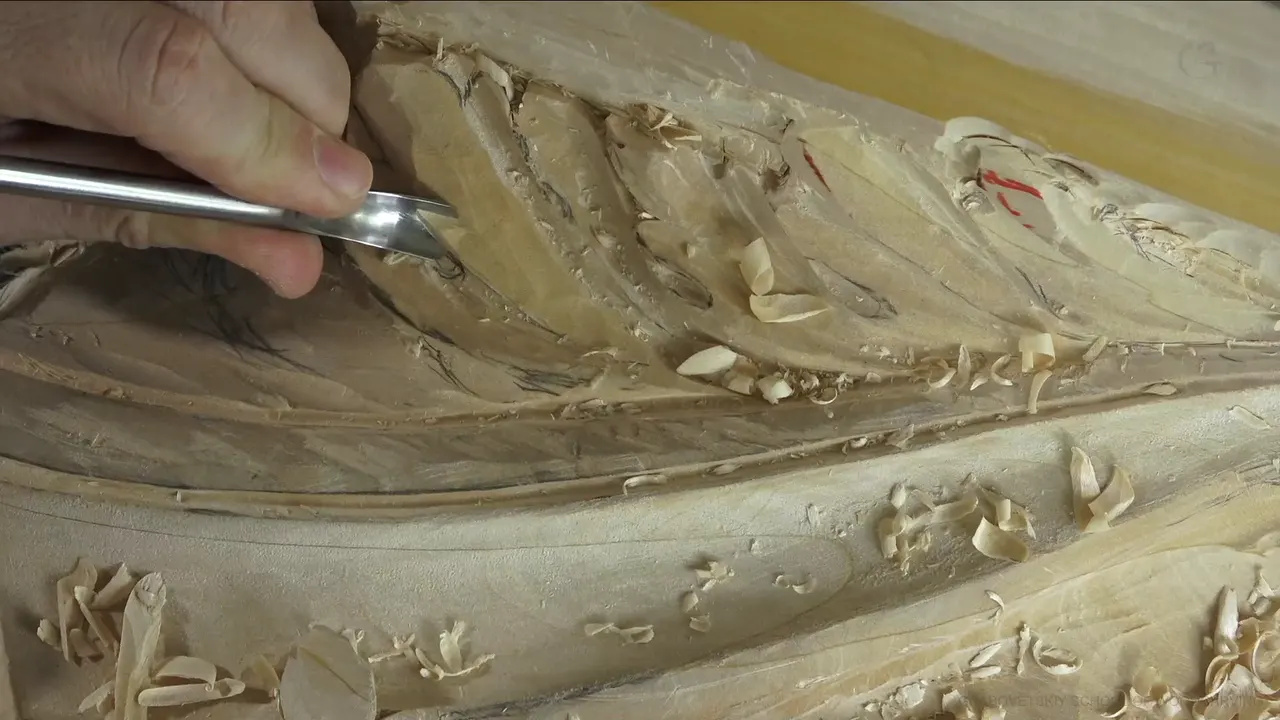

In Venice Room 60, part 6, I say I really need to raise a pipe up. I guess a deep concave on the side is the only way to do that. Other workshops of mine put the same words beside a ceiling, a deep undercut and sharp tools, and this page lines them all up for you.
Have you ever worked where your own hand covers the work? Where a ceiling sits close to your tool? Below is the passage from part 6, and then the lessons where I say it again.
What did I say about the pipe?

I ask: "And how should I do that? I could do, actually, with the big spoon, with 10 millimeters or so." The gouge I name: "In this case, I just took 10 millimeters, three-eighths of an inch, number nine." Ten millimeters make 0.39 in, and three-eighths of an inch makes 9.5 mm. Of number 11 I say: "I could do the same operation with number 11, of course. That would give me the same thing."
On the pipe: "I really need to raise that pipe up." And: "I guess that is the only way to do that, just to create really deep concave on the side."
A spot bothers me in the same stretch: "what I don't like too much, this area." Right now, I say, "it's on the same plane, and I have to make the decision of which part is going to go where." I add: "But it's okay. I'll make my decision."
Which tools did I name near the eye?

Next: "Let me cut opposite side of the pipe." Later, a tool plan: "I guess I need to switch to smaller tool, otherwise it's not going to look good." And on the pipe: "the pipe's supposed to go to the same direction, to the same movement."
Next, the eye: "I don't want to lose this pipe because there's going to be an eye also right here. So got to be careful." That tool will be a little too big for me, I say. My plan: "I have to turn that to either two millimeters, or maybe let me try four millimeters first. Four millimeters, number 11." Those sizes are 2 millimeters (0.08 in) or 4 millimeters (0.16 in). As a fallback I plan to use something else if "it doesn't work."

At the eye: "Let me do first that." I plan to go around it carefully: "Carefully." About my view of the work: "It's impossible for me to see sometimes, that's why I have to stick my head."
Which sweep and size did I plan next?

"Now we're going to take a back bend, and in this case, let me think, let me see, and let me think which back bend is going to be the best." Probably sweep number five at six millimeters (0.24 in) is my plan, and then "Let me see if it's going to work or not."
On the shape: "Because I need to create that roundness. But in this case, it's not raised as much." Also: "I can't see because it's a little too far from me." Then: "Let me knock down this pipe also a little bit." I add: "That is a beautiful pipe, by the way, coming from this direction."
Where did I say I had no position to attack from?

At the concave I say: "Let me take care of the side of this concave. I kind of don't have any position I can attack it. Maybe from the opposite side." Then: "It's still on my way, the ceiling part." Next: "Little bit I'll be able to clean it, but not much."
And: "Again, if you think it's easy, try to do the transition piece. Transition, like 90 degree piece. It will change your mind."
Inside, I have another plan: "I don't like what I've got on inside. So on inside, I have to clean a little better, maybe with a smaller tool, maybe two millimeters number 11." Two millimeters is about 0.08 inch, and I say "Okay. And let me try."
How did part 6 end?

"I know on a camera it probably doesn't look too good, but it makes sense, actually, because visually, this piece is going to go underneath. Let me do that. And if I don't like it, I'll fix it. I'll change it. But I think I'm going to like it, and I'm going to start from the eye position."
Which lessons say it of a ceiling or a dangerous cut?

Over in Venice Room 28, part 4: "I am sorry that I'm covering with my hands, but that's the only way I can attack because I've got the ceiling really close by." Then: "Okay? Really close by." Number five is the tool, "in 10 millimeters" (about 0.4 in). As for the shape: "Maybe even a little bigger back bend because I want to see that convex in the middle."

Venice Room 58, part 10, has a ceiling too, and I say "Turn to that line and cut from opposite direction." Then: "My apologies if I'm covering that with my hands. I'll try not to, but if I am, please forgive me." That, I say, is the only way, "because I really do have a ceiling." What I name as the result is "a clean cut."
A ceiling sits on one side in Venice Room 49, part 10, and I say "I am breaking the rule of working with the grain." From the opposite direction the tool cannot come in there, so I can only work in one direction right now.

Part 5 of Venice Room 57 has the words too. "The reason why I'm working toward myself, and that's a little bit dangerous. But in this case, that's the only way I can excavate." I name a safer way: "Rotate the piece or walk around and attack from opposite direction. That would be smarter. Okay? Safer, I should say."

I go on: "But sometimes I have to deal with the huge pieces like that." Then: "I just can't walk around." Also: "I do have a kind of deadline." And on saving a minute: "Only if it's still safe, okay? Because if it's a safety concern, no, I'm not going to save a minute."
Where do the words fit a cut inside the wood?

The Venice Room 27 lesson, part 4, has a distance I dislike. "I also don't like the distance right here, so I need to make sure I excavate inside kind of deep." Next: "Otherwise, it's going to look awkward." For the leaf, I say, the only way is "just excavate a really deep undercut," so that "that leaf goes underneath, inside of this upper part."
Part 8 of Venice Room 39 asks for care. "I have to be careful how I do this area because I do not want to dig too deep in that area." For that, the only way is "if I can just get this leaf going underneath of this one." Then: "And again, number 11. But I'm not going too deep yet because I still did not establish the true movement right here."

Beginner workshop 10, part 2, is a knife job. "I started really low bevel on this point." "I have to organically connect low bevel with the higher bevel." I plan to raise my knife and finish with the sharper bevel, and taking multiple passes is the only way for me to control that.
Hashemi Flowers 9, part 1, is about thickness. "I need a small, really tiny, small gouge, maybe eighth of an inch, number nine." That is one-eighth of an inch (3.2 mm). Then: "Carefully, without pressing too much, because I really don't want to mess up, and I constantly have to check the thickness." My check is to look at the light: "if the light already penetrating, or if the light is already you can see through, I should say, then that's probably too much." To check the thickness, looking is the only way.
Do sharp tools come with the same words?

Lily Box 11, part 7, has a plan: "Let me use a number 11, and maybe just use it as a gouge and remove some of the material with that." Then: "Let's get closer, but be careful. Don't create any pressure, please." Really super sharp tools with no pressure is the only way. "And if you have dull tools, don't even try. You will cut yourself."

Hashemi Flowers 35, part 2, says it of flowers. "Really important, again, I know I said that a million times, the tools must be really, really sharp." About the grain: "It's just impossible sometimes. I wish, but it's impossible. You have to attack that from different angles. And the only way you could do that, if the tools are really sharp. I think it's the only way."
Carving with the Grain, in my techniques Q and A course, has the same pairing. "In a complicated carving, you have to really sometimes work against the grain no matter what." The only way for that is "sharp tools. Sharp tools."
Which lessons say there are other ways?

Venice Room 36, part 7, has this: "So that is one of the approaches. It should have a look like that." I say there is more than one approach, and that I would never call it the only way. "There's a lot more ways, of course."

A different tool is the subject of part 11 of Venice Room 57. "My point why I'm actually showing you a different tool right now, just to drive point home that there is a lot more ways to do exactly the same result or to come to the same result. It's not the only way, what I showed you at the beginning."
The part goes on: "I do understand not all of you having the same amount of tools like I do, but at least you will be confident that you can do same operation with the tools you have." Next: "I could do that, all the beads, with just a knife pretty much. I've done it multiple times."

Furniture Panel 15, part 3, has a number 23. "See, like I said, it gives me perfect wall." Other ways get that wall too, I say, and I name a veiner: "I really like to use veiners number 11." Its size is "a 3 millimeters, eighth of an inch." Three millimeters make 0.12 in, and one-eighth of an inch makes 3.2 mm. As for the number 23: "You don't need to buy number 23 if you have a veiner," or even just a small number nine gouge. Then: "there's more ways than people think to do exactly the same operation."
Over in Hashemi Flowers 15, part 2, I describe a way to hold the work, a sandwich with plywood: "You could just glue like a sandwich. That's how we call it. Piece of plywood, then paper, and then this piece, and carve it like that." Next: "It is possible. But I don't think it's the only way." And of the other: "This is the solution also I like because I can quickly unclamp it and work from the backside also."
Rosette Workshop 1 turns to how I learned. "In my case, I was the only one student, and he was a master who taught me." Then: "Of course, I believe that is probably one of the best approaches, when a student can ask any question and just watch the way it's done. And of course, it's not the only way. Every master actually develops his own methods, approaches, how he does his work."
The words sit beside right and wrong in Venice Room 69, part 5. "I can tell you what's right and wrong in the wood carving, in my opinion, of course, again." And: "I would never say that is the only way you're supposed to carve or do something."
Which workshop gave me which line?
Numbers read workshop first and part second, so 28.4 is workshop 28, part 4.
| Lesson | Situation | Tool |
|---|---|---|
| Workshop 60.6 | A pipe to raise up | A number 9, the big spoon |
| Room 28.4 | My hands over the cut, with a ceiling close by | Number 5 |
| Lesson 58.10 | A pass in the other direction, with a ceiling again | Clean cut |
| Venice 49.10 | A ceiling on another side | One direction |
| Venice 57.5 | Working toward myself, a little bit dangerous | Excavating the wood |
| Lesson 27.4 | A leaf that has to go underneath the upper part | Deep undercut |
| Workshop 39.8 | A leaf going under another one, in a spot I must not dig too deep | Number 11 |
| Beginner 10.2 | A low bevel to connect with a higher one | Multiple passes |
| Hashemi 9.1 | Thickness judged by the light | Small gouge |
| Lily Box 11.7 | A finger underneath, with no pressure on the tool | Super sharp tools |
| Room 36.7 | One approach, and a look to match | More ways |
| Panel 15.3 | A wall made with a number 23 | Veiner number 11 |
| Hashemi 15.2 | A piece glued like a sandwich | Plywood, paper |
Where can you watch every lesson named here?
Each one sits inside a course of my wood carving school. The Venice Room Part 5 course holds workshops 50 to 61, and workshop 60 is the lesson for this page. Other lines come from the Hashemi Flowers, Furniture Panel and Lily Box courses. For a place to begin, start here.
How it's done
- Name a first tool. The nine, at 10 millimeters, about 0.4 inch.
- Keep a second tool in mind. A number 11, pretty close to the exact same.
- Protect the eye. I guess I need to switch to smaller tool.
- Try the back bend. Probably sweep number five at six millimeters (0.24 in).
- Name what stays in the way. The ceiling part is on my way.
- Leave the look open. If I don't like it, I'll fix it. I'll change it.
Frequently asked questions
What was my plan for the pipe?
The pipe needs to come up, and my guess was a deep concave at the side. I named a number 9 at 10 millimeters (0.39 in), and I said a number 11 could do the same operation.
Which tool sizes did I plan near the eye?
Either two millimeters (0.08 in) or four millimeters (0.16 in), with the four, number 11, to try first. Later, for the inside, I named maybe two millimeters in number 11.
What was hard about the side of the concave?
Position. I kind of don't have any position I can attack it, I said, and the ceiling part was still on my way. A little bit I'll be able to clean it, but not much.
What to carve next