

Alexander Grabovetskiy, woodcarver, School of Woodcarving · Published 2020
What is a skew gouge in wood carving?
Quick answer: A skew gouge is, in part 9 of Venice Room 60, a specialty tool I modified, equal to number seven, pretty much. The cut goes on an angle, I say, so a push slices. Lessons from my other courses name the same tool, and each one is on this page.
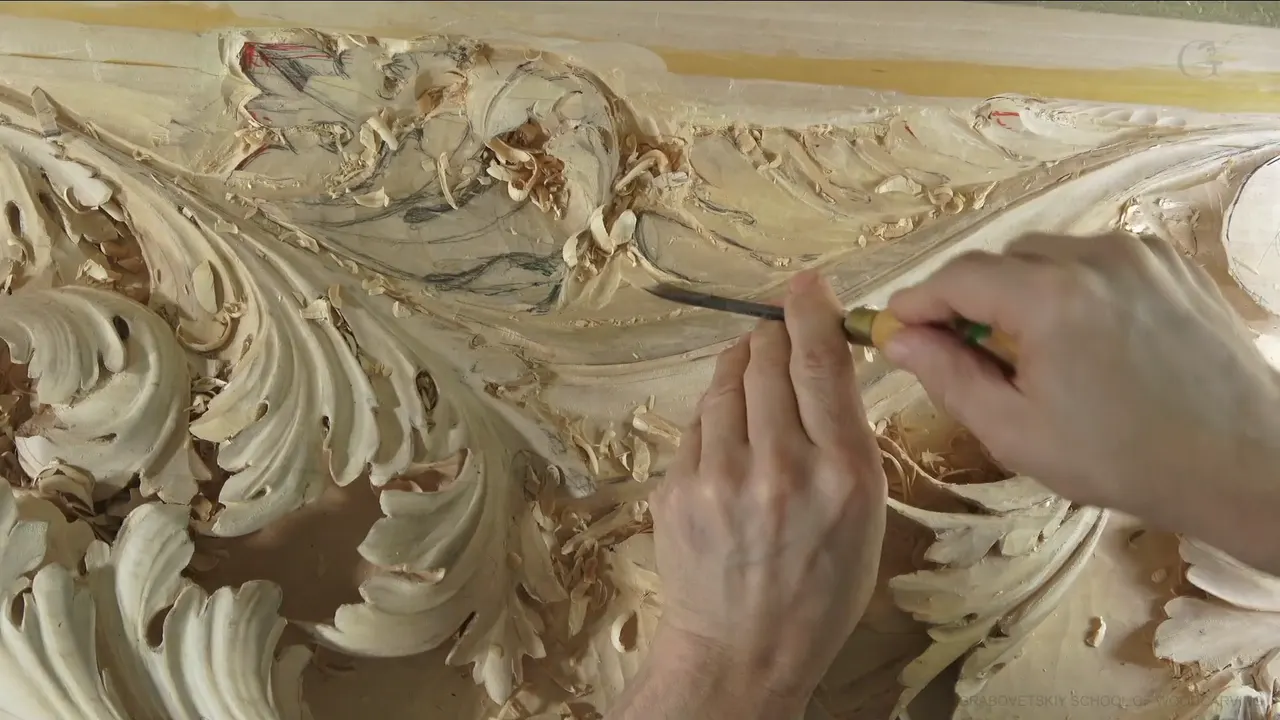

A skew gouge, in Venice Room 60, part 9, is a specialty tool that I modified with a long bevel. I love skews, I say there, and lessons from my other courses name the same tool. Each one is below, with its own words.
Do you want a cut that slices when you only push? Part 9 names the tool that does it for me, and the other lessons show it at work in tight spots.
What is the skew gouge of part 9?
A skewed gouge with a long bevel, which I called a specialty tool. Before I reach for it I say: "Okay, just create the first channel cut." Then comes a word about the veiner: "By the way, the name veiner for that tool comes from creating those veins on your wood." I add: "Or I shouldn't say on the wood, on your project."

Another specialty tool comes next, a skew. Of it I say: "Of course, I modified that. I've got a really long bevel on that, but it's a skewed gouge. Okay? Equal to number seven, pretty much. But it gives me beautiful slicing cut right on the push."
I also say I love skews, in these words: "I love skew chisels and I love skew gouges." After the pass I say: "So we get that the right way. Although I lost the line, which is okay."
How does a skew gouge slice when I only push it?

If you understand the slicing cut, I say, "what that means when you carve, you're actually slicing. Okay? You're making slices just like that." And: "I'm just exaggerating that." After that, the skew itself: "But see, with the skew, first of all, it makes it a lot easier to slice. And also, I don't have to slice it, I can just push it pretty much, and it's already going to slice it. Okay? Because the cut goes on an angle."
Is it for beginners? In my words: "So that's more, I would say, advanced topic than beginners, I would say. But it's going to help you a lot."
Where do the pipes fit in part 9?

Ahead of the next skew I lay out a plan for one pipe, and the words are these: "So now I have to exaggerate that pipe. I guess today's lesson is all about pipes, at least right now. So I need to raise and exaggerate that pipe because I really want to see that shadow casting." Its path, I say: "And that pipe is going to go all the way underneath of this pipe to create the motion."
For that I say "number 11 again," and then "Let me think." What follows: "Because I do have a nearer spot closer to this side, I can't use a really wide number 11, but I can probably use the same number 11 right now. But carefully go underneath of this pipe, like two pipes close to each other."
Near the pipe I add a warning: "And please pay attention that I'm not excavating my eyes. Eyes of Acanthus, not my eyes. Of course, that would be a big mistake to excavate my eyes. Eyes of Acanthus. All right? Sorry. So I've got to work on my language."

Of the pass itself: "But anyway, going opposite direction this way and create that channel cut." For the other side: "One side and I will do this side. But how do I do that? Again, have to swap my hands and go that direction." And: "Sorry that I'm covering with my hands again, but please understand why."
Then the shadow: "Okay, I really need that pipe. Okay. Now, to pop that pipe out, I need to excavate and take out some of that material because I really want to see a shadow. Right now, those two are too close and I don't really see any shadow. Almost no shadow whatsoever." The tool is the skew: "Okay, I'll take a skew. Skew, and let me think. How am I going to attack that? Like that. Okay. See how that helps me?"
Can you make a skew gouge yourself?

Here is part 9: "And yes, you can do those skew gouges with no problem yourself." Of one of you, who watched me use skews: "He is a professor of design, by the way, in a university. And he actually saw me using those skews and he made his own skews also from number seven. It's easy to do."
There is a back bend too: "And I've done, actually, some skews even on the back bends. Not too many, but see, this is a back bend, but it's a skewed back bend."
What do I say about skews in old work?

Of old English work I say: "if you look at the English work and tool use, like let's say when they carved for the churches and so on in 16th, 17th century, you would not find any skews. No knives and no skews like that skew gouges I'm talking about. You can find maybe skew chisels, but not gouges."
Then Germany: "But if you go to Germany to 15th century work, they used those skews all over. The reason why, because it's actually really easy for the Gothic work. If you're working with some Gothic style, and maybe someday I'm going to show you one of the projects like that, the Gothic style. It's actually really easy to connect two cuts together with similar skews, just skewed from two different positions like this. This is the same tool, but it's skewed that direction, that's skewed that direction."
Which lessons use it for tight spots?

In Hashemi Flowers 9, part 5, I say I have a skew gouge: "and this one is a #7. And this is an excellent tool right now to reach some areas that other tool wouldn't let me." And: "I could go deeper right here in this area." The next tool is a plan: "I should probably take again quarter inch #9." A quarter inch is 6.35 mm.

Carving Corinthian Acanthus Leaf 5, part 3, has this: "A really handy tool would be if you have a skewed gouge like what I have. And those come really handy in work like this."
On finding one, I say: "And sometimes it's hard to find on the market those skewed gouges. You can easily make yourself, actually. Buy just a normal gouge, and you can remake, reshape, whatever, resharpen those gouges. But you can get to really tiny spots." And a number: "This is actually just a number three skewed gouge, if you could call that way, but it's really handy."
"And you'd be surprised, you're going to use it much more than you actually thought at the beginning how good those tools are." Another reads: "I've got even number seven skewed gouge. What I did, it's number seven, and of course, I resharpen that with a really low angle, and I can get really deep, and I can remove a lot of material with number seven."

In Venice Room 7, part 7, I say: "This one I need to probably work little more a little later because I still have to develop that. But right here, I am able to, maybe on this one." And: "But I need to attack that from opposite direction, which I'm still not able to because of this almost no position for me to attack that." And: "That's why sometimes it's a wise idea to use a skewed one, skewed back bend. And do something like that. It's still not the same result what I wanted to see."
A short line sits in Hashemi Flowers 47, part 9: "I'm using a skew gouge. And that's probably sweep number five, I would say. But sometimes it's really handy in spots like that."
The Lily Box lesson 11, part 11, names two sides: "Like a skew and it's a gouge." I call it a skew gouge: "So there is two sides, right and left. All right? And I could get in and just hit that with the skew. It gives me ability to get really in tiny spots with just that point right there." Then I add: "But most of you probably don't have it anyway."
Where do I talk about slicing?
Over in Hashemi Flowers 43, part 5, I say: "And probably one of the best tools for that would be a skewed gouge. What I have, this is number seven skewed gouge, or skew gouge." Then: "But also, if you don't have a gouge, you could use just a knife. Just a normal wood carving knife. I really like this number 12. And what you could do, just remove and go in."
Part 6 of that lesson has what I said about slicing cuts. My words: "I told before about slicing cuts, when you cut and you're moving your tool to the right or to the left, doesn't really matter," and "that actually creates the slicing in the fibers, just like that." And of the skew: "On a skew, to create that slicing, you don't even have to move it like that. So you can just push it, and just because it's already skewed, it actually creates that slicing on its own. And especially it helps on the end grain."

The Carving Hazelnuts 4 lesson, part 2, says: "You can use any skew gouge or even just number three normal gouge."
What do I plan to use it for?

Back in the Lily Box, part 6 of lesson 11, I say: "Again, I'm using just a skew gouge, number one, and establish my form. Creating just a 90-degree cut. If you look from the side, you should see that what I did, essentially, I created some space for me to work around."

A plan sits in Venice Room 19, part 5: "Keep the edge really smooth and nice. Okay? And go a little bit inside like that." Then: "let me use a skew gouge again and go from the bottom up."

Another sits in Venice Room 56, part 4: "Because I have plenty of space right now to work with, I could take number 11, a skew gouge, or skew chisel. Not a skew gouge, not a skew chisel, skew veiner. And scoop out all, whatever I need to scoop, and create beautiful transition on inside."

Workshop 63 of the Venice Room, part 5, gives a number: "Maybe I can just use a little smaller tool and start. What I'm using right now, it is a skew, and that's slightly bent." Then: "Skew gouge, number seven. Okay. That's what it is." And a maybe: "Maybe skew the opposite direction. Going to give me a much better cut."
Last in this group, Floral and Molding for the Panel 3, part 2: "You know what? I do have a really good tool for that. I've got skewed gouge. And let me use it. Maybe number seven, and it's going to be a skewed one. Like a skew number seven, okay?"
Do I own more than one skew gouge?

After a stretch about lights, tools on the workbench and skew chisels, I say this in my April 2020 livestream: "And yes, I do have actual skew gouges too. I really love skew gouges." Of one I say: "Here it is. There's a skew gouge. It's also a skew, but it's number seven."
Which lesson says which number?
Numbers read lesson first and part second, so 63.5 is lesson 63, part 5. A cell that says none named means the lesson names the tool and gives no number.
| Lesson | What the line goes with | Number |
|---|---|---|
| Workshop 60.9 | A modified tool, a long bevel, slicing right on the push | About seven |
| Corinthian 5.3 | A skewed gouge made from a normal gouge, to reach tiny spots | Three and seven |
| Hashemi 9.5 | An excellent tool for areas another tool would not let me reach | A number 7 |
| Hashemi 43.5 | Corners taken inside, with a knife as the other choice | Number seven |
| Hashemi Flowers 47.9 | A sweep of probably five, handy in spots like that | Number five |
| Venice 7.7 | Almost no position to attack, so sometimes a skewed one | A back bend |
| Venice 19.5 | An edge kept smooth, and a plan to go from the bottom up | None named |
| Venice Room 56.4 | Plenty of space, and a plan to scoop out the inside | Number 11 |
| Venice Room 63.5 | A slightly bent skew, and a maybe for the opposite direction | Seven |
| Lily 11.6 | A 90-degree cut to establish my form | Number one |
| Lily 11.11 | A right side and a left side, for really tiny spots | None named |
| Floral 3.2 | A really good tool for that, and a plan to use it | Maybe seven |
| Hazelnuts 4.2 | Any skew gouge works, a normal one too | Number three |
| April 2020 | A stretch about skew chisels, then actual skew gouges | A number seven |
Where can you watch every lesson named here?
Each one sits inside a course of my wood carving school. The Venice Room Part 5 course holds workshops 50 to 61, and workshop 60 is the lesson for this page. For a place to begin, start here.
How it's done
- Open with a channel cut. I opened by saying to create the first channel cut, and then I named a specialty tool.
- Use the long bevel. The skew is modified, I said, with a really long bevel.
- Push instead of slicing. The angle of the cut does the slicing, I said, so pushing is enough.
- Plan the pipe. I need to raise that pipe, I said, and I can probably use the same number 11 right now.
- Take out material. To pop that pipe out, I said, I need to excavate and take out some of that material.
- Attack that spot. I'll take a skew, I said, and I asked myself how I am going to attack that.
Frequently asked questions
What did I say a skew does when you push it?
The angle of the cut, I said, means pushing is enough and the tool slices. I also said that when you carve, you're actually slicing.
Can you make a skew gouge yourself?
In part 9 I said skew gouges can be done with no problem yourself, and that a viewer made his own from number seven. In Corinthian Acanthus 5 you can buy a normal gouge, I said, and remake, reshape or resharpen it.
Why did German carvers use skews, in my words?
In 15th century German work, I said, they used those skews all over. The reason I gave was that Gothic work makes it easy to connect two cuts with similar skews, skewed from two positions.
What to carve next