

Alexander Grabovetskiy, woodcarver, School of Woodcarving · Published 2020
What does a wood carver mean by "messed up"?
Quick answer: In part 11 of Venice Room 60, I apologize for all those marks. In other lessons I say messed up beside an edge that slipped, a notch, a line and a drilled hole. The lessons are named below, each with its part.
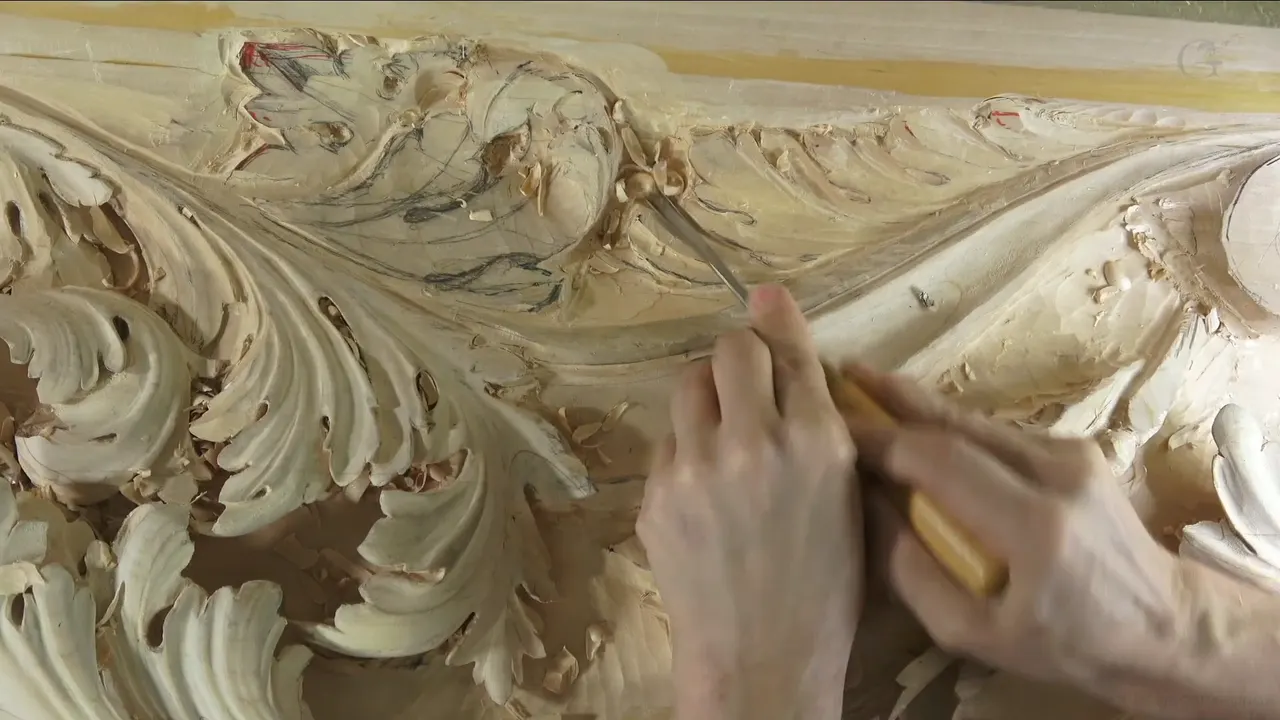

In Venice Room 60, part 11, I say: "I apologize that I messed up a little bit with all those marks." Other lessons of mine use the same two words beside a tool that slipped, a line, a notch and a hole I drill. This page lines them up, and every quote names its lesson and its part.
Have you drawn so many pencil lines on a board that you could not tell them apart? Below is part 11, and then the lessons where I say the same words.
What did I say about my marks in part 11?

The apology comes near the end of the part. Right after it I say: "I just want to make sure I am on the right track." One more line closes the part: "Also, what I want to do, I want to kind of go to this point with the middle line."
What was on the board before the marks?

Early on: "I really want to exaggerate. And I also want to raise upward the right-hand side." About the middle: "there's going to be a middle ridge. And the middle ridge, I need to make sure it's in the right position." A line follows: "Again, it's kind of hard for me to see that. It's okay."

Without the first tool I name, I say, a skew chisel will do: "Even the big one. Okay? Like that." Knock down whatever you don't need, I say, and: "Blend that out there." About this tool: "This tool has created some more problems for me, and I need to clean it."
Which gouges did I name in part 11?

For one division I name number 11: "And for this, I'm going to use again number 11. I'm talking about for relieving, okay? For relieving those triangle areas." Later I say "Got the relief," and I plan to pull number five or number six, whichever turns out to be better.

The drawer gets a line: "It's actually number six, but how has it got in my number five drawer?" Then: "All right. Number five." I plan on number five at 16 millimeters (0.63 in) by my figure: "Number five and approximately 16 millimeters." The inch figure I give is 5/8 (15.9 mm).
"Maybe a little bigger than that. Maybe about 17 or even closer to 18 millimeters." Those are 0.67 in and 0.71 in. I close the size with "But not quite 3/4 of an inch." Three-quarters of an inch is 19 mm.
How deep did I plan the first shadow line?

"Okay. So now we've got that shape done, and I'm kind of happy, and I can start excavating little underneath." I plan to start with "only one millimeter first," which is 0.04 in. My words for it: "Because all I need is just a shadow line. No more than that in this area."
Where did the volute and the flower fit?

"Well, I think for me, probably right now would be a really smart idea to start developing of this section right here." I say that section "has to become a volute," and: "So I have to work on this volute now."
A corbel is in my plan too. Then I say I need to develop the overall idea at the end: "There's going to be a corbel connected." Another line there: "But I don't want to mess up overall feel." A flower will stick out somewhere in this area, I say, with "an interesting movement going like this."
The middle part: "So it actually has to kind of repeat this shape and taper a little bit. It has to be tapered angle."
Do parts 10 and 12 mention marks too?
Part 10 has one line: "It is kind of messy, but it is what it is." In part 12 I say: "I'll use a blue marker, so that way I'm not going to forget what is what." Further on there: "Oops, shouldn't put that marker right there."
When a tool slips, what do I say?

Part 12 of Venice Room 46 has the slip: "Oh, that's bad. That is bad what just happened. I slipped, and I messed up with my edge. But I'll fix it. That's okay. Well, it's not okay, but I'll fix it." Later in that part: "Maybe I need to just go with this tool."
Venice Room 47, part 3, goes like this: "Maybe I should use just a number five, but not the six. But I did six." A second line from that part: "And I messed up a little bit with this a little earlier, so I need to fix this moment also."

In Venice Room 32, part 7, I say I messed up while I attack from one side: "Got a little closer than what I need to. Got too quick." Later in that part: "And that is better for me to take time not to rush it because it's easy to make mistake, but it's hard to fix it."
Which lessons talk about pencil marks and lines?

Workshop 73, part 11: "But before I do that, I need to see that in the overall how it looks, right? And yes, I know I messed up. Not messed up, but I got too many marks, pencil marks. I need to take out those pencil marks, and you will understand much better what I'm talking about."
In Carving Greek Acanthus Leaf 4, part 3, about lines: "Although don't pay attention to the lines yet because they are messed up right now and we're going to reestablish them later on." On a mark I plan: "But right now, before I lose this detail, I'll make sure I'll place my pencil mark,"

Workshop 160, part 2, is about a line I placed: "So which means the line I placed, this line is no bueno. No good." Then: "And I messed up in my favor because I'm still able to take some material out." After that: "I am able to take some material out, and I place my big gouge and try to fix it."
That same workshop, part 3, has: "I was afraid I messed up really badly."

Over in Carving Vase with Grape Leaves 1, part 12, a background gets the words: "Including that piece I messed up." From Venice Room 7, part 4: "So really important for me not to mess up. Because every line now, it's almost final line." Further on: "I messed up, which is still okay." After it, another: "I did not mess up, but just because I had some uneven spot."
What about a cut that went too deep or too weak?

Carving Grape Onlay 4, part 2: "Oops, I just messed up big way actually. Okay, so change of design. I mean I could glue it but uh, probably not gonna do it. I'll just lower down the whole section." The next line: "I just messed up. Oh, I see why, because I already excavated too deep."
Number 11 and two millimeters (0.08 in) are my plan in Carving Furniture Panel 29, part 3. The slip: "made it little too weak, but it's okay. I'll get, you know, my waviness with the number 11."

Venice Room 16, part 11, is about a ridge: "I messed up little bit. Not messed up, but because I chopped, so now it's not consistent. Okay. So got to take care of it." The line after: "And see, that's not the right tool or not the right direction."
About the flow, Venice Room 11, part 3: "I messed up with the flow, but it's not actually what I messed up. I did not mess up the overall movement." Of a bump I say: "I can see the bump right here. Which should not be there." I add: "Take this bump out."
A fix for what I messed up is named in Venice Room 14, part 2, and: "Which is still not a big mess I created, but still it's not so good. I shouldn't do that. I wanted to keep it a little bigger, but that's okay."

Carving Roman Acanthus 15, part 2, has a carving knife: "And what we can do in cases like that, we could just create extra notch, and let us repeat on this side. Or extra subdivision, I should say." On the knife: "And I'm going to use just the number 12 carving knife and make that extra subdivision because I messed up." Then I say I got "too carried away, too much."

A notch is in Venice Room 73, part 5: "Except I kind of messed up previously. See that notch right here? So that needs to be addressed and fixed."
In Grinling Gibbons class in Maine 17, part 3, about a roll: "it's supposed to roll at the same direction, but since I didn't do that in the beginning. I should say I messed up at the beginning."
Floral and Molding for the Panel 3, part 1, is where I talk to you: "just slightly deeper, and you messed up." The next line: "Well, it all depends. If you're trying to do the lifelike human face, and if you're trying to get a certain person, every slice matters."
Which words go with a drilled hole?

The hole is in Venice Room 79, part 12: I have to drill "about an inch and a half" (38 mm). I mention a slip, and: "Here you go. Let me double-check." Later: "Okay, I've got about five-eighths of an inch more, about 16 millimeters more."
Then in Venice Room 81, part 2: "Okay, and I have to drill approximately at three-quarter of an inch." That is 19 mm. After it: "And double-check if I messed up. And yes, I did mess up."
When was a slip only small, or only a close call?
In Floral and Molding 3, part 2, I am "almost there," I say, and: "So really dangerous. So almost messed up. I didn't mess up, but pretty close. Really, really close already."
Carving Plate with Butterflies 13, part 3, has this: "I almost messed up. So that is about three millimeters right there." Three millimeters is 0.12 in.
In Carving Authentic Venice 15th-century Room 154, part 1: "And let me check if I messed up or not. I hope I did not. And no, I did not. I still have about 16th of an inch, so that's good." A 16th of an inch is about 1.6 mm.
And in Venice Room 123, part 2, a mallet is in the way: "And that is good, except I messed up little bit, just a slight area." Next comes "There is a mallet in the way." A tool follows: "I can take number seven, 14 millimeters, and create some corners." Fourteen millimeters is 0.55 in.
Which workshop gave me which line?
Numbers read workshop first and part second, so 73.11 is workshop 73, part 11. Each row below is one line from one lesson.
| Lesson | The slip, in my words | Next |
|---|---|---|
| Venice 60.11 | Marks on the board, with a middle line still to go | Right track |
| Venice 73.11 | Too many pencil marks, taken out so you understand better | Take out the marks |
| Greek 4.3 | Lines, and I say don't pay attention yet | Reestablish them later |
| Venice 73.5 | A notch that does not look too good | Addressed and fixed |
| Roman 15.2 | Too carried away, too much, with the carving knife | Extra subdivision |
| Venice 46.12 | An edge that slipped, which I call bad | Fix it |
| Venice 47.3 | A little bit, a little earlier | Fix this moment |
| Venice 32.7 | A pass that got a little closer than I need to | Not to rush it |
| Venice 16.11 | A ridge, after I chopped, no longer consistent | Take care of it |
| Venice 11.3 | The flow, but not the overall movement | Take this bump out |
| Grape Onlay 4.2 | A section where I excavated too deep | Lower down the whole section |
| Panel 29.3 | Made it a little too weak | My waviness |
| Venice 160.2 | A placed line, and I say no good | My big gouge |
| Venice 123.2 | A slight area, with a mallet in the way | Number seven |
| Venice 79.12 | A drilled hole, and a check right after it | Let me double-check |
| Venice 154.1 | A check, and no, I did not | Reestablish my line |
| Floral 3.2 | A spot that was really, really close | My line |
| Butterflies 13.3 | A measure of about three millimeters | The right one |
Where can you watch every lesson named here?
Each one sits inside a course of my wood carving school. The Venice Room Part 5 course holds workshops 50 to 61, and workshop 60 is the lesson for this page. Other lines come from many courses, among them Furniture Panel and Grape Onlay. For a place to begin, start here.
How it's done
- Check the middle ridge. I need to make sure it's in the right position, I said.
- Relieve the triangle areas. Number 11, I said, for relieving those triangle areas.
- Pick the size. Number five and about 16 mm (5/8 in).
- Start the shadow line small. Start at one millimeter (0.04 in), I said. A shadow line is all I need there.
- Mind the overall feel. But I don't want to mess up overall feel, I said.
- Go to the middle line. With the middle line, I said, I want to go to this point.
Frequently asked questions
What did I apologize for in part 11?
For my marks. Right after that I said I just want to make sure I am on the right track.
How deep did I plan the first shadow line?
I said I would start with only one millimeter first (0.039 in). No more than that in this area, I said.
Which tool is for the triangle areas in part 11?
Number 11. After I said I got the relief, I talked about pulling number five or number six.
How big was the number five I named?
What to carve next