

Alexander Grabovetskiy, woodcarver, School of Woodcarving · Published 2020
What does a wood carver mean by "readjust"?
Quick answer: "Readjust" is a word I said near the end of Venice Room workshop 78, part 1, about working on a big part and then switching to tiny details. In other lessons it comes with a camera, the lights, a vise, a marking gauge, a sharpening jig and a line on a petal.
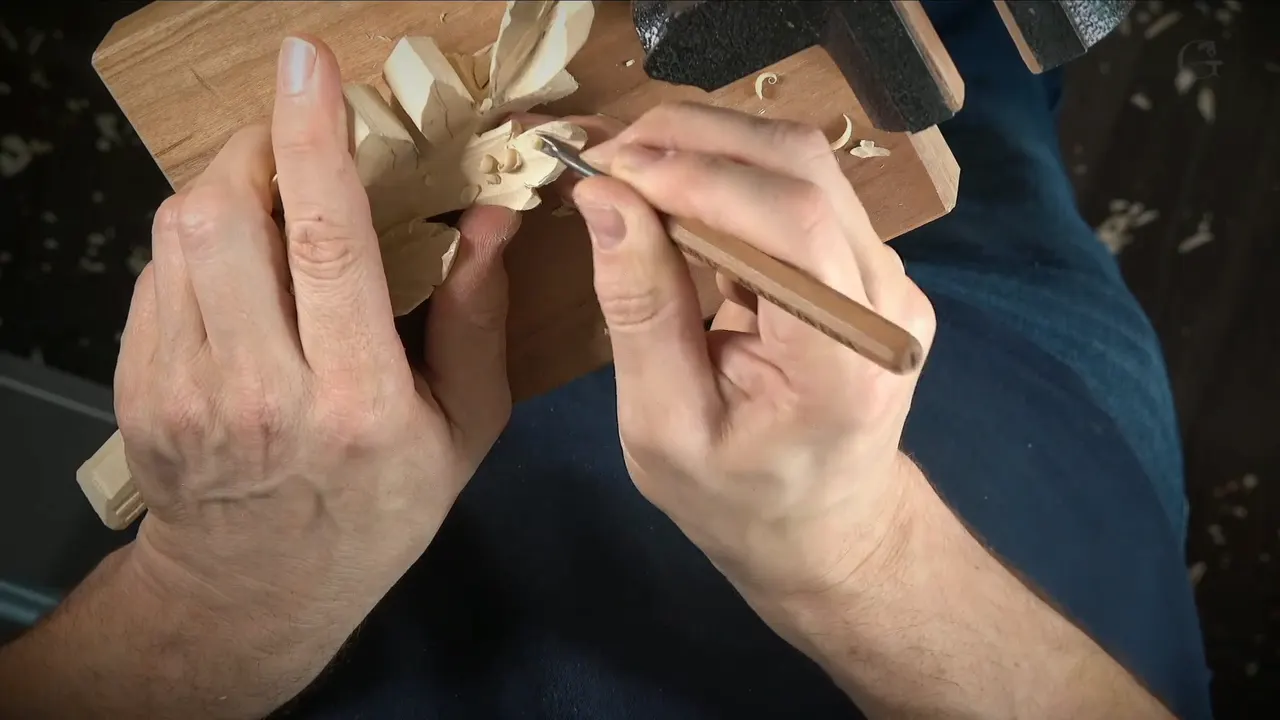

"Readjust" is a word I said at the end of Venice Room workshop 78, part 1, after really aggressive cuts and a switch to tiny details: "Sometimes it just takes time to readjust." In other lessons I put the same word in front of a camera, the lights, a vise, a marking gauge, a sharpening jig and a line on a petal.
Ever gone from big, fast gouge work to one small curl, and watched your first small stroke come out wrong? Did you stop and look before the next one? Come through part 1 with me, then through the lessons where I used the same word about a camera, a gauge or a jig, and see what came next.
What was I doing in part 1 before I said the word?
The piece was waiting for its clean-up. "And yes, a little later, I'm going to just fasten that in a vice and clean everything," I said, "because it doesn't look too appealing right now." And "I'm just establishing the form."
A small curl was the plan. "What I could do, I could kind of create a small curl," I said, "just make it look like this curls upward that way." It would take "a small gouge like this," and I was unsure of it: "I'm not sure if I should do it or not, but I think it's going to look kind of interesting."

Soon I said "It already should look like it's curling," and "Of course, I can do it a lot more." Two concave cuts were still to make. Then a check of the wood: "I don't have too much thickness. I've got less than 32nd of an inch right here." That is under 1/32 in (0.8 mm).
Next, a smaller gouge, "maybe just about 16th of an inch, a millimeter and a half." A sixteenth of an inch is 1.6 mm, and a millimeter and a half is 0.06 in. With it I could "excavate inside a little deeper shadow, and create that curling effect, going all the way to the edge."
"All right. So you should be able to catch that, how it curls." Next, "let me clean a little bit on the side," and "I need to clean a little bit this edge." Then "It's already establishing the form."
What went wrong on the other side?
Jumping to the other side, one part "needs to be glued again." "I wasn't too careful, I guess," I said. I kept going: "But anyway, let me work on this one, and I'll take care of that one. We'll see." One idea was "Maybe I can just make them much shorter, just a small section, get rid of this completely," and I added "we'll see, because it just doesn't look too good right now."
A second curl was another plan. "I think I could curl this one up also like this," I said, and "just repeating this side." Maybe it was a good idea "to fasten it inside of my vice." For the tool: "maybe I can use a little bigger gouge, maybe number eight, let me think." Then "Number eight or number nine will work, but let me make the decision. Let me use number eight, and we'll see."

After "we'll see," I said "Maybe it's a little too big." Close behind it, "And hopefully, I'm not going to break it anymore." Then I said it. "I wasn't too careful at the beginning. That happens sometimes when you're working on a big part, like really aggressive cuts or what I was working before, and then you're switching your brains to tiny details. Sometimes it just takes time to readjust."
In part 1, the word is about me, and no camera, light or tool comes with it. In the lessons below it does, and each has its own next line.
What did parts 2 and 3 of workshop 78 show next?
Part 2 opens with "Number 8. That's what I'm using right now, and that would be about a little bigger than a quarter inch. Okay? Seven millimeters to be exact." A quarter inch is 6.35 mm, and 7 mm is 0.28 in. "Make a little bigger, deeper excavation. We do have a lot of material on the backside right in the middle, so I'm safe there."

Part 2 also has "I mean, I shouldn't be that aggressive right here." And an "Oops," followed by "That's good that I have wood flooring."
Part 3 brings "I'll take number eight again and carefully attack that from the backside." Of a thick part: "I really don't need that much right here, so I can probably get rid of lots of it." Near the edge: "I am all the way, I think, to the edge, so I should not do more than that." Then "I can probably just take a knife right now. Any knife will work."

Which other lessons had me readjust a camera?
Venice Room 50, part 9, has "So big chunk, but beautiful chunk. Okay? Let me readjust my camera and I'll meet you there."

Part 3 of Venice Room 88 has "I apologize if you don't see that." A little readjusting of my camera would help you understand, I said.
In Venice Room 86, part 8, "I am safely, safely, safely able to remove that chunk." Next came a plan to readjust the camera and start working on that.
What about the lights?
Lights first, in Venice Room 66, part 10. My plan was to develop this side and take care of cleaning up later, "probably off camera because there is no reason to spend time on that." Next, "Let me readjust the lights. I'll just little bit readjust that so I can see it much better." Then "Okay. It's good."

Furniture Panel 19, part 7, has a magnifier line. "But I really should use a magnifier. And let me bring my lights closer where I can see." Then "I'm going to readjust everything." After that, "I can see much, much better right now."

A line about the lighting is in Venice Room 155, part 3: "I need to readjust the lighting. It is a little too bright, I would say." Then "But take a look from above."
A lamp shows up in Lily Box 7, part 5. "I do apologize if there is going to be some color adjustment on the video because I'm using a magnifier lamp," I said, and "camera trying to readjust the exposure." In part 10 of Venice Room 50 it was the shades: "I need to close my shades. Otherwise, it's not good." And "The color of the shot going to readjust in just a moment."
What if the camera cannot be readjusted?
Part 3 of Venice Room 163 covers it. The rest would be "off-camera because I have to attack that from that position." Next, "there is almost no way I can readjust the camera positions." Then my table: I would readjust it, work on it and show the final result.
Part 1 of Venice Room 162 has a clean side on the right and a rough side on the left. "I wish it's the opposite way," I said, but I had "readjusted my cameras and readjusted my position," so I would carve it that way.
The Furniture Panel gives a reason for breaking a rule, in lesson 16, part 9. Cutting against the grain versus with the grain happens "because the position of my cameras." And "I don't really want to jump around and readjust my cameras all the time and waste a lot of times."
A vise came into it in Venice Room 91, part 6. I was not sure how to show you what I was doing on that side, and the plan was to readjust my vise.

Pinching comes up in Venice Room 92, part 8. "Oh, I'm sorry. You didn't see that. So what I did, actually, I just readjusted with the pinching on my iPad."

Which marking tools did I readjust?
In Carving Greek Acroterion 1, part 3, I wanted to be sure I was not going "deeper than that line right here." "So for that, I'll readjust my marking gauge. I'll make a notch." Then "Need to readjust. I guess I didn't tight that enough." And "I'll make a line."

Part 5 of that lesson has "I'll take my marking gauge, readjust it to about eighth of an inch, or just place my cutting part of a marking gauge in a notch I just made. Make sure it's tight, and then I'll just mark it." That is about 3.2 mm.

A rod comes up in Floral and Molding 1, part 2. "I can extend my rod, and let me first try if it's going to work or not." Next, "Okay, let me take it back. And readjust." Later in that part, "looks like I've done another mistake. I have to readjust right now because it is going to be in my way." Remeasuring was part of it: "Which takes only about one second. It's not a big deal."

Venetian Flowers Rosette 1, part 1, is about dimensions. "I readjusted a couple of times until I'm really satisfied with the overall dimensions." The first one "was a little too wide," the second "a little too narrow," and "that red line is actually perfect."
Which sharpening jigs got readjusted?
Sharpening a Fingernail Gouge shows a jig with an adjustment, zero to five. At zero it is for straight gouges. Then "if you readjust that slightly forward," it makes "the bevel as a fingernail."

Later in that video I said "So let's readjust that first. Okay, right now it's at zero, but I want to take it first halfway and see what's going to happen." The jig would go "on three, on a mark three." A little later, "I was working on sharpening a spoon gouge, so let's readjust that back."
With the V tool, in Sharpening a V Tool, I would readjust the angle. "I need to check. It's a little too high angle, so as low as possible." A back bent gouge, in Sharpening a Back Bent Gouge, needed "to lower that down a little bit. So let's untight that and readjust it little lower." Then "Yeah, I can actually go even slightly lower than that. Let's tight it down again." Next, "I'm just eyeballing, so I'm not measuring my degrees."

The Maine Coast sharpening class has leather and felt. "Now your height changes. My height changes, yes. You have to readjust, but I'm not going to use jig on leather or felt." Leather is for stropping, I said, and felt is for honing.
Which lines or depths on the carving needed readjusting?
In Lily Box 10, part 6, "maybe I need to create an even deeper concave on the inside right here." Next I said maybe the line would have to be readjusted.
Slopes come up in Venice Room 62, part 10, which opens with "And yes, I could go slightly deeper and readjust my future slopes."
Before a router plane pass on the Furniture Panel: "if you would ask me if I'm afraid to lose how deep I've done in other areas, not really. I'm not, because I can always check that back and readjust that. It just doesn't take too much effort." Lesson 16, part 2, has it.
Part 4 of that lesson has a blade change. Nothing needed readjusting after it, I said: "Just stays at the perfect same position."

Where does each readjust sit next to the others?
Each lesson here, what I readjusted in it and the next thing I said.
| Lesson | Readjusted | Next |
|---|---|---|
| This video, 78.1 | Me, after big cuts, for tiny details | Takes time |
| Workshop 50.9, with a big chunk | My own camera | Readjust it, and I'll meet you there |
| Room 66.10 | The lights, to see it better | Okay, it's good |
| Panel 19.7, with a number three tool | The lights | I can see much, much better |
| In Room 155.3 | Readjust the lighting, a little too bright | From above |
| Workshop 163, part 3, camera positions | Almost no way | My table, then show the final result |
| Greek 1.3 | The marking gauge, for a line | Not tight enough |
| Floral lesson 1.2, measured with my rod | Remeasure it | Takes just a second, nothing more |
| Venetian Rosette 1.1 | A couple of times, for the dimensions | Red line |
| Sharpening a fingernail gouge, the jig | The jig's adjustment | Halfway first, then on a mark three |
| V tool | The angle, a bit too high | Make it lower |
| Panel 16.4, with a router plane blade | No readjusting | It stays at the same position |
Where can you watch part 1 and the lessons on this page?
You can watch part 1 in Venice Room 78. The course page, Venice Room Part 7, holds workshops 74 to 85. The other lessons named here are linked where the page is public, and a workshop number means the Venice Room.
Want to hear me say it in my own voice? Start here.
How it's done
- Check what the wood has left. Before the smaller gouge I looked at the thickness. I had less than 1/32 in (0.8 mm) right there.
- Name the small gouge. My plan was about 1/16 in (1.6 mm) to dig a deeper shadow in the curl.
- Say what went wrong. A part needed glue again, and I said I was not too careful at the beginning.
- Pick the next number. Number eight or number nine would work, and I said let me use number eight, and we'll see.
Frequently asked questions
After aggressive cuts, what did I say about tiny details?
I said it happens sometimes when you work on a big part and then switch your brains to tiny details, and that readjusting takes time. The line is in part 1 of Venice Room 78, close to the end of the video.
When I readjusted my camera, which words came with it?
Venice Room 88 carries the line I apologize if you don't see that, and a little readjusting would help you understand. The Furniture Panel course adds that I don't want to jump around and readjust my cameras all the time.
Which words went with a marking gauge?
Greek Acroterion 1, part 3, has the words I guess I didn't tight that enough. Part 5 sets the gauge at about an eighth of an inch (3.2 mm). Before that I wanted to be sure I was not going deeper than that line, so I would readjust the gauge.
What to carve next