

Alexander Grabovetskiy, woodcarver, School of Woodcarving · Published 2020
What does a wood carver mean by "what did I do"?
Quick answer: "What did I do?" is what I said in Venice Room workshop 78, part 6, right before "I just broke my separation cut." In other lessons of mine the same four words come beside a measurement, a gouge number and a line I could not explain, and what follows is different each time.
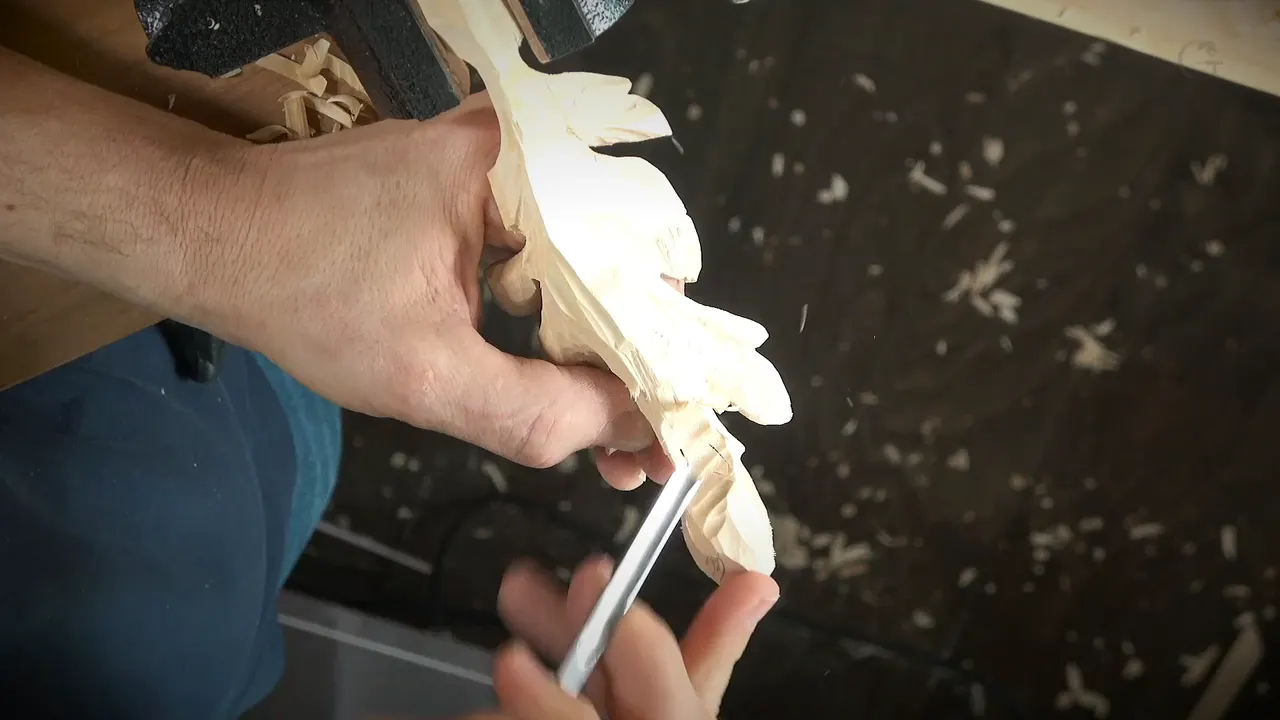

The question I asked in Venice Room workshop 78, part 6, came just before a cut broke. My other lessons carry the same question beside a measurement, a gouge number and a line I could not explain.
Ever lifted a gouge and not been sure what the last pass did to the leaf? Does a spot look different the second the tool leaves it? Those are the moments in wood carving when I say it out loud, and the lines below are my own words, lesson by lesson, with the course each one comes from.
How does part 6 of workshop 78 begin?
It begins with a warning to anyone not used to that movement: "I know if you're not used to that movement, it's kind of scary. But it is stable." A confession follows: "I hate that I made a couple mistakes and broke the leaf. That's just because I wasn't too careful." Then: "But if you get in a mode, if you know what I mean by get in a mode. So you should be safe."
I planned to get number seven again and "bring the cuts over to what I just excavated." The check came next: "Got to check," then "I'm pretty close," and "that's probably the most I can get right here." One more line closed it. "It would be a big mistake for me to get more than that."

Then the question, and "I just broke my separation cut" came with it. Next: "It's okay, I'll fix it. It's not a big deal." A guess about the cause followed, "Maybe I was just a little too aggressive." Then: "But right here, that's a big chunk I need to get rid of."

Where did the checking go after the break?
"Let me check," I said, and a look at "How it's going to look" came next. My forecast was "pretty good." What I was checking came next: "I just want to make sure everything is going to work out with this part. So which means I need to actually excavate a little more right here."

A small gouge could do it, I said, and I could "work my way in." Turning the piece was next on the list, "Let me turn it a little bit," and after it "I'll use just a small gouge right there." The last order of that stretch was "Bring that right to the edge."

Closing lines are a plan, "let me get rid of this chunk with a small tool." I was "really close," I said, "but I still want to do it right to the edge."
What do the next parts of the lesson say?
The next part opens with "And little by little, I can get better and better result." Of one spot I said, "Okay, right here is a big chunk I don't need. This is a big hump."
It carries a number, too. "Again, I'm checking I've got no more than one-eighth of an inch right in the middle," I said, and that is 1/8 in (3.2 mm). A guess is the next line, with a way to measure it: "Of course, I'm just guessing, but you could measure that with the calipers." My own word on that was "I really don't need to."
Where does it sit beside a slip?
Workshop 43 has one, in part 1. Just before it I said "And now it blends nicely." My answer sat right behind the question: "I pushed too hard. That's what I did." A need came with it, "I need to go from this side now and clean it, because I just messed up," and the size of the mess, "Little bit, not much, but little bit." Last: "So still fixable."

The same part has "It gave me really nice movement, but I don't like 100%."
Butterfly plate lesson 12 is a case: part 1 has me tell you to keep a small gap from the line, and that way it gets a lot easier for you. "And here you go," I said, and the question came. Next to it sat "Some kind of mistake. This way right there." Then: "All right, that would be preliminary movement. And let me think what we can do." Volutes were an option if I wanted them, I said, but "I'm not sure if I wanted to or not."

Byzantine acanthus lesson 3, part 2, holds a spot where "you have to start that cut. You can finish it." Farther along the words were "But that's okay. That's fine. I'll just use a bigger one. Doesn't matter." Then: "And I'll fix that one."

Workshop 65, part 9, starts with a long bevel number five and a plan: "I'll fix that movement right here." Next came "Sorry that I'm covering with my hands," and the question followed. The next words were "And yes, that needs to be also taken out. And that needs to be fixed also." The underneath will be undercut later on, I said, though "maybe not later on. Maybe I'll just chop some of it right now."
The other side of a slip is in Venice Room 127, part 2: "And that is not good, what I just done, but it's okay." The need was "I need to relieve it much better now and make it a little deeper." Good movement was still ahead, I said.

Did the answer ever turn out good?
Furniture Panel lesson 15 says it did, in part 4: "Yeah, let me think. No, I didn't do anything bad. I've done actually good." A warning came next, "Be careful if you're doing again along the grain." Only 1/16 of an inch (1.6 mm) of design would be right there later on, I said, and "I don't want to destroy that." Too fragile, I added. Of the tool, I said number five on 12 mm (about 0.47 in), and that it would be exactly the same depth, 1/8 of an inch (3.2 mm).

In part 8 of that course's lesson 17, a knife is the tool: "I'll just use a knife." "Right here" went with the question. Two sizes followed, both 1/16 of an inch (1.6 mm), the second for a boundary line. A volute was coming, and then "Right. Good. Now I think I'm ready."

Lesson 9 of Floral and Molding, part 2, begins with a measurement. "Let me check actually how big it is on the first one, and it looks like it's about six millimeters or so, about a quarter inch." I added "Let me draw that." Next to the question I described a leaf that would go below, another leaf, and a small separation, and I said "it should look good."

Modern Acanthus lesson 6, part 2, goes on into a lesson. I said "It's the overlapping motion," and next "Create couple concaves on one side is going to be concave and on another side going to be also concave." One more line: "I'm not creating too deep of a cut."

When did I forget what I had done?
Floral and Molding lesson 4 has me measuring in part 3: "I need to measure how I've done on my original piece." Then the question, and "Oh, I know what I did. I forgot to make it tight." The depth came after it, "no deeper than about three millimeters, about one-eighth of an inch at the lowest spot," and I called it good.

Lesson 39 of the Furniture Panel series has another answer, in part 1. I said 2.5 mm (about 0.1 in) and that I would outline again, just carefully, and "You don't wanna destroy the design." A line had a continuation, and I did not remember why I did it kind of this way, slightly. "Don't remember," I said, "But anyway, I'll go straight first." Of the memory: "Later on, maybe I'm gonna remember why I've done what I've done."

Does it come in another form?
It does, with a "why" in front. In lesson 26 of that course, part 2, I said "So why did I design that? I have no idea." I think I made it overcomplicated, I said, but not really, and it would look good. Maybe a small number 16 V tool, at 35 degrees, would outline it.
Lesson 37 of that course has it, in part 1, as "And if you would ask me why," said of a first cut. The fibers came next: "I don't have to create a lot of stress in the fibers."
Part 2 of Venice Room 59 has a "why" about a drawing: "Because it's easy to draw something and then kind of think," and the question ends there. My reason came next: "Because I still have to be able to carve it, and the challenge is it's really challenging." So: "I have to think twice or more before I do something like that."
Does the same look back come in the past tense?
In Furniture Panel lesson 23, part 4, "See, that is a mistake," I said, and "It's not that bad and all." Then: "I've got too deep with the undercutting, and I just created an extra movement, which is absolutely okay."
Floral lesson 12, part 3, has me call a slip a mistake. The chip got this line: "See, I just chipped that, so not too careful." My note to myself was "Got to be more careful. Which is okay."
Hashemi lesson 6, part 6, goes with a number one chisel: "Okay, I'm just using number one chisel." A slip is next, "I made a mistake. It's okay."
About a broken spot, Venice Room 40, part 9, has "I also want to clean this because I broke it." Then "When I was working on inside, that's not good. But it's really easy to clean. Just like that." In Venice Room 20, part 10, the line is "And yes, I should not do what I've just done" and then "I just have to be more careful."
Which gouge numbers came beside it?
Venice Room 83 holds this in part 1: "I'm happy with the result like it is right now. So let me take again number one. Number one, if I can find it." The question gave way to "Right here," and then "It's already placed back, and I can just shave it to the final form." A smaller tool was the next plan, "like one and a half millimeters" (about 0.06 in).

In Venice Room 2 the words come with a number too. In part 4 "my number seven" came before the question, and "Okay, number seven" after it. My warning was "got to be really careful because it looks like I'm splitting all the way down, and I don't want to do that." So the plan was to attack from two sides, upside down. Then: "And that makes me worry what I've just done right here."

Venice Room 127, part 2, has number seven too. It comes just before the question. Then came "Okay, number seven," and a plan to establish my letter S curvatures right away.
Lily box lesson 5 offers a bigger number 11, in part 1: "I could use again, bigger number 11." What followed was "Like three millimeters at first, and remove some of the material," and that is about 0.12 in. Next, the one millimeter (about 1/25 in). It would lay almost flat on the surface on one of the sides, and excavate underneath. Going on that way could connect two surfaces, so you would see a light through. "But I don't really need that in this case."

The Grinling Gibbons class in Maine has the words with number 16. In lesson 11, part 3, I said "I think it's gonna be good idea to use. again number 16" and the question followed. Then: "number 16 and 35 degrees 3 millimeters" (about 0.12 in) and "and I really love that number 16 because it just you know, really nice cuts." The tool would go on upside down, "Let me use that tool upside down," so "I'll just get really close to that separation."

Lesson 16, part 2, begins with "Oh, I could use also probably. Number 16 if I can find it." After the question came the next plan, "And use that upside down."
Where did I say it, in one table?
| Where | What came next in my own words | Topic |
|---|---|---|
| Workshop 78 | It's not a big deal | A cut |
| Room 43 | I just messed up, little bit | A push |
| Butterflies 12 | Some kind of mistake, this way right there | A mistake |
| Byzantine 3 | But that's okay, that's fine | A fix |
| Furniture 15 | Be careful if you're doing again along the grain | A warning |
| Floral 9 | A leaf is going to go below | Leaf plan |
| Floral 4 | I need to measure how I've done | A measure |
| Furniture 39 | Don't remember, but I'll go straight first | A line |
| Venice 83 | It's already placed back, and I can just shave it | A tool |
| Maine class 11 | And I really love that number 16 | A tool |
One question, and a different next line in every row.
Which lessons can you open?
The home of the leaf is Venice Room 78, and Venice Room Part 7 holds workshops 74 through 85. Each lesson above has its own page, linked where I named it, and each opens with school access. A plain workshop number means the Venice Room. In the pictures from part 6 the leaf hangs from a vise.
Do you want to see a chisel work on a leaf you can hold in one hand? Looking for lessons that show a slip and the fix after it? Start here.
How it's done
- Check how close you are. Part 6 has "Got to check" and then "I'm pretty close."
- Name what broke and what comes next. After the question I said, "It's okay, I'll fix it."
- Look again. A look at "How it's going to look" came next.
- Reach for a small gouge. A small gouge was my option, to work my way in.
- Finish at the edge. The part ends on a plan for one chunk and a small tool.
Frequently asked questions
How did I answer myself in the leaf lesson?
My next words were about the cut that broke, and then I guessed at the cause: "Maybe I was just a little too aggressive." I also said there was a big chunk right there that I need to remove.
Could the answer be a good one?
Part 4 of lesson 15 in the Furniture Panel course has "No, I didn't do anything bad. I've done actually good." In Floral lesson 9 I went on to say a leaf would go below another one, with a small separation, and that it should look good.
When did I say I forgot something?
Floral lesson 4, in its third part, has "I forgot to make it tight." Lesson 39 of that course has "Don't remember," and I added that maybe I'm gonna remember later why I've done what I've done.
What to carve next