

Alexander Grabovetskiy, woodcarver, School of Woodcarving · Published 2020
What does a wood carver mean by "fuzz"?
Quick answer: Part 10 of workshop 78 has me asking for the half millimeter number 11 (0.5 mm, about 1/50 in) to clear fuzz from one section of a small leaf. Other lessons of mine name a tool for fuzz too: a number 5, a number 11 veiner and a skew gouge, and one lesson plans for texture.
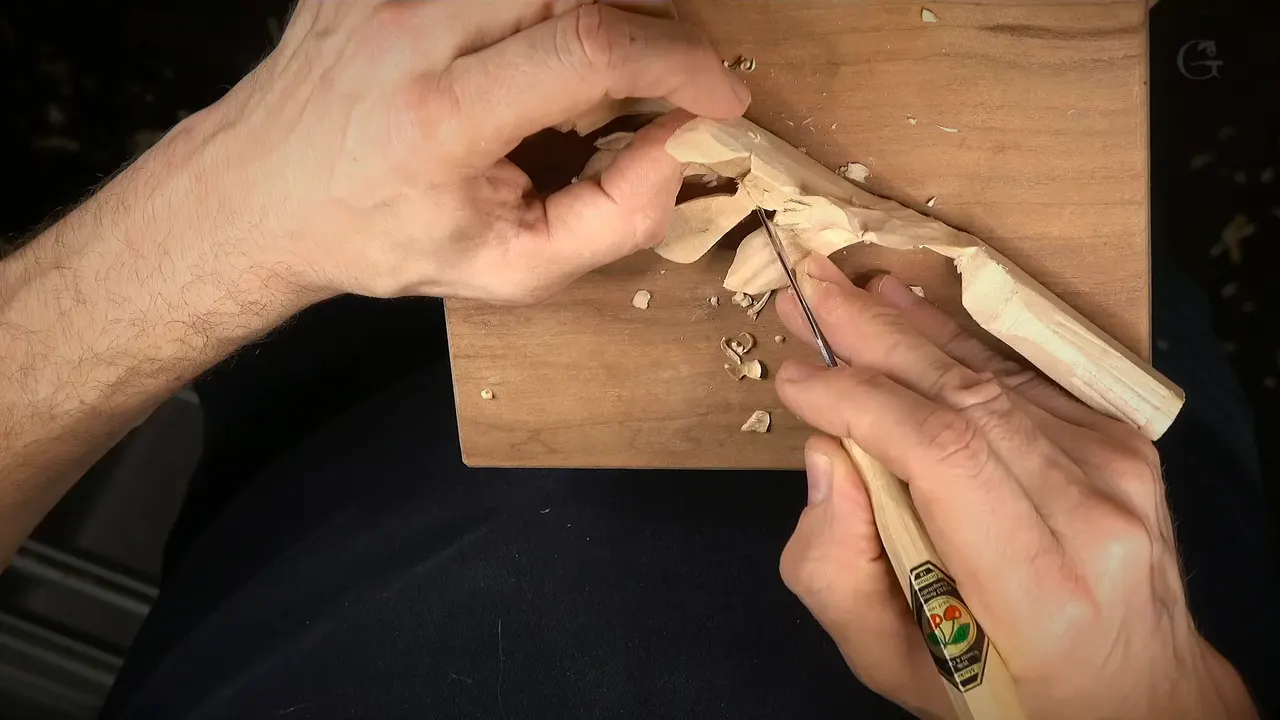

In workshop 78 (part 10), a small leaf was almost out of wood, and I asked for the number 11 to clear one section. Other lessons of mine name a tool for it too, a number 5 or a skew gouge, and one lesson plans to let texture cover it.
Ever carved a clean spot and found a fringe of loose fibers along the edge? Does your smallest gouge still feel too big to go in there? Those are the places where I said this word, and the lines below are mine, one lesson after another, each with its course.
What did I say in part 10 before the fuzz?
Depth comes first, and "It doesn't have to be a really deep cut," I said. "All I have to do is just create an illusion." A step back followed: "Well, a little more than an illusion." Then the section, which I planned to remove: "It's a little too much going on." The tool I would take was number five and quarter inch (a quarter inch is about 6 mm), going all the way to whatever I had just created, to that small section. Last, an outline: "let me outline it a little better with the number five."
Doubt came next, out loud, with "I'm not sure if I'm doing the right thing or not" and "Maybe I shouldn't even bother with it." Then the light: "I don't really see what is going on," and "A little more light will help me a lot."

Where does the fuzz come in, in this part?
The wood is almost gone by then, and the lines show it: "Don't have too much material left." I told myself to be careful, "really careful now." What I wanted to do next was "just to clean around this section with the half a millimeter," which is about 1/50 in. Then: "We need the half millimeter number 11. Just remove all that fuzz." And: "And maybe go that direction a little bit."
Next: "I really need to get close to it, but otherwise, I can't see." Removing this section right here was next, and I asked how: "How would I do it?" The answer was "From probably opposite side. Carefully," and a smaller tool entered the plan.

"I should probably use a smaller tool right now, maybe three millimeters, number three." Three millimeters is about 1/8 in. "Here you go," I said, and then "And I got it." A bit of cleanup remained, and I said I would probably do it off camera, because I really need to get close, just to see what is going on right there. One more line, about this piece: "But I need to also establish this piece because it doesn't look too good right now."
What happened to the thin piece in part 10?
"And that's really fragile." Not sure we would be able to keep it, I said, and for some reason this side was more fragile for me. My try: "If I'll be able to pull it, I'll keep it. If not, I don't know." Then: "I just chopped the end of it. Here you go. I couldn't keep it." Maybe it was a little too fragile, I said.

"But anyway, let me leave it like that, okay, nobody's going to know there was a piece. So this is going to be replacement for it." Then came "let me bring it to the edge," and, off camera, the plan to clean everything and chop this side.
The saw is next in the part. "Maybe I can actually cut this side right now. I'll just take it to the scroll saw and I'll cut it." After the cut: "There you go. I cut this, just whatever the handle was there." Then a plan, to take away some junk from underneath. "I still have to clean it."

That piece, I said, would just be a part of the composition. "I do have a really good connecting point right here, and the gluing point, it still goes all the way." I could glue at that point too, just to connect to that movement, and the piece would stick out from underneath of the flower. Verdict: "I think it's actually not bad at all." I could move it a little in that direction, and "Maybe that's what I'm going to do." Off camera, the plan was to clean everything, make it look more appealing and stick it right there. "And you'll see the final result."
What did I say about fuzz after trying rasps?
Rasps are the topic in workshop 14: rasps that I stayed away from. "I just stayed for many years away from those rasps, I really did not believe in them." To me they looked "not authentic to the woodcarving world," since my teacher never used them, and some other famous woodcarvers in the past did not use them either. And I saw one of the woodcarvers use them. "He's got some good results, and I just said to myself, 'Why not to try?'" That project, I said, would be painted, why not. That lesson's part 10 has the lines.

The result came next. "See? It doesn't look too bad at all. Yes, it leaves some fuzz, but that's okay." Then line work, "if you wish to call that way": I could use probably number seven, to create multiple cuts "just exactly the same what I did right here." Earlier in that part I said "I actually even like the lines, I really like those tool marks." I would paint it, I said, and the client wants to see the brush marks, so it gets a brush and not a spray.

Which tool did I name for the fuzz?
It changes by lesson. Over in the Hashemi Flowers course, workshop 45, part 2, I would take a smaller knife to create the right shape right here. A note to myself followed: "Again, don't want to force it. It's better to go back and attack with number 11 in this case. Half a millimeter. And remove all that fuzz." Then number 3, 14 millimeters (about 0.55 in), to kind of establish my form or movement, "not the final form yet, but still, it's the main movement."

Clearing the junk is not always easy there. "Sometimes it's not that easy to take all the junk out. Kind of hard, but I have to." And an idea: "Maybe I can just use a knife."
The Vase with Grape Leaves course, workshop 2, part 4, has a number 11 for the fuzz. One more section, I said, I can do upside down with three-quarter of an inch, about 19, 18 millimeters, something like that. Cleaning it called for the number 11, "with the flute position about 45 degrees out, I'm not undercutting yet, just removing some of the fuzz, okay?" Cuts like that were not final, I said: "So those are not final cuts, I should say."

In the Furniture Panel course, workshop 21, part 8, I was looking for a different tool. "Maybe number five and three millimeters. 1/8 of an inch, okay?" "And I'm not going to force it," I said, since I can always undercut the fuzz underneath again using a number 11. Then: "But I kind of like that look." The number 11 at 0.5 mm (about 0.02 in) could clean that mess underneath, I said.

In workshop 81, part 12, I was after a beautiful shadow that was still strong. "And three millimeters again. I'll kind of shave a little bit the sides. Okay? I don't want to see fuzz or whatever, the mess right there. All right, that's good. That is good. I'm really happy about this eye." Three millimeters is about 1/8 in.

The work in workshop 93, part 10, looked choppy. "It looks really, really, really choppy, but it's okay. We'll fix it." The plan was a number 5 at a quarter inch (about 6 mm), used upside down to kind of blend in. After that: "Take again previous tool and get rid of some of the fuzz." And then, "And now I need to blend that middle convex."

A cleanup is in the Carving Hazelnuts course, workshop 3, part 3, where I said maybe I could spend a little more time cleaning up inside, I said. "You don't really see it, but there's some kind of small mess." For that I would probably use number 11 and attack from a couple of different angles. After that I would take a number 5 at one-eighth of an inch (about 3 mm) "and get rid of fuzz. You can detect that fuzz," with "barely creating any pressure." And: "Obviously, you must have sharp tools, there's just absolutely no other way."

Does the fuzz have to go right away?
Some lessons let it wait. In Venice Room 100, part 4, I wanted my surface on the right-hand side of the future convex to be nice and flowing, since beads go right inside. A skew gouge, "which is about number three," was my plan to just shave it. "I don't worry about the fuzz when I'm getting it. I can always go back with the number 11 veiner and clean it. But the main goal, to make it really nice movement for my beads. That's really important."

Later in the part came the same thought: with some fuzz or mess inside, I can go back and clean it a little bit.
More on waiting sits in the Carving Roman Acanthus course, workshop 16, part 4. "When you got really sharp tools, you can break those rules and work even across the grain or against the grain, I should say, and it's still going to give you a really clean cut." Then: "I'm not going to worry right now too much about this fuzz," and I would create my undercuts, and that way the fuzz would be gone. For the undercuts I could probably use a little bigger number 11, which I gave as 3 millimeters or one-eighth of an inch.

Part 9 of the same workshop 93 has a line about loose chips. "What you see, it's just a bunch of loose chips." Not always do I need to work more, I said: all I have to do is blow a little bit and take off the chips. "But in this case, we're going to have texture. And the texture going to take care of all the fuzz and so on."

How did I clear fuzz from a background?
The Rosette course, workshop 1, has a cut on a line, with a router plane. "So I adjusted my router plane" first, and for a second pass, "I will lower it down." I also keep somewhat away from the main circle yet, since the knife had not yet cut the full eighth of an inch (about 3 mm). "Because on the line is going to be my final cut, so I'm taking three passes because I want to make sure my background is clean." Then: "Let me cut right here. Remove that fuzz." Then: "Also really important when you're using your router is your blade is sharp."

Next, my word on sandpaper: "Well, it's up to you of course, but I usually don't use any sandpaper on my carving. Nothing wrong with the sandpaper. It's just a European tradition to leave carving out of chisel, you can say." I added that I should not say European tradition, because it's not necessarily the fact.
Fuzz in each lesson, and what I said about it
| Where | Fuzz and the tool |
|---|---|
| Small leaf, Venice 78.10 | Number 11 around one section, for the fuzz |
| Hashemi 45.2 | Better to go back to a number 11 than to force it |
| Grape vase 2.4 | A number 11 on the fuzz, not undercutting yet |
| Furniture Panel 21.8 | Fuzz underneath, and an undercut that could come again |
| Venice 81.12 | A 3 mm (about 0.12 in) tool again on the sides, with no fuzz wanted in sight |
| Venice 93.10 | The previous tool again, on the fuzz |
| Venice 100.4 | No worry while shaving; a veiner can clean it afterward |
| Hazelnuts 3.3 | A number 5, barely creating pressure, and sharp tools |
| Roman Acanthus 16.4 | Not worried right now; undercuts planned to clear it |
| Venice 93.9 | A plan for texture to cover the loose chips |
| Rosette 1 | Three passes for a clean background, then a cut |
| Venice 14.10 | Some fuzz after trying rasps, and that was okay |
Same word, a different spot in every row.
Which lessons can you open?
The small leaf lives in Venice Room 78, and Venice Room Part 7 holds workshops 74 through 85. Wikipedia has pages on wood carving, on sharpening, on the knife and on the chisel, if you want the tools side.
Do you want to watch a tiny gouge go around a spot that has no wood to spare? Looking for lessons where I say what I will clean now and what can wait? Start here.
How it's done
- Name the tool first. Workshop 78, part 10: I said we need the number 11 for the fuzz around a section.
- Go back to a number 11. In Hashemi Flowers 45 I said it's better to return with a number 11 than to force the cut.
- Leave it for a pass. In Furniture Panel 21 I said I can always undercut the fuzz with a number 11 again.
- Keep the edge sharp. In Hazelnuts 3 I said sharp tools are the rule, and I wanted as little pressure as I could.
- Let texture cover it. Workshop 93, part 9: I said texture would deal with the fuzz in that spot.
Frequently asked questions
Which tool did I name for the fuzz in part 10?
The number 11. We need it, I said, and my wish was to clean around one section and remove the fuzz.
Do I clean fuzz at once?
Not always. Venice Room 100, part 4, has me saying I don't worry about it while shaving, and a veiner can clean it afterward. In Roman Acanthus 16, I planned undercuts to clear it.
Can a tool leave fuzz and still be okay?
Venice Room 14, part 10, has me trying rasps and saying "it leaves some fuzz, but that's okay." The piece would be painted, and the client wants to see brush marks.
Does a sharp tool matter for fuzz?
What to carve next