

Alexander Grabovetskiy, woodcarver, School of Woodcarving · Published 2020
What does a wood carver mean by "dramatic"?
Quick answer: In Venice Room workshop 78, part 2, I said maybe a deeper dig inside a small leaf could add dramatic effect, and later I said "extreme curl." On a hazelnut husk, a grape onlay and Venice Room light at night "dramatic" returns, and "extreme" returns on lily petals.
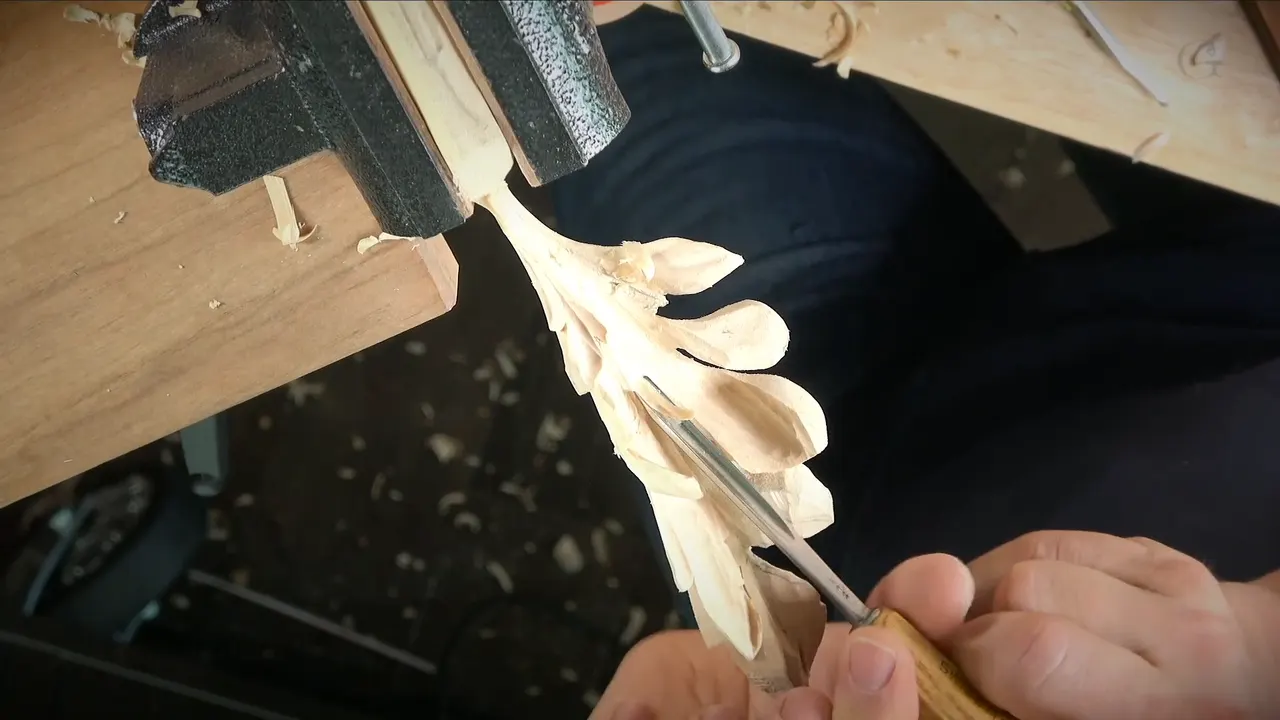

In Venice Room workshop 78, part 2, I said maybe a small leaf could take a deeper dig on its inside, and I planned a dramatic curl on another part. Later in that part came "extreme curl." The same word returns on a hazelnut husk and a grape onlay, and "extreme" returns on lily petals.
Ever looked at a small curl in wood carving and felt it could say more? Walk through part 2 with me, then through the other lessons where I used the same words, and read what I said around them.
Before the word came up, what was I doing in part 2?
The part opens on a tool number: "Number 8. That's what I'm using right now, and that would be about a little bigger than a quarter inch. Okay? Seven millimeters to be exact." A quarter inch is 6.35 mm, and 7 mm is about 0.28 in.
A plan to chop more from the side follows, with "a little bigger, deeper excavation," and a reason to feel easy about it: "We do have a lot of material on the backside right in the middle, so I'm safe there."

In the picture the leaf sits in a vise, and of that holding system I said "you can work pretty much from any angles."
About the movement I said "I think it's a really good, interesting movement, really deep and beautiful movement." Then a brake on myself, "I shouldn't be that aggressive right here," and a check: "Double-check."
Here is the line with the word in it: "I think that's probably the most what I want to do. Maybe I can excavate on the inside a little deeper, just to create even more dramatic effect in the middle." It is a maybe, an idea for the middle of the leaf.
Which part bugged me, and what did I plan for it?
Of one part I said "it just bugs me," and gave two ideas: "maybe I'll glue, or maybe, like I said, I'm going to get rid of this part and just use the small part right there." A plan for a curl came next: "Let me clean this one and make a little more dramatic curl on this one."

I said "Wonderful" and "maybe just bring that a little bit to the edge." A second thought followed: "Or actually, I can curl it even more, just like extreme curl." I closed that stretch with "That extreme curl I'm talking about, okay?"
After that came "I like it," with a need to follow: "Now I need to attack that from the opposite side." To show the curl I said "take a look," and "See how beautiful it curls?" I called it nice, "in my opinion."

Then an "Oops," and "That's good that I have wood flooring." What was left to do, in my words: "I need to just flip that upside down and clean that from the opposite side." On the leaf itself: "Beautiful detail." Then "So now I need to get rid of this part right here."
Which words in parts 1 and 3 cover the same leaf?
The plan for the curl sits in part 1: "I could kind of create a small curl," to make it look like it "curls upward that way." About the shape so far I said "It already should look like it's curling," and "Of course, I can do it a lot more."
The wood got a check as well: "I don't have too much thickness. I've got less than 32nd of an inch right here." That works out to under 1/32 in (0.8 mm). My plan was a smaller tool, "maybe just about 16th of an inch, a millimeter and a half." In metric that is 1.6 mm, or 0.06 in. With it I could "excavate inside a little deeper shadow, and create that curling effect."

Part 3 has the leaf curling up: "It goes all the way up like this." A division came after: "I can do a really nice concave on inside for this division, going all the way to the centerline just like that." It would bring "even more depth, if you wish." The tool for it, probably: "the same number eight and a quarter inch, or seven millimeters to be exact."
Which other lesson put the word on light at night?
Light comes first in Venice Room 101, part 3: "it's a light and shadow game or light and shadow play." During the day, I said, the source of light is windows and open areas. "And at night, it would be just the light source from our ceiling." One part would "play big role during the night," because light would "cast a really beautiful dark shadow in this area."
By day it would still create "some shadow," but "not as deep as at night." And then the line: "At night, it should be more dramatic, I should say."

Beyond that came "you already see how beautiful shadow it creates," and "I have a really nice deep shadow."
How did a grape onlay get its dramatic effect?
On a grape onlay, in Grape Onlay 10, I said I was going to take a number three spoon gouge, to "get on inside of this hole and clean little bit above." That excavation, I said, "gives even more dramatic effect, like a 3D effect." And: "Taken from different angles."

A second tool followed in that video: "like a number one," which could be a skew or a double-sided chisel, I said.
How deep does a dramatic shadow go?
My depth figures are in Grape Onlay 9, part 3, along with some thoughts about shadow. "With the two millimeters, I can exaggerate that motion even more." And "Exaggerate that shadow," and "Pretty much we are painting with the shadow." Two millimeters is about 0.08 in.

I also said "You are an artist who uses shadow and lights as a media." On depth: "How deep that's up to you, how deep you wanna go. And also, it depends how you're gonna use it." Here is the line I wanted: "But let me tell you deeper, you go more dramatic. It's gonna look and it's gonna look awesome."
My own number followed. "I've got pretty deep, I've got about five eighths of an inch." Five eighths of an inch is 15.9 mm, and I said "about 16 millimeters," so the two figures agree. Then: "you don't have to, like I said, but you know, why not?"
Which words went with a hazelnut husk?
A hazelnut husk gets the word in Hazelnuts 3, parts 2 and 3. A concave cut is planned in part 2, with "especially this area got to blend together," because "people are going to look from this side." Next was the link between drama and exaggeration: the further I push the drama, the more exaggeration I plan to bring in, and "much nicer it's going to look."

The tool plan is in part 3: "create in-cut with the same tool inward." Then I said "you can see it like a dramatic letter S curvature," and that I wanted to see it everywhere. And "just the main idea. The big idea without the details yet."
Further along in part 3 came an idea: "Maybe actually it's a good idea to raise that one up." Raised, it would "look more dramatic," and I said I would "cast more shadows." I planned a number seven for that job, at "3/8 of an inch," which is 9.5 mm, and said "it's a fishtail."

When did "extreme" land on a petal?
Lily Box 10 has the word on a lily flower. In part 3 I said "extreme concave right in this portion," and called it "a really beautiful detail." A tiny number eight was next on my list, "3/32 of an inch," which is 2.4 mm.
A curl takes the word later on. "I can give a much more extreme curl on this side, because that side is going to flip over the main design, and I need to leave some material right there." Elsewhere "this part can go much lower." That would give me "a really good movement, so I can chop a lot more material right here." Then: "It's tough. Not easy."

In part 2 comes "curl back those points," with "extreme concave underneath, which means I have to dig underneath of here and also on that side." Before that I said the concaves "are quite extreme on those inner parts." A smaller line comes from part 5: "I am really close to what I want to see. Just little more extreme right here."

Why do I say wood carving sits on "an extreme side"?
More is in Lily Box 11, part 1. "You should already see how it makes it even more three-dimensional, just by creating those really extreme concaves." Then I said wood carving sits on "an extreme side, I would say." And: "So we try to exaggerate the real life." And: "But even in real life, you can see sometimes those really extreme movements." After it, "even deeper with one and a half millimeter." Call that about 0.06 in.

Further on: "I really, really, really like this extreme concave right here. Beautiful." The flower itself gave a reason. Looking at "the real flower," I said "it's going to have that extreme concave on that side just like that, what we're doing, okay?" And: "Because it makes sense. Those petals, they come together like that."

That same part has two more lines worth reading beside the others. "I think I have a good amount of material on the backside. I can actually get even more extreme right here." And a plan with a smaller tool: "One millimeter, number 11," to "even make it more extreme" with one millimeter, about 0.04 in.
What about extreme shadows and movement in the Venice Room?
A wish comes in Venice Room 35, part 5: "I kind of like it, but not as much. Okay. I really want to see maybe more extreme movement right here." A separation was next: "And looks like I have to do another separation somewhere right this area."

shadow gets the word in Venice Room 48, part 2. "But I really like the idea of creating really extreme shadows." You did not see that shadow right now, I said, but "if I'm going to turn one of the lights off, you'll see it." And: "It's just what I'm after. And without it, I would not have that deep shadow. It's not going to be as three-dimensional, let's say."

The goal came first in Venice Room 54, part 9: "that is the goal. Just the goal create that deep shadow." Then, since the light was changing and it was getting late, the shadows would be "even more detectable," and I said "more extreme shadows."

Where else does "extreme" sit next to a curve or a movement?
A cut comes in Acanthus over Moldings 7, part 2: "Create cut like this. Blend it downhill." Then "you can do extreme movements, by the way," and it would "look awesome." On how far to go: "you can just get lost," and "there's no limit pretty much." Cleaning would use that number nine again. A quarter inch is about 6 mm.
Hashemi Flowers 30, part 1, has "sometimes it's a good idea once you go a little extreme." Then: "What I mean by extreme, I know lots of that" would be hidden under the upper layer. "But sometimes when people look from the side, they can catch little tiny details."

Venice Room 114, part 3, joins the word to two shapes. I planned "extreme concaves and convexes," and said they would give "almost like a life look."
Subdivisions get it in Hazelnuts 3, part 3: "I really want to do extreme subdivisions. That way, I can create more beautiful look." Number nine or number 11 would do the job. And in Carving Plate with Butterflies 13, part 3 has me saying you can leave it like this "or you could take it even more extreme," and adding "to dress this up even more."
How do the lessons line up?
Each lesson, the word I used and the line that followed it.
| Lesson | My word | Next |
|---|---|---|
| This part, 78.2 | Dramatic effect, I said, for the leaf | Dig deeper |
| The 78.2 part that bugs me | More dramatic curl | Actually, I can curl it even more |
| Venice 101 | At night: more dramatic, I said | A deep shadow |
| Grape Onlay 10, a number three spoon | 3D effect | Get inside the hole, clean above |
| Grape Onlay 9 | Go deeper for more dramatic, looks awesome | Pretty deep |
| Hazelnuts 3, part 2, concave cut | More dramatic, exaggeration | Maybe number three, 1/8 in (3.2 mm) |
| Hazelnuts 3-3 | Dramatic letter S curvature, in-cut inward | The main idea |
| Petal curl, Lily Box 10, part 3 | More extreme | This part can go much lower |
| Lily lesson 11 | Extreme concaves made it even more three-dimensional | Even deeper |
| Room 48, part 2, on shadows | Really extreme shadows | Turn one light off, you'll see it |
| Room 54.9 | Going to be more extreme shadows | The light changes |
| Acanthus over Moldings 7, part 2, flowers | Extreme movements | No limit pretty much, I said |
Where can you watch part 2 and the lessons on this page?
You can watch part 2 in Venice Room 78. The course page, Venice Room Part 7, holds workshops 74 to 85. The other lessons named here are linked where the page is public, and a workshop number means the Venice Room.
Want to hear me say it in my own voice? Start here.
How it's done
- Name the tool. Part 2 begins with a number 8, a little bigger than a quarter inch (6.35 mm), which I called 7 mm (0.28 in) to be exact.
- Check the back. The backside held a lot of wood right in the middle, I said, so I was safe there.
- Say where you could go deeper. Maybe the leaf could take a deeper dig inside, I said, and I left it at that.
- Look at the curl. Take a look at the curl, I said, and I called it nice, in my opinion.
Frequently asked questions
Did I plan anything for the middle of the leaf in part 2?
There might be room to go deeper inside the leaf, for even more drama there, I said. That was only a maybe. After that I turned to a part that bugged me and said I might glue it or drop it.
What came right after the tool number in part 2?
Right after it came "Let me chop a little more from this side also," and a bigger, deeper excavation. That was a plan for the side, with a lot of material left on the backside.
How deep did I say to go on grapes?
On grapes my answer was that the deeper you go, the more dramatic it gets. I had about 5/8 in (15.9 mm), so about 16 millimeters, and said you don't have to go that deep, but why not.
What to carve next