

Alexander Grabovetskiy, woodcarver, School of Woodcarving · Published 2020
What does a wood carver mean by "just guessing"?
Quick answer: In workshop 78, part 7, I checked "one-eighth of an inch right in the middle" (1/8 in, 3.2 mm). I called that a guess and named the calipers for measuring it. My other lessons put the same word beside unmarked tools and beside lines I placed by eye.

The words came in the Venice Room, workshop 78, part 7, about a measurement I did not take: I was just guessing. Other lessons of mine use the word beside tools with no marking and beside lines placed by eye.
Ever picked up a gouge with no number on it? Does a thin spot on a leaf make you reach for the calipers, and do you wonder if you need them at all? Those are the places in wood carving where I say it, and the lines below are my own words, lesson by lesson, with the course each one comes from.
What did I check in part 7 of workshop 78?
The part opens in the middle of a thought: "And little by little, I can get better and better result." A plan comes next. "And you know what? I could actually get a little better lighting for myself." A second plan: "I can excavate from this side right to the edge also." Then: "Right to the edge, and let me clean this side."
Just before it, part 6 has a limit of its own: "Got to check. So I'm pretty close. So that's probably the most I can get right here. It would be a big mistake for me to get more than that."
Next, a spot got its verdict: "Okay, right here is a big chunk I don't need. This is a big hump." Then the other side, in one short line: "I am constantly checking the opposite side."

Two numbers come with the checking. The first is "I've got no more than 16th of an inch right here" (1/16 inch, 1.6 mm). The second is "I've got no more than one-eighth of an inch right in the middle" (1/8 in, 3.2 mm).

Here it is: "Of course, I'm just guessing, but you could measure that with the calipers. I really don't need to."
A look and a plan close the part. "Let me bring that all the way to the edge on this side." Then: "I think it looks good." Next: "Double-check." After that came "Yeah, I really like that. I really like it." Another plan, to glue the piece back, followed: "Well, off-camera, I probably going to clean little bit this side and glue back that thing." Then: "All right. So that is how it looks."

How does part 8 of the same lesson name a size?
Sizes in part 8 come the same loose way. For the middle stem: "I'll use one millimeter number 11" (1 mm, about 1/25 in), and a little later "half a millimeter number 11" (0.5 mm, about 1/50 in). Of an extra concave: "Maybe about five millimeters or so, like 3/16 of an inch" (5 mm is about 0.2 in, and 3/16 in is 4.8 mm).
Next, a tool idea: "Oh, you know what? I probably should use back bent, really tiny, small back bent right here, which in this case would be equal to number five and two millimeters" (2 mm, about 0.08 in). Right after: "I would use probably three millimeters. Same number five." (3 mm, about 0.12 in).
Part 8 begins with a plan for the vise: "I think I'm probably going to take my vice out. I don't need it as of now, and I'm going to just use holding by hand this piece and just finish up." Then: "I think it's a smart way to work. But again, it's my personal opinion."

Of a separation in part 8: "I could completely separate that like I did right here." Next: "My question is do I want it to or not?" Next: "I think I don't want it to." Next: "I don't need it in this case because I don't want frustration later on because it's going to be shipped, and it can be broken if I'm going to make it too fragile."
A thought of its own sits in part 8: "But the more I take out, more fragile it becomes, okay? More I take out, more fragile it becomes. I have to keep that in mind."
Grain comes up in part 8 as well: "you have to understand it's a long grain. It's pretty strong."
Where else does "just guessing" turn up?
Venice Room workshop 29, part 12, has it beside tools that carry no mark. "And chip with that number five, I believe," I said. The size came next: "number five and about 5/8 of an inch, about 15, 16 millimeters, something like that" (5/8 in is 15.9 mm). Then: "There's no marking, by the way, on those tools." Close behind: "I am just guessing. So what those tools are."

A plan followed: "get rid of this chunk." For the inside: "It will be probably smarter for me to use number 11, like two millimeters or so" (2 mm, about 5/64 in).
What do I do with a tool that has no number?
In Hashemi lesson 10, part 9, I held a tool that was "about 3/8 of an inch" (9.5 mm). The word "about" had a reason: the maker marks no inches on it. "All they mark is just the number of the sweep. So this case is just the number eight, and you have to just kind of guesstimate all your measurements."
A second thought followed: "if it's close enough to the task what you need to achieve, then that should be fine."

Hashemi lesson 11, part 9, has me ask how I pick a tool. It starts with "again #5 and probably about 7/16 of an inch" (11.1 mm). Then: "And if you would ask me, how do I determine what tool should I grab, I actually look at the piece of wood and approximately by eye, trying to guesstimate what tool is going to work the best in this section."
More: "There's not too much math involved in that. Just whatever looks good in this case."

On the Greek acanthus leaf, lesson 14, part 1, a small gouge sits in my hand: "about 3/32 I would say" (2.4 mm). Then: "It's not marked, but I can just guess by approximately." Of the small ones I said I can get "to the tiny spots just like that."

Do I guess at what I cannot see?
Roman acanthus lesson 10, part 1, has this: "sometimes I do have to make some excavations that I'm even not able to see with my eyes." The next line was "But I have to kind of guesstimate what is going on underneath where I'm making my cut." A check came after it: "Looks like I am all the way through, which is a good thing. That is actually my goal, where I can make continuous cut underneath, just like that."

When do I place a line by eye?
In Venetian rosette lesson 6, part 1, I wanted to find a spot "between those two previous lines." Then: "approximately, of course, it looks like this caliper, just approximately at the middle." Later, with the lines going all around, I said "I'll just eyeball it between those two. Doesn't have to be perfect."

Vase with grape leaves, lesson 1, part 4, has a circle of "four and a half inches diameter" (4 1/2 in, 114 mm). "So pretty much we're going to use the calipers again," I said. Then: "you can just eyeball it. Eyeball the golden ratio."

Same choice in Venice Room 94, part 2: "Well, usually I don't use those calliper, I'm actually just eyeballing it for me." Next: "It's not a big deal to eyeball it, but it's a good idea if you do have a callipers."

Workshop 131, part 1, names a golden ratio split: "62/38." Then: "I'm just eyeballing it. But I can always use golden ratio calipers. And I see I am right very much on the money right there."
I added "I don't really need to measure. I'm pretty close, I know."

When do the calipers come out?
A point has to match the other side in Venice Room 67, part 10: "Well, not equal, but it still has to just kind of be readable by other side." My plan was to measure it. After the check: "And it looks like I actually got that right on the money, pretty much right there. So just by eyeballing it the first. Okay. So I'm actually safe."

A line I was glad of sits in Venice Room 79, part 9: "And why is that line important for me? I'll be able to measure." The calipers had a job there: "check my depth." A question followed: "if you would ask me if it matters, yes, it does." Next: "It does because it's a more architectural carving, even if it's decorative, but it's still going to go inside of the house and everything measured." And: "Absolutely no room for error."

A mark looked wrong to me in Venice Room 160, part 2: "Yes, I am off. But I need to make sure what is off." A caliper was the idea: "Maybe I could just use a caliper. Use a caliper and check that. Which side I'm off."

Two tools are named in Venice Room 159, part 1, a ruler and calipers: "For me, I could use just a ruler or even just calipers." Also: "I can measure whatever the distance is." A way with no calipers came next: "You don't really have to use a calipers. You can use a piece of paper if you wanted to. Piece of paper is one of the best measuring devices."

On the panel, Floral and Molding lesson 2, part 2, I had to "establish how wide my molding." "Absolutely, there's different ways to do that, but what I like to use, I'll use calipers. Calipers is always probably one of my favorite measuring tools. Probably the most accurate, I'd say."

In lesson 8 the calipers go away after a miter. "I want to make sure that is going to be my miter. It's going to look like it's mitered, which means I really have to connect those lines together right there, that point." Then: "That's it. Don't need any more calipers."
Same idea in Venice Room 57, part 10, with a mark to place: "And you could use any other tools like calipers if you wish to mark that. I don't need to." Next: "Eyeballing is okay. And if there's a little bit variation, that's okay, too."
I said what the calipers would do in Venice Room 1, part 11: "Normally, what you would do, you would probably just measure the distance just using calipers." In this case, I said: "I probably could be a little off." Of my set: "Got only 12 inches" (305 mm).
Can the size in a drawing be a guess?
The plate with butterflies, lesson 4, part 1, has a drawing with no scale beside it. "When you draw a boat, you really don't know how big or how small the boat is." Of the butterflies on the plate: "how big those butterflies you can just guess obviously, we do know that we do have only about 10 inches diameter" (10 in, 254 mm). A need came with it: "I gotta feel the space around."

One word, ten lessons, and what I sized each time
| Where | What I sized and how |
|---|---|
| Workshop 78 | The middle, a guess, calipers named |
| Workshop 29 | Tools that carry no mark, number five at 5/8 in (15.9 mm), a guess |
| Hashemi 10 | One tool marked only by its sweep, a guesstimate |
| Hashemi 11 | Which tool fits a section, picked by looking at the piece of wood |
| Greek acanthus 14 | A small gouge of 3/32 in (2.4 mm) with no mark, a guess by approximately |
| Roman acanthus 10 | The space under my cut, which my eyes cannot see, a guesstimate |
| Venetian rosette 6 | A spot between two lines, eyeballed with no calipers |
| Grape vase 1 | The middle of a circle of 4 1/2 in (114 mm), eyeballed |
| Workshop 94 | Where a division lands, eyeballed though calipers would help |
| Workshop 131 | A split of 62 and 38, eyeballed and then checked |
One word, and a different measure beside it in every row.
Which lessons can you open?
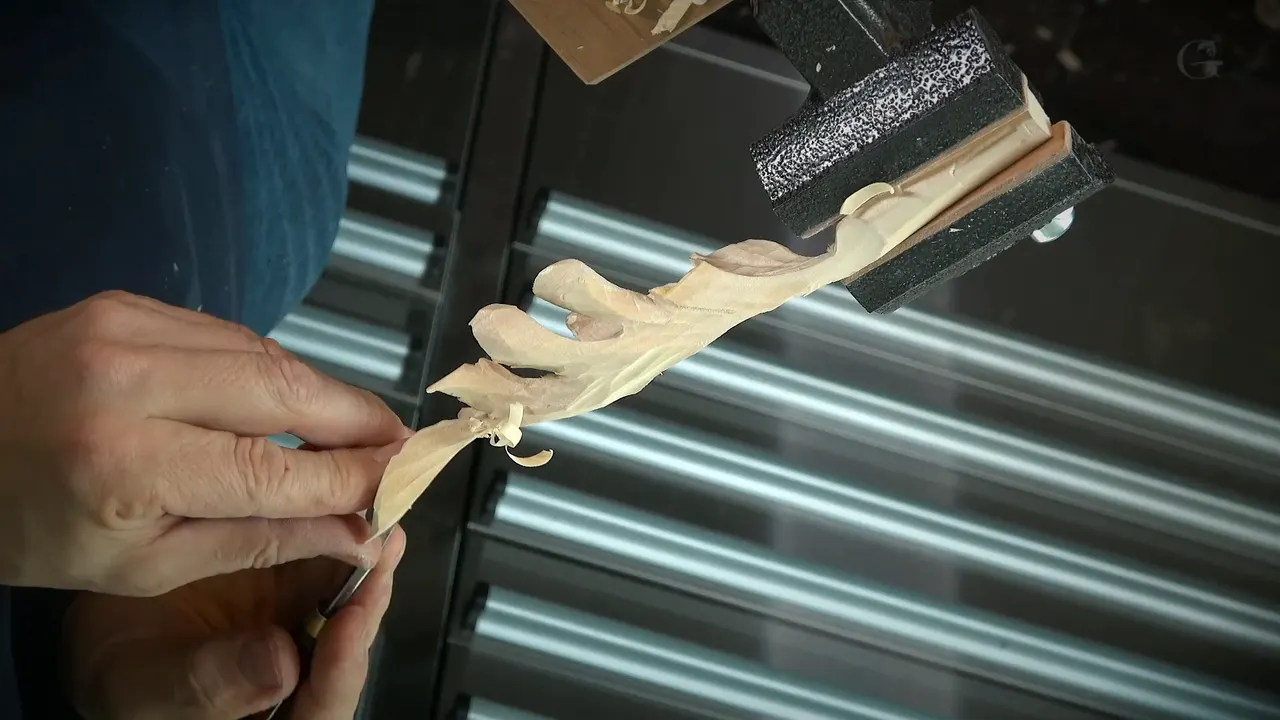
The home of the leaf is Venice Room 78, and Venice Room Part 7 holds workshops 74 through 85. Each lesson above has its own page, linked where I named it, and each opens with school access. A plain workshop number means the Venice Room. In the pictures from part 7 a leaf sits in a clamp, and one picture from part 8 shows a piece held in a hand.
Do you want to see a small tool work on a leaf you can hold in one hand? Looking for lessons where I say out loud what I did not measure? Start here.
How it's done
- Say what you check. The check is for the middle, and I gave a size.
- Say it is a guess. Workshop 29 has "I am just guessing."
- Name the calipers. The calipers come up in part 7, in one short line, as the way to measure it.
- Say you do not need to. I did not need to.
- Look again. Part 7 has "Double-check," and then a word of liking.
Frequently asked questions
How did I handle the measure in part 7?
I called my size a guess and named the calipers as the other way. I added that I did not need them.
Which tools carry no marking, in my words?
In workshop 29, part 12, I said "There's no marking, by the way, on those tools." In lesson 10 of Hashemi I held one that marks only the number of the sweep.
How do I choose a tool when its size is not marked?
In part 9 of Hashemi lesson 11 I said "approximately by eye" and "There's not too much math involved in that."
Which words came after I measured a point?
What to carve next