

Alexander Grabovetskiy, woodcarver, School of Woodcarving · Published 2020
What does a wood carver mean by "geometry"?
Quick answer: Part 5 of Venice Room workshop 79 is where I called a print a wireframe and said I did not want to lose some of the lines on it. Other lessons use it for panel lines, petals, spirals and blocking out.
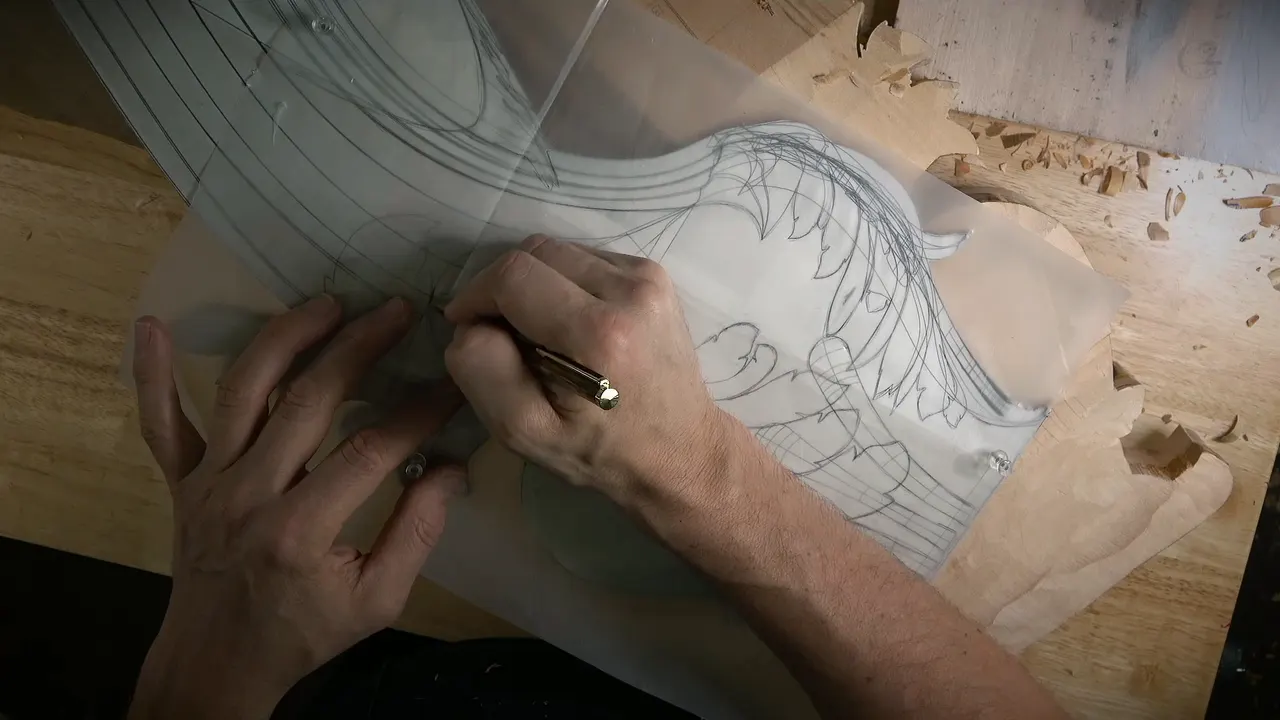

Geometry is the word I said in part 5 of Venice Room 79, when I looked at a print of the 3D lines and said "you see all the geometry." I say it in other lessons about a panel's lines, a lily's petals and the spirals on a sunflower, and I say "geometrical" about chip carving.
Does your drawing ever turn into a mess of lines? Can you picture a flat sheet lying on a thick block of wood? Below are the places where I said the word, with the lesson each one comes from.
Where does geometry come up in part 5?
Right at the start. "Which in this case, it's kind of messy-looking one," I said, and gave a reason: "because it's 3D lines and it's a wireframe." Then, "If you know a little bit about 3D modeling and wireframe, you see all the geometry, which I prefer to print that way."
I could have picked another mode. My words: "but I don't want to lose some of the lines."

Which line did I say I needed?
"Here you go," I said. A little later came "And it is going all the way down like that." Then, of one part: "Really interesting transition in this part. I need that line."
I spoke about a wireframe in another lesson, too, and gave a reason there.
Why wireframe mode in my first Venice Room lesson?
The reason sits in part 11 of Venice Room 1. "I generated that on the computer in 3D," I said, and "a lot of lines, which is somewhat confusing for me, even for me." As for the mode, "wireframe mode gives me perfect line. So that's why I did it the way I did, okay?"
carbon paper came up in that part too, and my verdict was "carbon paper gives me a lot of black dirt, which I'm not the biggest fan of."
What changes between a 3D program and real life?
Further on I said "I think I have to change all of those." About "those movements," I said "I kind of don't like." Then came the line about the two views: "I like overall movement, but there is a big difference when you're doing a 3D program versus the real life."

The next words were "in real life, you see much better how is it going to look, and I already made some changes on the main front piece."
What did the old method let me do with a flat sheet?
Part 4 began with "I am ready to work on the details. Not the details, but on the carving itself." I planned on "just the old method, plastic," with "plastic and carbon paper." I was "just using normal garden plastic," and "painter's plastic will work also." I also had "a full-scale drawing."

I came back to that method in part 5. I can "just flip it and I can see through, and I can align whatever the side I'm working on," I said, and "which makes a lot of sense."
What makes a 3D form hard?
"But on the other hand, I do have a 3D form. It's not flat, so I have to be careful how I do it." Next, the plan: "side by side. First side, and then we're going to stretch it a little bit and so on." And a warning: "we've got to be somewhat careful."

"Let me align first this side," I said, then "Something like that. See, it's not matching exactly." After that, a second plan: "do first probably bottom. Let me do bottom first. Align it." The part ends with "Couple push pins. Oh, actually, you know what?"
Did part 6 show the same trouble with a 3D form?
The sheet fit no better there. In my words: "Again, just because it's 3D, it is not as accurate as I wish. But I'll be really close." And "I'll use a carbon paper. By the way, you're still able to buy it."

I knew a later section would not be accurate and would need a small move, but "at least I can start on this section." Then "now I need to move it slightly in order to reach this line." And "I could probably stretch like that."
"Doesn't have to be exact, but somewhat close." Later, "time to move it again, because this side is not really matching. I have to readjust slightly, just like that." Near the end: "I actually don't really need too exact."
What is pure geometry on a panel?
Lesson 6 of Furniture Panel design gave me the words. In part 1 I said "I'll take a piece of paper again," and "Carry that line here." Then "this line actually repeats those vertical lines. That's pure geometry, if you wish."

Same part, a measure: "about 5 millimeters" (about 0.2 in). "I'm just eyeballing. You don't have to really measure that, but if you have to, please do."
The circle comes in part 4 of that lesson. For that circle, "you take this point and that point, and you draw another line." And "Exactly the same on other corners." On accuracy, "I'm just doing approximately, but if you want to be more accurate, you can just spend more time and just even use a ruler." Then "corner to corner lines like this, and it's a pure geometry."

Next came "those dots, intersections." And "Although it's not really accurate how I did it, but you can see you can get really pretty accurate circle."
Is true art a feeling, or geometry?
Lesson 5 of that course has the line in part 2: "the true art was minimized to just some kind of soul therapy. Like it makes you feel good." Then "the true art is the real math, the real geometry, okay? And that's a true craft and that takes some knowledge when you develop the piece of art, not just strokes of different colors and random composition."
For example, "my youngest daughter, she wanted to be an artist," and "we thought the teacher going to teach all the composition rules, all the color palettes and so on. But no, it didn't happen."

In part 3 the word turns up again. "Maybe it is wonderful idea to use the same measurement," I said, and "we get really close. Not perfect, but really close." After that, "It's going to be more geometrical."
My process, as I put it: "That is the usual process for me, how I design something. The main movements, and then I establish the details and so on." And "a lots of erasing and redrawing until I get to the right point."
How do lily petals show geometry?
Lily lesson 10 has it in part 1. Of the petals, "the distance from the central point all the way to the end on all of them" was to be "absolutely accurate." Some curl down, and "some of them are going to curl down even more."

"They're supposed to be absolutely equal." Then "You have to understand that flowers, they are really complicated geometry. Okay? Mathematics, actually." And about a lily, "especially on a lily, it's true geometry."
The same part gives my tool plan. "I can excavate the middle right away pretty much," to make "kind of like a bowl on inside." I would take "a number eight and a quarter-inch" (about 6 mm). That was for "carefully going to start removing." The bigger tools were out, "because how fragile my poplar piece below is."
Does a sunflower show geometry too?
In Lily Box lesson 12, part 3, I said "all of those spirals will be visible" once a finish goes on, and "Right now, just kind of impossible to detect. Well, not impossible, but really hard to see." Then "Maybe someday I'll show you on a bigger flower what I mean by that. And especially, that movement will be visible on big sunflowers. That's real geometry."
The lesson comes back to the center of a flower in part 4: "I should go from the center, go outward like that." And "it goes around and around and around."

About other flowers I said "there's different movements, but it's a more geometrical, more mathematical, I would say, than just whatever the shape is. Okay? So it's actually based on a true creation by the laws."
What can a block-out lose?
Carving Hazelnuts lesson 2 has a warning in part 1, about blocking: "please don't be tempted to go in every cavity, in every cut." My reason: "once you're going to do the sloping and stuff like this, you're going to lose geometry of it, okay?"

"All I need is just to remove around the big material," I said, with "number nine and 20 millimeters" (about 0.8 in) as "my number one tool." Also "don't create the cut, like I said previously, too deep," and "Like 1/8 of an inch, about three millimeters."
Which rules did I tie to geometry?
In Venice Room 72 I said in part 5 that there is "such a thing as a dynamic symmetry." My example was "if this would be two centimeters wide, this one, I have to make this one three centimeters wide," which is 2 cm (about 0.8 in) and 3 cm (about 1.2 in). Then "that would be a golden ratio."

"I know nobody's going to estimate that and put the ruler on that." I called it "applicable to the geometry like Fibonacci sequence." On the ratio, "It would be like a two-to-three ratio or five-to-eight ratio."
That lesson has more in part 6: "Most of the people don't know about those rules and the geometry in wood carving and everything else, like architecture and so on. But it's still going to make pleasing to the eye."
In Venice Room 73, part 4, I said "I'm not going to get too mathematical or geometrical." The numbers followed: "38%, and this would be 62% of 100."
Can geometry be done by hand and by eye?
In Venetian Flowers Rosette lesson 1, part 1, I wanted a better oval. It was "just freehand sketching, and I need kind of little better version of it." Then "the most ancient way to draw. It's by hand and by eye."
A computer with "a true geometrical measurements and so on" would give a perfect oval, I said, but "you can do really accurate work." My list was "pretty much the oldest stuff, like some kind of twine," "some nails, small ones," about 5/8 of an inch (about 16 mm), "number 18," and "pretty much pencil."
Is geometrical carving the same as chip carving?
Carving Greek Acroterion lesson 3 covers it in part 2. When we say chip carving, I said, "most of the people" picture "just geometrical carving." My next words said chip carving goes well past that.

Curly Kitchen Cutting Board lesson 4 has two lines in part 2. "You associate chip carving with just more geometrical," I said, and "before geometrical carving, ornamental carving was in its existence."

The Livestream of April 2020 has it too. I told what some people say: "you're not supposed to use carving knives because carving knives, it's only for the chip carving, okay?" And "Chip carving is geometrical, geometry carving." Further on, "with just the one knife, pretty much you are able to do a lot of stuff."
The lines side by side
| Which lesson | What the line was about | My words |
|---|---|---|
| Workshop 79, part 5 | A print of 3D lines, messy-looking and set up as a wireframe | "messy-looking one" |
| Venice Room 1, part 11 | Why I picked wireframe mode, and a word about the black dirt from carbon paper | "perfect line" |
| Furniture Panel 6, part 1 | A line that repeats the vertical lines, said after I carried a line on a piece of paper | "a really important line" |
| Panel 6, part 4 | A circle from the dots and intersections of lines drawn between the corners | "it's a pure geometry" |
| Panel 5, part 2 | What I said true art rests on, after a short word about the 1950s and 1960s | "the real math" |
| Lily Box 10, part 1 | Petals measured out from the central point, and some that curl down | "really complicated geometry" |
| Lily Box 12, part 3 | Spirals that show on big sunflowers once a finish goes on | "That's real geometry." |
| Hazelnuts 2, part 1 | Blocking out, and a warning about going into every cavity and every cut | "lose geometry of it" |
| Venice Room 72, part 6 | The rules most people don't know about, and what a human brain reads from them | "the geometry in wood carving" |
| Greek Acroterion 3, part 2 | What most people picture when they hear chip carving, and what I said next | "just geometrical carving" |
Do you have a print that does not fit your block? Can you hold a sheet in place with two pins?
Where can you watch these lessons?
You can watch part 5 in Venice Room 79, and Venice Room Part 7 holds workshops 74 to 85. The first workshop sits in Venice Room Part 1. The panel drawing lessons are in the design course for the panel, and the flowers are in the Lily Box course. The next workshop, Venice Room 80, uses a 3D model too.
How it's done
- Print the lines. I prefer to print in wireframe mode. The sheet looks messy, with every 3D line on it.
- Check the real piece. I compared the program with the real piece, and I had already changed the front piece.
- Turn the sheet over. Flip it, look through it and line up the side I'm working on, I said.
- Take one side first. First side, a little stretching, and the bottom first was my plan.
- Pin it down. Part 5 ends on a plan for push pins, and then a second thought.
Frequently asked questions
What is the wireframe in part 5?
A print of the 3D lines, which I called messy-looking. A different mode would have cost me part of what the sheet shows, and I chose to keep every line on it.
Does a flat sheet match a 3D form?
Mine did not match exactly, and the reason I gave was the 3D form. The plan was to start with the first side and then stretch it a little bit, and in part 6 I had to move the sheet again and readjust slightly.
How did I compare a 3D program with real life?
I liked the overall movement, but I said the two views differ a lot, and the real one shows the look much better. Some changes were already made on the main front piece.
What to carve next
- Venice Room 79
- Furniture Panel design 5
- Venice Room Part 7
- Venice Room 1
- Venice Room Part 1
- Furniture Panel design 6
- Furniture Panel design course
- Lily Box 10
- Lily Box 12
- Lily Box course
- Hazelnuts 2
- Venice Room 72
- Venice Room 73
- Venetian Flowers Rosette 1
- Greek Acroterion 3
- Curly Kitchen Cutting Board 4
- Livestream April 2020
- Venice Room 80