

Alexander Grabovetskiy, woodcarver, School of Woodcarving · Published 2020
What does a wood carver mean by "what is going on"?
Quick answer: In workshop 79 I said I needed to look at one section of my corbel, and later I said I did not "really understand" a spot there. In other lessons the same question comes with more light, a flip, a clean pass, or a better view.
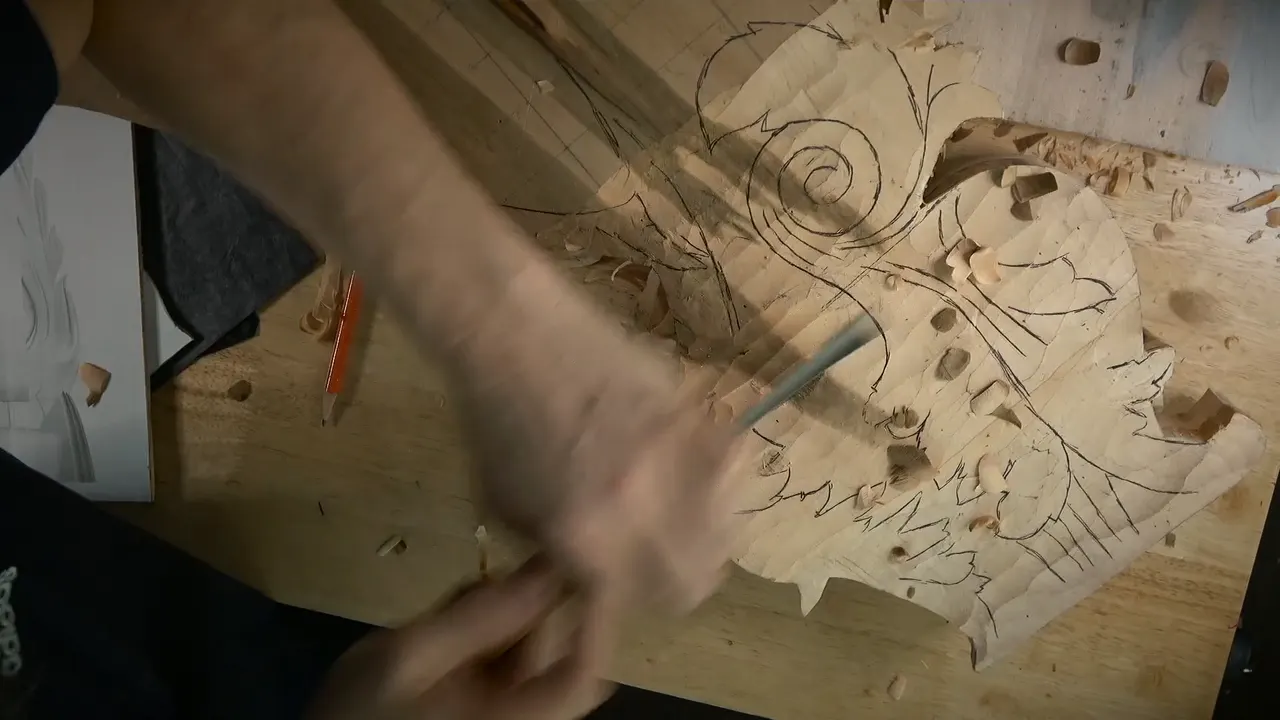

One question came up over a section of my corbel in part 8 of workshop 79, and I asked it again in other lessons.
Have you ever stopped over a spot on your own piece and could not say why it looks that way? My words for that moment were "Now I need to see what is going on." Below are the places where I asked it, and what I said or did next.
Where do I ask it in part 8 of workshop 79?
The plan for the bottom of the piece comes first. "I'm going to reestablish my movement right on the bottom and knock some of this material," I said, and added "Although I really don't have to." One more line followed, "I can do it a little later, too."
Next came "Now I need to see" and the question itself, then "All right, so that is good."

Which parts did I say would show?
The question that followed was "So which part is going to be visible?" I answered it myself, "There is actually a couple parts."
A second spot, "right here," got the same question as the first, and I said I did not "really understand." That left me a job, "I need to figure out what I did because I know for a fact this section has to go down also, and this section." I stated it as a need, not as something done.

What did I plan to do about that shape?
A plan follows. "So I really need to do that shape, but this way." Next, "And that's kind of deep." The reason I gave was "It is kind of deep, going all the way to that point because it has to repeat the shape." Last in that run, "And this way also."
For the tool I said "probably the best for me would take a number 11" gouge. Sides come first in that plan, "first of all, just to remove the sides," and the last words on it were "and measure it." A short line repeats it. "Measure it." Depth gets its own line, "But a couple ways I could measure it, the depth, how deep it's supposed to be."

On the distance I said "Right now, what you see is this line. And about half an inch or 5/8 of an inch above" (about 13 mm or 16 mm). "Right? So it has to go down." "So which means I'm safe to take that distance," I said.
How much wood did I leave to take off?
Numbers come near the end. "When I roughed out, I left approximately three millimeters up." Then "Three millimeters, some spots five millimeters, some spots more." My own inches came too, "from one-eighth of an inch to about some spots 3/16 of an inch or so higher than the line." That makes 3 mm (about 1/8 in) and 5 mm (about 3/16 in).
Earlier I said "I also going to need to lower down this section, which you don't see." The line it points at is "this section to the true line." The tool I planned for it was "the same number 7, 14 millimeters" (about 0.55 in).

What do I say in nearby parts?
Part 7 of workshop 79 has "Let me see if I missed something." Then "yes, I did miss just a small section." Later, "I already see the problem." And a turn, "No, there's no problem. I'm sorry." Right after, "Because it's a 3D, so that's why it's a little longer."
Part 9 says "Maybe I have to change our camera angle." Next, "There you go," and "I am right on the line now," followed by "And let me check." Much later, "where my middle is, which is somewhere right here."

The outline numbers sit in part 9 too, "about actually 10 millimeters, I'd say," and "it's the three-eighths of an inch." And "I'm safe" with that size, I said, to outline.
Which lessons pair it with a light, a flip or a clean pass?

Venice Room 78 pairs the question with "more light" in part 10. Soon after, "A little more light will help me a lot," and "Have to be really careful now." Then "just to clean around this section with the half a millimeter" (about 1/50 in).

At Venice Room 84 I said "Clean a little bit, and that way I will see much better" and ended on the same question. "Wonderful." The movement "is wrapping this way."
Shadow gets a method in Venice Room 6. "Sometimes I have to check under different lights because shadow can also create the problem how you see," I said. "So very often I just go back and just check that under a different light condition, like at night," I said, and "I just turn one side, and I turn another side."
Junk gets in the way in Venice Room 9. "That is all junk on my way, and I can't even see" the spot, I said. "Let me brush it," I said next.
A cleaning spot turns up in Venice Room 11. "It's tricky to clean," I said. A "flatter gouge, smaller flatter gouge" was the one I named, and "try not to break it." And "right now it is fragile."
Part 11 of that lesson says "I need to excavate underneath of that upper part," and "Otherwise, I don't see clearly" the same thing. The size was "Maybe 5 millimeters" (about 3/16 in), and then "I'm using 2 millimeters" (about 0.08 in) with "Number 11."

The Tray of Blessing lesson has a flip in workshop 6, part 3. "Then I'm gonna flip again this way and I can see where I stopped." And "So, which means this area could be excavated again."
Hashemi Flowers 15 is about turning a piece over. It sat in a vise, and I said I could "take my piece from this vice, this part, and apply it to my MDF board with the 20-millimeter holes" (about 0.8 in). Then "when I need to flip it over and see what's going on on the backside, it's easy for me, just unclamp it."
Workshop 85, part 3, comes at the problem from the other side. On the bench, "I would be able to carve only two sides," and "I'm not going to be able to see what's going on on the backside." But "now I can attack from all of the sides."

An iPad was in my hands in Venice Room 130. "I have to pull my iPad and get the picture ready," I said. Once it was open I said "let's take a look" and asked the question. Then, "that is my spot." And "So I need to recreate that." After it came a need, "But in order to recreate that, I need to get my pencil."
Where does my lens stop showing the spot?
Venice Room 82 ties the question to the camera. "It's making a lot more sense to do some of that stuff off-camera because really I can't show" it. Over in Venice Room 64, "And yes, I can also clean that off camera with no problem because you really don't see" the side.
Part 4 of workshop 78 has "the other side" and then "Let me clean little bit this moment right here." And "That's the back side."
Chamomile and Bow Rosette 4 puts a head in front of the camera. "In my case, I have to stick my head in the front of the camera because of the vision." "I want to really see" it, I said, and "I'll do that off camera."
What comes out when a spot puzzles me?

Back in Venice Room 1, a print did not stick. "It did not stick," I said. My guesses: "Maybe I have to put some kind of weight for a few seconds, or maybe my glue is a little too old." That left me not knowing, and "Okay, let's line up this side."
A smarter way came to me in that clip. "Of course, there is a smarter way. I could use just blue tape, and I think I should if it's not going to stick quickly."
In Furniture Panel 15 I said "I'm not sure." My first guess was "It looks like my wood is moving," and then "I have some kind of bump" and "I need to clean that first." Later, "No, it's actually glue." And "I need to check actually all around."

A chip bothered me in Hashemi Flowers 11. "Now, I don't like" the spot, I said, "just because of that chip." Next, "I have to take care of it," and "Let me think how I can do that." The first idea was "Maybe with the smaller number five."

A leaf lies above the spot in Furniture Panel 18, and I said "But I don't really see" it. "Looks like I do have a leaf like that going above." "So I need to work around those leaves," I said. Next, "So just number 11. And right now, just 1 millimeter" (about 1/25 in).
Part 12 of Venice Room 64 has "I don't know" and then "So that doesn't make sense." "That is good." "I can probably undercut a little bit," I said, and that was the plan.

A knife that moved shows up in Furniture Panel 16. I asked the question and said "Let me raise it slightly." "Almost feels my knife has slipped lower a little bit," I said, and "that happens sometimes, by the way." The tool in that clip was a router plane.

The same words came out over my gear, too. At Venice Room 72 I said "I apologize for that black screen." "Sometimes my camera or whatever, the recorder, gives me trouble," I said next. Furniture Panel 19 has "sorry for that flickering effect." "I will take care of it." "I think it's just the cable" came after it, and so did "I need to replace the cable."
How do I plan to find out?

The question comes up in Hashemi Flowers 7, then "Should I take this down or not? And it looks like I should." Then "I could actually take this all the way." Another part of that lesson has "Let me see" the section, and "I think I could take it more down."

Workshop 85 has "Maybe yes, maybe no" in part 10. I needed to figure out the same question for the middle line, "because I've got some high ridge." Next, "I'm going to preliminary just indicate the movement." And "change the position and see where I'm at."

Floral and Molding for the Panel 12 has "Really have to just look at the previous one and see" it. The answer I gave was "that part right here." And "Well, first of all, let's establish my volute."
"So let me think," I said in Furniture Panel 22, about "right here in this section." Then "So obviously, this has to be deeper cut because I have to make sure this is distinguished."
Floral and Molding for the Panel 5 has "And kind of hard to see." Then "That would be about four millimeters tool" (about 5/32 in). And "I know it's not the best view, but I have to work with that no matter what."
At Hashemi Flowers 10 I said "Again, I don't want to overdo it." A check on "the other side" came next, and "it looks good, at least for now."
A line I did not like shows up in Venice Room 3, "I don't know what I don't like about this line, but that's okay." Then "Let me create my cut and then I'll figure out" the question.
Over in Venice Room 2 I said "On that side, what I have is a mess, I should say." Later, "I can clearly see." The plan for the tool was "three-quarter of an inch" (about 19 mm), "and that's number nine."
Hashemi Flowers 4 has me "just cleaning the surface," "for I can now recreate my flowing lines and so on." "I can easily place my marks if I need to" came after it. Furniture Panel 20 has "Doesn't look too good in this spot," and the plan was "Go in a little deeper into space."
The same question side by side
| Spot | Words |
|---|---|
| A print | Weight or old glue was my guess in Venice 1. |
| A bump | My plan in Furniture 15 was to clean it first. |
| A chip | Hashemi 11 had me weighing a smaller number five. |
| A leaf | Furniture 18 had a leaf lying above that spot. |
| A knife | Furniture 16 had me planning to raise it slightly. |
| Black screen | Venice 72 has my apology for a black screen. |
| High ridge | Workshop 85 has a high ridge along the middle line. |
| The backside | A board with holes made flipping easy in Hashemi 15. |
| More light | Venice 78 had me wanting a little more light. |
| Different lights | Venice 6 has me checking under another light at night. |
| The picture | My iPad picture was open in Venice 130. |
| My lens | Some of the work went off-camera in Venice 82. |
Is there a spot on your piece that you cannot read yet? The clips above show where I stopped over mine.
Where can you watch these lessons?
You can watch part 8 in Venice Room 79, and Venice Room Part 7 holds workshops 74 to 85.
How it's done
- Plan the bottom. My plan was to reestablish my movement along the bottom and knock off some material, though I added that I really did not have to.
- Look at the section. I asked which part would be visible, soon after saying I needed that section in view.
- Name the spot that puzzles you. One spot puzzled me, and I said I needed to figure it out.
- Pick the tool and the way to measure. A number 11 was what I named as probably best for the sides, with a couple of ways to measure the depth.
- Lower the section to the line. Another section had to come down to the true line, and the number 7 was the tool I named for it.
Frequently asked questions
What came right after the line about seeing it?
A question to myself about which part would be visible, and then my own answer, "a couple parts." The spot that puzzled me came later in that part.
What was the job I gave myself?
My words were "I need to figure out what I did." My reason started with "I know for a fact," and it ended on a section that had to come down. Both lines sit right after the spot that puzzled me.
How far above the line was my wood after roughing out?
About 3 mm (1/8 in) up from the line, 5 mm (about 0.2 in) in some spots, and more in others. The number 7 I named for the job was 14 mm, about 0.55 in. All of it is in part 8.
What to carve next