

Alexander Grabovetskiy, woodcarver, School of Woodcarving · Published 2020
What does a wood carver mean by "the old way"?
Quick answer: In Venice Room workshop 79, part 4, I called plastic and carbon paper, in my words, "a really simple and old way." Other lessons use the old way for a gouge, carbon paper, hand sharpening, a scraper, a stain and sandpaper on a bench.
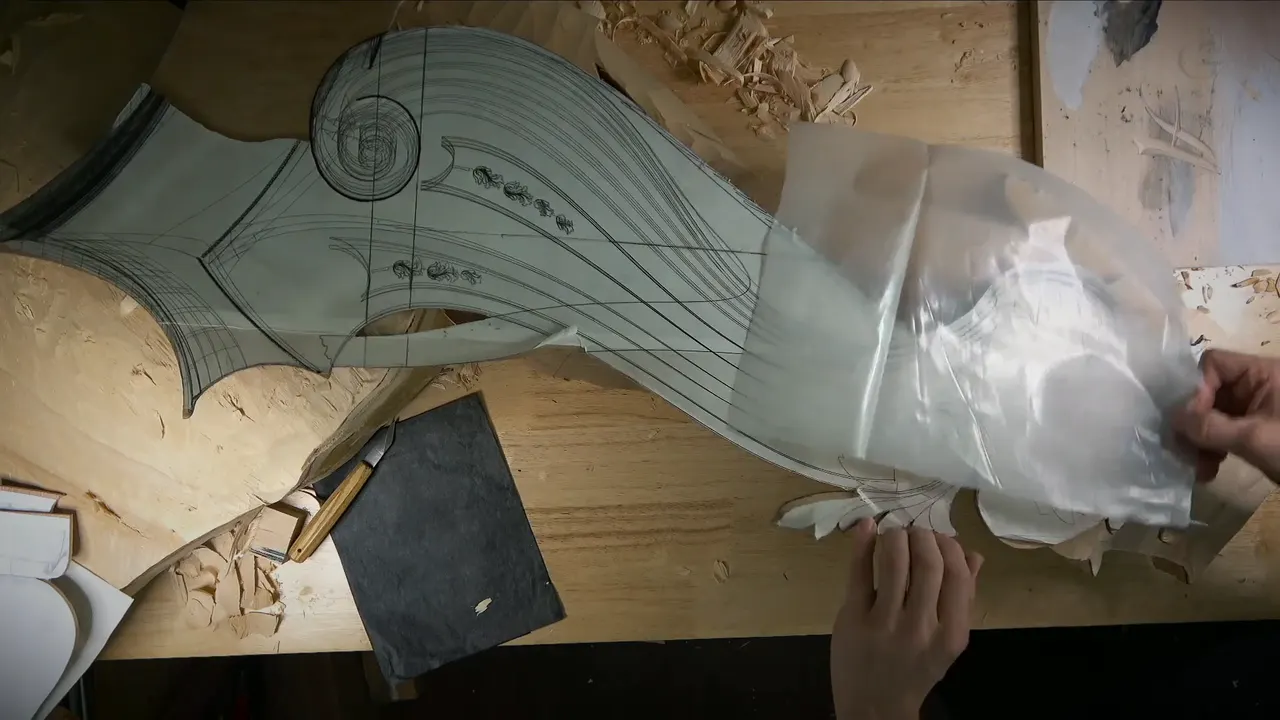

In Venice Room workshop 79, part 4, I said I would move my drawing with "the old method, plastic." My other lessons use the old way for carbon paper, a gouge, a scraper, a stain and sandpaper. Here they are in one place.
Do you have a drawing at full size on your bench? Is there plastic on your shelf? Here is where those two met on my bench, and the other places I used those words.
What was the old method in part 4?
The part opens with "I am ready to work on the details. Not the details, but on the carving itself." Transfer came first. I planned to move "my drawing or my design," and for that I named "just the old method, plastic." I added "That's what I prefer probably in this case." The pair was "Plastic and carbon paper" and, in my words, "those two things."

The plastic was plain. "By the way, I'm just using normal garden plastic or painter's plastic will work also," I said. I called it "really good" and "not really thick." Next I said "I need a little bigger piece." Later came "So that is plenty." Only part of it would be needed, I said. A remark about my knife followed: "Looks like this knife is not as sharp."

How did the plastic go over the drawing?
Here is how I described the method: "the way I'm going to do it, it's a really simple and old way." Next, "I've got a full-scale drawing," and a wish, "I wish it stays in place." After "let me apply it," the pins came up. I said I would need some, "Couple of push pins, three, four."

One section was my target: "just work probably on this section," in the "opposite direction." About flipping it, I said "Just because I'm using my plastic, so it's not that complicated to flip it both directions." And then, "So it's really easy."

What went on the plastic first?
Pen or marker? "Either pen or marker, and I'll use just a pen." Then, "let me start from this point." I named the first shape "a drop, a cloth drop." Then I said "I do have some movements going that direction," and "the most important is my acanthus movement."

About the sheet I said "It doesn't look as nice as of now because it's going to be more 3D look later on." What I needed was "the boundary." Maybe I would change "some of the stuff," I said.

Flutes were next. "Those flutes" would be needed, I said, and "Most of it, that's going to be hidden." "I even don't know why I use those flutes," I said. A volute came up as well: "And I have a volute or a voluta to be more accurate right in this area."

What did part 5 add to the method?
Part 5 opens on a print, "kind of messy-looking one," I said. "The reason why, because it's 3D lines and it's a wireframe." Another mode was possible, "but I don't want to lose some of the lines." Later, about the movements, "I can't, those movements, I kind of don't like. I like overall movement, but there is a big difference when you're doing a 3D program versus the real life."
Then, "in real life, you see much better how is it going to look, and I already made some changes on the main front piece."
Then came "this really old method," and "I can just flip it and I can see through, and I can align whatever the side I'm working on." On the other hand, "I do have a 3D form. It's not flat, so I have to be careful how I do it."
"Let me align first this side," I said, and then "See, it's not matching exactly. Again, just because it's 3D." Bottom first was the plan: "Let me do bottom first. Align it." And once more, "Couple push pins."


Did I name carbon paper in the Apron lesson?
Yes, in Carving Dining Table Apron workshop 5. I listed transfer tools there. One was "just the needle." The line was "That's what they used, actually, to transfer the patterns in 18th century, 19th century." The method: you "would just kind of trace with the needle point, just poking." I called it slow: "it takes too long, in my opinion."
Then I got to the next one. "And carbon paper is also kind of old way. It used to be when you go to a store, you can just buy that carbon paper. Right now, it's hard to find it. You have to buy it online."
How did paper come up on my livestream about plastic?
My April 2020 livestream has a similar line. The pad came first, and I said "I'm using big drawing pads." And "I like bigger ones." Then, "First of all, I'm saving some money." With a paper, "you have ability to establish the boundary, whatever you need to draw."
The transfer had two routes. One was to "just push and you're able to see it through just the area." The other route got these words: "the old way, just use a carbon paper and transfer it." After that, "you know exactly what needs to be developed."
Was a block on paper the old way too?
Carving Greek Acanthus Leaf 1, part 1, shows two ways to start, and which one I would pick. "I actually could just draw probably on the piece of wood itself, and that would be probably sufficient." My line after it: "But I'll go the old way, what we did before. I would probably just place my block on a piece of paper, trace it, the size of my wood block."
Depth was next. "We're going to take maybe 5/8 down, 5/8 of an inch down" (16 mm).

Was a background punch the old way too?
The Grinling Gibbons class in Maine has class 6, part 2, where I said "we're gonna create like a background punch the old way." My next words were "what I can do I can actually create few cuts." Then, "one of the ways you could just to create multiple cuts and create like a grid look." Another route was "like a cross cut."
When did the old way mean a gouge?
Venice Room 82, part 3, has a need I named: "the plug cut in this section" to "create a really nice shadow." I asked, "Why don't I do that with the number nine and maybe quarter inch again?" A drill came up next. I could "always drill it in this case since I actually do have a drill." Then, "Maybe I'll just use the drill. Maybe yes, maybe no. No."
My choice came after that. "I'll probably use just the old way, just my number nine and a 6 millimeters gouge." I repeated the size: "the quarter inch gouge." (6 mm is about 0.24 in, a hair under a quarter inch.) A limit followed. "I can't go too deep because I can damage this side." And "I also probably have to aim a little different direction."

A big rasp was my plan in part 12 of Venice Room 18, "to give a really good shape to this area." Soon, "Maybe that is little too extreme and too big." Then my plan changed. "The old way," I said, with "just the gouge."
Venice Room 6, part 3, goes the same way. "Let me use a rasp, and figure out what is going on with this edge." Then, "Just something off." Later came "I'm too aggressive." My next call: "Oh, no, I just going to use my old way." The gouge would "touch out this side."

The edge improved. "It's still not what I want to see, but much better," I said. Then, "Let me give a slight cut right here," and later, "now it's much better."
Part 3 of Venice Room 9 shows a switch. I said "maybe it's a good idea for me to try again to use my new addition, which I didn't use too much before." Then, "Maybe it's a little too aggressive there, so I got to say they're grabbing a lot. Okay, got a different one." After that, "let me use just the back bent again, the old way."
A number 11 is the tool in part 9 of Venice Room 91, and the plan is straight cuts. "So with the number 11, and I'm going to do old way, like that. Okay? Just straight down cuts." Off camera, I planned "those multiple cuts." And "for now, for me, it's just not convenient to get with the camera." Rasps came up too: "I will use probably rasps."

Did the old way reach my sharpening bench in the gouge course?
It does, in Sharpening Straight Gouge, part 1. "There's two ways to sharpen, to get your tools sharp," I said. "By hand, the old way, or if you're just like me, and you're doing that for a living, you actually carve for a living, sometimes by hand is just too long."
Still, "I do love to do sharpening by hand, and we're going to talk about that, too." That day, my plan was "to concentrate on sharpening tools with machines." Of machines I said "the quickest way."
The Techniques, Tips, and Tricks course uses the words too. For a strong edge, I said, "You can go to Home Depot and buy 6,000 grit, whatever for the automotive sandpaper." Of the next step I said "the old way," and "just go inside and sharpen it." Then, in my words, "Easy solution."
If you do not want to spend much on stones and a machine, I said, "just to do the old way," with "different grit sandpaper" from Home Depot, to "use it on a bench, and use that for sharpening." Next, "That was actually the first thing what my teacher taught me." The teacher's words, as I gave them: "Don't overcomplicate things unless if you have enough money to invest in stones."
Is a scraper the old way to clean a carving?
Curly Kitchen Cutting Board 16, part 4, has me saying "It's all dirty, and that's not good. I don't like it." Then, "A couple of ways you could actually clean it. Well, the old way, we could just use a scraper and scrape it. That's probably my preferred way until everything is just clean."

Sanding was the other route. "If you don't feel comfortable with the scraping, at the beginning especially, it's absolutely okay." One warning came with it: "Don't over-sand it because you're going to lose the detail."
What stain was the old way?
Workshop 18 of the same board, part 1, shows a stain. "You can see what I did actually on the corners right here, like I aged that," I said, "also kind of old way to stain." My mix was "I took some vinegar and I got some iron parts dumped in it, and that's what I've got, actually dark brown."
On a white spot, "not much going to happen." On wood "already pre-stained with the natural stain," I said "it's going to create the black or like a blackish color." And "you can actually really, really nicely age it if you wish."

The lines side by side
Each row is a place I said it, with the tool I named next.
| The job and where it happened | My words for the tool |
|---|---|
| A full-scale drawing, at the start of part 4 | "painter's plastic" |
| A pattern in the apron course, workshop 5 | "that carbon paper" |
| My livestream, after pushing to see through | "transfer it" |
| A block on a sheet in Greek Acanthus, lesson 1 | "a piece of paper" |
| The Grinling Gibbons class in Maine, part 2 | "a background punch" |
| A plug cut in workshop 82, part 3 | "a 6 millimeters gouge" |
| A big rasp that felt too big in Venice Room 18, part 12 | "just the gouge" |
| A rasp that was too aggressive in Venice Room 6, part 3 | "touch out this side" |
| My new addition, then a different one, in Venice Room 9, part 3 | "the back bent" |
| Straight cuts for a deeper spot in Venice Room 91, part 9 | "the number 11" |
| Gouge sharpening by machine or by hand, in part 1 | "By hand" |
| An edge made strong in the Techniques course | "different grit sandpaper" |
| A dirty carving in the cutting board course, workshop 16 | "a scraper and scrape it" |
| Aged corners in the same course, workshop 18 | "vinegar and I got some iron parts" |
Wikipedia has pages for the objects named here: carbon paper, plastic, push pins, pen, marker, volute, acanthus, gouge, rasps, drill, sandpaper, vinegar, needle and tracing paper. It also has wood carving, flutes, drapery, stones, wood stain and wireframe.
Where can you watch these lessons?
The Venice Room 79 page holds part 4, and Venice Room Part 7 holds workshops 74 to 85. Other lines come from the Dining Table Apron, the Greek acanthus course, Grinling Gibbons in Maine, gouge sharpening, the Techniques course and the cutting board lessons, plus workshops 82, 91, 9 and 6. Is there a drawing waiting on your bench? Do you have the plastic for it?
How it's done
- Say what you will use. Plastic first, and also carbon paper, the pair I named.
- Get a bigger sheet. Mine was too small, so I asked for a little bigger piece. Later I said that was plenty.
- Pin the drawing. A full-scale drawing was ready, and the pins I expected to need were "three, four."
- Pick a pen. Either a pen or a marker would work, I said, and I would use just a pen.
- Start at a point. "This point" was where I would start, I said, and the first shape I named was a cloth drop.
Frequently asked questions
Which two things did I name for the transfer in part 4?
Carbon paper, along with plastic. Ordinary garden plastic was what I was using, and I said painter's plastic would work also. In my words it was really good and not really thick.
How many push pins did I say I needed?
Three or four. They came right after I said I had a full-scale drawing and wished it would stay in place. Part 5 mentions a couple of pins again, with the bottom to be done first.
Were the first lines on the plastic final?
As of now, I said, the first lines did not look as nice, because a more 3D look was coming later. I needed the boundary, and maybe I would change some of it.
What to carve next
- Venice Room 79
- Venice Room Part 7
- Venice Room 82
- Venice Room 91
- Venice Room 18
- Venice Room 9
- Venice Room 6
- Carving Dining Table Apron
- Carving Greek Acanthus Leaf 1
- Grinling Gibbons Maine class 6
- Sharpening Straight Gouge
- Woodcarving Techniques Q and A
- Curly Kitchen Cutting Board 16
- Curly Kitchen Cutting Board 18
- Livestream April 2020