

Alexander Grabovetskiy, woodcarver, School of Woodcarving · Published 2020
What does a wood carver mean by "nothing exciting"?
Quick answer: In Venice Room workshop 79, part 3, I said "nothing exciting" before I took waste off a marked corbel block, "just the roughing out." Other lessons use the same words for cleanup, a straight undercut, chopping, removing waste and digging deep.
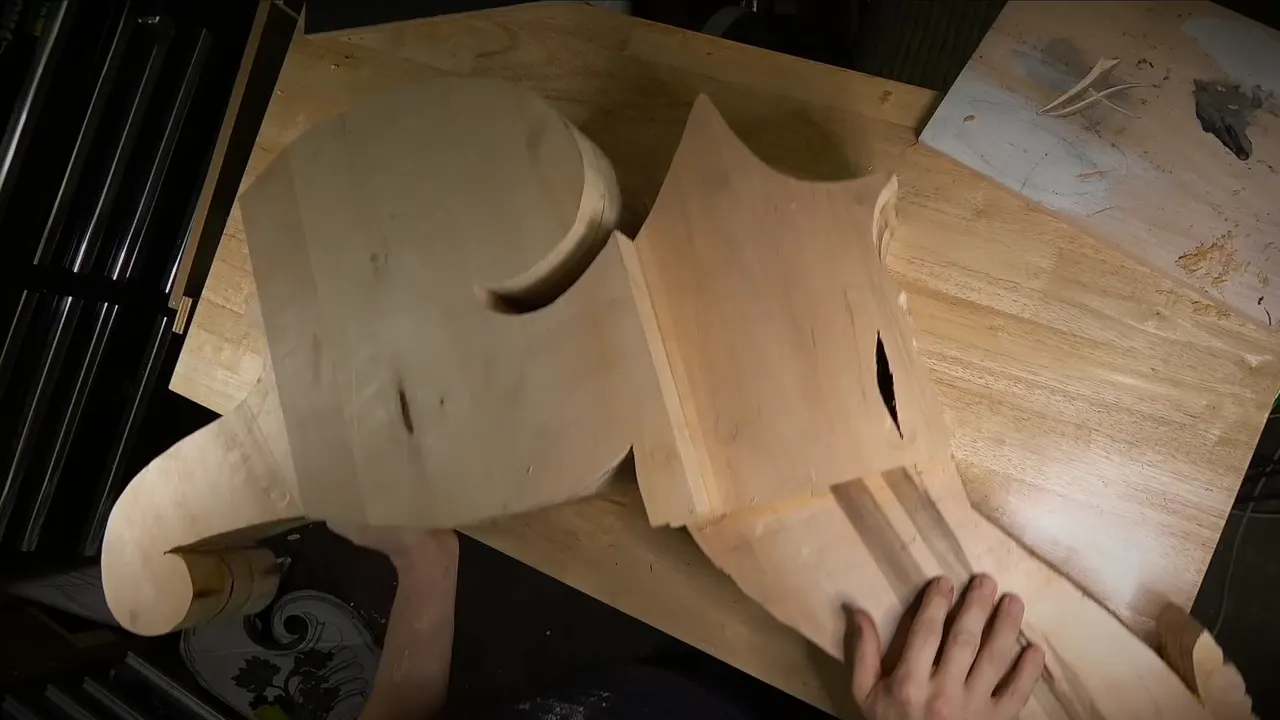

Nothing exciting is what I said in Venice Room 79, part 3, just before I took the waste off a block I had marked, "just the roughing out." The same two words come back in my other lessons, ahead of cleanup, undercutting, chopping and digging deep. This page puts those lines side by side.
Is there a stage on your own piece that you do without a second thought? Can you name the tool you reach for? Here are the places I used the words, in my own lines, with the lesson each one comes from.
How did the roughing begin in part 3?
Before the roughing came the marking. "I marked everything," I said, and "I had to actually do some grid work, like inch by inch." My marks went on "all of the sides" in red marker, and I was "ready to carve."
The weight came next. "Let me try to show that to you, but it's super heavy," I said, and "now I need to flip it upside down without breaking." Then, I said, "I can start carving," and I would probably begin "from this section."

Right there, I said this: "Nothing exciting. It's just the removal of the material. So it's going to be pretty much just the straightforward cuts." I added that there was no design in it, only the roughing out.
The block's place came next. "I'm going to place it on the cookies again," I said, and then I asked "That's stable?" and answered "That's stable." Carving across was the plan, with my marker "almost at the edge right here," and I was "pretty much ready."

Which two ways did I name for the line?
Two. "There's a couple ways, actually," I said. One was a saw: "make a saw cut to the line and then remove it, but I'm not sure if it's going to be faster or not." The other used the gouges alone: "I can probably do as fast with just the gouges without making any saw cuts."
Marks on both sides meant "multiple cuts," and "that way I'll be dead on the line." Then came "it's not a big deal for me at all, so I can just take a gouge and just remove it." "Do that."

What came before the roughing on this corbel?
"I know it's off-camera, but it's about 42 inches" (107 cm), I said of the block, "a huge corbel." It was "about nine inches thick" (23 cm). "I have to make two of them." For measuring I said I would use "probably a lot of times just the calipers," and my templates were glued on "about 3/16th, five-millimeter plywood."
A bandsaw could not take it: "I wish I could take it to a bandsaw, but it's too huge." On the bench, "I'm using those cookies to hold it, and that's super heavy," and I wanted it "flush with my workbench."

My line in part 2 was one "which you don't see," one I "can't really show." That line, I said, is the end of the volutes. The easy ways there were a speed square, a line divided in inches and calipers: "one of the easy ways also to transfer in 3D." The page for the whole workshop is the lesson 79 page.
My template was a print of the side view, and "I cut that in half." One part was "going to go right there," and the other "supposed to represent this side right here."

Does cleanup get the same words?
In Venice Room 119, part 3, cleanup gets them too. "Now what I have to do, just clean up," I said. "And that's it. The main movement is done. Just lots of cleanup and undercut, which is nothing exciting." The job was "pretty much the same operation as always."
For the cleanup I planned a number 11, to "attack from different points of view and get my excavation deep." The cleaning job itself, "I'll get off camera." A flatter gouge, "like number three," would "get rid of some of the marks I don't want to see."

Later I would use a bigger veiner to "create concaves and convexes and blend them." For this side I said "I'm not going to do anything complicated right here, just clean up and round up." And "it's not the main details."
Did I film the cleanup in Venice Room 73?
Part 7 of Venice Room 73 has me finishing a section and saying "some of the stuff I'm going to clean up, but I don't need to do that on a camera because it's nothing exciting. It's just removing whatever I don't need to."

A small triangle came next: "Remove that carefully out. That triangle." "I think it gives beautiful shadow," I said. "Extra small triangle, but huge difference." Next, a note on depth: "here I can go probably even deeper and remove even more." Then: "But I still have to be really mindful how much more, okay?" The tool was "one millimeter number 11" (about 0.04 in), and there was a technique for the roughness inside, too.
Sometimes, "not always," I use a "tool for the leather carving." It is "almost impossible to see," I said, but it is "a really good tool for getting inside of those cavities" and makes the "cavity or excavation much cleaner."

What did I say about chopping in Venice Room 68?
Venice Room 68, part 4, has a slip. "Oops, I apologize. You don't see it," I said, and "Have to switch my cameras more often, and it looks like I didn't." Then I said "nothing exciting. I did exactly the same thing." "Just chop," I said, and "Chop, chop all the way."
Quick, in this case. "I know it's extreme, but that's quick," I said. "And for me, quick means good, in this case, at least." The tool was a number 11, "20 millimeters" (0.8 in), and I said "I can safely outline it."

Which side did I reach the waste from?
Hashemi Flowers 14, part 3: "Now I need to remove all that waste right here." I would take a number nine, "though it's nothing exciting, only removing this waste." The opposite side was where I would go in.
Later: "you can see it's actually already through." The grain was my reason: "just because of the grain, it was easier for me to reach from opposite side. And that way I can easily remove a lot of waste."

After that, "I could use actually number seven and attack that like this." A V tool followed: "let me use a V tool," I said, and "logically, I have to attack that from opposite direction." Between the two parts: "Not too convenient to work between those two parts, but if I'll be careful, I'll be able to." And a tip: "Just make sure you create the leverage against your finger."
What was under-carved before the second layer?
The second layer opens Hashemi Flowers 27, part 1. What I had done off camera, I said, was this: "whatever the wall I found on the carving, I under-carved from the backside." I did it "because I thought it's probably a good idea to get it done," with "nothing exciting about it."

"So you can do it on your own," I said, and "I don't think you need instruction for that." The advice: "Just attack that from the backside." As for the rough look, "It does look a little rough on the backside, which is absolutely fine."
The piece for the second layer was "an 8-quarter piece of material, which is approximately two inches" (51 mm), and "to be exact, one inch and 15/16 after I planed everything" (49 mm). I gave the size as approximately 13 inches tall (330 mm) and about 7.25 inches wide (184 mm).
Why did I put off the cleaning in Hashemi 40?
Back in Hashemi Flowers 40, part 1, I said maybe I would clean all my carving "a little later off-camera." My words for it were "I don't have to do all the cleaning on the camera because it does take a lot of time, actually, a long time, and there's no reason to keep filming that because there's nothing exciting about cleaning."

"All you do, you just take the same tools which you used and make clean cuts." Then the leaf: "it looks like I do have a thickness right in the middle." Next I would take "an even smaller gouge" to "create a concave on inside of this leaf," a number eight, "about 5/16 of an inch" (8 mm).
"I have to constantly check the backside of it," I said, and "let me just make more passes." About that concave: "I think this concave cut in the middle is actually going to look really good." The V tool was next, to "carefully undercut and clean it."

Where did I dig until I could not see?
Hashemi Flowers 46, part 3: "Maybe I should use now number 12, or I'm sorry, number 11," I said, at "one millimeter" (about 0.04 in). A habit of mine came out, too: "I don't know why I'm always saying number 12 because probably number 12 knife is, as of now at least, my favorite knife."
And then: "But nothing exciting what I'm doing right now, just excavating deep as much as I can until I can't even see." And: "Okay. I like it."

Is an undercut something nobody can see?
Roman Acanthus 11, part 4: "I know it's impossible to see what is going on inside when I'm undercutting, but believe me, there's nothing exciting, just a straight cut." It "just goes to the point," I said, with "no beauty in it."

"I still like to see all my undercuts really clean," I said, and "let me take number one double bevel and make it a little nicer." Next, "I'll take V tool and remove what I just created. Hopefully, you can catch the shadows. That's the whole idea, to make it look really deep."
"This is not the final undercutting yet," I said, and "it's just preliminary." But "even preliminary, try not to make too many mistakes because it's still undercutting."

Later on, I said, "we do have a second line," and it is "going to create even more beautiful shadow." Placed "in a frame and on a wall with the right lighting hitting this thing," I said it will create "beautiful effect." And "even without the finish on it, just the bare wood is still going to look really nice."
Can a pass straight down be a plain one?
Venetian Flowers Rosette 1, part 3. "Maybe I'll just use different tools," I said, flatter ones, "like number three, number two," to "get little nicer cuts. All right? Just like that, straight down. So nothing really exciting about it. Just to get my boundaries all the way down."

I planned to "get it done off camera," and "once it's done, I'll turn on my camera and just show you the next step." After it: "I cleaned all around." And "it's not really clean-clean, but clean enough for me."
A measure came next. The high spot and that spot sit "exactly one inch" apart (25 mm), "and I checked that with the calipers." On that one inch: "It doesn't have to be that, but it ended up that way."

Is blending another plain job?
The Venetian rosette, lesson 3, part 2: "a little more time probably blending all together," I said. "But I'll do that little later." And: "Blending is not that exciting."

Next: "let me get some wave in also on this side." I want to make sure "I'm not taking too much material" and "I don't want to damage it," with another flower close by. And "you can see it's already showing really beautiful design-wise."

The lines side by side
| The plain job and its lesson | My line |
|---|---|
| A block marked on every side, with the waste still to come off, in part 3 of lesson 79 | "the roughing out" |
| Cleanup and undercut after the main movement, in Venice 119 | "same operation as always" |
| A section to clean up, in Venice 73 | "removing whatever I don't need" |
| Chopping, with a camera slip, in Venice 68 | "Just chop" |
| Waste taken from the opposite side, a number nine, in Hashemi 14 | "only removing this waste" |
| Walls found on the carving, under-carved from behind, in Hashemi 27 | "you need instruction for that" |
| All the carving cleaned later, in Hashemi 40 | "make clean cuts" |
| Digging deep until I could not see, in Hashemi 46 | "excavating deep" |
| One pass inside an undercut that nobody sees, in Roman 11 | "just a straight cut" |
| Flatter tools, boundaries straight down, in Rosette 1 | "straight down" |
| Blending it all together, which I said would come later, in Rosette 3 | "not that exciting" |
Wikipedia has pages on the objects named here: corbel, workbench, gouges, wood carving, marker, calipers, bandsaw, saw and plywood. There are also pages on grain, leather carving and the millimeter.
Where can you watch these lessons?
Venice Room 79 holds part 3, and Venice Room Part 7 holds workshops 74 to 85. Other lines above come from Part 10 and Part 6 of the Venice Room, from the Hashemi Flowers course, from Roman Acanthus 11 and from the Venetian Flowers Rosette course. Do you have a block waiting to be roughed out? Can you tell which pass is the plain one?
How it's done
- Finish the grid work. Red marker went on every side of the block, inch by inch.
- Turn it over. Flipping the block was the next job, and it was super heavy.
- Check the support. The plan was the cookies again, and I asked "That's stable?" and answered "That's stable."
- Choose how to reach the line. A saw cut to the line was one way, I said, and gouges alone were another.
- Start the roughing out. Carving across was the plan, with the marker almost at the edge, and the waste coming off in straightforward cuts.
Frequently asked questions
How did I finish marking the block?
Red marker went onto all of the sides, after some grid work, one inch at a time. Then the block had to be turned over, and it was super heavy.
Why did I leave some cleaning off camera?
In Hashemi Flowers 40 I said it takes "a long time." In workshop 73 I planned to clean up a section without a camera on it, since I called it nothing exciting. Other lessons here say the same.
What did I say about the inside of an undercut?
In the Roman lesson I said you cannot see what is going on inside, and "no beauty in it." I still like to see all my undercuts really clean, and I called the undercutting preliminary.
What to carve next