

Alexander Grabovetskiy, woodcarver, School of Woodcarving · Published 2020
What does a wood carver mean by "alternative way"?
Quick answer: In Venice Room workshop 79, part 2, I said "alternative way" right after I marked a thick block with a speed square and ruled inch steps. Other lessons use it for an opposite curl, a knife next to gouges, a jig I made myself and a second choice of router plane.
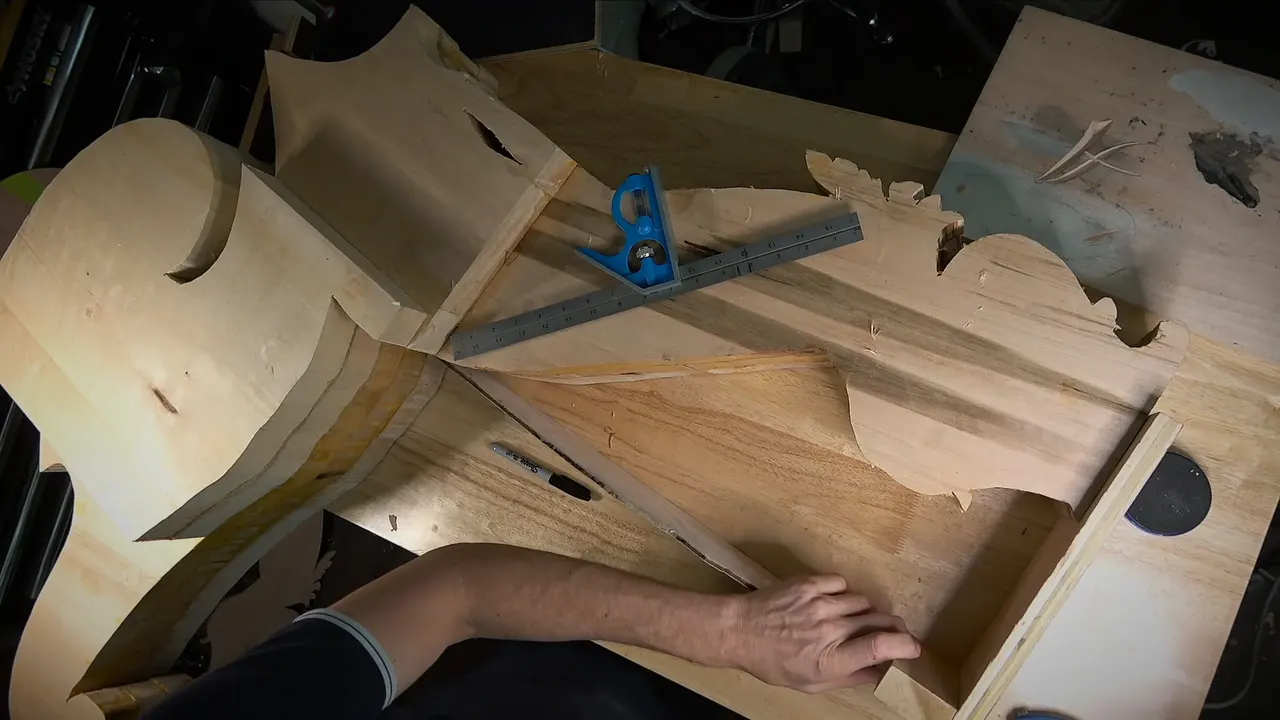

Alternative way is what I said in part 2 of Venice Room 79, right after I marked a thick block with a speed square, then with ruled inch steps. The same two words turn up in other lessons of mine, about curling the other way, working with a knife, making a jig and picking a second choice.
Is there a job on your bench where the first method stalls? Can you picture another way? Here are the places I used the words, in my own lines, with the lesson each one comes from.
Where does alternative way come in part 2?
Near the end, after the speed square and the ruled inches. The part opens on a line the camera cannot show: "I also have a line which you don't see, and I can't really show that to you." That line ends the volutes. I carried it onto a block of wood, and "I know I aligned that perfectly," I said, and "I know I can do that."
Finding the position was "only one method," in my words, and I said "there's multiple methods." Mine was a good one. My tool was a speed square, a "really, really easy-to-do process."
How did the speed square reach the board?
"If you look at this side, I've got a bunch of lines," I said. I could always line up my speed square with them and know exactly where a point lands on the board, "with no problem." About clamping, I said "maybe I can just clamp that also," then "Somehow, I don't have anything to grab." And "This is not going to work, but it's okay." My fallback was "Maybe I'll just support it with the cookie."

"This one is already rusty," I said, and I could use a smaller clamp: "I really don't have to use those." Screws got a vote next. I said "Maybe it's a good idea." "Maybe bottom," I said, where they would not show, and I could take them out "with no problem." The screws were "a couple inches long" (about 5 cm), I said. And "Most of it is going to be waste anyway, so I'm safe."

Then "So now I know it's going to be 90 degrees to line, which we don't see, but it's there." A right angle to a line nobody can see.
Why did I keep the marking off the camera?
I would not film everything, I said, "but you should get an idea." The plan was to place the speed square, run it to the board, and find the height I need. I called it "the process." For leaving the rest out I gave this reason: "I have to be all the time having my head in the camera, so it's not even interesting process." Then "But let me work on it."

What was the other way?
Calipers are the next thing I named: "Another way what I could do or you could do, there is multiple ways to do, just use calipers." Off camera, I had done something else. "I placed whatever the line's supposed to be 90 degrees to my base, and I've got just divided that in inches from one, two, three, and so on."

I did "exactly the same right here," with "the same one-inch increments," and I said you can "measure the same line, and that's really easy." Marking went "Point to point," until "here you go," as I put it. I named two things here, calipers and inch lines.

Straight after that I said "I can always mark it just inch by inch by inch and go all the way and make my marking." After that: "So that is one of the easy ways also to transfer in 3D, okay? That's alternative way."
I planned to "probably use both," though not on the camera: "I'm going to do it off camera." Another way exists, too. "There is actually the other way to do that, too." I do not name it in this part. For more than one way, my words were "this is so heavy, I cannot move it around and so on. That's why I have to probably use multiple ways, okay?"

Did other parts of workshop 79 use two ways?
Part 3 has "a couple ways" for taking waste down to my marks. One was a saw run down to the line, then remove the waste, though I was not sure the saw would be faster. The other was gouges alone: "I can probably do as fast with just the gouges without making any saw cuts." With marks on both sides, I could "just create multiple cuts, and that way I'll be dead on the line." "It's not a big deal for me at all," I said.

The bandsaw was out in part 1: "I wish I could take it to a bandsaw, but it's too huge." I could not hold it, I said. Instead, "it's not that complicated. So all I need to do is just measure."

Does alternative mean the opposite direction?
In part 7 of workshop 77, it does. I wanted one leaf to curl up on one side only, "versus this one, it curls up that way," and the other was to curl two ways. "If it makes sense." One side needed to come down. My words were "Kind of alternative or alternate different way, opposite direction, just like in real life." I gave a reason: "So it's not going to look good if it's all the same." And "that's what I'm after."
Before that I said I can dig in with a small tool, which is "less dangerous." It "takes a lot less material at once." Slower, yes, a "little slower process," but "I still able to pull pretty quickly that shape, or I should say variation of a shape."

Part 10 says it again as I move to a second leaf. About the first one: "It's catching some shadow, and I think it's looking not bad at all." Then "Let me move to another one." Of the new one I said "this one, going to go opposite direction, moving that way. Okay? So I'm going to use alternative to this one."
The plan wobbled: "And yes, I could probably start chopping that. Well, actually, you know what? Why don't I just do it this way?" Then came "I probably should clamp it," and "Again, any clamp will work." One warning to myself: "I can actually work with my skew, but I got to be careful."


Is the reason ever shadow?
Venice Room 134 adds a reason in part 1. Before it I said "Logic is the same. The bigger tool I have, the quicker it goes," and that I would get that big number seven.
The sentence itself runs long. "Why I'm doing it alternative way, I sloped those two guys this way, and that guy goes that way, just for the shadow's sake," I said, "because different time of a day, light going to hit from different angles, and it's going to look nicer."
On depth I kept it open, "I could go this side maybe slightly lower," though I did not have to, "but I can do that probably." "Let me outline this side" was my plan, and later "I think that is low enough."

What if a concave sits next to a convex?
In Venice Room 25, part 6, I planned to start subdivisions "and other concaves and convexes." I had been studying "how they've done" them, and "it looks like sometimes they just made the alternative approach." My example was "If this is a convex, then make this one as a concave." I was not sure I would. "We'll see." Next on my list, "this is my pipe side and I need to blend a little nicer to the pipe."

Is a knife an alternative to gouges?
In Roman Acanthus lesson 4, part 1, it can be. I was working on a preliminary eye, "not the true eye yet." Beside it, I planned to find the tool that fits, and "number seven fits perfectly." Next came the words: "Alternative way versus using just the gouges, we could use just a number 12 knife."

That knife is "one of my favorite knives," and "it's exactly the same idea. We can just follow the pattern just with that knife." Quicker, too: "much, much quicker way to work around." Then back to the gouge, with "I'll take again number seven and remove even more," and a note on depth. "And that is not my final depth yet. That's why I'm not afraid."

Flower Rosette lesson 5, part 1, opens with the words: "Today I want to show you some alternative way you can approach actually carving that type of carving." It was a rosette I still had not carved, a "little different approach."
On tools I said "It's not always you have to have all the tools, the whole complete set for the carving." With "just simple tools like a chip carving knife, and maybe just one small gouge," I said you can still do that type of carving. It would have challenges and not be the easiest thing.
On gouges I took my side: in the previous workshops I "used primarily gouges to establish my form," and "I prefer gouges." "I think that's actually more accurate and looking nice," I said, and this time my plan was "just a knife mostly."

The knife went "just straight down" for the outline. I held it "as like a pencil," and said "that's easy for me to create the pressure." My other move was "pulling my knife toward myself." For wood I said "if you're using basswood or limewood, same like I'm doing right now, it should not be any problem." The wood is soft, and it "digs really nicely."
My names for it were plain. "I can call it carving on steroids," because it's "actually a lot quicker." Also "a simple carving." Talking about a tool list, I said "the number one tool which you have to really buy to carve is a knife." A chip carving knife.

Can a jig be an alternative way, too?
In the Tormek bar lesson, yes. The Tormek jigs are ones I "really like," "genius about those jigs." Then came the news, "just late 2017, we found out Work Sharp, they don't make those bars anymore, and that created the problem for some of you."
My answer was "there is an alternative way." You "can use still the same jigs from Tormek, but you have to just make alternative jig." Here is what I did. "I just bought the jig for a grinder from Tormek, and I created the actual jig myself where I can adjust and use it on the different machines."
"Even better," as I put it, a jig you "can just raise it and lower down." With it, the attachment need not be "just attached to the one machine." The base was a dovetailed piece. "I used that piece actually to set up my jig to make the dovetails, and I just kept the piece." Then "I attached my bar to it, and now I have absolutely no limit. I can just clamp it to my table." And a small doubt: "I'm not sure if I'm clear or not."
What about the alternative option in the stropping lesson?
The stropping lesson has someone in the chat saying Work Sharp was not made in Europe anymore. "Sorry to hear," I said. Then "There is an alternative option, actually. There is alternative options." I did not name one there, and went on with "But let me get back to stropping."
Stropping was the topic. I told of a video where I imagined I had bought an inexpensive set of tools, with no expensive stones, but with a piece of leather. "I just stropped pretty much those tools. And I was able to use just the stropping technique and the carve."
Do I use the word for tools and wheels, too?
The Livestream of April 2020 has both. The spoon gouge sharpening one has "I'm using Work Sharp, using a bar, and I showed you yesterday the alternative way." The U-veiner one has me on CBN wheels, "diamond wheels for the sharpening on the Work Sharp." Then "It's an alternative to a sandpaper, but I really like that alternative."
Can the word mean a second choice?
In Furniture Panel lesson 17, part 4, I was talking about router planes. "Beautiful router plane," I said, then named two brands: "I like Lie-Nielsen, and I like Veritas." Of those two, "I like Lie-Nielsen the most," and "That's probably my most favorite one."
My word is in the next sentence. "If the quality is good but no blades, so I have to just go to alternative, and the choice number two is Veritas." A bit later, "for some reason, I'm really having fun." And "It just feels really good to use this router plane." It "gives me true consistency," with "That's the goal to be really consistent with the depth."

The lines side by side
| Which lesson | What the other way was | My line |
|---|---|---|
| Part 2, lesson 79 | After the square and the inch lines, one more way to mark a point in 3D | "That's alternative way." |
| Same lesson, part 3 | A saw to the line, or only gouges | "there's a couple ways" |
| Lesson 77, part 7 | A leaf that curls the opposite direction | "alternate different way" |
| Part 10, lesson 77 | The next leaf, going the opposite direction from the first | "alternative to this one" |
| Workshop 134, part 1 | Two sloped this way, one sloped that way | "the shadow's sake" |
| Workshop 25, part 6 | A concave where a convex is, and the reverse | "the alternative approach" |
| Roman Acanthus 4 | A knife beside the gouges, following the same pattern | "one of my favorite knives" |
| Flower Rosette 5 | One knife and maybe one small gouge | "a little different approach" |
| Tormek bar lesson | The same Tormek jigs on a jig I made myself | "make alternative jig" |
| Stropping lesson | No option named before I went back to stropping | "alternative options" |
| Furniture Panel 17 | A second choice of router plane | "go to alternative" |
| Livestream, April 2020 | A bar I showed on the day before, and CBN wheels | "alternative to a sandpaper" |
Wikipedia has pages on the words and tools here: corbel, workbench, mallet, chip carving, gouges and wood carving. The measuring and marking come under speed square, calipers, right angle and volutes. Others cover plywood, vises, screws, limewood and sandpaper.
Where can you watch these lessons?
Venice Room 79 holds part 2, and Venice Room Part 7 holds workshops 74 to 85. The leaf lessons are Venice Room 77 and Venice Room 134 of Part 12, and the sharpening ones sit in the tool sharpening course. Do you have a block too thick to trace? Can you hold a square against a line?
How it's done
- Name the first method. Mine was a speed square run along the lines I had on one side, with the points carried to the board.
- Hold the block. For holding, I talked about the cookie, then a smaller clamp, then "a couple screws" low down in the waste.
- Divide a line in inches. I set a line at a right angle to my base, divided it in inches, and did the same right there.
- Measure the lines. Measure the same line on both and mark it in inches, all the way.
- Name another way. I named calipers, said I would probably use both, and said there is actually the other way, too.
Frequently asked questions
What did I name besides the speed square in part 2?
Calipers: "just use calipers." I also divided a line in inches and did the same one-inch increments right there, then named it among the easy ways "to transfer in 3D."
Why did I slope two in one direction and one in the other?
I gave a reason in workshop 134: "just for the shadow's sake, because different time of a day, light going to hit from different angles." Two of them slope this way, "and that guy goes that way."
Can a knife stand in next to gouges?
In Roman Acanthus 4 I said the knife can follow the pattern, and called it "much, much quicker way to work around." My plan after that was a number seven again, to "remove even more."
What to carve next