

Alexander Grabovetskiy, woodcarver, School of Woodcarving · Published 2020
What does a wood carver mean by "match"?
Quick answer: Match is the word I said in part 6 of Venice Room 79: "It looks like it still matches," and later "this side is not really matching." Other lessons of mine use it for leaf sides, depth, slope, gouge sweeps and curves, with the lesson for each one.
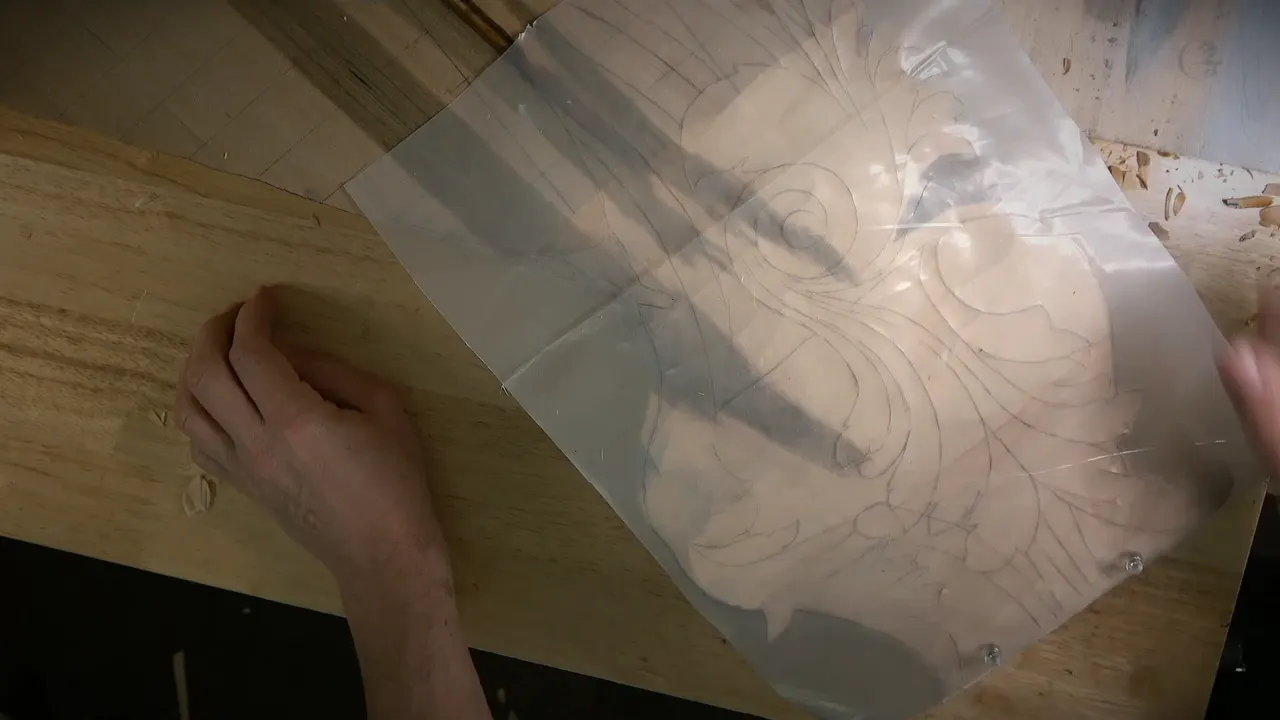

I say match twice in part 6 of workshop 79, and I say it again in lessons about leaf sides, depth, a slope, gouge sweeps and curves.
Have you ever laid a flat drawing over a curved piece and watched one side line up while the other did not? Can you see when a line has drifted off its mark? Below are the places where I said the word, lesson by lesson.
Where do I say match in part 6?
Twice, and the first time follows a long gap in the captions. It opens with a plan to take one section first. Then, "Again, just because it's 3D, it is not as accurate as I wish."
"But I'll be really close," I said. "I'll use a carbon paper," I added, and then came an aside: "By the way, you're still able to buy it."
Another line: "this section is not going to be accurate." Then came "I have to move it a little bit," and "at least I can start on this section." Also in there: "It's kind of hard to see with the lamp."

The captions show no words for the next minute. Then comes "And maybe this one," and after it, "It looks like it still matches."
What followed the first match?
A need to move it, as I put it: "now I need to move it slightly in order to reach this line." After that, "I could probably stretch like that."
Next: "Doesn't have to be exact, but somewhat close." Then "just that corner first."

The other form of the word comes later: "that's probably time to move it again, because this side is not really matching." Right after it: "I have to readjust slightly, just like that." And "it looks like it's pretty close."
How did I know I had room to go on?
I named extra material: "I know I got some extra material, so I'm pretty sure I'm safe. I can actually go all the way, this section."
A plan came next, "I'm going to put some push pin this way." After a quiet stretch in the captions: "And here you go. I think I'm really close."

What were the last words of part 6?
Then a plan for the opposite side: "Let me get on the opposite side." After it, "double-check, because I really want to stretch little bit this way."
After "Oh," the captions show a pause, then "no" and "Just lost the position," followed by "No, I did not." The part ends on "I actually don't really need too exact."

What do parts 5 and 7 add?
A cause sits in part 5, and part 7 has a template. In part 5 I said "Let me align first this side," then "See, it's not matching exactly," and the reason, "just because it's 3D." Part 6 gives the same reason.
The template in part 7 was one I had glued. About it: "I need to make sure my form is repeating this way," and "the sides are supposed to be matching like that."
A moment later: "And I already see the problem," followed by "there's no problem." The reason was "Because it's a 3D, so that's why it's a little longer." So "I cannot lean it like that," and it "has to be really 90 degrees toward that surface."

Which other lessons have a side to match?
Venice Room 37 is one. In part 10 I said "I also have to recreate kind of deep excavation," to match a side. Also: "I think it's about the same depth," and "if I need to dig a little deeper, I will."
A little further on: "continue this excavation on inside right now. It has to match this part."

Next, Venice Room 38, part 1. "I need to lower down this one even more," I said, with a side to match. Seconds later: "let me actually undercut. Undercut of this acanthus movement." And "once I'm going to undercut, I can probably excavate deeper with no problem."

In Venice Room 48, part 4, I said "Now let me clean little bit and start developing the movements and so on." And "that also has to match right now opposite side, so then I can easily excavate deeper. Much deeper, actually."
Can an angle match too?
In Venice Room 64, part 7, I named "number nine and a little bigger, maybe about three-eighths of an inch" (about 10 mm), and said "really important to position that properly. The angle supposed to match."
What I did not want to do was dig that way, because it would be too close to undercut. I planned "just a half a round," then a turn of the tool and the same again.

How did I match a division on a leaf?
It had to be repeated on the far side, as I said in Venice Room 143, part 2: "whatever I just drew on inside, I have to match on opposite side." And "logically if I have a division this side," I said, I need that division "on the opposite side as well."
My plan came next: "somewhere right here." There would be "another movement going that way," and I could "create a bigger opening in this section."

A line got the word in Venice Room 120, part 3: "match this line, which means I'll take number three or number two." Then "I'll take a number three by Henry Taylor, and about three-quarters of an inch" (about 19 mm).
How does a curve match?
With a number five, in Venice Room 73, part 3: "the depth of that section is supposed to be equal to this side," I said, and "that's why I'm extra careful in this case."
Then "I'll use number five and about 12 millimeters or so" (about 1/2 in), "just to try to match whatever the curvature I have." On the method: "I could use just a knife or anything else for this method, but I really love the idea. It gives me perfect curvature."

The livestream on plastic carries the word for a curve. "I know it's matching this curvature," I said of the plastic, and I planned to "place it in the right position." Then "Again, take push pins. Same push pins."
And I added: "it's really important not to damage the area with the push pins." I said "match my curvature" twice.

Does a gouge sweep match a profile?
I tried it that way in Furniture Panel 17, part 8: "I could probably find the matching profile sweep and do that way." Then "Try number 7 and see if it's going to match. Yep. It looks it does."
On the size: "approximately, I would say, 10 millimeters, three-eighths of an inch, and I need to get something smaller. Maybe number 8 will fit." (10 mm is about 0.4 in, and 3/8 in is about 9.5 mm.)

Later, "I'll use number five, and that one is 7/8 of an inch" (about 22 mm), and "let me use just a corner of it." I added advice for a run of panels: "you can record what kind of gouges you used to match the profile, and remember exactly the location you used this gouge."
Venice Room 160, part 3, gives a reason not to eyeball it: "why I'm not just eyeballing it, I could, but I've got a lot of molding to do, and I want to make sure it's going to match everywhere."
Can two surfaces match in height?
In Lily Box 6, part 6, I said "I also have to check both sides, this side and that side," then "this surface and that surface." After that, "it looks like I am matching. Okay. That's good." Then I offered a different point of view, "so you can really see the side of this volute."

Lily Box 9, part 1, has the word for a slope: "this side of the detail versus opposite side," and "match the slope." Relief cuts were my next plan.
In Lily Box 5, part 2, I said "I'm constantly checking the both sides." "You could measure it, that's up to you," I said, and "usually you can detect that just by eyeballing it." Then "this ridge," and "match the same height right here."

Roman Acanthus 13, part 4, has a limit: "keep an eye how low you go, because it's supposed to match." My check was "how much material you've got above the second line," and "where is your high point." In my case, "about quarter inch on this side" (about 6 mm), and "it's a good idea just to check and recheck."

Which two pieces were a pair?
The two pieces in Chamomile and Bow Rosette 4, part 1: "I'll just take number 11 and 2 millimeters" (about 0.08 in), then "It's actually 2.5" (about 0.1 in). On starting with a number seven: "I don't want to lose that edge."
"But since we have two pieces like that," I said, they had to "match each other." I wanted "that middle part" to be "exactly the same like on the second piece, or I should say, on the first piece that I've already done."

I closed that with "I need to establish that border, so I cannot go beyond that border."
The April 5 livestream has "the challenge I have, I have to match this side and that side. They have to approximately be the same. Not exactly the same, but approximately." Earlier in it: "I need to match the size, how wide that section is." The tool was "veiner number 11 and 7 millimeters, about quarter inch" (0.28 in; a quarter inch is 6 mm).

Can a background match an original?
Two lessons have it. In the Dotted Background Texture lesson I said "original piece has texture on the background, and I need to match that texture, and I did on all my previous pieces already." Then "for my background, I had to match original."
Later in that lesson: "I'm blessed that the sets I have match exactly the original design." And "If I wouldn't have that, I also had to make it from just a nail."
In Carving Dining Table Apron, workshop 16, I said "this background going to go all the way down also," and "match exactly like that the rest of the background."

Workshop 2 of that course has a transfer tip. I called something "probably the easiest way to transfer the original carving," and said "to match something."

What about a picture or a square?
In Carving Antique Style Rosette 3 I said "match exactly like the picture shows." The picture came from a customer: "match the antique style my customer sent to me, just a picture, actually, pretty much." And "I love to work from pictures."
Hashemi Flowers 17, part 1, is about squares on a tapered detail: "approximately quarter inch squares right here, and gradually make it lower. I mean smaller, not lower." Then "match kind of square to make it look like a square."
Right there, "it's only eighth of an inch. That means I have to make it eighth of an inch squares." (A quarter inch is about 6 mm, and an eighth is about 3 mm.)

The lines side by side
| Which lesson | What the line was about | My words |
|---|---|---|
| Workshop 79, parts 5 to 7 | A section I moved and checked, and the sides of a template I had glued in | "still matches" |
| Lesson 37, part 10 | A deep excavation I had to recreate, and a depth I thought was similar | "just to match" |
| Venice 64, part 7 | An angle, with a half round as my plan before the full turn | "position that properly" |
| Venice 143, part 2 | A division on one side, and the same division needed on the far side | "match that division" |
| Class 73, part 3 | A curvature, with number five at about 12 millimeters (1/2 in) in mind | "perfect curvature" |
| Furniture Panel 17, part 8 | A profile, tried with number 7, and a smaller number considered | "matching profile sweep" |
| Lily Box 9, part 1 | A slope on one side of a detail, with relief cuts as the next plan | "match the slope" |
| Roman Acanthus 13, part 4 | The depth to stop at, with about a quarter inch (6 mm) of material above a line | "how low you go" |
| Chamomile and Bow Rosette 4, part 1 | Two pieces alike, and a border I could not pass | "match each other" |
| Dotted Background Texture | An original piece with a textured background, and my earlier pieces | "match that texture" |
| Antique Style Rosette 3 | A picture my customer sent, and the background to be carved from it | "exactly like the picture" |
Do you have a drawing that will not sit still on your piece? Can you check one side against the other before the first pass?
Where can you watch these lessons?
You can watch part 6 in Venice Room 79, and Venice Room Part 7 holds workshops 74 to 85. The next workshop, Venice Room 80, uses a 3D model too. The livestream lessons sit in the April 2020 livestream collection, and the Chamomile and Lily lessons are in that rosette lesson and the Lily Box course. A wood carver could start with the Venice Room 37 lesson.
How it's done
- Start with one section. Starting with just a section first, then moving it a little bit, was my plan.
- Look at what still matches. Of one spot I said it still matched.
- Say when a side is off. A side that was not matching meant time to move it again, I said.
- Adjust a little. Then came the line about readjusting slightly, "just like that."
- Plan the pins. My plan was to put some push pin this way, and then to get on the opposite side.
Frequently asked questions
Where does "it still matches" sit in the lesson?
The line sits in part 6, after a minute with no words in the captions and just after "maybe this one." Later in the same part came the other form of the word, followed by a line about a small adjustment.
Must a match be exact?
Part 6 has "Doesn't have to be exact, but somewhat close," and later "I actually don't really need too exact." Two sides in the April 5 livestream needed only to be about the same.
What did I say about angles?
Part 7 has "it has to be really 90 degrees toward that surface." An angle shows in Venice Room 64 too, with a half round as my plan.
What to carve next