

Alexander Grabovetskiy, woodcarver, School of Woodcarving · Published 2020
What does a wood carver mean by "the finish line"?
Quick answer: In part 9 of Venice Room workshop 79 I said I needed a flatter gouge, maybe a number three, to reach the finish line. In other lessons the same two words sit next to a smaller blade, a smaller number 11, a flower, a boundary and a warning about breaking the grain.
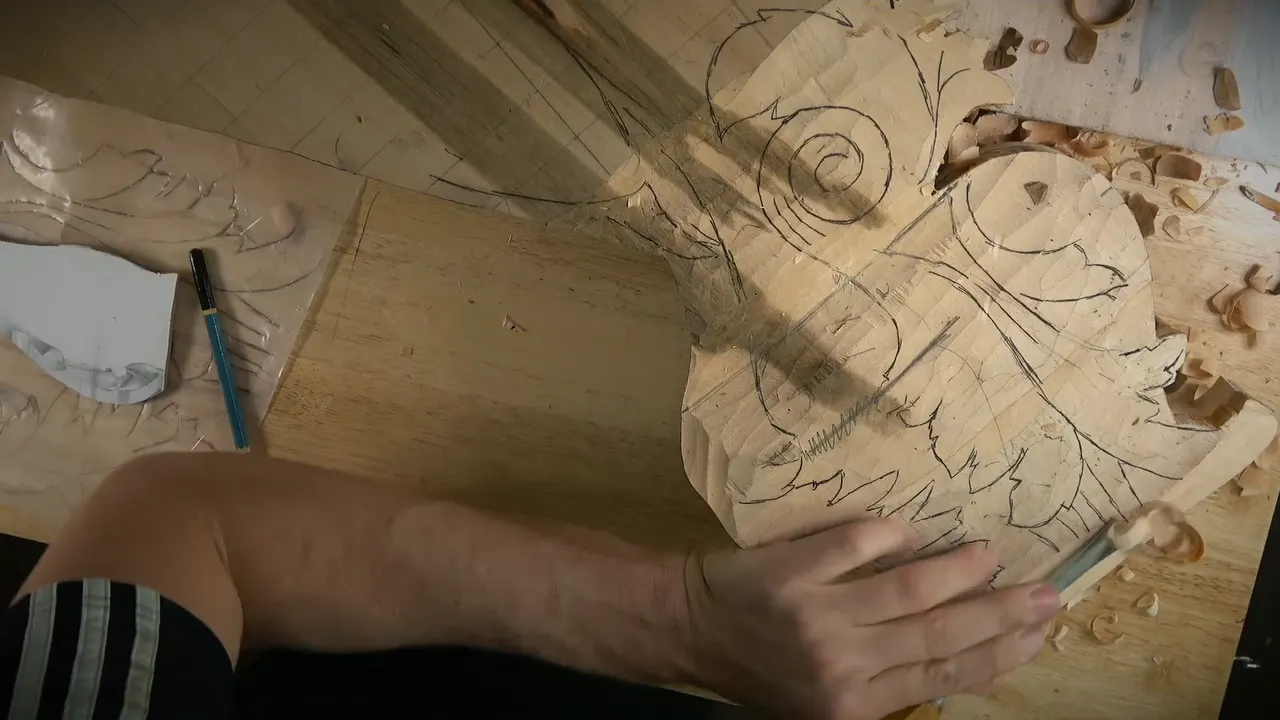

The words "the finish line" came out of me in part 9 of Venice Room workshop 79, over my corbel, and they turn up in other lessons too.
Ever worked a surface down and wondered where it should stop? Here is what I said around those words in part 9, and where else they show up in my wood carving lessons.
What was I doing right before I said it?
The part opens with "So now it's time for me to true it." Then "Okay. There you go," and "Maybe I have to change our camera angle." My next lines were "I am right on the line now" and "And let me check."
Then a need, "And I need to lower down this section also." Part of that work could wait, in my words "But I can do this part little later," and I added "But I'm really happy about this part."

What did I plan for the finish line?
This is the plan: "So now I need to get some flatter gouge, maybe a number three, and get right to the finish line." The flatter gouge was a need, and the three was only a maybe.
I called the line "my measuring point," and the lines after it carry "That way I'll know" and "perfect." The second one is in it too: "I'll know exactly" because I'm "getting the same line on both of them."

How flat and straight did the line get?
"Here you go. So I've got that absolutely flat." An offer followed, "I also could use a block plane just at the edge and get that absolutely straight line."
My verdict: "So now I know it's absolutely straight line and looks like I am right on the money." A job stayed open, "little later I'm going to clean this section also," and I said I have to make it "90 degrees" to the back of that corbel.

Then: "But now I'm happy with this line. Really happy."
Why is that line important for me?
I asked it myself, "And why is that line important for me?" The answer opens with "I'll be able to measure, because I do have patterns, and that distance is this distance right here."

Calipers come next. "Now it's much easier to measure with the calipers and so on the high spots," I said, "and I can always just go with the calipers and check my depth."
"Even with calipers like that, it's easy for me just to find the spot, whatever, and then just go in and figure out if I'm really accurate or not."
Does it matter how exact the line is?
My words were "if you would ask me if it matters, yes, it does." I gave a reason, "it's a more architectural carving, even if it's decorative, but it's still going to go inside of the house and everything measured."

I closed that point with "So there is no room for error, I should say," and "Absolutely no room for error."
What came after the line was set?
The flutes were next: "let me reestablish those flutes and this movement." Then "Now I know it's going to be there." On the middle I said "maybe I have to double-check where my middle is, which is somewhere right here," and "that is my middle center point."

A size came in: "That's about actually 10 millimeters, I'd say. Ten millimeters, it's the three-eighths of an inch." The 10 mm is 0.39 in (about 0.4 in), and 3/8 in is 9.5 mm. Outlining with that size was "Really safe," I said.
My tool pick: "I'll take number 11," plus "I could take probably seven millimeters or even 10 millimeters will work." Seven millimeters comes to about 0.28 in, and a plan followed, "And I can start outlining." The part ends on "so I safely can go deep."
How much wood stood above the line, per part 8?

Part 8 of Venice Room 79 has the roughing numbers: "approximately three millimeters up," then "Three millimeters, some spots five millimeters, some spots more." Alongside them, "3/16 of an inch or so higher than the line." In metric: 3 mm (0.12 in) and 5 mm (about 3/16 in).
Another section "which you don't see" had to come down as well, to "the true line." For that I named "the same number 7, 14 millimeters," about 0.55 in.
Which measuring tool came up in part 10?
Next up, in part 10, a tool I probably should grab, "7 millimeters, a little bigger than a quarter-inch," because "I've got multiple small details." The need that follows: "But I also need to measure from the backside."
One tool got its name: "One of the tools I really, really like, it's a pointing machine." And "Sometimes it's hard to use even calipers, but pointing machine is good." Once I had a depth from the backside, I said, "I can actually measure from out since it's laying flat on my workbench."
Part 9 is not the only place I say "finish line." Other lessons carry that phrase too.
Where did I plan the finish line of a movement, Venice Room 17?

Venice Room 17, part 7, has a plan: "Get even deeper with the number 11," followed by "let me try five millimeters first" (5 mm, about 0.2 in). A second size: "follow with the four millimeters inside" (4 mm, about 0.16 in).
The words I wanted came next: "Let me actually use number seven and create the finish line of this movement somewhere right there." A direction came with them, "it's going to go also downhill, just like that."
The tool plan reads "I'm going to use number seven upside down, but I could use probably number nine. Number nine and a quarter inch," which is about 6 mm for that quarter inch.
Which small tool came up in Venice Room 18?

Over in Venice Room 18, part 7, my plan began "closer to finish line," and went on to "a picture how it looks on inside, because I think it worth it to see."
Earlier in that part I said "I still have to clean inside, which again, you don't see."
A smaller tool is named after: "I need to use maybe small, like number four or so. Okay? Like one-eighth of an inch. Like 3 millimeters or so, and get that stuff finished." One-eighth of an inch is 3.2 mm. My verdict on it: "I think number four is actually good tool right here."
Deeper shadow came up too, "I also could excavate little more on inside to create even deeper shadow right here." My caution: "But let me take care of inside first, okay?" And the tool for the inside, "number 11 again," probably "like 2 millimeters or so" (about 0.08 in).
Which number did I name when I got pretty near it, Venice Room 46?

In Venice Room 46, part 2, number three came up: "let me see if number three will work. It looks like it will." And "I can probably give a clean edge." I also looked at how far I was from the big tool, "I'm not too far from big number seven."
My warning: "got to keep an eye how deep I'm cutting. Don't want to make mistake." And "It's not pierced work, so I don't want to go all the way."
The number 11 comes in here: "little bit of the junk I can always take care with the number 11." Then "With the smaller one, because I've got pretty close to the finish line."
About the shape: "can you see how it develops nicely? Just goes around, around, go on the way like this and dies in." My dislike: "The only part I don't like is this movement right here, because it's sticking too much out and I can always fix it like that." On the bigger tool: "And by the way, that is number seven, but it feels like number eight."
How does a smaller blade help in Furniture Panel 18?

Furniture Panel 18, part 4, has my line "So get the smaller blade, and cut really closer to the finish line." "That is the final" came next, then "let me switch to the small blade. Maybe even just 1/16 of an inch." That is 1/16 in (about 1.6 mm).
A caution came with it: "Make it a little higher for now because I want to make sure I am going in." My fix was a plan, "I need to make a micro cut with the one millimeter number 11 first, okay?" One millimeter is about 0.04 in. Why: "Otherwise, I create a weak point right here."
Where does it land in the lily lesson?

In Lily Box 7, part 7, sizes come before the line. One was a plan: "leave approximately about five millimeters" (about 3/16 in), "for now." Another: "I'm using number seven," with "that's about half an inch. To be exact, that's 14 millimeters" (about 0.55 in).
A grain note went with it, "Going to attack that from different positions because grain right here is more straight, like a normal grain." After that, "I left approximately maybe about 10 millimeters right here," about 3/8 of an inch.
Next, "And now I can redraw my picture." Then "Okay. Let's see. So right here is the finish line." My following line was "Here's going to be my boundary for overall movement." A second part was planned, in "small subdivisions."
The tool plan: "we're going to outline it with probably number 11 and 3 millimeters" (0.12 in). My thought on it was "I think it's a good idea," and the last plan was "I can use a mallet, I think," with a warning, "But I have to be really careful."
How near was the flower in Lily Box 11?

In Lily Box 11, part 2, I said "now I can clean everything, and this flower's almost ready, except I need to work on the backside." Then "And we should be really close to the finish line with this flower."
My plan for a tool: "let me use some kind of gouge. Maybe number seven and a quarter inch." The aim was "We can just blend everything nicely. Make it look clean and beautiful." Later in that part came "a quarter inch, six millimeters" and "I'm gradually blending to the convex."
Inside the flower I said to "take again the same tool. Number 11 and half a millimeter" (0.02 in). About that side: "that is a kind of final form on this side." And "This side could take a little more cut."
Further on I said "Make it look clean. Clean and deep. And I'm kind of happy."
What does "almost at the finish line" look like on a cutting board?
Curly Kitchen Cutting Board, workshop 6, part 4, opens with "Okay, let's finish with the flower." In that part I also said "now you can see why I said that line should be divided in two, because you can see really nice and sharp edge right here."
For a big chunk: "Make it deeper." And "Although in cases like that, it's a good idea just to chip away little by little until everything is just almost at the finish line."
My reason: "you can see this chunk is really big, and I could just start digging right away, all the way deep, but I can break my knife again, and I don't really want to do that." And "I'll just chip away little by little with a really low angle until not much material left." The plan after that: "go back to my flower."
Further on, "Then I'll rotate and make my cleaning cut." And on the bird outline, "you remember we outlined that bird with a straight down cut. So that's why it actually creates beautiful shadow line."
What did I say about a break near it in Venice Room 69?

In Venice Room 69, part 5, I said "Okay, got to be careful. See, it's already breaking the grain, which is okay in this case, but if it would be closer to finish line, that would be a big mistake to continue my cut." Then "That would be a huge mistake."
On mistakes, my words were "Sometimes those mistakes are unforgivable," and then "Well, I shouldn't say unforgivable. Almost every mistake is forgivable, but consequences you can't change." Next, "Same like in the Bible, actually." And "You can get forgiven, but the consequences you still have to face."
My last words there: "I can tell you what's right and wrong in the wood carving, in my opinion, of course." And "I would never say that is the only way you're supposed to carve or do something."
The same two words side by side
| Where | Words and plans |
|---|---|
| Flatter gouge | A number three, maybe, for part 9's line. |
| Movement end | Number seven, somewhere right there. |
| Small four | A number four at 1/8 in (3 mm) or so. |
| Smaller eleven | Chosen because I got pretty close. |
| Small blade | Maybe even 1/16 in (1.6 mm). |
| Drawn line | About 10 mm (3/8 in) left, then the finish line. |
| Inside the flower | Half a millimeter (0.02 in), a number 11. |
| Chip by chip | A really low angle, so my knife stays whole. |
| Grain break | Careful, or it ends in a huge mistake. |
Is there a line on your own piece that you want to reach? My words from these lessons sit above, each with its lesson and what I planned.
Where can you watch these lessons?
You can watch part 9 in Venice Room 79, and Venice Room Part 7 holds workshops 74 to 85. The other lessons are linked in the sections above.
How it's done
- True the surface. Time to true it, in my words, and then I was on the line.
- Check it. Checking came next, and another section needed to come down too.
- Reach for a flatter gouge. A flatter gouge was the need, with a three as a maybe, for the finish line.
- Use the line to measure. From it I would be able to measure using calipers and check depth.
- Reestablish and outline. My plan was to reestablish those flutes, then start outlining with a number 11 at probably 7 mm (0.28 in) or 10 mm (0.4 in).
Frequently asked questions
What were my first words in part 9?
"So now it's time for me to true it." Then "There you go."
Which gouge did I name for the finish line?
A flatter one, put as a need, with the three as a maybe.
Why did I call the line important?
Measuring: I have patterns, and calipers on the high spots let me check depth. It also matters because "it's a more architectural carving."
How far did I say I could outline?
What to carve next