

Alexander Grabovetskiy, woodcarver, School of Woodcarving · Published 2020
What does a wood carver mean by "measure again"?
Quick answer: Measure again is a line I say in workshop 81, part 2: "I'm going to measure again those spots, whatever I marked." Later in that video I said "I need to re-measure it." The same words come back in Floral and Molding, lessons 4, 5 and 10, and in a rosette lesson.
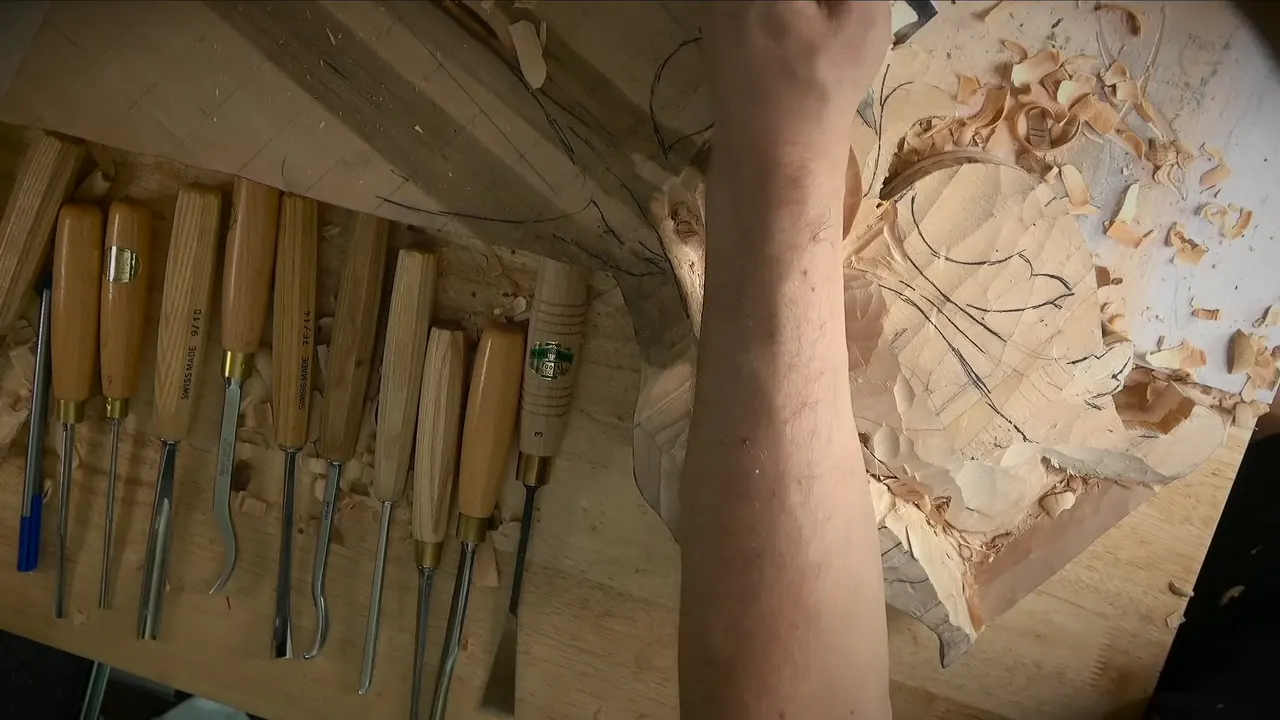

Measure again is a line I say in part 2 of workshop 81. "I'm going to measure again those spots, whatever I marked," I said there. Further on I said I needed to re-measure. Other lessons of mine use the same words, and each one is below, with the lesson named.
Have you ever carved down to a mark and wondered if the mark was still right? Can you point to it? Here are my own words from each lesson where I came back to a spot, with the lesson named beside every one.
What did I say in workshop 81, part 2?
A plan opens the video. "I want to just lower down a little bit this section," I said, and then "So just around this, that way." The tool I named was a big gouge. At 1:14 came a plan to work on this section also.

Whatever I got low in one spot would move over to another, and I would "translate right there and lower that down."

A check followed. "Let me double-check," I said, and soon after, "I'm actually missing some stuff."
At 2:04, my pointing machine. After a "There you go," came "And that's somewhere right here." The doubt landed at 3:14, "Well, I need to re-measure it. I need to make sure."

"That doesn't work that way," I said. By 3:57 I could say "And yes, now I got to the point right here."

A depth followed, "Okay, and I have to drill approximately at three-quarter of an inch, three-quarter of an inch" (about 19 mm). After it, "And double-check if I messed up. And yes, I did mess up."

The 5:01 line was "And yes, I'm right there. Really close. That's good."
A job followed, "now I have to just remove that section and just repeat whatever I've got right here, this section." My hope was "I think one hole should be enough. I hope so, at least."

Near the end came one more need, "And I also need to lower down, blend kind of this side also." The video stops on "And maybe I can."

How do the other two parts of workshop 81 frame this line?
Part 1 ends on a need of the same kind. One part must be "also low, but not as low," I said, and then "I still have to figure out the right position of this section."
A side in part 3 is to be lowered "to a quarter inch" (about 6 mm), "but let me first get a little closer to the design."

How near did the needle get in lesson 4?
In part 1 of lesson 4 I said "I know I have to drill approximately also six millimeters down" (0.24 in), with "I do have a reference so I can see it." Soon came "Okay, let me measure again," and then "I am pretty much right there."
The needle did the showing. "My needle goes all the way to the hole, to the bottom of it," I said. I was not pressing too hard, so it was hitting the floor. For the gap, I said "Let me get a piece of paper and just try to place it right there."
The gap was "just about paper." Going all the way was possible, I said, "but I don't need to." It was "close enough for me," and "I still have to shave it."

On the other side the plan was the same, "also on another side," and later came "Let me check. Hope I did not make any mistakes."
Part 2 brings a second volute and a second check, "I also know for a fact that this part, it's going to be lower. Okay? So I need to measure again." Its height was the aim, "this side of that volute," "because right now it's kind of flat."
"It looks like I already marked that before." Then "let me double-check that section, I'm not sure if I'm there or not." And "I really want to make sure."

After "Get my tool again," came "And yes, I am right on the money. I am exactly at the spot." A new goal followed, "to create really smooth uphill cut," and "I don't need to draw anything. Just eyeball it."
Why check a low volute before the wood comes off?
The small volute in lesson 5 "should be somewhere really low. Really, really low." For it I would "measure again just my original piece."
The needle gave a number, "about maybe 7 millimeters right here in that spot." I added "Little more than a quarter inch" (0.28 in). I said I could probably remove all that material, and then I checked once more. "And yes, I'm safe."

"All of that stuff has to be at the same level. So we're going to expose the flower." That was the reason I gave. Soon after, I said I did not want to lose that line, and the plan was to "remove first just that section" and keep the line.
Is the second check easy to make?
In lesson 10, part 3, I called it "Not always convenient, but I'll deal with that. No problem." Just before, I had said "I have to establish the height of this line, and I need to measure it again. Just use the same device, pointing machine."

The result came as "looks like I'm right there, even without the measuring" and "I got the right spot."
"I'm glad I didn't excavate that deeper, that would be a big mistake." Next I named "a spoon number 11. Number 11 veiner, like five millimeters or so" (about 0.2 in), and "let me excavate that."

Why reach for the pointing machine a second time?
In workshop 107, part 2, I wanted "30 millimeters" (about 1.2 in). "Well, I could probably eyeball it, but for me, that would be much easier to use that pointing machine again."
A confession followed. "I really, really, really like, love pointing machine," I said. Then came "Place it on a flat surface," and after "And here you go," "And let me check."
The depth held up, "And oh, yeah, look at that, I am right on the money." Then "that is my depth" and "not even a millimeter off." The line after that was "So I better mark it before I wouldn't go deeper than that."
Over in workshop 79, part 10, the tool gets another use. I had to "measure from the backside somehow." Then "One of the tools I really, really like, it's a pointing machine." Then "Sometimes it's hard to use even calipers, but pointing machine is good."
My plan there was to change the position of my needle and "raise it to the depth." Then "now I know, so this depth is supposed to be whatever I just measured, okay?" And "So now what I can do, I can actually drill."
When is it fine to eyeball?
A small acanthus in lesson 3, part 1, shows both sides. "It's actually going up really low," I said of its height, and then "So I'll just measure again." My same tool would "measure the highest spot."

Next came the mark, "Let me put the mark," and later "See how nice that tool is? Really quickly I can transfer." Then a different thought, "Although I could probably just eyeball it, it's not a big deal a piece like that."
Still, I like the tool, "especially if you're working on a human face or lion head when every slice matters." And "If it's just generic, that's not as big of a deal."
What about another mistake in lesson 1?
In lesson 1, part 2, I said "looks like I've done another mistake. I have to readjust right now." Then came "I have to readjust it and remeasure it."
The fix "takes only about one second." I called it "not deal-breaking." Three spots would do, "Middle, the right side, and the left side," to be "accurate."

The figure was "about 10 millimeters" (0.39 in), and "three-eighths of an inch" in the same breath. A finger would serve as a guide. "Probably a good idea just to double-check that, just make sure I'm not making any mistakes."
The check ended with "And yes, I am right there." On a fine line I said "you can do a fine line, but I really don't need that." And "I took my first measurements."
How far off can two divisions be?
The rosette course, lesson 3, part 3, has "measure again the distance between." And "let me start my divisions."

I was "pretty sure they're going to be slightly off when they're going to just meet each other." So I would "just go backward and go that direction," a spot I called "a good spot to hide inconsistency."
Later I found "pretty close, maybe about one millimeter off this side" (0.04 in). At last it was "half a millimeter by the end" (0.02 in), and "now at least I know exactly the size of those beads."

Do I measure everything twice?
Not on every piece, going by the lines below. Workshop 84, part 4, has "about 10 millimeters number three" (0.39 in), "about three-eighths of an inch." Soon, "let me get the right shape because I don't want to remeasure on a second piece everything."

"But I probably still going to do it, remeasure it. But not as much because I want to make sure I'm not losing the main shape of it."
At workshop 87, part 8, the word sits beside a line. "And this one I need to redraw again, and I have to measure it," I said. Then "I have to measure it again." After a "Here you go," I said "So that is the movement," and then "except this part I'm not too happy about, this side. It's okay. I'll leave it at that."

Over in workshop 86, part 7, I was working on a spot when I said I would "measure it anyway." My plan was "approximately quarter inch, six millimeters higher than original picture."
A second source was on the computer, "I also do have a reference in the computer, my 3D model, and that way I know exactly what is going on." Later, "It looks fine."
Does measuring come before the carve or after it?
I have said it both ways. Lily Box lesson 10, part 4, has "my concave, and it goes downhill." Then "Let me measure, I hope I didn't take too much material." And "And no, I'm actually right here." A little later came a hedge about the tool, "Maybe I can use a mallet."

In part 5 of that lesson there is a measure, too, and a reason for it. "Really important because we don't want to overdo it again." Then "Go to the center and to my point. And I'm really close, okay? Really close."
Workshop 82, part 5, flips the order, with the measuring first. I had more material to remove, and "I do not want to remove too much." Another line followed, I had to "measure it first."

Which lessons did I check twice?
The rows below set seven of them side by side. Each row names the lesson and part, the spot or height I went back to, and a few of my own words.
| Lesson and part | What I went back to | My words |
|---|---|---|
| This video of workshop 81 | Marked spots first, then the depth of a hole I had planned to drill | "re-measure it" |
| Floral and Molding, lesson 4, part 1 | A hole checked with a needle and a sheet of paper | "pretty much right there" |
| Lesson 4 again, part 2 | The height of one side of a volute that looked kind of flat | "exactly at the spot" |
| Lesson 5, part 2, molding course | A small volute that I said should sit really, really low | "I'm safe" |
| Chamomile and Bow Rosette 3, part 3 | The distance between my divisions | "slightly off" |
| Venice Room 107, part 2 | The depth of 30 millimeters, found again with the pointing machine | "not even a millimeter off" |
| Lesson 10 of the molding course, part 3 | The height of one line, checked with the same device | "even without the measuring" |

Where does this sit in the Venice Room?
This is one workshop of Part 7 of the Venice Room, and the lesson page is workshop 81. Right before it sits workshop 80, and right after it workshop 82. The room also has workshop 79, workshop 84, workshop 86, workshop 87 and workshop 107.
My pointing machine has its own page. The lessons named here are lesson 1, lesson 3, lesson 4, lesson 5 and lesson 10 of the molding course. The rosette course has lesson 3, and the Lily Box course has lesson 10.
Do you have a spot on your carving that you marked a while ago? Can you check it a second time before the next pass? Then watch me do it, and the whole room sits behind one tuition plan.
How it's done
- Lower one section. I planned to lower one section a little with a big gouge.
- Name the spots. The next plan was to measure those spots again and carry what I got low in one spot to another spot.
- Fetch the pointing machine. I said I would get the pointing machine, and "re-measure" and "make sure" came later.
- Name the depth. I gave three-quarters of an inch (19 mm) for the drill, then "double-check if I messed up."
- Repeat on the next section. Once I was "really close," I had to remove one section and repeat whatever I had there.
Frequently asked questions
Which tool did I go for in part 2 of workshop 81?
A pointing machine, at 2:04. "There you go" came before "And that's somewhere right here." At 3:14 I had to re-measure, I said.
How deep was the hole that I planned to drill there?
Three-quarters of an inch, about 19 mm, is the figure I gave for drilling. Near the end I said "I think one hole should be enough," and I hoped so.
Do I check every spot a second time?
Going by my own lines, some pieces got an eyeball instead. In the molding course, lesson 3, I said I could probably eyeball "a piece like that." In workshop 84, part 4, I would remeasure on a second piece, "not as much."
What to carve next