

Alexander Grabovetskiy, woodcarver, School of Woodcarving · Published 2020
What does a wood carver mean by "or whatever"?
Quick answer: Part 12 of Venice Room workshop 81 has me saying "or whatever" about fuzz while I planned to shave the sides with a three millimeter tool. The same two words come back in my other lessons beside a hole, chips, a blade size, a finish and a tape, each with its link below.
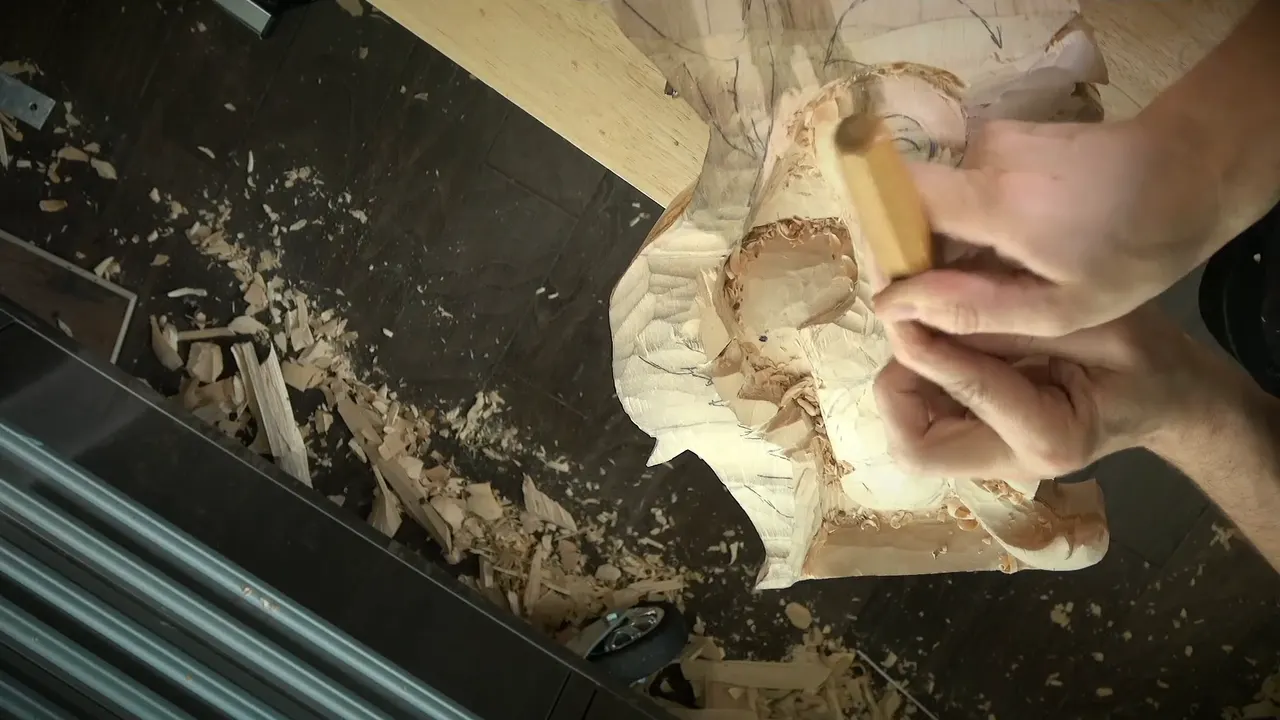
In workshop 81, part 12, fuzz is where I said "or whatever." My wood carving lessons carry the same two words next to a hole, chips, a blade size, shellac and tape. Each lesson is named below with a link, so you can hear me say it.

What was I doing right before the fuzz line?
First comes the pipe. "So I've got my pipe." Next: "And that's somewhat the shape I'm after."
My plan came next. "So let me actually right away to create my plug cut." Another line: "I can remove that center part." Then a hope: "I hope I'm not too early doing it."

Which tool took out the deep hollow?
A number nine. "I'm using number nine, by the way, one-eighth of an inch, three millimeters." Depth had a condition: "And go in, and I can go as deep as I want to, but still have to be mindful how deep am I going."
The size came down. "All right, three millimeters, not going to remove whatever is left right there, so I'll use just the two millimeters." Two millimeters is 0.08 in. What I got was "really deep cut, about 25 millimeters or so," and of the depth I said "About one inch deep right there." And I gave my verdict on it: "That is really good."

How did the eye get its shape?
By a plan for tools. "Let me create the nicer shape of this eye with the number 11." Sizes changed as I talked: "And I used seven millimeters, but I'm going to switch to three millimeters." That is about 0.28 in, then 0.12 in. The tool turned over: "Use that cut upside down, create a really nice, beautiful cut." It "creates a really nice shape, like an eye drop."

Smaller sizes came next. "And with the two millimeters or a millimeter and a half, number 11, I can always clean and go like that." The half is 0.06 in. "It's going to give me a beautiful shadow. Beautiful shadow, but it's still strong." That is how I put it after "And also this side."
What was the fuzz line, word for word?
Here it is. "And three millimeters again. I'll kind of shave a little bit the sides." Next: "Okay? I don't want to see fuzz or whatever, the mess right there." Then: "All right, that's good" and "I'm really happy about this eye."

The word "whatever" is in my own part before that line too, in "whatever is left right there." It is in part 11 of this workshop as well, in "whatever I have on my workbench."
After the eye, what came next?
"Okay, so now I need to develop this section." Then: "I've got this movement right here, which is the center line." The center point, I said, would be "somewhere right here," and "that is going to be boundary of this section." Last: "But not sure if I like what I see."

Next: "So maybe I have to make a little shorter this overlapping thing." For the other side: "And I need to do an opposite side exactly the same, go in that direction." Also: "Although, I have to just probably lower that down also." The words "Hope it makes sense" followed. One more thought, "I also could create a couple movements from that direction which you don't see."

How does part 12 end?
On plans. "Okay, let me outline it with the smaller number 11, with the 3 millimeters" (0.12 in). Then: "Or you know what I could do? I could actually do something really interesting." The offer: I could "get that piece going all the way this way." Then a question: "So why don't I do that?"
Last came the size. "But I still need to create a cut, and I'm not going to use too big of a tool." Next, "I'll use just a millimeter and a half" (0.06 in). Soon: "And create that flipping above idea." Later: "maybe even just a one millimeter," which is 0.04 in. And: "Think one millimeter will work really good."

What do parts 10 and 11 add?
Part 10 holds a need for a tiny cut, "maybe about one millimeter even, more than one millimeter, just to create that separation look." Of it I said "It should look like it's laying right on it." Part 11 brings the words "preliminary tool" and "just number 11." Both live in the lesson for workshop 81.
What did I call the mess a cut leaves behind?
Beside a hole: workshop 76, part 4. "And all of my cuts can go to that plug cut or whatever." My sentence ends on the hole I created by removing that plug.

Chips are in workshop 72, part 10. A skew comes up first: "I just like the idea of skew." And the 7 millimeters veiner "going to ride right on top of those chips or whatever." Fibers that were just cut out come next. Seven millimeters is a bit over 1/4 in.

Dirt gets them in workshop 43, part 4: "I just took oxidation or whatever." The dirt follows, "it's accumulated." That was "Not good." A plan follows: "Probably going to go deeper, maybe with number seven, at least at some point."
Pencil is in lesson 11 of the floral panel course, part 1. Not much time would go there right now, I said, and I spoke of cleaning "all that pencil marks or whatever." After that comes "my drawing I did." Then: "I want to establish a nicer form."

How do I say a size in two systems, metric and inches?
Blades come first, and Furniture Panel 15, part 1, has a router plane blade that "can go from a 1/16 of an inch blade to 3/4 of an inch blade, or whatever, 20 millimeters, 19 millimeters blade." In millimeters, 1/16 in is about 1.6 mm, 3/4 in is about 19 mm and 20 mm is about 0.79 in. That blade, I said, can "get to tiniest spots if I need to."

Depth was the size in Furniture Panel 19, part 2. "Initially it was cut at 3/32 of an inch, but we shaved about 1/32 of an inch. So the final depth is going to be 1/16 of an inch or whatever, 1.6 millimeters." Going deeper was possible, I said, but "I really want to be authentic to the original, and that's supposed to be really shallow design."
A gouge width came in lesson 4 of that course, part 3: "Number seven, big one, like 28 and a half millimeters or whatever, 30 millimeters." Then: "So two millimeters doesn't make a big deal." For inches, 28.5 mm is about 1.1 in and 30 mm about 1.2 in, with 2 mm near 0.08 in.
Time is the size in Furniture Panel 17, part 3. Carving 1/16th of an inch deep is "still time-consuming operation," I said, and "sometimes it actually takes more because you have to control a lot more." I compared the amount of time spent in "one certain area," for "just one square centimeter or whatever." One square centimeter is about 0.16 square inch. The Imperial side comes next: "how long it's going to take to carve half an inch, or one inch."
Leaves are in workshop 115, part 3: "We can just give some waviness to those leaves, too." Next: "That's what I'm probably going to do a little later, or whatever." Deciding comes last.
Which tools did I name loosely?
Glue is the topic in Byzantine Acanthus 10, part 3: "Now, before you glue, just turn that upside down." For the clean-up: "You can just use a knife or whatever." Next came the gouge, and a line to bring that "also to the edge, wherever we had that curvature."

Two names for one cut turn up in workshop 54, part 2: "I need to create a relief cut or whatever." Then comes "the excavation cut." The tool was plain, "seven millimeter number 11," a bit over 1/4 in.
Number two is in workshop 138, part 1. "Number two in this case. It doesn't have to be number two." My next words: "It could be number three or whatever fits."
Thickness shows them in workshop 77, part 12. "I've got only a 16th of an inch right here, the thickness on this side." And: "bring this side up to speed, or whatever, just remove whatever I don't need." A sixteenth of an inch is 1.6 mm.
A part I could not name is in workshop 74, part 2. Earlier in it: "Sharp tools, that's the solution." And: "I've got some kind of mess right here." The next words: "And let me relief pretty much right away this triangle right here, and this corner, or whatever that subdivision. It's not a corner. What am I talking about?"
A vein is in workshop 116, part 1. I planned to run some concaves toward the center line, "just to give that extra shadow." The next sentence: "And you can see it just looks like a rib or whatever," and in the same breath "the vein."
Stems are in Grape Onlay 13, part 1: "when you are trying to introduce those guys or whatever." Then: "the stems are connecting things, make sure you just follow overall flow."
What about shellac and tape?
Shellac is in Lily Box 5, part 5. "I don't really want to lose that detail. I really like it." Next, a thought on a detail: "It's not broke completely." Then: "put shellac or whatever." Last: "the finish I'm going to apply." Wikipedia carries a page about shellac, if you want the background.

Byzantine Acanthus 5, part 2, lists finishes in my talk about gold. Of the leaf I said it "never left as a bare wood or finished wood or stained wood or whatever." Last: "shellacked wood. It was always gold leaf." These are my words from the lesson, not a source I checked.
Tape is in Lily Box 13, part 10. "And if you were to ask me, if you don't really like to protect it with blue tape or whatever, in my case, it's a green tape." Then: "you're still able to create a nice line with just carefully coming to the edge with the brush." And: "So it's still possible." The tape is masking tape.

Did I use the words away from the bench too?
Hashemi Flowers 24, part 1, takes them to a painter and a photographer. "Even if a photographer going to use the Photoshop or whatever." Also: "the Lightroom or any other programs, it does take time sometimes even for the photographer."
Posting is in Furniture Panel 18, part 7. "If you need to clean that mess, just clean up." Then, on posting online: "Facebook or Instagram or whatever you post on, yeah, just go ahead and clean it." Last: "I don't really worry about it."
Sharing is in workshop 13, tenth video. I asked you to share the lessons: "Please do it." Facebook is next: "Facebook or whatever," and then the words "the platform you like."
How do the lessons line up side by side?
Eleven of them are below, with what I named and the words I put in front of the two words.
| The thing I named | Where | Words in front of it |
|---|---|---|
| The hole a plug leaves when it comes out | Venice Room 76, part 4 | plug cut |
| Chips | Venice Room 72, part 10 | the 7 millimeters veiner rides on top of them |
| Dirt that had piled up on the wood | Workshop 43, part 4 | oxidation |
| Marks left from a drawing on the piece | Floral and Molding 11, part 1 | pencil marks |
| The largest blade size, with the metric figure said after it | Furniture Panel 15, part 1 | 3/4 of an inch |
| The depth where a shallow design ended up | Furniture Panel 19, part 2 | one sixteenth of an inch |
| A big number seven gouge, given first in one size and then in another | Floral and Molding 4, part 3 | 28 and a half millimeters |
| What to clean the piece with from the other side before glue | Byzantine Acanthus 10, part 3 | a knife |
| Another name for the cut I was about to make, given in the same breath | Workshop 54, part 2 | to create a relief cut |
| A finish for a detail I meant to keep | Lily Box 5, part 5 | shellac |
| What protects an edge, and a way around it | Lily Box 13, part 10 | blue tape |
Where does this sit in the Venice Room?
This is one workshop of Venice Room Part 7, a course on Venetian style wood carving. Before it comes workshop 80, and after it workshop 82. The other lessons belong to the Furniture Panel course, the floral panel course, the Lily Box course and the Byzantine Acanthus course.
For plain background, Wikipedia has short pages on woodworking, chisels, gouges, wood, millimeters and inches.
Ever caught yourself saying "or whatever" while a cut left a mess you did not want to see? Then watch me work through one, and the whole room sits behind one tuition plan.
How it's done
- Plan the plug cut. Words from part 12: "let me actually right away to create my plug cut" and "I can remove that center part."
- Go in with a number nine. I used number nine, one-eighth of an inch (three millimeters), and said I had to be mindful how deep I was going.
- Shape the eye with a number 11. My plan was a nicer shape for the eye with the number 11, with the cut turned upside down.
- Shave the sides. Sides come next: I said I would shave them, and I spoke of fuzz and the mess.
- Move on to the next job. After I said I was happy about the eye, I turned to the section I needed to develop.
Frequently asked questions
Where did I say it in workshop 81?
About fuzz and the mess, in part 12, right after "three millimeters again."
What came right after the fuzz line?
I said it was good and that I was happy about the eye. Then I said I needed to develop a section.
Did I say it beside sizes?
Yes. In the nineteenth Furniture Panel lesson it was a final depth, and in the fourth floral lesson it was the width of a number seven.
Which tool came first in the Byzantine acanthus lesson?
What to carve next