

Alexander Grabovetskiy, woodcarver, School of Woodcarving · Published 2020
What does a wood carver mean by "scratching, not carving"?
Quick answer: I said "Almost scratching" in part 10 of workshop 81, about an area I called not convenient. Before it I said I was going to need "probably three millimeters veiner, number 11" (about 0.12 in). The same word is in my Lily Box and Furniture Panel lessons.
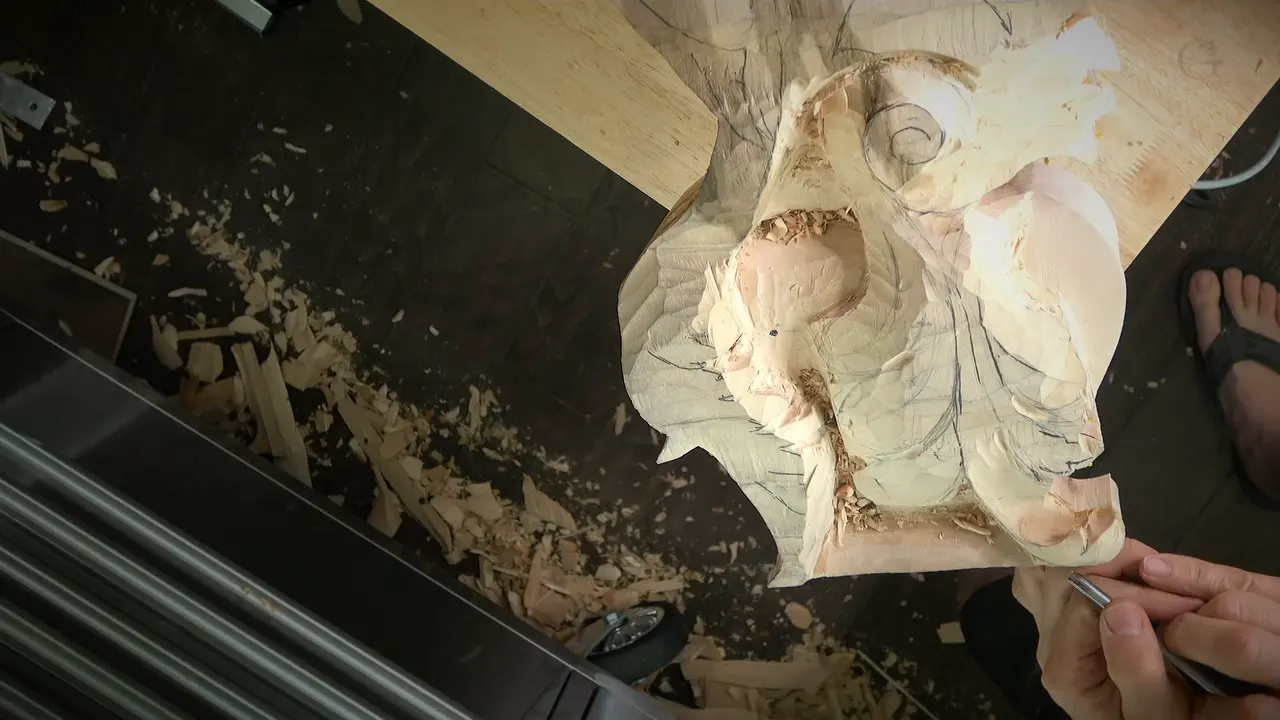

In part 10 of workshop 81, I called one area really not convenient and said I was almost scratching. The same word turns up in the wood carving lessons of my Lily Box and Furniture Panel courses, and in other Venice Room workshops. Every lesson is named below with a link, so you can watch the moment yourself.
What was I carving when I said it in workshop 81, part 10?
The part opens on the grain. "And in this section, I do have to work sometimes against the grain and going uphill, which you're not supposed to do." A condition follows: "But if the tools are sharp, sometimes it's okay."
A question comes next, and I answer it as I go: "And again, what is uphill and downhill right here?" My own answer was "So I start downhill cut, but then raising up uphill. So it's not really downhill, uphill."

Tools came next, and a smaller one was needed, "like maybe even two millimeters" (0.08 in), with "Create that undercut." as my note to myself. To get rid of some material I planned "the spoon gouge or spoon veiner, I should say. Veiner." The size was a maybe: "Maybe use five millimeters again" (0.2 in). And the approach: "And attack that from two sides."

A limit came with it: "I'm not undercutting really deep yet. Okay? I don't really need it. Not yet, at least." A promise followed: "But later on, I absolutely will fix this shape."
My next tool was a plan too. "And I'm going to need, again, probably three millimeters veiner, number 11, and create little nicer transition downhill" (0.12 in). Then I described the spot, and after that the work: "Really not convenient area for me." And: "Almost scratching, not carving."

A verdict followed, "I think I'm somewhat happy," and then a check: "Double check. Yep, it looks good." My next jobs, in my words, were "I need to clean little bit that surface" and "create couple concaves, convexes."

One line still had to be dealt with: "Although, I still have to attack this side because I do have that line." What I planned for it, in my words: "And I need to create a really tiny cut, maybe about one millimeter even, more than one millimeter, just to create that separation look" (0.039 in). And what it should look like: "It should look like it's laying right on it."

A plan for a part you would not see: "But I also going to trim little bit this side later on, but since you don't see it, you don't need to worry about it. So I'll just chop some of the section right here off camera because I really need to figure this out." And: "Where's the end? Which actually not that hard to figure out so I can lay it flush."
The part closes on another plan for off camera: "Okay. And this is going to be somewhere in this area. Again, I'm going to do it probably off camera, because really there's nothing special about this section. But section of it's going to be gone completely, just a chunk."

What did the videos next to part 10 say?
Part 9 has a smaller tool too. "So for some reason, this area is kind of dense," I said there, and "smaller tool will give me a lot more control." A limit went with it: "I cannot go too deep because I don't want to destroy the movement."
Part 11 has a spot that was not convenient as well. "Maybe I have to change the position how I carve it because it's not really convenient for me. I'm just covering with my hands and you don't see what I'm doing." Later: "again, uphill cut. Not the best, but what can you do?" And for a tool: "I'll use just a number three, whatever I have on my workbench."

Which Lily Box lessons call a hard spot scratching?
Scratching instead of carving is how I put it in Lily Box 6, part 4, and I called it "like a wood scratching." A number three came into it: "I can use number three to create a clear separation right here."

A knot shows up in Lily Box 7, part 6: "And again, I'm approaching to area with the knot." Next: "Really carefully have to take care of it," and then "I feel like I'm not carving, but scratching, because it just takes so long in this area." My note to myself: "Okay, use a little bigger spoon," a number three of "maybe about quarter inch" (6.35 mm), "six millimeters" (0.24 in).

Fragile wood is the reason in part 13 of that lesson. I named "Number nine and 1/8 of an inch" (3.2 mm), said "Carefully," and added that "it feels like I need to attack it from opposite direction." My words for the work were "almost scratching out," and the reason came right behind: "Because of how fragile this area is."

Lily Box 8, part 4, has a hard area too. "Really hard area." I added "Not really carving, more like scratching," and then "Okay, that's good. I think I left just a little bit to connect that to the bottom."
Over in Lily Box 9, part 4, I asked for "a smaller spoon," a "number 11 and half a millimeter" (0.02 in). I called the wood tough: "Again, see how tough it is underneath," and then "Just not even scratching. It's a really, really tough area right now." Breaking another tool was my worry.

Some spots are really hard, I said in Lily Box 11, part 9: "some spots really hard. Like almost, again, not carving, but scratching." A thick spot was fine with me, "I am absolutely okay with that," and the reason came with it: I "need to make sure" it is "held together." Shaping the sides: "I'll use a number three, maybe just to shape the sides a little bit."

What do I say when a tool is too small?
In Lily Box 10, part 8, I said I had to be "really careful in the middle" so as not to repeat a mistake from another one. Then: "Maybe I have to use a little bigger. This one feels too small. Scratching almost."

Smaller went the other way in part 9, with a number 11: "I'll switch probably to one millimeter and work my details a bit more" (0.04 in). After that: "I barely carve anything. It just feels like I'm just scratching."

A small gouge appears in part 13, "number eight, 3/32 of an inch is what I'll take" (2.4 mm). In that part, too: "it is more like a scratching." On the backside: "I don't have too much material" and "I need to use a smaller one," probably "two millimeters or even smaller, number 11" (0.079 in). The plan, in my words: "Try to use two millimeters. We'll see how it's going to go."
I said "Wood scratching. Doesn't matter, it still removes the material." Then came a question and my answer: "Did I break it? Indeed, I did. I just broke my two millimeters right there."
In Lily Box 12, part 1, I talked about small flowers: "please understand, that is not the only way to do those small flowers. There's a lot of different ways of doing it, okay?" The plan was to "just scratch a little bit with the gouge."
What do I call all that scratching?
Glue came into it in part 12 of Lily Box 10, where I said the glue "didn't hold really well." I called the work "A lot of wood scratching" and said "as long as we can get to the result, whatever you call it, wood scratching, wood carving, or wood shaping. As long as it works." Then: "It's fragile."

Sound gets a line in part 14 of that lesson: "Can you hear that material?" I asked. "It's just like scratching, squeezing it. Like a really squeaking sound." And: "attack right away, the backside a little bit."

Crunchy came up in Lily Box 11, part 9, too: "I'm not even carving, scratching pretty much. See? Crunchy."
Does the edge matter when it feels like scratching?
In Furniture Panel 19, part 16, I was "talking about chamfer cuts" and said "I get much deeper" and "It's almost scratching." Next: "Got to undercut it." About the tools, in my words: "your tools, they must be really sharp. Otherwise, you're not going to get the good results." The work would be "all smooshy."

Workshop 81, part 10, has a line about sharp tools too, near its start.
What other jobs get the word scratching?
A line from nothing is the job in Lily Box 8, part 9: "And give just a line cut. Almost from nothing to deeper cut." I planned "maybe 1 millimeter" (1/25 in) and said "Almost like scratching first, okay?"

Furniture Panel 20, part 7, has a concave with no deep spot for the pipe: "Let me start with this concave cut all the way in this region right here. Okay? Carefully, almost just scratching the surface." The pipe would be "almost like indication of pipe," I said, still visible and still detectable. An admission: "And, yes, I am carving against the grain, so which is not the best."

A tiny knife shows up in part 4 of that lesson: "What I could do again, just to take small, tiny knife and kind of scratch little bit." I corrected myself: "Not scratch, but whatever. It is scratching, by the way, the pencil marks." And: "It's scraping, but it's still scratching, and blend little bit nicer."

In Venice Room 30, part 12, a concave is almost not there: "Start from here. Almost no concave." "I'm barely scratching the surface," came next, followed by "now I can probably put the middle line right here."

Sweep numbers come up in Venice Room 57, part 7: "Number eight would be a sweep, and number six after forward slash would be how wide it is." The six is "a 6 millimeters, quarter inch" (0.24 in; 6.35 mm). About the groove: "I could place my tool right inside of the groove," and "just kind of scratch it." Then: "You see I'm scratching the opposite side. I know it's almost impossible to see."

Venice Room 18, part 10, has a size choice: "2 millimeters, number 11, or I could go even with 1 millimeter, but let me try 2 millimeters first" (5/64 in; 1/25 in). "And yes, I'm kind of scratching it." A smaller choice came after: "let me use number three again. Tiny number three, and get rid of this triangle kind of bugging me." And: "But it's still possible. And now it looks good."

Does scratching mean something else in my lessons?
I use the word for a line in my Carving Plate with Butterflies course, too. "Let me create the scratch," I said, after "about three millimeters from my previous line" (1/8 of an inch). I added "It's important to do at the beginning of the project," and that later on it would be really hard to get from the right point from the center one line.
In my Grinling Gibbons class in Maine, workshop 6, the word meant something else. "I don't want to do simple projects," I said, and "There's no reason to just travel all the way" and "do just a scratching." Then: "Okay, it is it's ambitious. It's hard. I understand."
The Mastery video of my Woodcarving Techniques Q and A course uses the word too: "More you carve, more you see. Not just the scratching wood. Deeper you go, deeper you see."
Which lessons use the word, and what was I doing?
Here are eight of them side by side, with what I was doing and my words.
| Lesson and part | What I was working on | My words |
|---|---|---|
| Venice 81.10 | An area that was not convenient | Almost scratching |
| Panel 19.16 | Chamfer cuts going deeper, then an undercut | Almost scratching |
| Panel 20.7 | A concave toward a pipe with no deep spot | Just scratching |
| Lily 7.13 | A fragile area, a number nine of 1/8 inch (3.2 mm) | Scratching out |
| Lily 10.8 | A tool that felt too small | Scratching almost |
| Venice 30.12 | A concave that was almost not there | Barely scratching |
| Butterflies 1.2 | A new line near a previous line | Create the scratch |
| Gibbons 6.1 | A class in Maine with no simple projects | Just a scratching |
Where does this sit in the Venice Room?
This is one workshop of Venice Room Part 7, a course on Venetian style wood carving. Its lesson page is workshop 81. Workshop 80 comes before it and workshop 82 after it. The flower lessons are in the Lily Box course, and the panel lessons are in the Furniture Panel course. For the plain background, Wikipedia has short pages on chisels, knives, pencils, chamfers, millimeters and inches.
Have you ever put a chisel on a spot and felt you were only scraping? Which tool were you holding? Then watch me work through it, and the whole room sits behind one tuition plan.
How it's done
- Keep the tools sharp. "But if the tools are sharp, sometimes it's okay," I said in part 10.
- Ask which way the grain runs. I asked "What is uphill and downhill right here?" before I named a tool size.
- Switch to a smaller tool. The tool note in part 10 was "smaller one," with two millimeters as a maybe (0.079 in).
- Change size when it feels wrong. In lesson 10 of the Lily Box course I wondered about "a little bigger" for one tool and planned to "switch to smaller" for another.
- Try a tiny line for a separation look. I planned "a really tiny cut, maybe about one millimeter even," just to create that separation look (0.04 in).
Frequently asked questions
What tool did I plan in part 10 before the word came up?
A veiner of three millimeters, number 11 (0.118 in), was the plan, for "little nicer transition downhill." Earlier I had named a smaller one and "Maybe use five millimeters again" (0.2 in) for a spoon veiner.
Did I call any spot hard in the Lily Box lessons?
Lesson 8 has "Really hard area," lesson 11 has "some spots really hard," and lesson 9 has "Just not even scratching." Lesson 8 also has "Not really carving, more like scratching."
How small a tool did I name near that word?
Lesson 10 of the Lily Box has "one millimeter" (0.039 in) in part 9 and "two millimeters" (0.08 in), which broke, in part 13. Lesson 9, part 4, has "half a millimeter" (0.02 in) on a spoon.
What to carve next