

Alexander Grabovetskiy, woodcarver, School of Woodcarving · Published 2020
What does "preliminary idea" mean in wood carving?
Quick answer: I said it in workshop 81, part 8, right after "So that's the idea. You should be able to catch that already." After it I named probably number 11 for a tool and spoke about rolling it. The same two words come back in my Venice Room, Grape Onlay, Furniture Panel and Hazelnuts lessons.
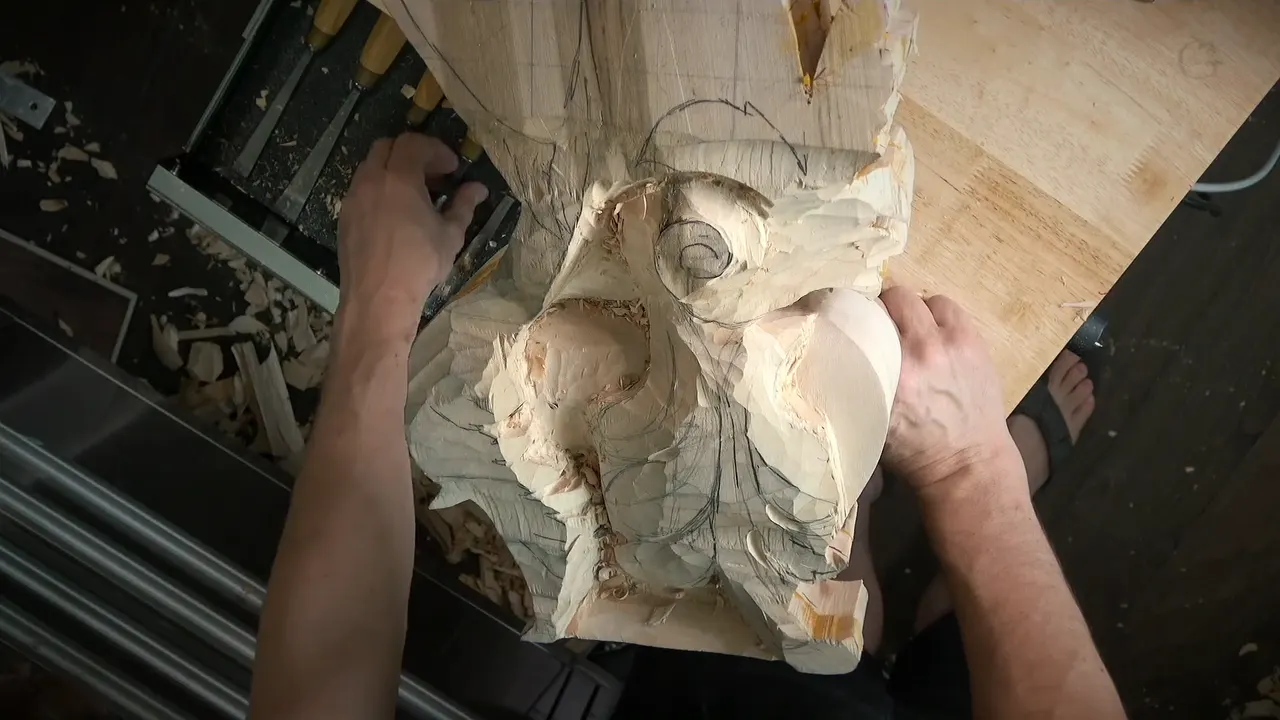

In part 8 of workshop 81 I say, "Of course, it is a preliminary idea." Those two words come back in other wood carving courses of mine, and each time they sit beside a different shape, tool or plan. Every lesson I use is named below, with a link, so you can see what came next each time.
What did I say in workshop 81, part 8?
The part starts with a plan. "If I'm planning to go underneath this line," then it is time to "start my movement." My first tool is "number nine and 14 millimeters" (0.55 in), and I "just cut across the grain just like that." Then comes an apology, "Sorry for all that movement."

Now the idea. "So the idea is to make it go like this and then wrap it." That means "I have to undercut a little more and I'll go this way." Then I look at what I have: "I've got this movement, and I can use some of that movement in my advantage of flipping above the middle part." After it comes "Let me outline it this way."
In front of the line in bold above stand the words "So that's the idea. You should be able to catch that already." Behind it I add a tool, "I can use probably number 11."

Now the shape. "I need to roll it. I need to create a really good shape." Probably "just a number three and about 16 millimeters, five-eighths of an inch," and "I'm going to create the shape."

The last thing in this part is where the leaf gets its point, with "a couple options." One is a point "all the way right here," with the leaf "rolling upward." The other is "all the way here, which I think is going to look more aesthetically pleasing." My pick? "My point of that leaf going to be somewhere right here," and "that way it's going to be more visible, I would say."
What do parts 7 and 9 of workshop 81 add?
These two videos sit on both sides of part 8, and the workshop 81 lesson holds all of them. Part 7 holds a plan, to "develop right now the movement of this acanthus, which starts from this volute," and to "change little bit the idea from the original design." The main movements stay, "of course."
Then I count. "So one, two, three," which makes "three main parts of this movement." About the widths, I want them different, not "exactly the same," so one part will be the widest, one the smallest and one medium. Eyes come next. "I really want to do some eyes and pipes." My plan is "number 11 and the 7 millimeters" (0.28 in) "and preliminary excavate the position of the eyes."
Part 9 is a different moment. "Let me relieve that with a straight-down cut." On the wobble, "that piece is super huge and super heavy," and "it's only about a half an inch stem which holds" (12.7 mm). Also, "I cannot go too deep," and "Later I'll get in and clean it little better." The undercut: "I have to undercut underneath right here." And the tool, "number 11 and five millimeters" (0.20 in).
Which shapes got those words?

Venice Room 69, part 11, is about the eyes of an acanthus. "They should look good." Then "Again, that is just the preliminary idea for those eyes," followed by "We're going to take care of concaves and convexes." Two questions come up, "how deep concave should I do?" and "Do I want to do deep one?" The answer is short. "No, probably not." It gets "just number seven for now," and "maybe just establish a bunch of cuts." One area is bulky, and I say so: "I don't really like how bulky this area is, but that's okay. We can always fix it."

Part 7 of Venice Room 11 has me "get already the preliminary idea." Then, "take that one a little more down," plus "a concave look right here." One plan follows, "undercut. Underneath of this main detail," starting with "the number 7" to see if it can "dig deep enough with that." One worry: "too weak at this point."

Acorns turn up in Venice Room 99, part 10. "It does look like acorn. If you look from above." My aim is to "Make it look like the real-life one," and "otherwise, I don't know if it looks even like oak leaves without those acorns." And "At least give some idea."
Further on, "I can give somewhat like undercut, not really undercut yet because, like I said, we still have to do a shell. But preliminary idea." Another cue names a tool, "Number seven and 14 millimeters" (0.55 in). A short apology follows, "I am sorry that I'm covering it, but so you should get an idea how it's supposed to take shape."

The oak leaf in Venice Room 96, part 11, comes with a bit of history, and with stone carving as the comparison. "I decided to just research a little bit what they carved back then." What they carved back then is "mostly like a stone carving," and "I've got an idea, preliminary idea, how they looked at the leaf, at the oak leaf." In the leaf I show, "there's three main parts of the leaf," and "that's Venetian style, I should say. It's not applicable to all other oaks."
A comparison follows. "It's pretty much the same idea as acanthus." And "the main divisions of acanthus, three main divisions. Sometimes it's five, sometimes it's eight." The idea is to "follow what they've done" and "fix whatever I don't like." Then, "let me start."

Another drawing gets the same words in part 1 of that lesson. "Don't pay attention to that drawing." It will get "some modifications." A walk is on the list, "to actually walk around and take a look," and "that's going to determine if I like it or not." The next step is to "lower down in this section right here. But not much."
Which tools came next?

Venice Room 159, part 1, plans not to finish the cleaning "until I've done it to my molding. So I've got my preliminary idea." For the shaping, "with this project, I'm okay. I can probably just use some rasps," which is "maybe time saving." Then "Take all of those ridges." "Pretty much it's just about the shape in this case, just the shaping."
Another piece waits. "Later on, I will create a small division on this little guy," and "so I don't want to overdo it." A section of the molding is another plan, "for the future acanthus development."

I say in Grape Onlay 6, part 1, "Let me, with the same tool, get preliminary idea," and then "Maybe this tool is a little too big. Gotta get smaller tool." The next one is "still gonna be number 11, but it's gonna be about two millimeters" (0.08 in), and "it's gonna give me much closer to the outline." The rest waits, "I'll have a chance to excavate a little deeper later."
Other sizes come up, "two millimeters, two and a half millimeters and maybe about four millimeters" (about 0.08, 0.10 and 0.16 in), or "just a gouge number seven, which is about three millimeters" (0.12 in). One more number: I left "about, like I said, 10 millimeters of the material for my future leaf" (0.39 in), "because I still wanna make sure I have some kind of curvature on the leaf itself."

Tray of Blessing 2, part 3, shows the tools that follow the idea. "Preliminary idea what's gonna happen now I'm gonna grab number nine and 10 millimeters again" (about 0.39 in). That tool will remove "some of that material, which is around, just don't overdo it." Next, "Grab number two again, and I'm gonna roll it underneath slightly."
There is a warning too. "You can just grab smaller tool and start undercutting, but don't undercut too soon before you see you do have a full barrel, you have a full block." Then "Otherwise, it's gonna be too squished and it's not gonna look good."
What did I leave for later?

Furniture Panel 36, part 1, puts the cut on the line, "carefully, carefully, carefully," and I left "about maybe millimeter or so for the background" (1 mm), and then "let me actually take care of opposite side." The cleanup waits: "Final cleanup of the background. I can do a little later, but now is just preliminary idea, although I could probably clean a little bit."

Hazelnuts 2, part 3, ends on a hazelnut carving. "So I've got about one-inch chunks" (25.4 mm, one inch each). "I don't really worry about the details. Don't need to worry about it. That's too early." And "preliminary idea what's going to happen."
Look at how I describe the sight. "I know it doesn't look too appealing, but we are getting somewhere." And "when you're looking straight to it, it doesn't look too much, but when you look from the sides, it does look like it's a full 3D."
What other words do I use for a first pass?
Preliminary idea has cousins. I also say preliminary shape, preliminary form and preliminary movement. Here are some of those lines.

Hashemi Flowers 16, part 1, has "that is my preliminary form. I'll take number five and one inch again" (25.4 mm), with "make it kind of round." The grain asks for care, "I got to be careful right here because it's against the grain."

Leaves get the name "a preliminary shape" in Furniture Panel 18, part 8. There I plan to "work around that curly detail" and "stay away approximately, I would say, a millimeter on both sides" (0.04 in). "Maybe less." I will need "the extra material," and "I can always make it smaller."

The skew gets a turn at Venice Room 55, part 8: "I'm using just the skew, okay, to clean and get that roundness." I call it "not the final form, but it's a preliminary shape." A change follows, "this tool is not going to fly," and "we're going to need number seven right now."

Greek Acanthus 4, part 3, shows a pipe. "My number nine, 5 millimeters will work really good right here" (0.20 in). "We're just establishing preliminary form." The pipe "also has to stick above this section," and I "want to make sure it is higher than the main structure." The lines wait, "don't pay attention to the lines yet because they are messed up right now."

The lily flower is the subject of Lily Box 10, part 2. "They all have to be the same length," and the difference is "how it curls." After that, "just preliminary form." From the side, it needs "some arch anyway, some movement anyway."

Part 3 of Acanthus over Moldings 2 mentions color. When I carve against the grain, it "changes the color completely, but I'm okay. So that is just preliminary form." That is "what I'm after."
The words meet a dislike at Venice Room 90, part 9: "That's the preliminary movement, but I still don't like how it looks." The plan is "another separation," "otherwise it's not going to look nice."
Roman Acanthus 14, part 3, has a gouge in hand. "I think it's a good idea to take a small gouge and establish preliminary form." Its size is "maybe eighth of an inch" (about 3 mm), "exactly the same number eight gouge what we used for the eyes."
A shaping stage comes up in Furniture Panel 29, part 1. I say "it's not the final loop there, okay?" and "we're gonna introduce some concaves, some convexes, otherwise it's not gonna look nice." Then "just preliminary shape if you wish," and then "that was just a shaping stage."
Which lessons say it?
The table below lists the lessons, each with the part, what the carving looked like, and a few of my own words.
| Lesson and part | What the carving looked like | My words |
|---|---|---|
| Workshop 81.8 | A movement under a line, then a roll, and where the point goes | "make it go like this" |
| Venice 69.11 | The eyes of an acanthus, and how deep a concave should go | "for those eyes" |
| Venice 11.7 | A plan to undercut under a main detail, with a number seven first | "dig deep enough with that" |
| Venice 99.10 | An acorn that should look like the real-life one | "we still have to do a shell" |
| Venice 96.11 | An oak leaf with three parts, like acanthus | "how they looked at the leaf" |
| Venice 96.1 | A drawing that will get some modifications | "that drawing" |
| Venice 159.1 | Rasps for the shaping, before the molding is done | "my preliminary idea" |
| Grape Onlay 6.1 | A smaller number 11, after a first tool that was too big | "get preliminary idea" |
| Tray of Blessing 2.3 | A number nine, then a roll underneath | "what's gonna happen" |
| Furniture Panel 36.1 | A background with a little wood left on it | "final cleanup of the background" |
| Hazelnuts 2.3 | Chunks of about an inch, seen from the sides | "what's going to happen" |
Where does this sit in the Venice Room?
This is one workshop of Venice Room Part 7, a course on Venetian style wood carving. Its lesson page is workshop 81. Workshop 80 comes before it and workshop 82 after it.
Have you ever looked at your own piece and wondered where one point should land? What would you check first? Then watch me do it, and the whole room sits behind one tuition plan.
How it's done
- Show the idea first. The movement comes first in part 8, and then I give it the words preliminary idea.
- Pick a spot for the point. The point has two options, and I think the second will look more aesthetically pleasing.
- Pick a smaller tool. The Grape Onlay lesson has the next tool smaller, still a number 11.
- Leave extra for the cleanup. About a millimeter (1/25 in) stays on the background in the Furniture Panel lesson, and the final cleanup waits.
- Hold back the small part. The little guy in the 159 lesson comes later on.
Frequently asked questions
Which tool did I plan for the shape?
Probably just a number three, about 16 millimeters (0.63 in), to create the shape.
Where does my point go?
The spot I name is "somewhere right here"; that way it is more visible, I said.
Which tool followed in Grape Onlay?
A number 11 of about two millimeters (0.08 in). My first tool there was maybe a little too big, I said, and I gotta get a smaller one.
What waits for later in the Furniture Panel lesson?
What to carve next