

Alexander Grabovetskiy, woodcarver, School of Woodcarving · Published 2020
What does a wood carver mean by "biggest fan"?
Quick answer: In part 9 of workshop 82, I said "I'm not the biggest fan of what I see right here," about one section. My next words were "So I'll fix it a little later." Other lessons of mine carry the same words about a knife line, carbon paper, sanding, and a color, each followed by what I said next.
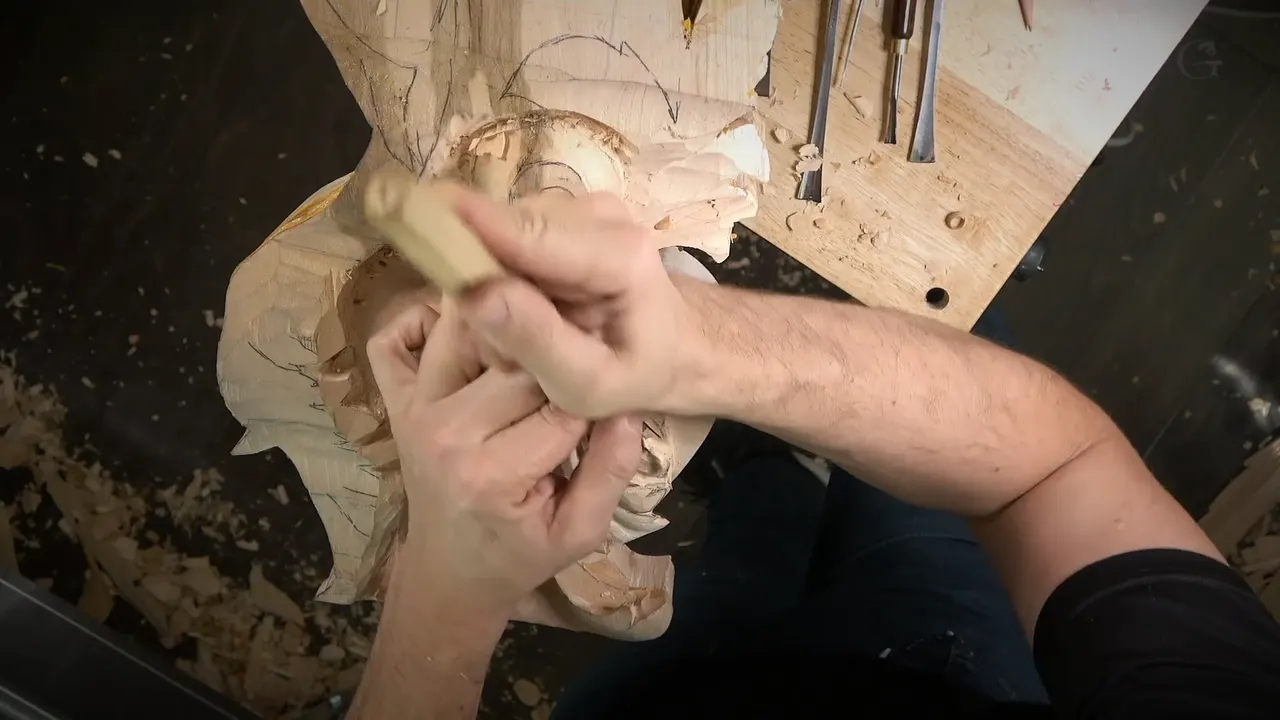

Workshop 82, part 9, has a section I said I would fix a little later. This page follows that kind of line through my other lessons.
Ever looked at your own carving and found one spot you did not like? Did you feel you had to change it that second? Read how I handled it in part 9, then in lessons from other courses, and see what I said next each time.
How does part 9 begin?
"And I'll carry that all the way to about quarter inch above that surface." These are the first words in the part. Next comes "Okay? So the bottom of my concave, it's going to be about quarter inch or even more little later." Then comes "But for now, just a quarter inch." That is about 6 mm.
Ridges follow. "So now I need to get rid of those ridges," I say, and the tool I name is "just probably flat, like number three." The other side gets "the same thing," and the stretch ends with "And blend that in."

What did I say about the pipe?
"Okay. I've got my pipe exposed." About what follows I said "I don't like too much what happens right here." Then comes "I'm not the biggest fan of what I see right here. I mean, on this section." The sentence after it is "So I'll fix it a little later."
Rounding comes up in the next lines: "But now let me just round everything up. Chamfer it. There you go."

Why did I say it will make sense?
"And yes, I can always clean between those two pipes." After that, "I know logically it doesn't make sense, because it just goes from whatever this part's going from underneath of here." It "goes from that side, and then it goes that way." I finished with "But it will make sense. It will. Okay?"
"Let me right away pretty much create this cut," I said, and "I'll know exactly what is going on." For depth: "I don't want to create a deep undercut in this section." It still has to be, I said, "a logical blending together somehow area."

What happened with the triangle?
"I do have a triangle, which is a really nice triangle." My check: "But I'll check later if it's too big or too small." "I actually check right now," I said. What I found: "No, it's not too big at all." I added "It's actually not bad."
I said "So I need to exaggerate the triangle. Okay?" That meant "I have to carry the concave and separate in two cuts," and for the job I name three millimeters (0.12 in) and "Number 11, of course." The plan for the cuts runs "And create my first cut," "Going all the way up," and "I'm going to create the second cut." My view of the area: "Again, it's kind of interesting area. But I think it's a really good area."

Where does part 9 stop?
"Again, maybe just cleaning little bit between those two guys." The next line is "And now I want to lower down this triangle. I don't want to leave that as a high spot." The line goes on with "I don't think it looks organic. So it has to be lowered." One more line names the tool: "Number seven, that's what I'm using. Okay?" The part ends on "And little cleanup."

What about rasps in part 10?
A line that begins the same way sits in part 10, about rasps: "but in this case, like I said previously, I think it makes sense." It goes on "See? I can create and refine the shapes really quickly."
Just before it I said "I also could use probably my new tool." I went on "create somewhat like smoother movements."

What else sits in the same workshop?
Part 8 has a rough underside: "Of course, it is looking a little rough underneath." After it, "But I'm just after really smooth form, okay?" For a case like that I said "I can do only with the really small, tiny tools."
Part 10 has "I'm not really happy how it looks so far." Right after it comes "I am not happy yet, I should say."
A movement with an easy fix
Venice Room 31, part 2, opens the line the same way. It comes right after "That is looking really good, actually," and goes on "how this one looks, the movement. But that is an easy fix."
The fix, in my words, was "number five or number six, just to get really nice profile and create just a straight down cut, just like that." Then "And that gave me perfect, almost perfect movement." Later on, I said, "I will spend a little more time maybe off camera and cleaning everything and make it more perfect."

Carbon paper and its black dirt
Venice Room 1, part 11, has "I could use probably just carbon paper." Next, "Maybe I should use carbon paper. I'm not sure." Then "But carbon paper gives me a lot of black dirt," and the same words close that sentence.
Then "I'm not going to work on those small details." Also "All I need is just pretty much the main idea, the big idea, okay?"

Waviness in the line
In Venice Room 108, part 3, I said "But I still need shadow." You see it, I said, "casts a really sharp and beautiful shadow." Next: "But on another hand, I can also see some waviness, which I am not biggest fan."
"I'm talking about this line is not really flowing," I added. My plan was "And little by little, I'll fix whatever I think needs to be fixed." Then "Maybe I should take a bigger gouge," and "Or you know what? I'll just do it by hand." Later in that part there is "So that is much better."

Cutting over the first cut with a knife
A knife line sits in Furniture Panel 18, part 8: "you can actually create the outline just getting cut over your initial cut if you want to." My view follows in that lesson and ends "of it in this case." Then "Sometimes I do, but not in this case." Last, "But yes, you can see much easier that way."
What happens, in my words: "the point of knife going to dig inside of the wall, and that leaves a cut inside." Also "It's not going to look nice, in my opinion, once you're going to work on details and so on." Then "And that's no good. I wouldn't do that."

An eye that I would probably change
Furniture Panel 28, part 1, has "an eye, which is a big open eye," and then "I kind of not big fan of it, okay?" Right after it: "So I probably gonna change it slightly."
For the cut I named "the same number 11," in this case two millimeters (0.08 in). I said "I don't wanna create too deep of a cut," and "I still wanna see my pipe." My cut is no more than half a millimeter (0.02 in), I said.

Volutes and roundness
In Furniture Panel 38, part 2, I said "I'm not gonna create any cuts. I don't wanna do roundness." Then "I know some people kinda liken those volutes," and "round it like a button, almost like a dome." Then "I'm not a biggest fan personally. Again, it's up to the taste, I guess."
On scraping I said "scrape slightly to get blending even more." Another line: "Just feel it what the grain does. Okay?" My tool is the one I used for cutting, my small tiny knife.

Sanding and the facets
In Floral and Molding 14, part 3, the line starts as it did in part 9 and ends "of the sanding of the process itself." I also said "I really like to leave all my work with the facets and so on." About other makers I added "But I know a lot of furniture makers, they really like to make it really smooth, which is okay, which is absolutely fine."
Of old carvers I said "The only reason why they didn't do a lot of sanding because they didn't have a sandpaper." Of them I added "I think if they would have a sandpaper, they would sand it, okay?"

Coloring and the grain
Carving Vase with Grape Leaves 3, part 7, has "there's multiple ways, actually, you can attack coloring." My opening on colors, in that lesson, ends "of acrylic colors or other artificial colors."
What I like came next: "I really like tints." They are, I said, "colorant for the paints and stains." The look, in my words: "it's going to leave a translucent color, and you will be able to see all the grain of the wood, which I really want to see." Also "So it's not ceramic or plastic."

A client's color
Lily Box 13 (Blending Color) has "I did not discuss the final look with the client. I really like the natural look like this." Then "let's say if they're going to decide to go with some kind of reddish color." My opinion of that color uses that same fan word.
Of the client I said "But client is a client and whatever they want." On the dark spots: "Those areas still going to be darker, and I like that."

Veins and lines
In Lily Box 5, part 10, the video opens with those words and goes on "putting lots of lines, lots of veins." After it, "I know there's a technique, and some carvers used that in history." Next, "But I guess that's just opinion of taste, how it looks." Also "with those lines, you can also overdo."
Older carvings look "really nice" to me online. "But still, if you look closer, you can see all the mistakes they've done also." I corrected myself: "Well, maybe I shouldn't say it's a mistake, just the approach they took." "Okay. And I kind of like it," I said.

Outlines on the Lily Box
Lily Box 2, part 8, says what I mean by an outline: "I'm talking about a straight down cut." In that lesson, I add "You place your tool right on the line you want to cut and make a cut." Then the same words end "of that because I still have to go underneath of those leaves."
Of the leaves I said "they can be more or less with the freedom movements." Also "if I change a little bit of the design of those leaves or movements of those, or edges of those leaves, it should not be any problem." My plan: "And I want to keep my main stem high enough."

A stabbing cut
In Grape Onlay 7, part 1, I said "Now obviously I could just do like a stabbing cut," and the line about being a fan follows, with "which is doable." "Maybe in this case" comes next, then "clean with the number seven."
On stabbing cuts I said "you're just spreading the fibers to the sides." Then "So I prefer to use number 11," I said, "but sometimes it's all right to use it." One more line: "I also have to keep an eye how deep I'm excavating right here because I don't have too much material left."

The same words in one place, with one lesson in every row
| Where I said it, and what came with it |
|---|
| A section of the pipe I would fix a little later (Venice Room 82, part 9) |
| Rasps, and one that made sense in this case (Venice Room 82, part 10) |
| A movement with an easy fix (Venice Room 31, part 2) |
| Carbon paper, its black dirt, and only the main idea needed (Venice Room 1, part 11) |
| Some waviness to fix little by little (Venice Room 108, part 3) |
| A knife line over the first cut, not in this case (Furniture Panel 18, part 8) |
| An open eye to probably change slightly (Furniture Panel 28, part 1) |
| A dome looking volute, left to taste (Furniture Panel 38, part 2) |
| Sanding, which furniture makers like, and facets I leave on my work (Floral and Molding 14, part 3) |
| Acrylic colors (Grape Vase 3, part 7) |
| A reddish color the client might choose (Lily Box 13, part 8) |
| Veins (Lily Box 5, part 10) |
| An outline cut that goes straight down on the leaves (Lily Box 2, part 8) |
| A stabbing cut with a flat gouge (Grape Onlay 7, part 1) |
Wikipedia has pages on a few of the things named above: gouge, wood carving, woodworking, grain, sandpaper, rasp, chamfer, volute, carbon paper, wood stain, acrylic paint, knife, triangle and shadow.
Where can you watch these lessons?
The Venice Room Part 7 course holds workshops 74 to 85, and parts 9 and 10 sit in workshop 82. Other lessons live in the Venice Room courses (Part 1, Part 3 and Part 9), the Furniture Panel course, the Grape Leaves Vase course, the Lily Box course and the Grape Onlay course. Which spot of your own carving would you leave for later, and which would you fix right away?
How it's done
- Carry the concave to a set height. The concave was to run to about a quarter inch above the surface, which is 6.35 mm, with maybe more a little later.
- Name the ridges. I named a flat tool, probably, for the ridges, and said the second side gets the same thing.
- Say what you see. About one section, in my words: "I don't like too much what happens right here."
- Say that the fix can wait. A little later, I said, was when I would come back to that section.
- Check a size. "But I'll check later if it's too big or too small," I said, and then "I actually check right now."
- Lower a high spot. A high spot was what I did not want to leave on the triangle, and so it had to be lowered, with a number seven as the tool I named.
Frequently asked questions
Which tool did I name for the ridges in part 9?
Number three, probably, and flat: "just probably flat, like number three."
Which size went with the two concave cuts?
Three millimeters (0.12 in) and a number 11, with a first cut and then a second cut to follow.
What was my verdict on the size of the triangle?
I checked it right then and called it "actually not bad at all." Even so, I said I needed to exaggerate it.
Which gouge did the lowering line name?
What to carve next
- Venice Room 82
- Venice Room Part 7
- Venice Room 31
- Venice Room 1
- Venice Room 108
- Furniture Panel 18
- Furniture Panel 28
- Furniture Panel 38
- Floral and Molding 14
- Carving Vase with Grape Leaves 3
- Lily Box 13
- Lily Box 5
- Lily Box 2
- Grape Onlay 7
- Venice Room Part 1 course
- Venice Room Part 3 course
- Venice Room Part 9 course