

Alexander Grabovetskiy, woodcarver, School of Woodcarving · Published 2020
What does a wood carver mean by "worth it"?
Quick answer: "Worth it" is my verdict, in workshop 82, part 1, on a mirror paste for stropping that I called expensive, short-lived and still worth the money. In other lessons I say it about a knife, markers, a three-inch gouge, tiny details and slow thinking.
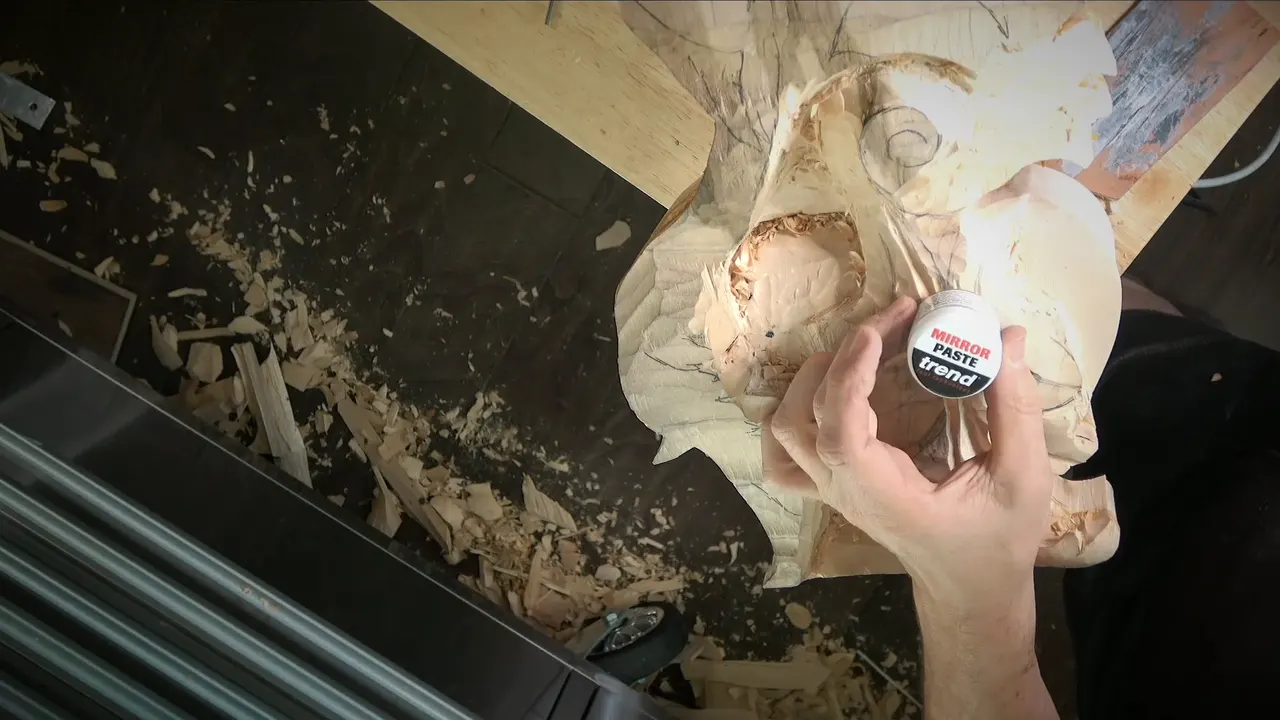

"Worth it" is my verdict on the mirror paste I strop with, said in part 1 of Venice Room 82, where I called it a kind of expensive product with a short life. The same two words turn up in other lessons about a knife, markers, a huge gouge, a tiny curl and a slow think. This page walks through each place.
Is there a tool or a supply on your bench that costs more than you like? Do you keep it anyway? Maybe a detail nobody will ever see keeps tugging at you, too. Here are the lines where I weigh it, each with the lesson it comes from.
Where did I say it in part 1?
It was the paste. "I'll use just a piece of leather and mirror paste," I said. I called it "one of the really good products, actually, for stropping." Now the price side. It has "a short life," and it is a "kind of expensive product, but it's worth it." Right after that, "It's worth it, but it doesn't last too long." And one more line, "It dries out."
As for how I use it, "I'm using that mirror paste only by hand because it is paste, really liquid-y." On a machine it would "fly all over you." Then a short line. "That's not fun."

Before the paste I said "this one needs to be stropped a little bit," and that I would do it.
What came before the paste?
The part opens with "Here you go." Then "that gives me a really nice shadow," I said. I could "right away pretty much undercut it with the 1 millimeter." After that I laid out my next move, "just going underneath," with maybe "a small section" just down below.

That wanted another tool. A flatter gouge was needed, I said, "maybe a number four or number three, or even one will work," and number three was my pick. A verdict on the cut followed. "Beautiful detail. I think it's a beautiful detail." I added "unfortunately, you don't see as good how it looks," and offered to show you "a little later, maybe a different angle."
Next, "So let me establish this shape now." I did not know yet what to do below it. Maybe "a secondary level underneath." For now, "too bulky section right here" would not make sense, I said. "I need to remove that part and create some kind of opening."

For the opening I named "number nine and quarter-inch," about 6 mm, "just to start across the grain cut." On the gap, I would leave "approximately a quarter inch above my main, whatever you call it," also about 6 mm. That part is "supposed to feel like it's laying right on top of that thing." I did not have the word for it. "I don't know how you call this thing," I said, and then said I would call it thing. Also, "I have no idea what's the proper name for it."

The work went slowly. "I can see now the movement," I said, "and that's the way it's done, pretty much just little by little."
Then the cleanup. A section needed cleaning "because it's just looking too messy." For that I wanted "probably just number three," one of my favorite number threes, a Henry Taylor, "about 5/8 of an inch, about 16 millimeters, maybe a little bigger, maybe 17, 18."

How did part 1 end?
The last lines are for anyone who will not carve the whole project. "I know most of you are not going to do that big of a project," I said, "but sections of this project could be used anywhere, pretty much." You can "use the details of it and just design your own application for that."
I gave one shape in the carving as an example. It "can be a design on its own because it has a really nice movement," and "you'll see it later on." Of it I also said it is "pretty much really authentic to the time period I'm working."
Is an expensive knife worth keeping?
The first workshop of my beginner course, part 2, starts with my favorite knife, a number 12. I said "It is somewhat expensive, but worth it." As an example, "this knife lasts 20 years on my shelf already," and "I'm still using it every day." I called it a "one-time investment," and "a lifetime friend, which you can actually use a lot."

Money came up as profit. This knife gave me, in the previous years, "a lot of profit," I said, and "I've done a lot of projects by using just one knife." You can watch it in Beginner Workshop 1.
Do markers earn their price?
Lily Box lesson 11, part 9, shows a brand of architectural markers that I kind of like, a German brand. That lesson has the line "And they're not cheap, but they're worth it." Then an example. "I got the mark right there, and I can just scratch slightly, and it's gone."

The comparison was a pencil. A marker "doesn't create any smooshing or any smudging like a pencil would." A pencil mark, I said, will show "all over your work later on," and I called that "plainly graphite smudging" with "nothing to do with the true patina."
Can a cheaper set be worth it?
In my tools course I weighed a set of gouges and knives, in the budget set review. I named a price per gouge and said "I would definitely buy tools from those guys." In the United States "you don't have to wait on the shipping," and for Europe, "you can go directly to the website and buy from them." I also said "I do not make any money from those guys, please." And the question? "So is it worth it? Absolutely."
I went further, "I think they should charge more," and then took it back with "Well, I shouldn't say that." The reason followed. Otherwise, "they will charge more," and there would be "a lot less sales."
Another budget set got a different test, in the other budget set review. "I don't want to review the quality of the tools," I said, and my goal was "not to reshape them, not to resharpen them." What I wanted was "to try it, if I'll be able to carve or not with those tools pretty much right out of the box," and to see, "if I would just start my hobby," if it is worth it or not.
My plan was grapes on a block of wood, with "a really quick sketch" on it. The block "is approximately six inches wide and approximately eight inches long," about 15 cm by 20 cm.
When does a huge gouge pay off?
Workshop 37, part 6, in the Venice Room 37 lesson, features a big one. "Three inches, that's what I'm using right now," I said, "number seven. Huge tool." Three inches is about 76 mm. I asked and answered myself, "Is it worth it to use it? Absolutely." Then, "If I want to get quicker results, yes," and "It absolutely worth it."

Why carve a detail nobody sees?
Over in Lily Box lesson 2, part 1, I planned to take out a small section "with the 1 millimeter and also number 11." The section is "almost invisible," I said, and if I left it alone, you could not even see it. Still, "If the only person will know about this detail, it's you, it's still worth it."

A curl was on my mind in workshop 22, part 12, in the Venice Room 22 lesson. "I just thought maybe I could curl it a little bit right here. Small detail." And "I know yesterday I said maybe it doesn't worth it, but I think it's going to give me." Then, "Even if it's not going to be visible too much, I think it's going to be nice detail." For the curl I picked "Four millimeters, that's what I'm using. Number eight." Four millimeters is about 5/32 in.
Earlier in that part I said "half a millimeter works much better in this case. It still gives me that shadow, but not excavating too deep." Half a millimeter is about 0.02 in.

The Venice Room 110 lesson, part 3, brings a number 11 for a curl, "four millimeters," which is "little bigger than eighth of an inch." I planned to undercut with it. "But see how nice that shadow I just created?" I asked. Later in that part, "A little detail, but I think it looks awesome."

On how close to nature it needs to be, I said "I really don't have to be really close to nature because it is ornamental carving or architectural carving," and "some details just to spice it." Then, "I know it's a tiny spot, but still, I think it just worth it."
Workshop 18, part 7, in the Venice Room 18 lesson, has me thinking of a picture. Maybe when I'm closer to the finish line, I might make a picture of how it looks on the inside, "because I think it worth it to see." And "But again, I need to excavate little more." The tool I had in mind was "maybe small, like number four or so," which I put at "one-eighth of an inch. Like 3 millimeters or so."

What if the spot is risky?
In Hashemi Flowers lesson 23, part 3, I talked about making one part flip down, with "my high spot" and "my lower." "That is not the easiest spot, but if you have sharp tools, it should be fine," I said. The gouge was a "5/16 of an inch number nine," about 8 mm.

The undercut came next. "Now I have to undercut," I said, "and again, like I said, that is end grain. And sometimes the end grain doesn't help, but overall result, worth it."

Lesson 39 of the same course, part 4, in Hashemi Flowers 39, has me saying I could "excavate even deeper underneath and create even more three-dimensional look." About the grain, "Though it's not the best area because it's the grain running this direction, but I should be fine." And "I'll raise that part completely."

Then "I got to be really careful," and "What I'm doing right now, just worth it." Afterward, "Ah, that's unfortunate, that is okay," and then "Just use knife."

How long should I think first?
Workshop 16, part 8, in the Venice Room 16 lesson, holds a spot that bothered me. "Something bugs me which I don't like," I said. Then "Let me think." I floated an idea, "a little element flipping right on top of this." "I know I'm taking my time to think," I said, and ended with "worth it sometimes to think hard."

The same words can answer no. For undercutting I said you "take whatever one-millimeter tool, number 11, and just go around," and that without glue by the edges, "it's actually really easy to remove." So filming that step got a no, in lesson 10 of the same course.
During the April 2020 livestream I was asked about a school in California. "I never communicated with those people," I said, and "If some of you want to introduce me to those people, yeah, I would consider, but it also depends" on whether it is worth it. "You have to understand that I am super busy." It is all in the April 2020 livestream, a Questions and Answers session.
Which wheel did I turn down?
The Maine sharpening class, part 6, covers a CBN wheel. "If you're going to buy a CBN wheel," I said. I named the price, "but it doesn't worth it, I do have them, but it's the second hardest stone, diamond does the job."
Next I planned "just to jump right away, pretty much either on a leather wheel or on a felt." Later in that part I came to the paste, "I found, like a year ago or so, this one," and "It's a polishing for the mirrors."
The lines side by side
| Lesson | Weighed | Verdict |
|---|---|---|
| Workshop 82, part 1 | Strop paste that costs a lot and dries out | Yes |
| Beginner Workshop 1, part 2 | My favorite knife, which is somewhat expensive | Yes |
| Lesson 11, Lily Box | Markers that are not cheap but leave no smudge | Yes |
| Budget set, tools course | Cheaper gouges and knives from one maker | Yes |
| Other set, tools course | Cheap set tested as it came from the box | Test |
| Workshop 37, part 6 | Three-inch number seven, which I called a huge tool | Yes |
| Lesson 2, Lily Box | Small section that almost nobody can see | Yes |
| Workshop 22, part 12 | Curl that may not be visible too much | Reconsidered |
| Workshop 110, part 3 | Tiny spot with a small curl in it | Yes |
| Workshop 18, part 7 | Picture of the inside of the carving | Yes |
| Lesson 23, Hashemi | Undercut on end grain that sometimes does not help | Yes |
| Lesson 39, Hashemi | Digging deeper underneath a detail in the carving | Yes |
| Workshop 16, part 8 | Taking my time to think when something bugs me | Yes |
| Lesson 10, Lily Box | Spending time on the camera for an undercut | No |
| Maine sharpening class | CBN wheel and the price I named for it | No |
| Livestream, April 2020 | Possible visit to a school in California | Depends |
Wikipedia has pages on words from these lessons: gouge, knife, wood carving, grain, pencil, marker, graphite, patina, polishing and leather.
Where can you watch these lessons?
Venice Room 82 holds part 1, and Venice Room Part 7 holds workshops 74 to 85. The sharpening lessons sit in the tool sharpening course, and the budget set reviews are in my tools course. Do you have a spot on your carving that nobody will see? Can you tell if it is worth your minutes?
How it's done
- Undercut the shadow. A really nice shadow let me pretty much undercut it right away, using the 1 millimeter.
- Pick a flatter gouge. Next came a flatter gouge, a four or a three, and the three was the one I would use.
- Open the bulky section. A too bulky part had to come out, with some kind of opening in its place, starting across the grain with a number nine, quarter-inch.
- Clean the messy section. A section that looked too messy needed cleaning, with a number three, a Henry Taylor, about 5/8 of an inch (16 mm).
- Strop by hand. A piece of leather and mirror paste, used by hand, was the plan, and I called the paste expensive but worth it.
Frequently asked questions
What did I weigh in part 1?
The paste I strop with. It has "a short life," and I use it by hand, because on a machine it would "fly all over you."
Does a detail nobody sees still get carved?
In lesson 2 of the Lily Box course I planned to take out a section that is "almost invisible" and said "still worth it." In Venice Room 110 I called a spot "a tiny spot" and still said it was worth the work.
Is a cheaper set of tools worth buying?
In my tools lessons I name a set I would buy and answer my own question with "Absolutely." Another budget set got a test right out of the box.
What to carve next