

Alexander Grabovetskiy, woodcarver, School of Woodcarving · Published 2020
What does a wood carver mean by "shaky"?
Quick answer: "Shaky" is a word I said in Venice Room 82, part 4, about "this kind of shaky area," just before a number seven at 14 millimeters (0.55 in). Elsewhere I use it for a spot with weak grain, a table, a sharpening bar, an old scroll saw, and a picture I hold by hand.
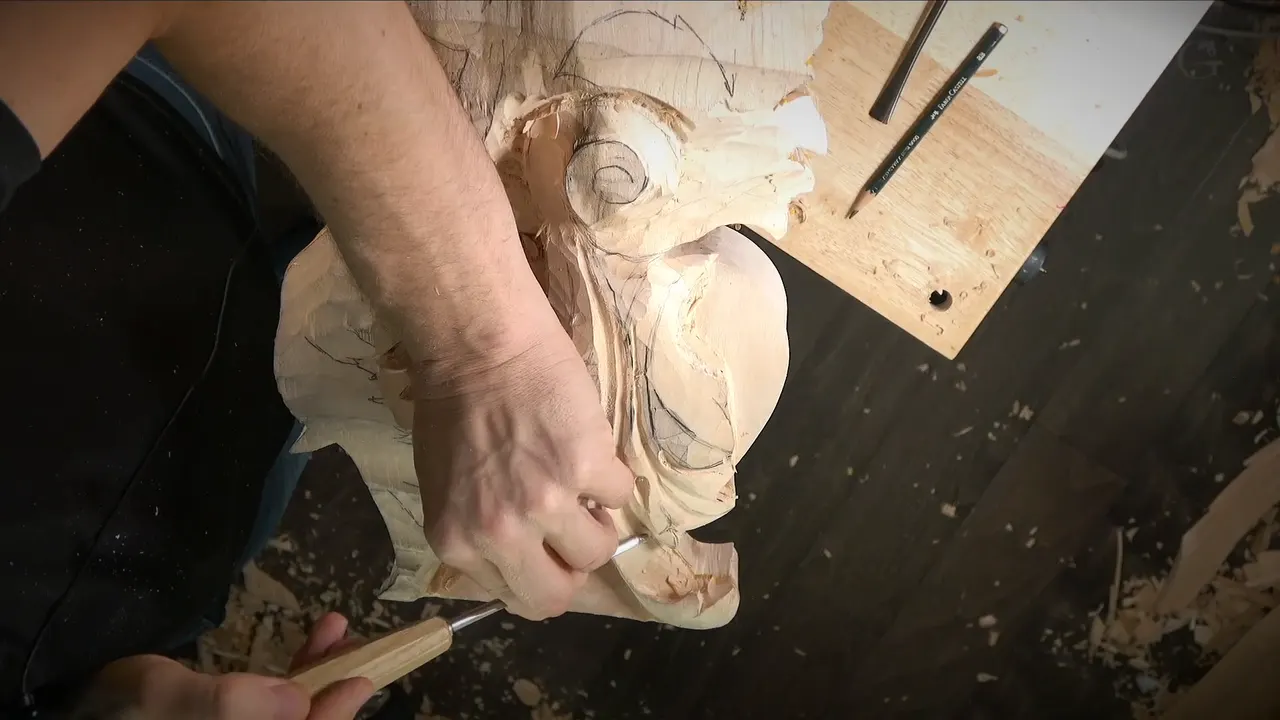

"Shaky" is a word I said in Venice Room 82, part 4, right after "Now get with the 1 millimeter." In other lessons I use it for a spot with weak grain, a table, a sharpening bar, a picture I hold by hand, and an old scroll saw.
Ever felt a piece move under your tool just when you wanted one quiet pass? Did you keep going anyway? Come through part 4 with me first, then through the other lessons where I used the same word.
What did I say before the word came?
The clip opens with "And that is my opinion." Next I said, "And now I need to form that detail and have to give a somewhat finalized look." An idea followed. "I could actually bring that point up just like that." After that, I wanted to "open up this section."
I thought it was "going to look really good," and I said it would "expose whatever is below." My last line on it was "I hope it makes sense to you."

A tool came next. "I'll use just number 11 veiner again and 3 millimeters, 1/8 of an inch." In metric, 3 mm is 0.12 in. Then a need, "to switch to smaller one, maybe 2 millimeters or even 1.5 millimeters," which is about 0.08 in and 0.06 in.
The picture came up too. "Unfortunately, you really don't see what is going on, but I'll try to make a good picture later on." I also said "looks like I need to sharpen my tool." Care came first, with a plan after it: "really careful how I approach this area, and let me... Maybe I can persuade that with a mallet."
Which tools did I name near the shaky spot?
Smaller ones. "I need the smaller tools to get inside right here," I said, and I named my "tiny number three." Its size was "1/8 of an inch," about 3 mm. It was "a really good tool to work in areas like that."

Next, a roll. The surface "rolls slightly backward," I said. "Not much, but little bit, and I think it's a good idea to do that."
Then the S. This area was "a really good area to do a letter S curvature," with one condition: "it has to be positioned properly." I closed the thought with "my letter S movement."

Two short lines ended that stretch. "Let me get undercut." And "Now get with the 1 millimeter," which is 0.04 in.
How did I describe the shaky area itself?
The line is short. "And this kind of shaky area." A calm one follows: "It's not as stable as I want it to be, but that is okay."

Number seven came after it, at "14 millimeters, half an inch." I added "A little bigger than half an inch," and I thought the tool would be good. Fourteen millimeters is 0.55 in, which fits "a little bigger."
Why did I call that position the worst?
First came a need: "I need to open up this section because it's not going to make sense the way it shows right now. So that all has to be gone."

About the view I said "you don't see that close enough," and a closer camera would mean "my head is going to be in the camera." On the position itself: "I have to break all the rules. I'm working uphill." Against the grain, and "actually the worst position," I said. Then: "But it is what it is. There's no other way I can attack that."

My number 11 was at "16th of an inch," which is 1.5 mm (0.06 in). After that, a plan: "Let me use a number 11 and 3 millimeters upside down, and I'll create my cut toward my previous hole." The part ends on a need and an aim: "I really need to expose this area. Create a really beautiful and deep shadow."

Is a shaky spot a weak spot?
In lesson 14 of the Floral and Molding for the Panel course, part 1, the two words sit side by side. I sized the job first, "maybe about four millimeters or so," then "maybe three millimeters, one-eighth of an inch." Those are 0.16 in and about 1/8 in.
Next came the spot. Care mattered, "really careful," because it was shaky, "and also it's really weak because the grain runs that direction." Plan: "I'm going to hold it with the fingers."

Later: "It is really easy to break just because, like I said, the grain direction." It would sit "lower on my right-hand side," I said, and I had to "slope everything that direction."
A tool came up, too. "This one needs to be sharpened or just stropped." Then a rough spot: "And yes, I know I'm doing it against the grain, that's why it's really rough." And "It is always better to attack that from the right position," I said.
How small should a tool get on a shaky area?
The panel course has an answer in lesson 3, part 2. The plan was "probably number three, I would say, and create straight down cut." Of that tool I said "it's a small one. This one is only six millimeters or so." That is 0.24 in.
I was "barely removing wood," I said, because the area was shaky. "It's easy to make mistake," I said, and "no mistakes allowed."
Then another tool I own. "I do have a really good tool for that. I've got skewed gouge." For it I said "maybe number seven," a skewed one.

A bigger tool comes up in the Lily Box course, lesson 7, part 1. "But let me try number seven. Well, I still have to be careful with the small, tiny details like that. So maybe bigger tool is not such a good idea. No, it's not."
Next: "Use a little smaller, maybe about 10 millimeters." It stayed shaky: "Even 10 millimeters," I said, which is 0.39 in. A reminder followed: "Remember, I don't have any glue underneath, and that doesn't help when you're working on those small details."
I weighed both sides. "If I can use bigger tool, if it's safe, it's always quicker. But only if it's safe, and I don't think it's safe in this case." So the plan was to "get even smaller," with "number five and a quarter inch," about 6 mm. After it: "It's little better, but still."
Does a shaky piece get more fragile?
In Hashemi Flowers 12, part 4, "shaky" sits beside "fragile." My plan there was to "just rotate and just attack from opposite side," and I said I had to watch the grain of the wood.
The pressure mattered too. "I don't want to create too much pressure because like I said, it becomes more fragile." I said there were "multiple points you can break now." A number seven was next in the plan, to "establish the main flow."

A wiggle showed up. "I do apologize for that wiggle. I don't want to overtight my screws on the bottom, and that's already kind of loose. Maybe I could little make it tighter." After a pause I said "That's a good idea," and "it's going to be less shaky."
Then the other side of it. "But more fragile it's going to become, so more shakiness you're going to see because even the piece itself, you'll see some of the areas, it's already really shaky."

My advice was about hands. "So also keep an eye how you support your hands." I named a style, too. There is "such a thing as like a airbrush, when you're just holding and airbrushing it without touching the piece." I call that "like a air carving." You hold "your tool in the air without too much support, without touching with your hands, just the edge of the tool touching."
One more line on it: "just controlling your tool without supporting the hands too much."
Is a shaky workbench a problem?
Students asked, and Roman Acanthus 5, part 3, holds my reply. "Some of you asked me can I eliminate my shakiness of the table, okay? Probably, yes. If I would use a different type of workbench, really solid, unshakable workbench, and that would probably eliminate the problem."

Then my own bench. My workpiece is shaky "a little bit," I said, and "for me, it is not the problem at all, okay?" My vise was connected to "just a small workbench," and "definitely it creates some movement."
A movie came up. "There was a movie I saw about the school of spies, okay?" Those future spies learned to write while "the table would float and just move and so on." Then: "they had to learn how to write with the pen on the floating and the shaking table, and write that accurately."
On benches in general: "If you have a really stable workbench, that is absolutely fine." I added "I like my portable workbench." The shaking "doesn't bug me," I said, and "maybe sometimes it's hard to watch," and "I promised I'm going to show you the way I'm carving."

Venice Room 146, part 3, goes the other way. "Not too stable. Let me stabilize my table. That's shaky. Hold on just a second. I need to put some kind of shim underneath. Okay. Now it's more stable." Two benches, one word, and two answers to it.
Can a sharpening bar be shaky?
A question came up about one in the spoon gouge sharpening lesson. "Some people have noticed that this bar, it's somewhat flimsy. So it's shaky." I compared it with another machine, which has "a double bar supporting two legs, but this one is only single."

The back side has "two screws you can adjust," and I said "it doesn't bug me if there is a little bit fluctuations."
On the machine itself: "It's actually the main reason why I don't use this machine to sharpen my plane irons, but I'm using that only for carving tools." And: "absolutely no problem for carving tools, no matter what kind of tool you do."
Was my first scroll saw shaky too?
The first Lily Box lesson has a story. "When I came to United States, long time ago, pretty much, my first woodworking tool was a not really expensive scroll saw."

The saw "was all jumpy," and "all shaky," and "really hard to get the blade in." And for me, "it was a lot easier to use just the old" Fretsaw.
I changed saws later. "I upgraded my scroll saw, and I bought a really good one." My last one, I said, was "like eight, nine years old, and it's absolutely nice and beautiful."
What do I say when the picture is shaky?
At times the word is about my camera, and in part 4 I said I would try "to make a good picture later on." Other lessons carry an apology.

The panel course, lesson 3, part 2, has "I can grab my iPhone again and try to show that to you." Then: "I hope you can see this area, and my apologies for how shaky that is."

The same course has one too, in lesson 5, part 1, and it adds a line about focus. "Now let me fly around. My apologies for that shaky camera. Again, I have to hold it at the right position for it to not blur, to just keep the focus."

An iPad did the job in Chamomile and Bow Rosette 2, part 1. The iPad was my plan "to show you what is going on." Later, shaky came up again, "when I'm holding it like that, with just a hand and iPad." My hope: "Let me know, please, in the comments, if it helps to show you details." And "I guess it just gives you an idea."

The shaky lessons side by side, one lesson in every row
| Lesson | What exactly was shaky or loose | What I did about it |
|---|---|---|
| Workshop 82.4 | A small area, not as stable as wanted | Okay with it |
| Panel lesson 14.1 | A spot where the grain runs the weak way | Fingers hold |
| Floral lesson 3.2 | Number three, only six millimeters wide | No mistakes |
| Lily Box 7.1 | Small details with no glue underneath the piece | Smaller tool |
| Hashemi Flowers 12.4 | A piece already really shaky, and more fragile | Hands supported |
| Roman Acanthus 5.3 | My vise on a small bench that creates movement | Not a problem |
| Venice Room 146.3 | A table that was not too stable | A shim |
| Spoon gouge lesson | A bar called flimsy, single not double | No problem |
| Lily Box 1.1 | A first scroll saw that was all jumpy | The old Fretsaw |
| Molding lesson 5.1 | A camera held by hand to fly around | My apologies |
| Chamomile Rosette 2.1 | An iPad held in just one hand | Hope it helps |
Wikipedia has pages on subjects behind these lessons: gouge, wood carving, mallet, workbench, stropped, grain, airbrush and vise.
Where can you watch these lessons?
Workshop 82 holds part 4, and Venice Room Part 7 holds workshops 74 to 85. The hub lessons sit in Hashemi Flowers, Floral and Molding for the Panel, Roman Acanthus, the Lily Box course and Chamomile and Bow Rosette, and the bar is in the sharpening course. Is there a spot on your bench that you call shaky?
How it's done
- Plan the opening. The detail needed to be formed and given a somewhat finalized look, and I could bring that point up and open up the section.
- Name the small tool. I'd use a number 11 veiner at 3 millimeters (about 1/8 in), and I needed to switch to a smaller one, maybe 2 millimeters (0.08 in) or even 1.5 mm (about 1/16 in).
- Say the area is shaky. I called the area shaky, and I said it was okay.
- Name the next tool. The tool in use was a number seven, 14 millimeters (0.55 inch).
- Open the section. The section needed opening, because it would not make sense the way it showed, and all of it had to go.
- Accept the position. I was working uphill, "the worst position," with "no other way I can attack that."
Frequently asked questions
Where is the word in part 4?
Right after my line about the 1 millimeter I said it. The area, I said, fell short of the stability I wanted, and I called that okay. A number seven came next in the clip.
How did I react when the Hashemi piece moved?
I apologized for the wiggle and said "Maybe I could little make it tighter." Then I said it would be less shaky. I also said it becomes more fragile, and "keep an eye how you support your hands."
Did I stabilize a shaking table?
Workshop 146, part 3, has me needing some kind of shim underneath, and then "Now it's more stable." In the Roman course, lesson 5, part 3, I said a shaking workpiece is not a problem for me, and a stable bench is absolutely fine.
What to carve next