

Alexander Grabovetskiy, woodcarver, School of Woodcarving · Published 2020
What does a wood carver mean by "shift"?
Quick answer: Venice Room 82, part 2, is where I used the word "shift" for the middle line, soon after I rolled a spot. Other lessons use it for a pipe, for a high spot, for eyes, and even for a tool, and each of those uses sits in its own lesson on this page.
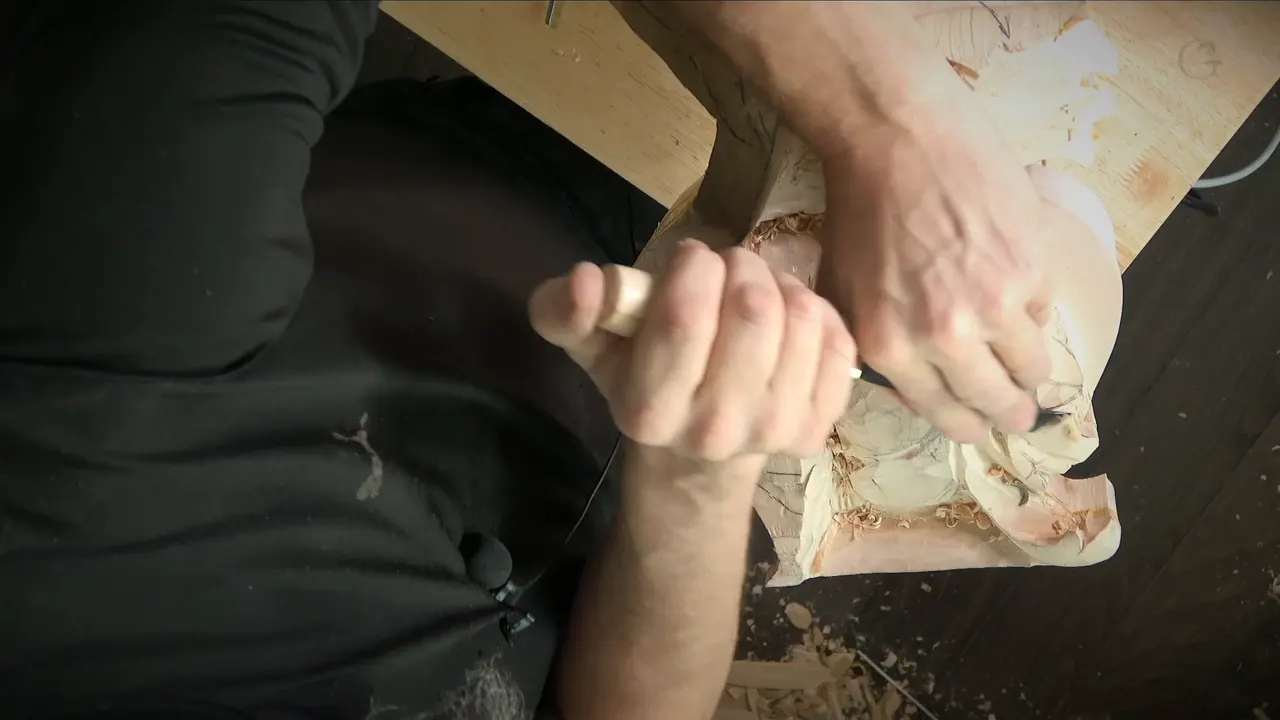

In part 2 of Venice Room 82 I used the word "shift" for a middle line, and said it would lay on top of "this movement." Other lessons use it for a pipe and a high spot, for eyes, and even for a tool. This page walks through each place.
Have you drawn a center line on a leaf and asked yourself if it sits in the right spot? Here are the lines where I move mine, with the lesson that holds each one.
Where did I say it in part 2?
It came right after a roll. I had planned that roll, saying "It's actually going to give a really nice movement." Next I noted "It repeats somewhat this movement, but that's not as extreme as this one." Then the line itself. "So now I can shift a little bit my middle line, and that is actually going to lay right on top of this movement. Okay? So that is really good."
I was pleased. "I'm really happy about that detail," I said, "and I can actually create this part a little farther, too, just because of what I just did with the rolling."

What came before the shift?
The part opens with "There you go. Now it's clean." And "I can develop something now with that." My line was "going this direction," I said, "which means I need to do another concave cut right in this section."
Next, a limit. I set out to "establish the boundary below what I can't go." The room to the lowest point was "only about 10 millimeters or so," which is 0.39 in. Even so, "I also can roll it a little bit just because of it."

Then I said it would be "visible from the bottom, so that is actually excellent touch. So it just rolls that direction. Really, really nice."
What did the shift change in the cut?
Right after it came a plan: "Let me lower that down a little bit," and "you'll see it much better." Then a verdict, "That is excellent."
Then the concave cut: "I can now create the concave cut because I really need the middle part somewhat convex." Space was tight, and I said so: "I'm really limited with the space."
How did I keep the ridge readable?
The next move was "refine this concave," and the refined cut would give me some shadow. "Really good shadow, actually."
My blend would use the left wing of a tool, "because I really want to see that middle line ridge. It has to be readable." After that, "maybe with the right wing also just blending a little bit." Last, "I'm happy."

What did I do about the ridges?
"Now I need to get rid of ridges. This ridge and that ridge. I don't want to see sharp ridges. It has to be more like transition to the convex." For that I named "the flatter tool with number three," and in my words, "I took about 10 millimeters number three." Ten millimeters is roughly 0.4 in (a bit under half an inch).

How did part 2 end?
I offered a closer look: "maybe I can actually show you a little closer what I'm doing," I said, "and hopefully, you will be able to see." Then "Although the camera position, it's not straight above, so that's why you don't see the exact picture what is going on. But at least you see some of it, okay?"

The last lines go like this. "Maybe reposition slightly like this. And I'll blend it all the way to the middle ridge. Okay, that's good. So it's a good area to create the letter S curvature. Just like that, okay?"

What is a shift measured against?
Here the word is used for a line in Venice Room 75, part 4. "I think the middle line needs to be shifted this way." The measure came next. "That's a 38% and 62%, which is a golden ratio rule."
That line might not stay put. "Once I'm going to slope it, that line also, it's possible it's going to move." The aim was to "approach carefully this area." My outline plan was a number 11 at "15 millimeters," (0.6 in).
The rule itself comes from my design course, in The Law of Movement. "Six parts out of 10. And that's going to be a golden ratio." On how to find it, "take that distance, find the middle, shift that to the right or to the left. It depends on the brain structure."

The introduction to that course puts it this way. "Even just the one simple flower, with all the techniques, if you just shift that from the golden spot, your brain is going to read that differently."
How far did I shift it?
A number comes from workshop 30, part 12. "I look at point to point, divide that in 10," and "I shift that a little bit, make it like a golden ratio, six parts out of 10." Before that I said "I tried to explain many times already when I'm working on a middle line."

A center line shows up in part 1 of Venice Room 127. "If you take this distance and that distance, I want to shift that little bit to the lower part." The goal was "like about golden ratio." The cuts after it were plans. The first convex would start "somewhere right there," and the second "somewhere right here." I planned to try "the huge 30 millimeters tool," a number 11 of course, which is 1.2 in, and said "I really don't need deep concaves."

A split sits in part 10 of workshop 61. I had to look at "the main middle line of overall movement." "If you take this point and that point and divide that by 10," I said, the line "shifts little bit" and goes "to the left. To the bottom, actually. It's the way you look at it." The split was four and six, "approximately. Just eyeballing." And "I'm trying to stick to this rule or law everywhere I can."

The Furniture Panel course does it, too. In Furniture Panel 19, part 12, I said I could leave a concave without a spine, but I thought it would look better with one. Then I planned to shift the line "this way," because "I've got this one as shifted, you can see," I said, and that one needed the same shift.
A check followed: the movement has to repeat and, in visual, stay parallel. "Again, law of repetition." After that I could take "number 11 and 3 millimeters," about 0.12 in, for an extra concave cut. "Just create the shadow, okay?"

Why move the line at all?
Next comes workshop 71, part 4, with "a letter S movement" in the same breath. Here the line was "going to shift" to the left, "a little bit." Then, "that would be really good, I think." The same tools were planned, a number 11 at 3 millimeters (0.12 in).

Room for a pipe was the reason in workshop 22, part 4. This time the line should shift a bit inside, I said, "because I need some space for this pipe." A cut was planned, "right on the side of this middle line." The pipe would move too, to the right, "to this side slightly." And "let me reestablish the main movement."

Back in workshop 61, part 11, I said "I'm not trying to rush." A hedged plan followed: I could stick that part a little farther, move the leaf slightly away, and shift "even more like that and make a little wider." The reason came after. "More fluent with the overall movement." In the same part I said "I don't really like this movement." Then "I'm talking about this line, how it looks." And finally "Now it does."
Next, workshop 53. In part 4 the need was to "recreate the line," with maybe a small shift, which would give "a little more chance to shift that slightly this way." A separation was coming, "a big separation right there."

Next came a reason with a line in it, in part 5. "I need to move to create a parallel. If I have a line right here, so I have to create approximately a parallel line, at least between those two lines." That line had to shift, with the point "somewhere right there." "Now it just curves more fluent, okay?"
Then, in part 7, "Let me recreate the middle line." Then "Although it shifted." I weighed a shift. "I could actually shift because it's still going to hit that point. That's okay, too." And then "Although, no, it's not going to be good."

And what if the thing I move is a pipe or a high spot?
A pipe took the word in part 9. "The pipe is supposed to go between those two lines," I said, and "I've got middle line right here of the separation." Next, "Maybe just a shift" came, "to be closer to Fibonacci sequence." And "I moved that little bit to that direction." Wikipedia has a page on the Fibonacci sequence.
Furniture Panel 19, part 15, gave it to a high spot. I did not want a concave all the way up. The plan was hedged, maybe "shift my high spot little closer right to this line." The golden ratio came in again. "I can find about six parts," I said, and that spot would be my high spot, with the carving moving "downhill this direction."
Next I said "we need to create at least some different movements," and "I don't want to be exactly the same on the same leaf." Then "let me create opposite direction convex cut."
What changes when the line moves?
Grape Onlay 8, part 2, shows a shift that left me a problem. "The only problem I can see," I said, came from a central line I had shifted. "My bulging, my convex, it's kind of center right here." So "I need to kinda drive an eye," and "I mean, I made that twist." Then came a bigger tool, "number 11 again and 10 millimeters." That is 0.394 in.

Over in Venice Room 31, part 2, I named a center line as well. My plan was to "shift it little bit toward this direction, which is closer to the golden ratio." A concave beside it was planned, "just gradually going to go. Almost no concave."
Does the word ever mean something besides a line?
It does. In workshop 55, part 11, it was about the eyes. "I'm still not too happy how big those eyes are. I still want to do bigger." Then "maybe I have to shift it this way, and maybe I can shift that way." I added "that way it's got a big eyes and still nice movement." I mentioned "even up to 10 millimeters maybe," 0.394 in, and then said I did not think it would fit.

Even a tool moved in Venice Room 115, part 2. "I'll get number 11 and 7 millimeters," I said, which is 0.28 in. The motion came next. "The way I do, I just place the tool and shift it to the left, about 10 o'clock or so. Flute 10 o'clock."

A shift was a risk in workshop 56, part 3. I could "shift" and "break this one" if I did not cut from the sides first, "almost like undercutting from both sides." "I'm creating space for myself, okay?" I said, and the purpose was the tool: "for the tool to work." And "because this particular tool has a really narrow neck, I know even if I'm going to slightly move to the sides, I'm not going to break anything."

The lines side by side
| Lesson | What shifted | Where to |
|---|---|---|
| 82.2 | My middle line, only a little bit | This movement |
| 75.4 | A line measured by the golden ratio rule | 38% and 62% |
| 71.4 | This line, with a letter S movement | A bit left |
| 22.4 | A line and its pipe, for some space | Inside, and right |
| 30.12 | A middle found by dividing a span in 10 | A golden ratio mark |
| 61.10 | The main line of overall movement | Left and down |
| 53.5 | A point between two lines, for a parallel | Into a parallel |
| 127.1 | The center line, with the golden ratio in mind | Lower part |
| FP 19.15 | The high spot, close to a line | Closer to it |
| 55.11 | Those eyes, to make them bigger | This way |
| 115.2 | The tool, a number 11 for an undercut | Left, 10 o'clock |
| 56.3 | The risky spot, and a tool with a narrow neck | Only a little |
Wikipedia has pages on subjects behind these lessons: gouge, wood carving, golden ratio, acanthus, corbel, grapes, pencil, marker, parallel, curvature, shadow and relief.
Where can you watch these lessons?
Workshop 82 holds part 2, and Venice Room Part 7 holds workshops 74 to 85. My design lessons are in the Principles of Design course, and the panel lessons are in the Furniture Panel course. Do you have a center line on your own carving that could move? Where would it go?
How it's done
- Say what is clean. Part 2 opens with "Now it's clean," and "I can develop something now with that."
- Name the limit. I named the boundary below what I can't go: only 10 millimeters or so (0.39 in) to the lowest point.
- Roll the spot. I also can roll it a little bit, I said, for the movement it would add.
- Shift the line. Next, the line itself: I can shift it, and it would sit on "this movement."
- Blend to the ridge. I planned to blend to the middle line with my left wing of a tool, and maybe the right wing, so I can see that ridge.
- Take the sharp ridges down. No sharp ridges, I said, and I took a flatter number three, roughly 10 millimeters (0.4 in).
Frequently asked questions
Which line did I shift in part 2?
The middle line, soon after a roll that was meant to add "a really nice movement." It would sit on "this movement."
Where does the golden spot come from?
My design course says to "take that distance, find the middle, shift that to the right or to the left," and adds "It depends on the brain structure."
Why would I move a line?
The reasons I gave were "I need some space for this pipe" in Venice Room 22, "more fluent with the overall movement" in Venice Room 61, and a line "to create a parallel" in Venice Room 53.
Can the word mean a tool?
What to carve next