

Alexander Grabovetskiy, woodcarver, School of Woodcarving · Published 2020
Can you overthink a wood carving?
Quick answer: Yes. In Venice Room 82, part 8, I was not sure whether to cut one more concave, a small one. Overdoing it or overthinking it was something I wanted to avoid, and I named the risk: overthinking can leave you with something more complicated. Other lessons carry the word too.
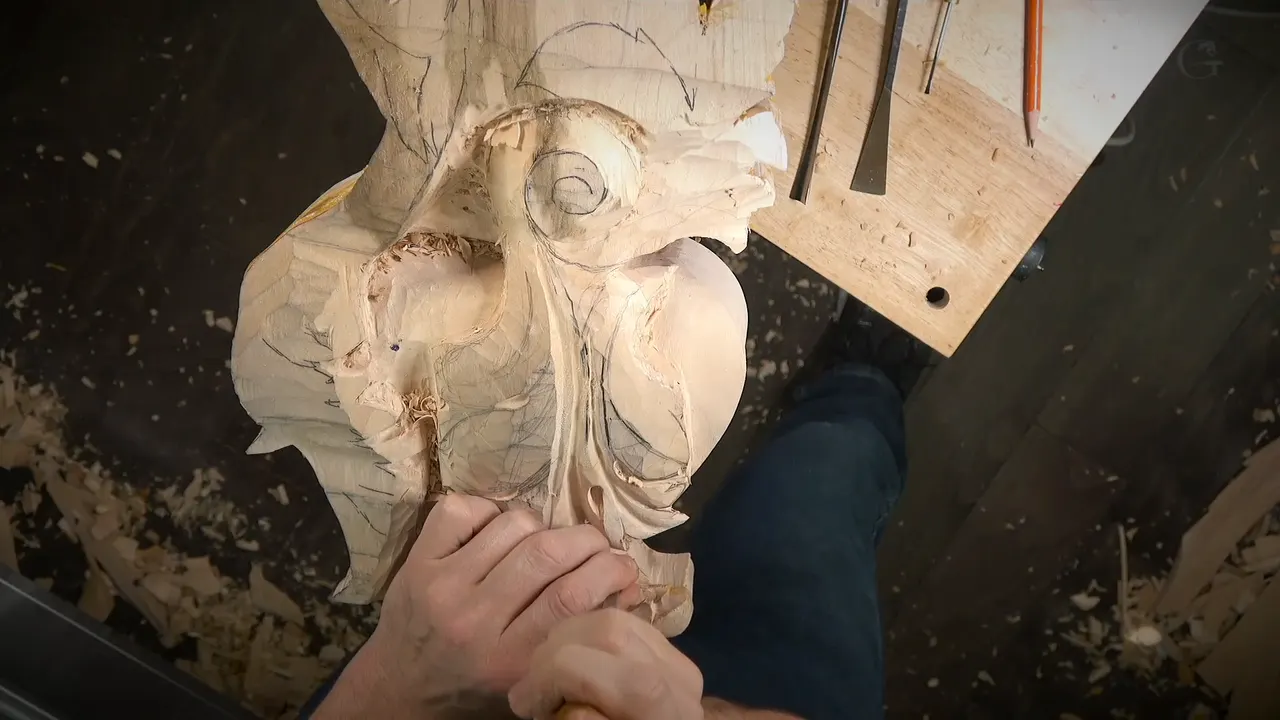

"Overthink" is a word I used in Venice Room 82, part 8, about one small concave. The part is short. Other lessons of mine carry "overthinking" and "overcomplicate," so this page follows the word through them.
Ever stood over a carving, unsure if one more cut belonged? One stretch of part 8 holds a spot like that. Walk through it with me first, then through the lessons where I say the same kind of thing.
How does part 8 begin?
"And bring it really close to the main body" are the first words in my transcript. After them come "Let me give you a really good shape of this one," and, about a smaller tool, "with the small tool, I can clean everything up."
Next comes a remark about the underside: "of course, it is looking a little rough underneath." About that underside, here is what I said: "for me, it's making a lot more sense to do some of that stuff off-camera because really I can't show what is going on right there."

"But I'm just after really smooth form, okay?" Here was my plan for the surface: "I'm going to just work my way in just like that with the flatter tool and clean that surface," and "make it look like this." I wanted it "Clean and nice right underneath." A case like that, I said, "I can do only with the really small, tiny tools."
Should I cut one more concave, or leave it?
"Here you go, so let me also create a small concave." Then came the doubt, "I'm not sure should I or should not," with a wish beside it: "I think I want to see a little more concave right here."

On the question itself I said "Well, I don't know yet, so we'll see." "Don't want to overdo or overthink" comes next. The full thought is "And it's possible to overthink it and make stuff more complicated than it should be."
What follows that thought is "Okay, let me jump on the next one."
Jumping to the next one
"And I'm probably going to work on this one." About that one I said "So this one has a really nice and beautiful movement, I think." The first need, in my words, was "And first of all, I need to probably lower down even more this section."

The direction: "like growing from this side and going this way." For the pipe I said "I do have a pipe, but that pipe is unique pipe." Blending: "Kind of have to blend it all together somehow." Of a high spot, "Let me get rid of this high spot, which just doesn't look too good."
Thinking a side through
"Think," not "overthink," is the word here: "Okay, I kind of have to think a little bit about this side." Next come "I have to think about this side," then "How is it supposed to look" and "Let me see what I've got on my pattern."

The pattern, in my words: "it shows all of those movements getting really close to this movement, okay?" So "I have to get rid of this line." Of the start, "So it's actually going to start like this, right?" My aim after it was "So let me clean a little bit this section where it's not going to distract me."
Planning the concave cuts
"And it has to look really uniform, okay?" After it, "So which means my concave cut going to be on this side of the movement, and I'm going to carry that all the way this way."

I asked for a tool: "And where's my number 11, seven millimeters?" (0.28 in) Then "And let me do that."
A caution about position: "I know it's not the best position to carve." On cuts toward yourself I said you should not do any, and "if you're locking your hands really solidly, it should not create any problem."
The plans for the cut were "So that cut, and let me carry that cut this way," and "Now it's going to be that direction." The last of them is "That's going to go this way."

Does the doubt show in the parts next door?
Part 7 says "And I don't know if I like it or not." In part 9 there is "I don't like too much what happens right here," with "I'll fix it somehow," "but I'm not the biggest fan of what I see right here," and "So I'll fix it a little later."
A triangle in part 9 got a check on the spot: "I do have a triangle, which is a really nice triangle," then "But I'll check later if it's too big or too small," and "I actually check right now." The result was "No, it's not too big at all," and "It's actually not bad at all." My plan then was "So I need to exaggerate the triangle."

Where else do I say "overthink" or "overcomplicate"?
The same two words show up in lessons from several courses, each in its own spot. Every passage below names its lesson, so you can open it and listen for the line.
The pen and pencil story
A grain question in Carving with the Grain, a question and answer lesson, ended with "any questions about the grain?" Next came "Don't overcomplicate things, did I tell you about NASA?" The story was about a pen and a pencil, and I called it a true story.
The lesson, in my words: "The lesson is don't overcomplicate stuff, okay? If it fights you, just sharpen your tools. That's it." Plus "Just don't overcomplicate."
About sandpaper on a bench for sharpening, "That was actually the first thing what my teacher taught me." He said "Don't overcomplicate things unless if you have enough money to invest in stones." One stone, I said, "can cost 200 bucks."
Why did I leave a spot plain in Hashemi Flowers?
Hashemi Flowers 22, part 1, has this: "And what I could do, I'm not sure I should or not, I could make it more complicated, but I don't think it's necessary right here." The reason I gave: "So that is not my focal point, so I don't have to overcomplicate it."
For the cut I named "number 16 and six millimeters, quarter-inch V tool." It was meant to "Kind of make my separation cut."

A leaf left as it is
From Hashemi Flowers 23, part 4: "Let me think what I can do with this one." The idea was "So maybe it's a good idea just to leave it the same movement," and I called it "I think it looks good just like it is." Next, "let me separate those two leaves, two movements with the V-tool."

A problem I made myself
Open Venice Room 35 at part 6 and you find "that is a good thing that I have extra material," and "Okay, I didn't lose too much." From the same stretch: "we had a problem and we solved that. I should say I created the problem, and my problem was overthinking, overdoing it."
The result, in my words: "I think it's looking much better than having almost like a pine tree with needles."

A thick piece with several endings
In part 7 of Venice Room 45, I said "there is a few different possibilities of development." The options, in my words: "I could leave it just like that, or I could give a flip, like a flipping over and get concave, which is going to look good, too, if I want it to."
Next, "But there is always possibility of overthinking, which I do not want to do." After "But let me find the middle line," come "Well, should I or should not" and "I don't think I need to."

Is thinking the same as overthinking?
Turn to Venice Room 66, part 2, for "I need to think," then "Why I'm thinking too much today" and "I don't know." Also "Maybe I can just do something else instead," and "But I kind of like the idea of wrapping." And "so it makes sense to create deep shadow."

Over in Venice Room 71, part 7, I said I would think about using 10 millimeters (0.39 in). "Well, I'm pretty sure I'm able to," I said, and "Of course, I'm able to." Then "It's the question how it's going to look."
How much about shadow is too much to explain?
Venice Room 64, part 12, has "maybe someday I have to explain to you all five levels of shadow." And "So it's really important to understand in design process five levels of shadow." Then I said I wanted to avoid overcomplicating stuff, that "It's not really complicated and all," and "But at least some basic stuff."
The basics were "the light source" and "how the light travels, how many light sources I have".

When a simple shape feels like too much
In Venice Room 90, part 10, I said "that's simple," and about the rest, that I had no wish to make it overwhelming. Next, "Maybe I just overcomplicate it," and "Which sometimes happens." What I planned: "I can try my new addition and get those ridges out," and see, with the rasp, if I like it or not.

The line in Venice Room 74, part 7, is "And there is plenty of movements." After it, "I think it's enough because I do not want to go too deep and create a problem for myself."

What my teacher told me to ask
Tray of Blessing 7, part 1: "For example, my teacher would tell me, think, how are you gonna carve it?" In the same stretch, "I could just do over complicated stuff, but I don't wanna do it in this case because the limitation of the tools in the class we have."

A golden ratio line sits in lesson 3 of the same tray, part 3: "See that 60 and 40, can you see that visually?" And "if you don't feel comfortable with the golden ratio, don't overcomplicate stuff." Plus "I mean, most of the people don't."

A design I made hard
Furniture Panel 26, part 2, has a tool choice: "and nope, I'm not gonna be able to use three millimeters." The answer was "so gonna use the two millimeters," which is 0.08 in. Also "So why did I design that? I have no idea."
About it: "I think just myself made it, um, overcomplicated but not really." And "I mean, uh, it's gonna look good."

Picking the number of parts for a border
Butterflies 12, part 1: "I could divide that in eight parts," and "I could divide that in seven parts." Then "But I made a decision to divide that into six parts." The tool: "I'll just use the calipers and I'll subdivide it in six, in six parts." And "Doesn't have to be perfect, by the way."

Is it overcomplicating to clean one area first?
Maine class 4, part 1, opens with "Make sure you don't over do it," and "You don't have to over complicate the stuff." Next, "Really important to understand there's the two schools or two approaches to the carving."
Of the first approach: "You actually work your details first per area." My way is "I create the main form and then work the details," and "if I need to change something, I did not waste too much time."

Why keep every eye the same shape?
Roman Acanthus 6, part 3, has "I could use a different sweep." Then "I didn't want to do that." Also "I don't want to make it too complicated," with "you could make variations of those eyes," "Some eyes could be smaller," and "Some eyes could be bigger." And "I didn't do that, okay? But you could."

What I meant by gradual
Lily Box 7, part 12: "And again, the idea is gradually move toward undercutting." Not a really deep undercut everywhere, I said, "just gradual, okay?" Not to overcomplicate was my wish, I said, but still I wanted to make sure "we are on the same page."

The same words in one place, with one lesson in every row
| Where I said it, and what came with it |
|---|
| A small concave I could not decide on (this lesson) |
| A plain V cut (Hashemi 22) |
| A leaf I planned to leave in the same movement, and a V tool to separate two leaves (Hashemi 23) |
| Overthinking, overdoing it (Venice Room 35) |
| A thick piece, a few possibilities of development, and a middle line to find (Venice Room 45) |
| Thinking too much today (Venice Room 66) |
| A 10 millimeter (0.39 in) tool, judged by how it looks (Venice Room 71) |
| Some basic stuff about shadow (Venice Room 64) |
| A simple shape that I wanted to keep from feeling overwhelming (Venice Room 90) |
| Enough movements (Venice Room 74) |
| A plan held back for the tools in the class (Tray lesson 7) |
| A design I called overcomplicated, but not really (Furniture Panel 26) |
| Six parts (Butterflies 12) |
| The main form first, the details after (Maine class 4) |
| One shape for the eyes, with variations left to you (Roman Acanthus 6) |
Wikipedia has pages on a few of the things named above: gouge, wood carving, woodworking, grain, sandpaper, shadow, rasp, golden ratio, calipers, pencil, NASA, Venice and Grinling Gibbons.
Where can you watch these lessons?
The Venice Room Part 7 course holds workshops 74 to 85, and part 8 sits in workshop 82. The other lessons live in the Hashemi Flowers course, the Tray of Blessing course, the Furniture Panel course, the Butterflies course, the Maine class, the Roman Acanthus course and the Lily Box course. Where on your own piece would you stop deciding and make the cut?

How it's done
- Say what you do not know yet. I did not know yet, and I said so.
- Name the risk. Overthinking can leave you with something more complicated, I said.
- Move to the next piece. Moving to the next one was my plan, I said.
- Look at your pattern. I had to think about a side, I said, and I would see what I had on my pattern.
- Plan the cut. It has to look really uniform, I said, and I would carry the concave cut all the way along the movement.
- Check it right now. My words in part 9 were "I actually check right now."
Frequently asked questions
Which spot made me say overthink in part 8?
It was a concave, a small one, and I wanted to see a little more of it right there. "We'll see" was my answer, and a few lines on, "let me jump on the next one."
What did I say about the next piece in part 8?
Jumping on the next one, I said, and probably working on one with a really nice and beautiful movement. My first need was probably to lower down even more one section.
Which gouge is named in part 8?
A number 11 of seven millimeters (0.28 in), named for the concave cut I planned.
What did my pattern show in part 8?
What to carve next