

Alexander Grabovetskiy, woodcarver, School of Woodcarving · Published 2020
What does a wood carver mean by "maybe I have to"?
Quick answer: In Venice Room workshop 82, part 12, those words come while I clean a surface with a small number 11. Other lessons of mine put tools, depths, a new position or a wait after them, and the part itself ends with a plan for the letter S.
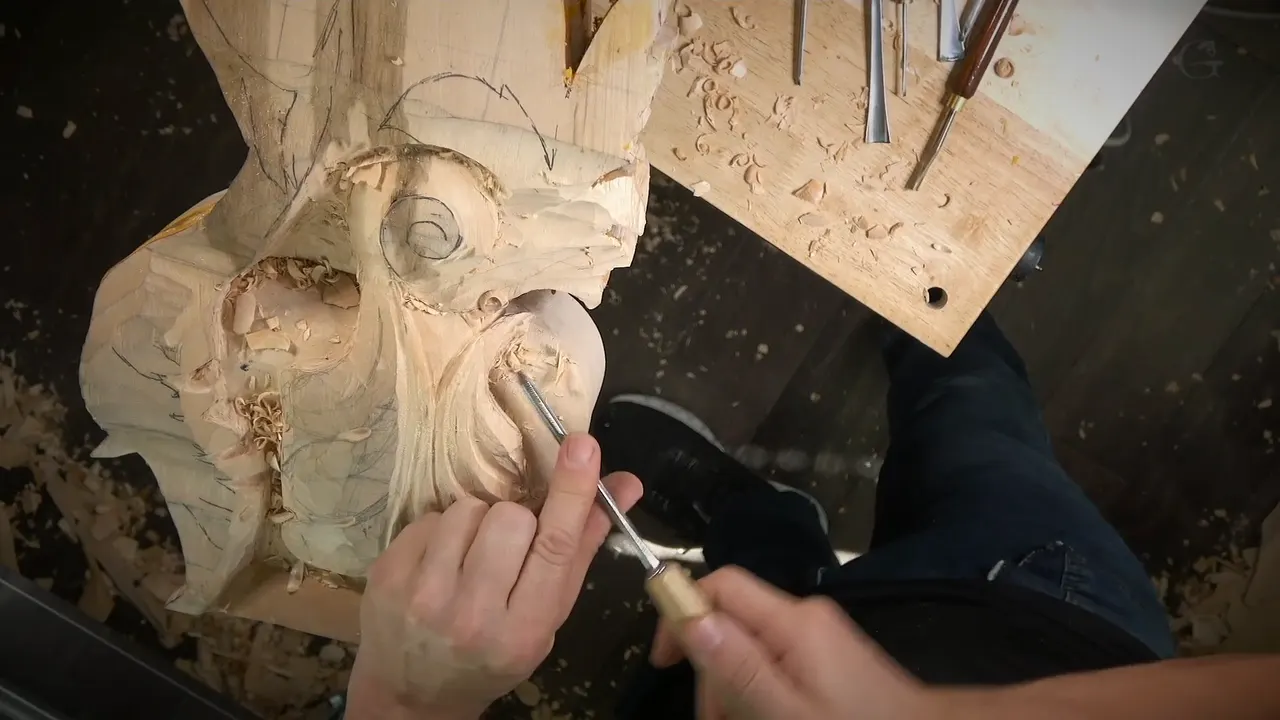

Part 12 of Venice Room 82 has me saying "maybe I have to switch to 2 millimeters" while I clean a surface. Other lessons follow it with tool names, depths, camera moves or waits.
Ever stood at the bench in wood carving, tool in hand, and not been sure the next pass was the right one? Ever lost sight of your own work in the lights? Then you know the spot where I say it. We start with part 12. Then we visit the lessons where I used those words again, and I give you what came next each time.
What did I say around that line in part 12?
The first words in the captions are "Here you go." and "And now I can clean it." My tool comes next, "And I'm going to clean it with number 11 again, and 3 millimeters." In inches that is about 0.12.
The next size comes in the same breath, "to 2 millimeters, and maybe one and a half millimeters later on." Two millimeters is about 0.08 in, and one and a half is about 0.06 in. My thought closes with "But for now, I'll just do 2 millimeters."

A bit later I describe the surface. "And I'm actually laying flat right on that surface also. So that surface is my guide." Soon after, "And yes, that shadow popping out right now. Really good shadow."
On the shadow, I tell you "I know you don't see that shadow yet. The reason why, because I've got lights from two sides, and if I turn this side off, you can see how deep shadow I just created." Next, "But now you don't see it. But here you go. That is the shadow."

After the shadow I carry on, "That is good. Let me blend a little more right here." Another thing I say is "And yes, I am cutting uphill, which I'm not supposed to. But that's okay." Another job is small, "So now I can undercut a little bit in this area."
I hold back on digging, because I am "not necessarily happy with the overall shape yet." My other plan is "So I might have to just refine a little more and roll it this way slightly." My verdict, "I should say it's okay, but not as nice as I wanted to see it yet."
Next comes a line about this separation. After that, "Now that is already showing up the form again. So I've got the middle ridge right here." And "You don't see it, but if it's in 3D, I've got not too smooth surface right here."

My plan for that surface is a rasp. "And again, let me take a rasp and just knock that down really quickly." Later, "So it's actually smooth right now. So just going really nicely downhill with the bumps." Then comes "Maybe a slight bump right here," and I say it again.
The last lines of the part are plans, and the first one is the letter S. "And what I want to do, I want to create the letter S curvature again, just like that. With number 7 and 14 millimeters, that's what I'm going to do." Fourteen millimeters is about 0.55 in.
The very end is "And let me remove it without forcing it. So use probably just number 11 again. Veiner. And little by little, I can get to that result."
Which tool comes after those words?
In part 3 of Venice Room 14, the line runs into "to one millimeter." Next I say "Actually, you know what? I could use just a straight tool. Don't really need to use a spoon gouge or spoon veiner I should say."
Then "So 1 millimeter, number 11." One millimeter is about 0.04 in. The result is "And yes, I got a kind of deep shadow right there. Really deep shadow."

In Lily Box 11, part 8, I am chamfering at a small angle. "I'm not hitting straight. I'm rotating my tool a little bit and trying to slice." The line turns into "switch and use the micro tools at some point."
Straight away I add "But so far, just because that back bend, I can reach really in those hidden spots."

Over in Venice Room 63, part 5, my words go on with "use a long bent." Then "Sometimes long bent helps a lot to hit those high spots." Next comes the tool itself, "Number four" and "Long bent."
A pass later I say "See, it's just really smoothly going up, and that's what I'm after." Then I talk about a "semi-final line, which is approximately about three millimeters away, one-eighth of an inch away from our initial cut."

How far does the next pass go?
Floral and Molding for the Panel 11, part 2, has the words turn into "excavate a little deeper right here." My reason follows, "Because I want to make sure it is sloping nicer. Or, has more 3D movement in it."
The other side gets a plan too, "another concave on the opposite side, but not as deep." Then "Although this one could be a little deeper."
A section in Venice Room 84, part 12, "still kind of doesn't make too much sense." My words lead to "just clean it, and then it's going to make more sense." Next come "some of the marks, like pencil marks." Then "blend little better."

Part 3 of Venice Room 47 has the line carry on into "create another concave, maybe I don't." A different thought comes, "But I think I should." Then comes a limit on the depth. The tool is a spoon, "going to use a spoon this case."
The same lesson has another, in part 4. I say "create concave maybe." Those words lead into "take this concave a little farther to create a better shadow casting." Afterward, "Clean little bit the edge of my previous one. And now it's much better."

Venice Room 91, part 8, is about going lower. My words go on with "actually lower that quite a bit because I have a main body really far." Another line of the same kind carries on, "actually just get rid of a lot of material and redo some of the concaves."
A lighter version sits in Venice Room 87, part 3. I am "not sure yet" whether to keep this part as high. Next, "lower that down. But I'll see." Right after, "I can always lower that down with no problem."

In Venice Room 62, part 2, I say "I don't want to go too deep because I don't know." I also say "But I'm still bugged." After "It just doesn't look too good," comes "just get this part going uphill and make this eye much smaller like that."
That lesson's part 9 is about what happens if I round this part, and about "that slope going up." My line runs into "probably create the inner barrel somehow inside."
What about the eye or the middle line?
Venice Room 69, part 9, is about deciding where "the middle line of this detail" goes. Right after those words comes "move this eye a little farther." I give it as "I think it's going to be better just slightly farther because I need to make the divisions on this piece."
I also say "And that eye was a little too close." The tool is next, "Let me get one-eighth of an inch again, number 11." That size is about 3 mm.

Look at Venice Room 79, part 9, where the line leads to "double-check where my middle is, which is somewhere right here." A little more, "So that is my middle center point."
The safe zone comes next, "So now I safely can outline everything," and then I give the depth. It is "That's about actually 10 millimeters, I'd say. Ten millimeters, it's the three-eighths of an inch." I end with "Really safe."

What if you cannot see the work?
Over in Venice Room 76, part 12, the line leads to "change the position for you to see what I'm doing because I'm carving right now on that side." Then "But let me check if I'll be able to get the position for you to see it."
I describe the setup of my vise. "If you look at that side, now I mounted my plate closer to the one side, and that gives me advantage, actually, to change the position, how I clamp my vice, the secondary vice, this vice." Then "And hopefully, you'll be able to see it."

At Venice Room 126, part 3, I hold off on one job. "I'm not going to undercut yet." I give the reason too, "I need to establish concaves and convexes on the main surface."
Those words lead to "turn my table." Why? "Just to reposition the camera where you would see those concaves and convexes." Last, "And yes, I think it's much better for you to see."

A check comes after that. "Let me double-check," then "check with my iPad drawing and see if I'm not making mistake how I want to do it. And yes, I do make mistake." Afterward, "Not a mistake, but it's a good idea to double-check. And I'm glad I did."
Light is another case, in Venice Room 63, part 9, where I say "I wish I have a lot more lights." My next words are "get a lot more lights." Then "so hopefully, I can see much better."
In Hashemi Flowers 47, part 9, I say "I don't want to face everything just one way because it's not going to look good." I mention "Again, that's against the grain." The words are followed by "change the direction how I make my cut."

Later in that part they come again, followed by "just chop off this edge but make that edge more wavy, just like that." Then "Okay, let me blend those cuts."
Carving Plate with Butterflies 5, part 3, has me name a knife after the words. They run into "change the angle of attack." Then "Let me get my knife and I'm gonna create little deeper cut underneath of my butterfly."

What if glue or a knot is in the way?
Furniture Panel 21, part 11, has "Maybe I should switch the spot I'm working on because, see, I just hit the same spot which I just glued." It runs on to "just wait until it dry and then come back."
I answer myself, "Why don't I do that?" Then I say "work on something else." And "We can establish really nice movement on that side, and then we can jump back."

Lily Box 10, part 12, has a scary one. "Kind of scary, because every time when I'm touching it, it moves more and more. And like I said, there is glue." Next in line are "break it again and re-glue it again."
I follow with "Well, it is what it is. What can I say?" The gouge comes next, "Let me use a small gouge and get number eight on inside." Soon after, "I will break it, and I will re-glue it. But let's move on this side, okay? So I'll do that off camera."
Carving Hazelnuts 3, part 1, is about a piece I may have to save. I say "So I have to somehow blend the whole thing." It goes on to "just chop the whole thing and just glue new piece on top and just redo that." Then "But let me try first saving it."
I add "Unfortunately, sometimes those mistakes, those errors happen." Later in that part I say it again, "Like I said, I'll try first saving it."

In Lily Box 6, part 11, I say what I see inside. "It looks like I've got a lot more damaged, not damaged, but knot on inside than I expected."
The line leads on to "redesign something in this area." My final thought is "I know lots of it is going to be covered with the flower, but still."

Where do these lines sit side by side?
Each row gives the lesson and part, what the words ran into, and a short second thought.
| Lesson and part | What the words ran into | Then |
|---|---|---|
| Workshop 82.12 | switch to 2 millimeters (0.08 inch) for now | smaller later |
| Workshop 14.3 | switch to one millimeter, number 11 | deep shadow |
| Lily 11.8 | switch and use the micro tools at some point | back bend |
| Venice 63.5 | use a long bent, a number four, for the high spots | smoothly going up |
| Floral 11.2 | excavate a little deeper right here, for a nicer slope | 3D movement |
| Venice 91.8 | lower that quite a bit and redo concaves | main body far |
| Lesson 69.9 | move this eye a little farther, slightly, for the divisions | eye too close |
| Lesson 126.3 | turn the table and move the camera | much better |
| Furniture 21.11 | wait until it dry and then come back | different spot |
| Lily 10.12 | break it again and re-glue it again, then a small gouge | number eight |
Where can you watch part 12 and the lessons on this page?
You can watch part 12 in Venice Room 82. Workshops 74 to 85 sit together in Venice Room Part 7. The other lessons on this page have pages of their own, linked above, and each one opens with school access.
Want to hear those words in my own voice, with the tool in my hand? This page starts you.
How it's done
- Pick a small veiner. Part 12 has me name number 11 first, and I say I am going to clean with it.
- Let the surface guide the tool. I called the surface my guide.
- Check the shadow. With one side of the lights turned off, you can see how deep the shadow is, I said.
- Blend, then undercut. Undercutting in that area was possible, and I did not want to dig in too much yet.
- Smooth with a rasp. My plan was to take a rasp and knock the bumps down really quickly.
Frequently asked questions
Which tool cleaned the surface in workshop 82, part 12?
Number 11, with 3 millimeters (0.12 in). I said I might go down to 2 millimeters (0.08 in), and maybe 1.5 millimeters (0.06 in) later on. Then came "But for now, I'll just do 2 millimeters."
What did I use as a guide in part 12?
Only the surface itself. A little later I said the shadow was popping out, and that it was a really good shadow.
Why could you not see the shadow in part 12?
Two sets of lights hid it, I said, and with one side turned off I could show how deep the shadow was. After that, "That is the shadow."
What to carve next