

Alexander Grabovetskiy, woodcarver, School of Woodcarving · Published 2020
What does a wood carver mean by "there you go"?
Quick answer: In Venice Room workshop 82, part 11, my marker came after I said I could roll a part a little, because it will be visible from below. Next I said "Okay, good." Other lessons of mine put a verdict or a measurement after it, and sometimes a warning.
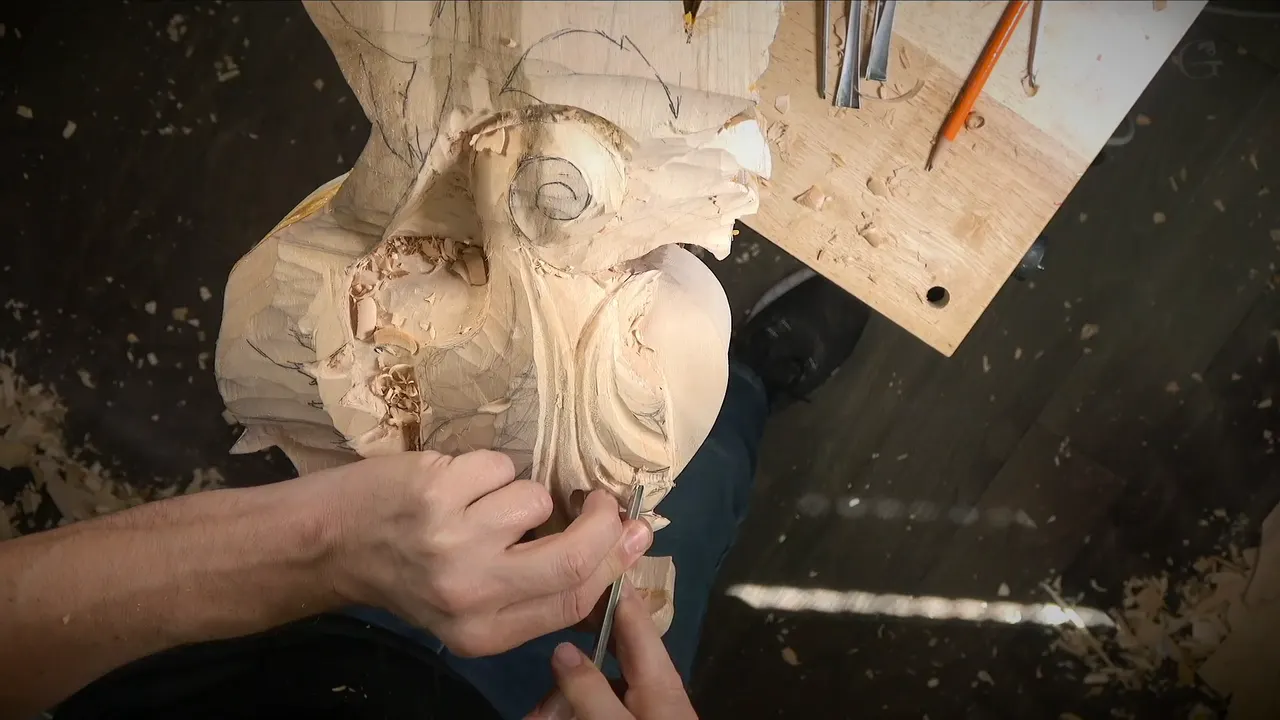

Part 11 of Venice Room 82 has me saying "There you go", and then I said "Okay, good." Across my other lessons I follow that marker with many things. Some are verdicts and some are depths in millimeters; others are tool numbers, plugs coming out, warnings to myself, or promises to blend later.
Ever finished a pass in wood carving and wanted to say out loud that it looked right? Ever wondered what a carver says next, once the tool leaves the wood? Many of these lines name a gouge by number. We start with part 11, then the lessons where I use that line again, with the words that followed it each time.
What came around it in part 11?
The part opens with a tool and a size, "Take number 11 and 3 millimeters and carefully outline it," which is about 1/8 inch. A plan comes next, and it stays a plan. "And I also could actually take this part and roll it a little bit that direction."
The view from below gave my reason. "Again, because it's going to be visible from below." I fixed my own wording with "I should say it's going to make more sense." Then my marker, and after it "Okay, good."

Two short jobs follow. "And get that separation pretty much right away." One more line comes after it, "And I can start shaping this area." Those lines do not tell what my hands did between the marker and the verdict, so this page does not guess.
What decision did I have to make in part 11?
Further in, I put a decision into words. "I need to make the decision what I'm going to do right here because I don't want to do something stupid." The other side of it came next, "But on the other hand, it has to look good." A loose idea closed it, "And maybe I can do something like that, which is going to create the movement uphill," and a postponement, "I'll leave it for now."

Height got its own note. "And by the way, it's little too high yet. I need to lower that down all the way to the quarter inch, even this section." I gave it in metric too, "To about six millimeters above the surface." A quarter inch and 6 mm are close, so the two figures agree. "That's what I need."
The separation came after that. "Here is my separation, and there's going to be somewhat deep cut, deep shadow." My plan for it was "Let me attack that right away," with "the number 11 and 3 millimeters, going to start."

I gave a reason for the depth. I did not want it too deep because I "still have to keep in mind how I'm going to finish it", and I also named the paint. The shadow stayed on my list, "But I still want to get some shadow. Okay? I still want to see some shadow."
How did I keep a surface flat in part 11?
The goal was to "make sure that is actually flat with that surface." I named the tool, "probably the best tool for it would be number one." After that, "Number one would be the best double bevel." A #1 is a flat chisel. Its bevel sits on each face.

The method was to lay the tool on the surface, "I can lay it right on a surface and create a rotating cut." My own motion came next, "make a slow motion, that's what I'm doing, okay?" Then my reason, "That way I know exactly it's laying right on top of..." and then "really at the same level, I should say."
A better tool came after that. "And also that is a double bevel, but a single bevel like this would help even better because you can lay it on a flat part and do exactly the same what I've just done, and that's not going to move anywhere from the surface." I closed the thought with "So it's actually a really good trick of a trade."

The last words in the captions are "So I'm just pretty much rising on top of that surface I created previously." Next door, part 12 opens close to my marker with "Here you go. And now I can clean it," and names "number 11 again, and 3 millimeters."
Is there a verdict after it?
Often there is. In Acanthus over Moldings 1, part 2, I said "That is probably good." A tool followed, a number 12 "and a smaller one, maybe about three millimeters" (about 0.12 inch), for a corner I like to call "triangle."

A short verdict sits in Venice Room 73, part 1, "So much better." Then an option, "And yes, I could give a small chamfer if I wanted to, which was really common also."
Another one is a marriage line, in part 2 of Venice Room 142. "Okay, here is my marriage line, and all I have to do, just blend in." Straight after it came "It's blended, and it does look good." I left one job for later, "And yes, I'll take care of this area a little later."

The longest verdict is in Venice Room 74, part 8, where I said "Really want to exaggerate that convex." The marker followed, and then "And that's beautiful and gradual. I don't need to do anything to it, okay? So it's already really nice."
In part 10 of that lesson the marker closes a sentence, "So here's somewhat like a result. A result of my idea. Okay? So that is exactly what I was imagining." Then came "It's change, actually." And "Change from the main design, what I designed previously." A job stayed open, "I still have to, of course, work around this area, kind of looking rough."
In part 7 of Lily Box 10 I had said "So just cut straight down like this." Next came the marker and then "That is my heart." Doubt followed right behind it, "But I doubt I'll be able to bring everything because it was an angle, and I tried to position that correctly."

Which numbers come next?
Often a number comes next. One sits in workshop 73, part 5, and my words were "How deep I've got? Let me see." Next came "About 10 millimeters or so. That's what I've got inside, okay? Ten millimeters deep." That works out to about 3/8 inch. I added "I could go deeper, but do I need to? No, I don't need to."
Look at Venice Room 111, part 3, for a bigger plan. "I am really deep, but I can take smaller now, like a quarter-inch number nine, and in this case, it would be six millimeters." Quarter inch and six millimeters name the same width, 6 mm, and I added "And get my plug even deeper."

Next comes a center, in Venice Room 134, part 3. "Right now, the center is approximately five millimeters or so." Five millimeters is 0.2 in. My words on size were that I could go "about quarter inch" (6 mm).
A miss shows up in Venice Room 160, part 2. Before it came "Overall movement." Then the marker, and "I'm about 16th of an inch off, okay?" In metric, 1/16 inch is about 1.6 mm. What it meant for the piece came next, "And for the molding, it's big. That would be unforgivable mistake."

The word "line" follows it, too. Take Venice Room 79, part 9, where "I've got right on the line" with my marker in that sentence, and later "I am right on the line now." For Venice Room 85, part 11, I called the piece "my corbel" and said "I left approximately one millimeter to the line." One millimeter is about 0.04 inch. Next, "And then get number three and clean a little more."
Which tool do I reach for next?
It is a number in Venice Room 112, part 2, and the line is short, "Number seven." My plan after it was a "letter S curvature." A close cousin sits in part 12 of workshop 82, "And what I want to do, I want to create the letter S curvature again, just like that."
Back in Venice Room 34, part 7, the next words were about blending, "I have to blend this part. Otherwise, it's not going to look organic." The tool was "just number three, by the way." It was a spoon number three, "and that's one inch, 25 millimeters approximately."

Sharpening is the job in Venice Room 69, part 6. Before the marker I said "And I need to use a different paste" and "A finer one." After it came "Let me take again on the 6,000" and "And I can pretty much remove all my wire edge like that."
Then there is Venice Room 159, part 2, where "I want to be safe than sorry." comes before the marker. Afterward I said "Let me do this side. A straight down cut." Short lines followed, "So now it is enough," and "Now I can take probably number one."
Does a hole or a plug come next?
In Lily Box 10, part 6, the line is "And I got that hole all the way through." I moved on to working around that hole. A crack was still there, "Although there is some crack on inside of the wood."

A plug comes up straight away in Venice Room 122, part 1, "Remove the first plug." I told the viewer something. "And I'm not sure the camera shows that or not, but it's already much darker shadow. Much, much, much darker shadow." I added that I was happy.
Venice Room 63 opens part 7 with it, and the next line is "I've got plug out." Then "See, it just gives me beautiful shadow. Really deep shadow."
Going underneath was the plan in Venice Room 64, part 12. Then came my own caution, "I have to be careful because I am working along the grain. So grain runs that direction." Then "I guess I've got really deep already." It was time to remove that plug, I said, "See?"
The same workshop has one in part 7, where I say I am through, "See that?" and then "So now it's just everything going to go through that same hole."

What warning comes after it?
At times. The words after it in Venice Room 24, part 9, were "I've got the extra notch. Just extra detail." A warning came next, one I gave myself, "But that is indication I have to be really careful what I'm doing, okay?" The reason was "Which means I'm probably rushing too much when I'm grabbing my tools," and the last line was "I have to slow down a little bit."
Shorter lines sit in Venice Room 85, part 8, "I almost made a mistake." Then once more, "Almost made a mistake." Then "And I kept the line."
A plan comes before it in Venice Room 119, part 3, "And carefully establish my cut." After it, "I don't want to rush anything." And "Really important for me not to rush it."

Venice Room 37 sends me to look from a different place, in part 5. After the marker I said "Again, double-check from below how it looks from this point." The reason was "It's important not to lose the overall feel," and then "It looks like I should take out a little bit this way." Below is the same view I spoke about in part 11.
Is there a promise to blend later?
It shows up in Venice Room 158, part 3, "Obviously, I have to blend a little later. I have to take out this ridge and blend the whole section." Then "But I am happy with the overall movement."
The same workshop has more of them. One is "And yes, I can always clean between those two pipes," from part 9. Another is "And I think I could roll it even more right now," from part 6. A third, from part 2, is "Now it's clean," followed by "And I can develop something now with that."
Do I say it to the viewer?
Sometimes the lines after it are for you. One lesson, Venice Room 57, part 9, has me saying "I apologize that you don't see it, but here. See?" Then "All I'm doing actually, just getting rid of this groove."
One more sits in Venice Room 75, part 1, with "And let me make that quickly." Then "So it took me literally just about 30 seconds."

Where do these lines sit side by side?
Each row below gives the lesson and part, what came right after my marker, and a short second thought.
| Lesson and part | What came right after the line | Next thought |
|---|---|---|
| My part, 82.11 | okay, good, then the separation right away and shaping the area | my own part |
| Moldings 1, part 2 | probably good, then a number twelve and a smaller one | a triangle |
| Room 73, part 1 | so much better, with a small chamfer as an option | if I wanted |
| Lesson 142, part 2 | it is blended and it does look good, with a concave coming | marriage line |
| Venice 73, part 5 | how deep I have, about 10 millimeters (0.39 in), and no need for more | deeper, no |
| Room 160, part 2 | about a 16th of an inch (1.6 mm) off, and a big molding | unforgivable mistake |
| Lesson 112, part 2 | number seven, then a plan for that curvature | a short line |
| Lily 10, part 6 | a hole through the wood, then work around it and a crack inside | work around |
| Workshop 63, part 7 | I've got plug out, then beautiful shadow | deep shadow |
| Workshop 24, part 9 | an extra notch, then a note to slow down, probably from rushing | slow down |
Where can you watch part 11 and the lessons on this page?
You can watch part 11 in Venice Room 82. Workshops 74 to 85 sit together in Venice Room Part 7. The other lessons on this page have pages of their own, linked above, and each one opens with school access.
Want to hear the line in my own voice, with the tool in my hand? This page starts you.
How it's done
- Outline with a small tool. Take a number 11 of 3 millimeters (0.12 in) and carefully outline it, as part 11 begins.
- Check the height. I said a section was a little too high yet and I needed to lower it to the quarter inch.
- Watch the shadow and the finish. I wanted the separation deep, but not too deep, because I still had to keep in mind how I would finish and paint it.
- Lay a flat tool on a surface. The tool was a number one, a double bevel, laid on the surface for a rotating cut. A single bevel would help even better, I said.
- Listen for the line after my marker. In other lessons I followed it with a verdict, a depth or a tool.
Frequently asked questions
Which tool outlined the shape in workshop 82, part 11?
A number 11 of 3 millimeters (0.12 in). Later I named a number one, a double bevel, to lay flat on a surface, and then a single bevel as an even better choice.
How low did I say to carve a section down in that part?
To the quarter inch, which I gave as about six millimeters above the surface. A quarter inch is 6 mm, near enough.
What was my plug line in workshop 63?
In workshop 63, part 7, I said the plug was out, and then it just gives me beautiful shadow. Really deep shadow.
Did I warn myself after that line?
What to carve next