

Alexander Grabovetskiy, woodcarver, School of Woodcarving · Published 2020
What does a wood carver mean by "texture"?
Quick answer: "Texture" is a word I said in Venice Room 82, part 6, about a surface that would be painted. I still expected brush marks because I would use chalk paint, which would give me some texture anyway. Then I said "I guess I can do that."
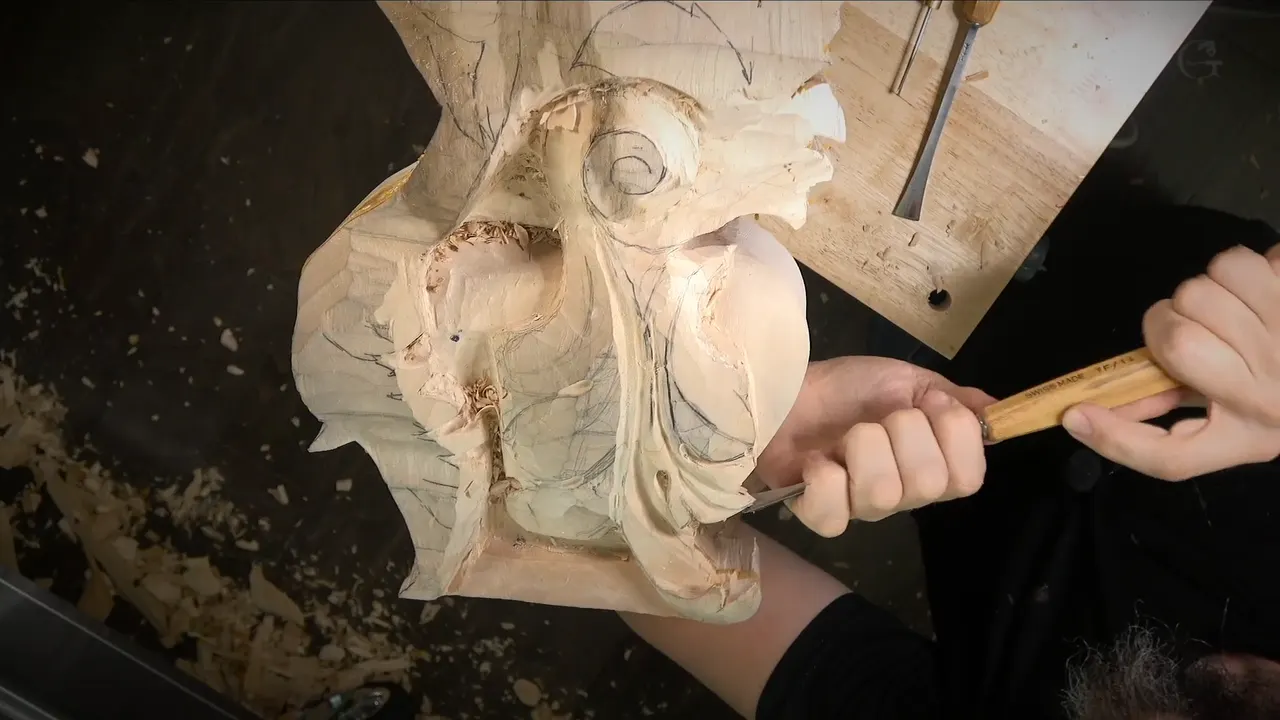

"Texture" is a word I said in Venice Room 82, part 6, about a surface that would be painted. My other lessons use it for punched backgrounds, gouge strokes and a powder called Flock-It.
Ever carved a surface until it felt smooth and then wondered what a coat of paint would do to it? Did you ask yourself whether a thick coat would hide your work? Walk through part 6 with me first, then through the lessons where I use the same word.
What was I doing in part 6 before I said it?
The part opens with "There you go." Next came "I think I could roll it even more right now." On my knees ("And yes, I am on my knees working. In that position."), I planned to roll it. "And let me roll it."
From above you really don't see that roll, I said, but from below it will be really visible. It "really creates beautiful detail."

Which separations did I plan?
Next I said "now I can work on this movement" and "I can always do something nice right here, too." Separations were on my mind. I needed to create some, one "down below, which you don't see," and one "right here." After that came "that separation can be a little higher."
Later came "And let me refine that detail." The idea, I said, was "just to create that curvature which you saw previously on my pattern." Then a second plan: "Let me create a second separation. Again, relief cut. Really important to create those reliefs." I closed that run with "And here you go. So that is somewhat what I want to see."

Which tool could shape the surface?
Rifflers. My words were "I could leave it like that or just use, again, just riffles or rifflers just to create nicer shape," and I added "just because it's a paint grade." My guess was "I can just probably shape it really nicely," and "create beautiful transition."
"Just like that," I said. "I think it looks good." And I said I would probably use "a lot more of those rifflers."

Which line in part 6 holds the word?
The line came next in the part. About the coat, I said it would be "brushed on with a really thick paint, and I'm still going to have brush marks because I'm going to use the chalk paint, and it's going to give me some texture anyway."
A question followed: whether to "leave some texture right here on the surface?" My answer was "I guess I can do that." Then came "here we go. This side also," and "I kind of like that."

How did part 6 end?
With rifflers again: "See? With those rifflers, or whatever you call it, I can take out the high spots and create beautiful form." The part closes on a slip, "Although, I just damaged the edge, which I shouldn't."
The clips on either side say little about paint. Part 5 ends on "So let me undercut underneath right here," and part 7 begins "And I don't know if I like it or not." The word texture appears in part 6 and in neither of its neighbors.

Where else do I use the word?
My other lessons use it for other jobs, and each passage below names its lesson so you can open that lesson and listen for the line yourself.
Is chalk paint in other lessons?
Once I apply paint, I said in part 5 of Venice Room 74, it will look really awesome, and in my case it will be more like a chalk paint. I called that "also really true to the European culture." The next line: "So they paint it a lot with just a chalk paint."
Floral and Molding 13, part 1, is about a project that goes inside a room, and I said it "will be painted," with "that's not just penetrating paint." It is chalk paint, I said, "which means a lot of those facets, what you see, will be completely covered with the paint." Further on: "those facets I don't really need to clean too much."

I praised the paint itself: "I really like how the chalk paint looks," and I called it "really matte," with "absolutely no sheen in it" and "just really chalky."
Chalk in Europe came up too. "You go to Italy, doesn't matter where you go to in Europe." I also said "The whole houses were covered pretty much with the chalk." And today's chalk paint has "some additives."
What does a punch do to a background?
The lesson Dotted Background Texture starts with a match: "original piece has texture on the background, and I need to match that texture." About furniture: "it's a common thing actually in the furniture carving." It is "not used as much in the architectural carving, but in the furniture-style carving, it's used a lot."
On tools, a regular mallet was not in my plan for the background. My main punch measured "about 5 millimeters" (0.2 in), "so 3/16." With no bought set, "you would just take a piece of thick nail, grind it flat like this, take a file, and make a series of cuts with the triangle file to create the pattern." Placed against my carving, it "actually created the texture."

Chamomile and Bow Rosette 4, part 3, opens on the same job: "Now what I would like to do is just give a texture to my background that's going to pop." The piece before it had "a textured background," and I asked you to see how big a difference it creates. "Huge difference." I planned punches, and said "I always use just a hammer, just a normal carpenter's hammer."
In Venice Room 93, part 12, I said "Mallet is not good idea. Use a hammer." While punching, I said, "I'm actually making rotation movement, okay, just to get my pattern different directions." It gave me, in my words, "a really beautiful textured background."

Where did a texture let me skip a clean-up?
A lowered background in that same part got this line: "I didn't really worry about make it super clean because there's going to be a texture." For that texture I planned "the same punches what I used previously."
Lesson 93, part 9, adds a shorter line about loose chips: "All I have to do just to blow a little bit and just remove some of the chips." In this case there will be texture, and "the texture going to take care of all the fuzz and so on."

Over in Venice Room 90, part 7, I said I could get my finish "almost like I sanded that with a 4,000 grit." I said it would turn out "nice and smooth and shiny." Next: "I don't need it, by the way, because I'm going to have a texture on the side. But at least I know there is a really nice surface without any valleys or hills."
Workshop 139 of the Venice Room, part 3: "I could spend a lot longer, definitely, and just to get that to the perfection, but I really don't need to. Reason why, because I also want to texture it, okay, inside of here, same like what I did right here, by using my punch."
How it will look, I said: "when I going to texture it, it's going to look more realistic, I would say." Later: "the texture what I've done, it just blends those designs together." And "So the same texture goes inside of this flower."

Can gouge strokes make a texture too?
Byzantine Acanthus 10, part 3, I planned "to give a texture to that background," marked in pencil, "all the way to those marks." One spot would stay flat, and that is where the glue would go: "the only part that's going to remain flat."

On the tool I said "you can do with just a number nine, either a small one or bigger one, it's up to you. Or even number seven if you wish." My own plan: "I want to just run across some stripes, some cuts."
A rule on direction followed: "it's a good idea to attack from the edge toward inside." Otherwise, I said, it catches the edge and the grain. It does not look as nice. I also said you could use "a different species of wood, like a darker wood, like oak or cherry." Trying it against the grain gives "a nicer texture," I said, and I added "stay just perpendicular to the grain."
Maine class 6, part 2, sets the size of the strokes. "For the texture, I'm not gonna go too crazy." A number seven came up, and 14 millimeters (0.55 in), "not as deep as what we did last year."

Strokes of "no more than quarter inch" (about 6 mm) were "the texture step number one." To soften it I could take "number two." My words: "I want to soften that texture." Some of it would still show, but "not gonna be as pronounced." And "It's not going to look as busy."
Almost flat was possible, I said, and "it's still gonna show the tool marks." And "it's done by you know by hand." Then "if you like it you can do it if you don't like it. You don't have to do it."

Is there a texture I do not want?
In Maine class 12, part 1, I spoke of "those separations and those triangles." Next: "Obviously, I don't like the texture of it. It doesn't look good." My plan was "same number five what I use previously to clean up that area. And carefully carefully."
Maine class 14, part 2, is about a background: "You don't want to damage that background unless if you want to texture it, but if you're not planning to textured" and "don't mess this up."
What do a roll and a powder add?
Venetian Flowers Rosette 6, part 2, is about a roll: "I can get an angle right inside of the undercut and create some texture right there." Texture there would "separate that even better," I said. The process is "really noisy." For striking: "Just make sure you don't use a regular mallet," and a hammer was my plan.

In Rosette 5, part 3, texture was a plan too. And Rosette 2, part 3, about the flowers: "if you look inside, I used some kind of texturing," with "just the texturing punch." That texture would also give "some realistic look," I said, "even if it's a stylized composition."
Lily Box 13, part 10, has a powder: "it's called Flock-It. Okay? And that's just going to give me really nice texture, like felt on inside. And, yes, that is just a powder." The glue is "a really thick glue," and "I don't worry about brush marks or anything." It would look "like a felt material."

Two short ones. Venice Room 102, part 8: "Not really deep, just to give some texture." Part 7 plans "cross cuts like this" for "some kind of texture." And in Furniture Panel 17, part 4, certain areas would get texture later, which I said would be "even more distinguishable."
What separates brush marks from tool marks?
In the Dining Table Apron course, workshop 8, I said a tool leaves marks "like a paint or brush marks," though they are tool marks and not brush marks. On sanding: "That's why I don't use any sandpaper and I'm leaving just out of tool because you can see that piece is unique."
Modern Acanthus 7, part 1: "for me when I see a brush mark, it looks better." I added "the light going to hit from different points and it's gonna present different look."
Hashemi Flowers 24, part 1, is about fine art: "the fine artist, he leaves his marks, the brush marks and so on, and it's considered as a piece of art. Same applies to this type of work."
The same word in one place, one lesson in every row
| Lesson | What the texture does in that lesson | My tool |
|---|---|---|
| Venice 82.6 | A surface headed for thick chalk paint | My rifflers |
| Chamomile 4.3 | A texture so the background will pop | A hammer |
| Venice 93.12 | A background I did not make clean | Round punches |
| Venice 93.9 | Loose fuzz that the texture takes care of | A blow |
| Venice 139.3 | Designs that the texture blends together | My punch |
| Byzantine 10.3 | Stripes across a background, working edge inward | Number nine |
| Gibbons 6.2 | Softened so the texture looks less busy | Number two |
| Gibbons 12.1 | Separations where the texture did not look good | Number five |
| Venice 102.8 | Shallow strokes across to give some texture | A straight tool |
| Rosette 6.2 | A roll that reaches inside an undercut | A hammer |
| Lily Box 13.10 | A felt material look from a powder | Thick glue |
| Apron workshop 8 | Tool marks that are not brush marks | No sandpaper |
Wikipedia has pages on a few tools and materials behind these lessons: gouge, wood carving, woodworking, mallet, hammer, chisel, rasp, sandpaper, chalk, paint, paintbrush, felt, grain and furniture.
Where can you watch these lessons?
Venice Room Part 7 holds workshops 74 to 85, and part 6 sits in workshop 82. The other lessons live in the Dining Table Apron course, Hashemi Flowers, the Furniture Panel course and the Lily Box course. Is there a surface on your bench that a coat of paint will change?

How it's done
- Roll the surface. I said I could roll it even more. The roll would be really visible from below.
- Create the separations. I needed some separations, one down below and one right here, a little higher.
- Refine the detail. My plan was to refine the detail, with the curvature from my pattern and a second separation as a relief cut.
- Reach for rifflers. I could use rifflers for a nicer shape, and I called the piece a paint grade.
- Think about the paint. Brushed on really thick, the paint would still show brush marks, and I planned chalk paint.
- Leave some texture. I asked whether to leave some of it on the surface and agreed with myself.
Frequently asked questions
Which paint did I name in part 6?
A really thick coat of chalk paint, with brush marks I still expected. Earlier in the part, when I spoke of rifflers, I called the piece a paint grade.
What were rifflers for in part 6?
A nicer shape, a beautiful transition and the high spots. The surface could stay as it was, I said, or take rifflers, and I planned to reach for them again. With them I can take out the high spots and create beautiful form.
Which tool strikes a punch when I texture a background?
In Chamomile and Bow Rosette 4 I planned punches and a normal carpenter's hammer. Mallets were not a good idea in part 12 of Venice Room 93, and a hammer was. My main punch in Dotted Background Texture was about 5 millimeters (0.2 in).
What to carve next
- Venice Room 82
- Venice Room Part 7
- Venice Room 74
- Floral and Molding 13
- Dotted Background Texture
- Chamomile and Bow Rosette 4
- Venice Room 93
- Venice Room 90
- Venice Room 139
- Byzantine Acanthus 10
- Grinling Gibbons Maine 6
- Grinling Gibbons Maine 12
- Grinling Gibbons Maine 14
- Venetian Flowers Rosette 6
- Venetian Flowers Rosette 5
- Venetian Flowers Rosette 2
- Lily Box 13