

Alexander Grabovetskiy, woodcarver, School of Woodcarving · Published 2020
What does a wood carver mean by "a nice look"?
Quick answer: In Venice Room 82, part 7, I named a plug cut that I could take through, and said I would need a number nine, only about an eighth of an inch (3 mm). The result I named in my words was a nice look.
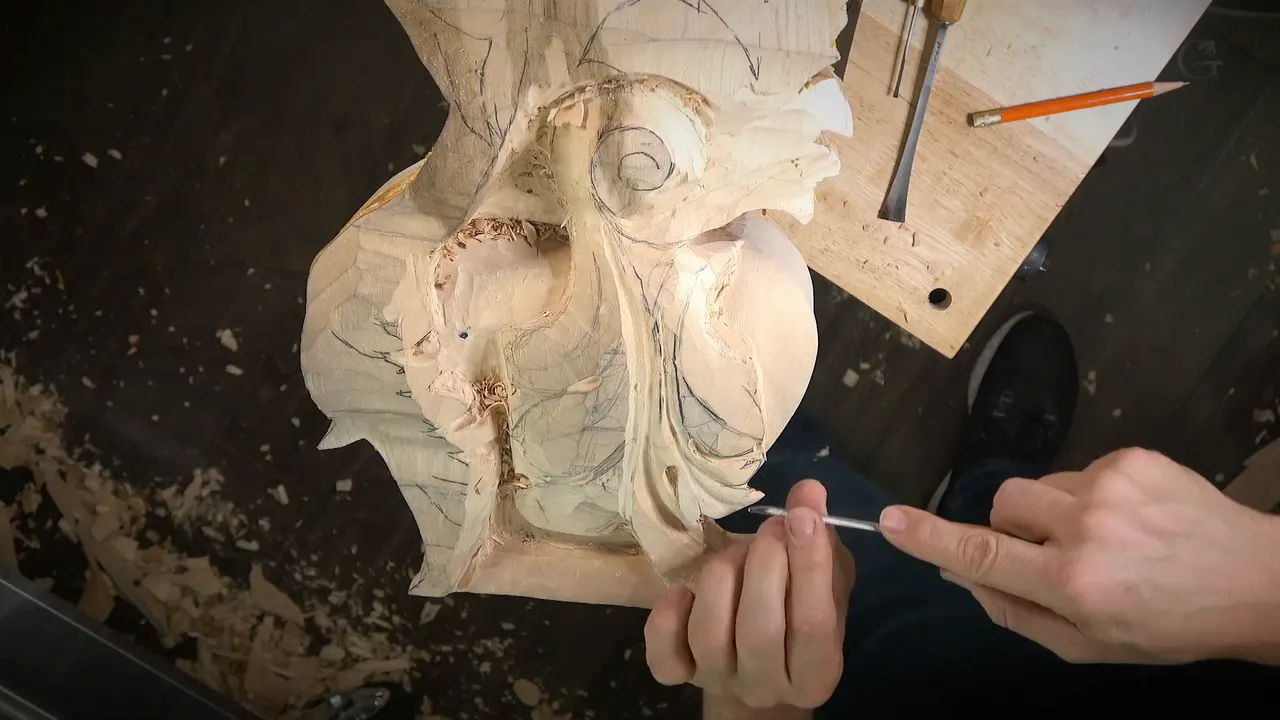

"A nice look" is a phrase I used in Venice Room 82, part 7, about a plug cut. Part 7 is short, and my other lessons carry the same two words.
Ever looked at a half-carved piece and not known yet whether you like it? It opens on that doubt. Walk through it with me first, then through the lessons where I use the phrase.
What was I looking at before I said it?
In my own words the part opens on a doubt: "And I don't know if I like it or not." A plan comes next, "Let me actually do prolonged cut right here." After that, "I think it's looking more or less uniform."
More of that cut was on my list: "I can also create prolonged cut in this section and this area, too." My verdict came next. "that's looking not bad at all." And "It's going to look really good once it's done, I know for a fact."

A need followed. "Okay, so now I need to take care of this transition, make it look nice, but I don't like how it feels, overall movement downhill." The fix was "So I have to take the high spots and make it more uniformed downhill movement." I closed that run with "I'm talking about 3D movement, okay?"
Which tools came before the plug cut?
My need was "probably number seven from this point on." Two maybes followed, "Maybe another movement" and "Maybe even bigger, just like that." The plan went on: "And another one right here, and I can expose this and make it look really, really, really, really nice." The reason I gave was "that way, I will reveal that main body form, okay?"

"I'll take number 11 again." About the size, "in this case, it's a 7 millimeters, number 11," so 0.28 in. A limit came with it: "And I have a mark below how far I can go. So I don't want to go too deep." After it, "let me get little smaller tool."
Which line holds the phrase?
This one: "Okay, this way," and then "I'm going to create a plug cut, and I could actually do all the way through." Right behind it comes "Okay? That's going to give me a really nice look."
For that cut I said I would need "only about eighth of an inch, number nine," about 3 mm. I closed that thought with "And I hope you already know what is plug cut."

What happened once the hole was made?
The line before it was "Get little closer to the final shape." Further on, "I do have a line right here, and now I can plug cut it." Later, "There you go. I'm all the way through. See that?" And "So now it's just everything going to go through that same hole."

Near the end came "let me get 1 millimeter" (0.04 in) and "And now you can see that creates beautiful, beautiful shadow." What was left, in my words, was "just refinement of the main movement and then undercutting." Of the undercutting, "I'm going to do off-camera," and "I'm not going to change the main movement." My last plan came with a "maybe": "a concave cut," just there.

How did the parts nearby sound?
Over in part 6 comes "I think it looks good." Part 8 begins "And bring it really close to the main body," and then "Let me give you a really good shape of this one." It also has "this one has a really nice and beautiful movement, I think." Later, about a movement, "it has to look really uniform, okay?" The two words I am following do not appear in either part.
Where else do I say it?
The other lessons use the words for other jobs, and each passage below names its lesson so you can open it and listen for the line. The Furniture Panel course comes first, with several parts.
Can the back of a tool give a nice look?
In Furniture Panel 19, part 9, I said "I'm using just the backside of the tool, by the way." It gave "a really clean cut," and that "all depends on the direction of the grain, how you're using your tool."
At a second spot the payoff I named was "nice look." The cut was meant to go almost to the background, and I said "I want to make sure it looks real organic."

Does a small undercut still pay off?
Its part 10 has "it's actually half a millimeter. It's a really, really small spot, but I still do undercut because it gives me extra shadow" (0.02 in). I also said to "use, again, the number seven and bring it to the point." A corner came next: "maybe I don't like how this one ends," and "I think I can just kind of chop a little bit this corner."
Of that corner I said it would give "a really sharp and nice look." For the camera I planned to "place my hand, so watch this area right here." Then "See how it creates that beautiful shadow casting?"

Can one cut shape an acanthus?
Furniture Panel 21, part 3, is a lesson about acanthus. The words were "Maybe cut this way also." That cut would bring "a really nice transition for this acanthus." I could go "actually" nearly the whole way down, I said, then "Small, but still beautiful."
A bit of paper stayed: "I really want to keep that as a high point." The plan was "an extra separation cut" with a "half a millimeter cut with number 11 to give that a little bit of shadow" (0.02 in). After "wonderful" came the need for "an even smaller tool," then "Maybe number 5 in 3 millimeters" (0.12 in).

How deep can a separation go?
In part 6 of Furniture Panel 20, I wanted to separate a movement from a stem: "just make a separation cut with the number 11." My thought was "I guess I could go really deep." Nearly to the bottom was possible, I said, "because I want to develop really a heavy detail right here."
A "nice look" was the payoff, I said. A knife was in my plan too, to "go downhill like that, gradually moving down." And "It's not the final stem yet, okay? Please don't get me wrong."

Is a small concave worth it on a tiny detail?
Next in that lesson, part 7 has "I kind of like the movement right here, but I would like to probably give a small concave to that detail." Next, "I don't have to." The concave, I added, "just gives extra detail."
After the cut I called it "a really small detail" that still gave a "nice look." An undercut was planned, "use number 11 and laying on just one side." For it I said "really nice flipping over feel."

Can I carve when little wood is left?
From Venice Room 47, part 6: "I've got only maybe five millimeters left in this spot, so I can't go beyond that point," or 0.2 in.
"that would be probably little bigger division right here," I said. I tied it to a "nice look," and "round this way" was my next phrase.

Can a deeper cut and a smaller tool help?
Back in Venice Room 11, part 11, I said "now I just created a small separation, of which I need to make sure it looks organic in overall design, okay?" Then came "And I can create a little deeper cut." About the cleanup before it, "That way I can see exactly what is going on."
Next came "The 1 millimeter" (0.04 in), to "create that cut even deeper right there." What it would do, I said, was give "extra pop." My next thought was "maybe I can continue this cut a little farther."

When is a shape good but not finished?
In Venice Room 90, part 2, I said "That is good, but it's not the final look yet, okay?" The tool I planned was "a small, like a quarter-inch number five," about 6 mm. Its "profile" already gives me a "nice look," I said.
Before that I said "What I can do, I can create small separations like this to give an extra something." A curve came next, and I said "I'll use upside down my tool and create that curvature." I added "it is always following curvature of the middle line."

What changes when the shadow is seen from below?
Workshop 97 of the Venice Room has, in part 7, "especially the light source is going to strike from this side, from above." Then "So I'll take number 11 again and 5 millimeters, 3/16 of an inch and start," and five millimeters is about 0.2 in. I would start with "just outlining."
A warning came with it: "it's going to be visible from bottom." Going too deep would leave me "hard for me to create nice look underneath."

Why put a chamfer beside a concave?
Lily Box 6 has this in part 6: "I really love the result of it." Of the result, "Really nice and beautiful look," and "It just really gives a three-dimensional look."
Then I said "I could create actually extra detail" and "I can actually chamfer this side," a chamfer that would give "extra dimension." On the opposite side, "I'll do the concave," with a "nice look" as the payoff, and "Small detail, but still, for people who do know about how it's supposed to look, I'm talking about the volutes."

What can an undercut do?
Lily Box 8, part 8, has "I like the overall movement. I don't really want to knock too much out. But what I could, I can actually take advantage of this and create really deep undercut and cast really good shadow."
The result I named was "a nice look." Then "Let me use a one and a half millimeters, number 11 at first" (0.06 in). Later, "Beautiful three-dimensional effect."

Can cutting against the grain be the only way in?
Maine class 16, part 3, has "yes, I do know that I am working against the grain but I have no other position like an attack." And "that's the only way I can do it."
About a tiny flower, "I think it's gonna give me really nice look." Later, "a dark spot. Really good separation between those two parts."

Can a flower get a nice look from a wave?
Maine class 4, part 3: "if you will do some waviness, it will be more natural look - organic look." The cuts I planned were "#9- 10mm" and "#7- 14mm" for the petal, which makes 0.39 in and 0.55 in. About a wavy flower, "it will give us a VERY nice look." Then "Makes sense so far?"

What if the wood is a little weak?
Next, Grape Onlay 5, part 3. The undercutting would start with "number 11, but I'll get two and a half millimeters" (0.1 in). "This part is somewhat weak," I said, and "you gotta be careful. But I like that." Here the words are "good look."
Then came "I'll use a smaller tool, two millimeters" (0.08 in) "and I'll go little by little." Earlier, "Again, please don't rush it."

The words in one place, with one lesson in every row
| What I said would give it |
|---|
| A plug cut taken through (Venice 82.7) |
| The back side of the tool, running toward the background, at a second spot where I said it would look real organic (Furniture 19.9) |
| A chop I planned at one corner, for a sharp and nice look (Furniture 19.10) |
| Down near the bottom, a deep separation cut for a heavy detail (Furniture 20.6) |
| A small concave on a small detail (Furniture 20.7) |
| Running down a scroll, nearly the whole way down, beside a bit of paper kept as a high point (Furniture 21.3) |
| Where only 5 millimeters (0.20 in) were left, a bigger division (Venice 47.6) |
| Going a little deeper, then a tool of about 1/25 in (1 millimeter) (Venice 11.11) |
| Its profile on a small number five (Venice 90.2) |
| An outline, not too deep, with light from above (Venice 97.7) |
| A chamfer on one side and a concave on the other, for people who know how it should look (Lily 6.6) |
| Casting a good shadow, a deep undercut (Lily 8.8) |
| A tiny flower and a dark spot between two parts (Maine 16.3) |
| A wavy flower, with cuts toward the center (Maine 4.3) |
| An undercut with a number 11, which I said would give a good look (Onlay 5.3) |
Wikipedia has pages on a few of the things named above: gouge, wood carving, woodworking, shadow, chamfer, grain, knife, volute, grape and corbel.
Where can you watch these lessons?
Venice Room Part 7 holds workshops 74 to 85, and part 7 sits in workshop 82. The other lessons live in the Furniture Panel course, the Lily Box course, the Maine class and the Grape Onlay course. Which cut on your bench would you like to see looking nice?

How it's done
- Start with a doubt. I did not know if I liked it, and then I planned a prolonged cut.
- Fix the transition. I needed to take care of the transition and take the high spots for a more uniformed downhill movement.
- Name the tools. I needed probably a number seven from that point on, and I planned to take a number 11.
- Plan the cut. I named a plug cut and said I could take it through.
- Pick the number nine. My tool for the plug cut was to be a number nine.
- Look at the shadow. Once the hole was made, I named a smaller tool and said it gave a beautiful shadow.
Frequently asked questions
Which cut did I tie to a nice look?
That plug cut, which I could take through, would use a number nine, I said.
What did I plan for the undercutting in part 7?
I planned to do it off-camera and said I was not going to change the main movement. My last plan, with a maybe, was a concave cut right there.
Which tools did I name in part 7 for the first cuts?
A number seven was my need, probably. Later came a number 11, which I gave as 7 millimeters (about 0.28 in).
What did I say about the shadow in part 7?
What to carve next