

Alexander Grabovetskiy, woodcarver, School of Woodcarving · Published 2020
What does a wood carver mean by "fasten"?
Quick answer: In part 1 of workshop 84 I planned to change how I fasten it, and then I said it was "much better for me" from that position. Elsewhere in my courses the word goes with a corner vise and screws, clamps, double-sided tape, a plywood backboard and a handle on the piece.
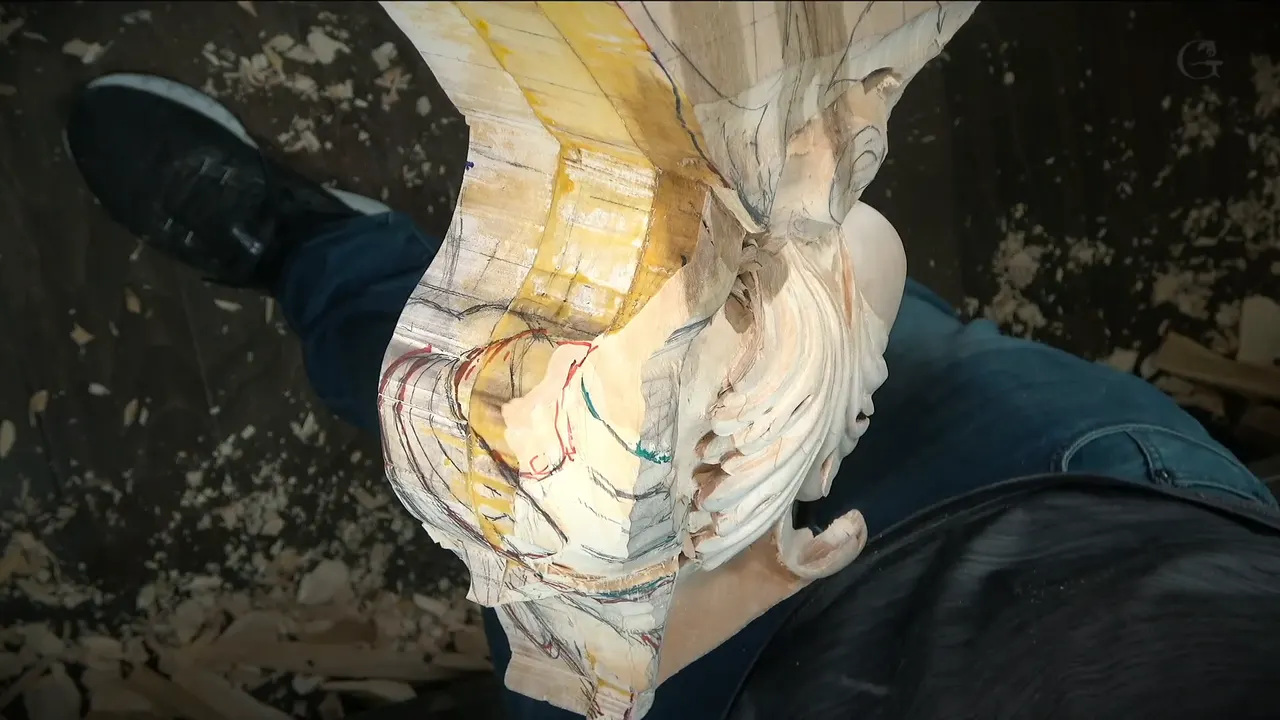

My hold on the piece was not convenient, I said in workshop 84, part 1, and I planned a change. Then I said the position was much better. The same word comes up in my other courses with a vise, screws, clamps, tape and a backboard.
Have you ever set a piece of wood down and known the spot was wrong before the first cut? The video from workshop 84, part 1, comes first on this page. My other courses come after it, and each one says how I held my work.
What was I doing before I changed my hold?
The video opens mid-thought. I had to make "this side also a little more going down to the corbel," and then I fixed it: "Not the corbel, but to that main body. But not now." Then came "So now I need to establish the main form yet." Wikipedia has a short page on the corbel.

After "Okay, wonderful," I planned to "right away outline this side with the number 11, of course," taking seven millimeters (0.28 in). Ten would work, I said, "but I think in this case, I have to be a little more careful" (10 mm is 0.39 in). "I'll take seven millimeters and outline it."

What could I do with one inch of wood?
"I do have approximately one inch to the main form right here" (about 25 mm), and with it "I can actually round this side also tremendously." The leaf, I said, would lay on the main form, and "It's going to be illusion it's laying right here." Then "So I can chop slightly, too, with no problem."

How did I handle a side that was hard to reach?
I thought out loud ("Let me think") and reached for "a skew again," then said I "maybe have to just raise it a little bit, make it more convenient for myself." The spot was "a kind of challenging area for me to reach." I could probably take "number nine" and "use a mallet and work from a back side," I said, and added "Yes, I am kneeling down, by the way." For the tool in my hand, see Wikipedia on the mallet.

What did I say about the new position?
The words were "You know what? I'm going to change how I fasten it," and then "It's not really convenient for me." Next came "All right. So it's now much better for me just from that position." I added that I can "relocate that as many times and just to find the right convenient position for myself," and "that's why I like it." Tools followed: "let me get number five," then "take probably number three and clean a little bit."

Where was the line above the main body?
"Hopefully you can see that is the line of the main body of the element," I said, and "it has to also be about quarter inch above that line because I'm going to undercut that" (about 6 mm). Then "let me develop movements, and we'll go from it." In part 3, about the grain: "all the grain runs like that, upright. So it's not the most convenient."

Later I showed it from other angles: "Okay, so now it should make sense. It's actually wrapping around going this direction." I said "the camera position is a little away," and then "Later on, I'll make a picture and you'll see it." The leaf "just wraps and goes that direction and falls back to the main body." Then "let me work right now on developing this section, those leaves."
Where else do I say fasten in my courses?
The word turns up in many of my lessons. Here the passages sit in four groups: what I fasten with, the times a hold is not good enough, the times I leave a piece loose, and the other things that can hold work.
What do I fasten a piece with?
Carving Hashemi Flowers, lesson 1, part 2, opens with a question: "how am I going to fasten it? What am I going to use?" There are "a couple of ways." One was to "glue that piece" to "another board," maybe later. For now I would take my corner vise and "screw that on the backside of this piece. Approximately in the middle somewhere." The screws were "about one-inch long" (25 mm), and the piece was "about seven-eighths in the middle" (22 mm). I left "a solid spot on the backside of it" for the vise. And "I can rotate, I can work from different angles, and it's really solid," with "some shakiness" that was "solid enough for me."
In lesson 4 of that course, part 2, the plan was to "take this piece and just refasten from the front." Then "Unscrew it," and "screw it to the front, which is going to be absolutely hidden." That system lets you "attack from different angles." With clamps to the workbench, I said, "you would not be able to do what I'm doing right now from the backside." A screw gets its own Wikipedia page too.

My Lily Box course, lesson 2, part 1, gives a longer answer. "This piece is not really a workbench," I said. "It's actually just a piece of MDF." On the backside there was a plate, and "this plate just goes inside of it," meaning the vise. "That way, I have a really good, flexible, movable workbench." I planned to keep one copy "right on the workbench." Wikipedia covers MDF.

Carving Hazelnuts, lesson 1, has the wording for a hard hold: "to fasten it really solidly, you either want to clamp it to the bench and attack it," or "in my case," I planned to use "screw clamps." Of the stoppers I said "it's going to give me really, really, really good solid stop." The holes were "a three-quarter of an inch" (about 19 mm).

In lesson 4 of the same course, I said "Let me actually get fastened, that piece." Then I wanted "the right position for myself because I need to attack that and kind of blend it the right way."

In workshop 76, part 10, I called my setup "a special device or special approach to vice." I held a "piece of plywood" "with a couple small clamps," "fastened to my tabletop. It's not tabletop, but bench." And "on the backside of the block of wood, I mounted plate," with "just a normal clamp vice, which you can take it out anytime." Plywood and the vise both have Wikipedia pages: plywood, vise.

When do I say a hold needs to be better?
Part 12 of workshop 76 has "Could probably fasten a little better," and then "Small clamps. They're not holding too good, but they're okay." The clamps sit "just around the dowel," with "holes drilled right on the side of it," and "I can attach any type of jig, any type of plate if I need to." Wikipedia also covers the dowel.
The same need shows up in other workshops. In 83, part 10, I wanted the hold "little better than what I have right now." Part 9 of workshop 92 adds "I apologize. That's my vice, so I needed to crank it a little better." In 101, part 12: "of course, I need to fasten it because it's moving." And workshop 153, part 2: "if I would move my piece and refasten that," it would be better.
The longest version sits in workshop 154, part 1: "refasten my piece more solidly on the workbench, because right now it's kind of loose, and it's just vibrating." Afterward: "I guess it's more solid now because I fastened and I actually got my clamp in place, so it should be a lot less vibration." And then "it's just actually excellent," and "I can get my cuts much deeper." Wikipedia has a page on vibration.

In Furniture Panel 15, part 1, I said "I need to make sure it's not moving on me, so I need to fasten it." I would use a couple of clamps, placed where they stay out of my way and the piece is still "kind of stable." Then "Okay, and now it's good. And let's carve."

When do I leave a piece loose?
Chamomile and Bow Rosette, lesson 4, part 3, shows a piece I left unfastened: "I'm not going to fasten it." I did not want to "damage my front," and the piece was "kind of flimsy." Then a warning: "Your tool can slip and cut in the finger." And "So always hold it behind your tool and carefully attack that."
Over in Carving Flower Rosette, lesson 4, part 2, I said "That is also the reason why I'm not fastened to anything my piece, because I constantly rotate and I always just have this block and butt against this block."
Workshop 3 of the Venice Room, part 12, has a piece I did not clamp. "You probably have a question how I fastened my piece on a work table, and I actually did not clamp anything." About a rubber I said "it's a rubber, it prevents that from slipping." As for the weight of the piece, I said "if the piece is heavy, it's a good idea." Later on it was going to become less heavy, I said, and I probably have to fasten it "from the backside." The page on rubber is short.
In Carving Roman Acanthus Leaf, lesson 16, part 2, I spoke to viewers who dislike a shaking piece. "That's the way I work," I said, and "my setup is two vices." "That way, I can attack from different points, and I'm used to that." Then "If you don't like that shaking, please use a stable work bench and fasten it really nicely." And "for me, it doesn't create a lot of problem."
What else can hold a piece, like a leg, tape or a backboard?
Part 8 of workshop 77 names "the advantage of a handle, a little leg extension, so you can fasten it multiple ways." You can put that in a vice, or "clamp it to a surface." And "That's really safe."
Lily Box 13, part 3, has the same idea with a leg. "It's not that I only can clamp it and fasten to some kind of vice or even clamps," I said. "I also can hold it just by my fingers and work on that piece also more safely." Then "that's the idea behind those legs." Of old carvers I said "it's authentic technique, by the way, to the 17th and 18th century carvers," and "I really don't know. I just read that in the books."

In Lily Box 11, part 5, a piece could be fastened "just because of that half extension." "So makes it a lot easier for me. I can make it really tight if I need to."
Chamomile and Bow Rosette, lesson 1, part 1, answers how to mount small pieces: "sometimes you have to work on the tiny pieces, and it's not really wise to just fasten that on a work bench." Then "It's a good idea to use some kind of backboard," mine being "half an inch plywood" (about 13 mm). The method was "just the printer paper, regular printer paper," with "the spray glue, spray adhesive."

Part 1 of Carving Grape Onlay, lesson 10 starts with "multiple ways you can fasten secure piece you're working on." I use "hold down clamps," "but it's not always convenient." Then comes "double-sided tape," not carpet tape, I said, but one "made for the CNC," and "I find that actually really good."
My beginner lessons use the word too. In beginner workshop 2, part 2, fastening came "first of all, of course," with "just the simple clamps." Workshop 1 of that course, part 5, has "also fasten that to the table." Later, after "we're going to flip that," came "Fasten that to the table again, and do exactly the same."
The holds side by side
| Which video | What held it | What I said in that video |
|---|---|---|
| 84.1, Venice Room | A different position for the piece, found by relocating it | "relocate that as many times" |
| Hashemi 1.2 | A corner vise for the back, with screws one inch (25 mm) long | "solid enough for me" |
| Hashemi 4.2 | The piece moved to the front | "absolutely hidden" |
| Lily Box 2.1, a long answer | A piece of MDF with a plate that goes in the vise | "flexible, movable workbench" |
| Hazelnuts 1 | Screw clamps, and bronze stoppers with a magnet inside | "good solid stop" |
| 76.10, in the Venice Room | Plywood and small clamps, plus a block with a plate on the back | "just a normal clamp vice" |
| Workshop 77, part 8 | A handle left on the end of the piece | "fasten it multiple ways" |
| Chamomile 1.1, the small pieces | A backboard of plywood, with printer paper on it | "a good idea" |
| Grape Onlay 10.1 | Double-sided tape, with carpet tape ruled out for the job | "made for the CNC" |
| 3.12, in the Venice Room | Nothing clamped, with a rubber under the piece | "prevents that from slipping" |
Where can you watch every video on this page?
You can find part 1 in workshop 84, and the workshops around it are 83 and 85. All twelve sit in the Part 7 course. Is there a spot on your own bench where a piece will not sit still? Pages worth a look: wood carving, woodworking, hand tools, workbench, bench vise, and the double-sided tape from the table.
How it's done
- Say what is wrong with the hold. My hold in workshop 84 was not convenient for me, and I planned to change it.
- Try another position. The system I use lets me relocate the piece as often as I like, to get a spot that suits me.
- Plan screws on the back. In my Hashemi course I planned to screw the vise on the backside of the piece, near the middle, with screws about one inch (25 mm) long.
- Refasten a moving piece. Workshop 101 shows the piece moving, and I said it needed fastening.
- Leave it loose when you rotate. Flower Rosette 4 has me rotating the piece all the time, with a block to butt it against.
Frequently asked questions
Which words did I use about fasten in part 1?
The hold was not really convenient, I said, and I would change it. I called the new position much better, and I said the system lets me relocate the piece as often as I need.
When did I say a piece needs a better hold?
Workshop 101 has the piece moving. Workshop 154 has it loose and vibrating, and after I refastened it, "it's just actually excellent."
Did I ever carve without fastening the piece?
At the bench in workshop 3 I used no clamp, and a rubber under the piece stopped it slipping. I probably have to fasten it later from the back, I said. Flower Rosette 4 has me rotating the piece constantly.
What to carve next